8100 Livingston St, Houston, TX 77051
Best Pressure Washing in Medical Center
Medical Center's mix of 1960s–1980s brick-and-stucco garden condos, post-Harvey townhome infill, and older single-family homes along Brays Bayou puts exterior surfaces through an unusually punishing cycle: FEMA Zone AE flooding deposits mud-line stains and organic debris, while Harris County's humidity keeps Gloeocapsa magma black algae actively colonizing every porous surface year-round. With a 33% owner-occupancy rate and virtually every condo and townhome governed by a mandatory association, pressure washing here is as much about meeting HOA compliance windows as it is about curb appeal.
Verified against Google Business data
Updated 2026
See the 10 Pressure Washing Serving Medical Center 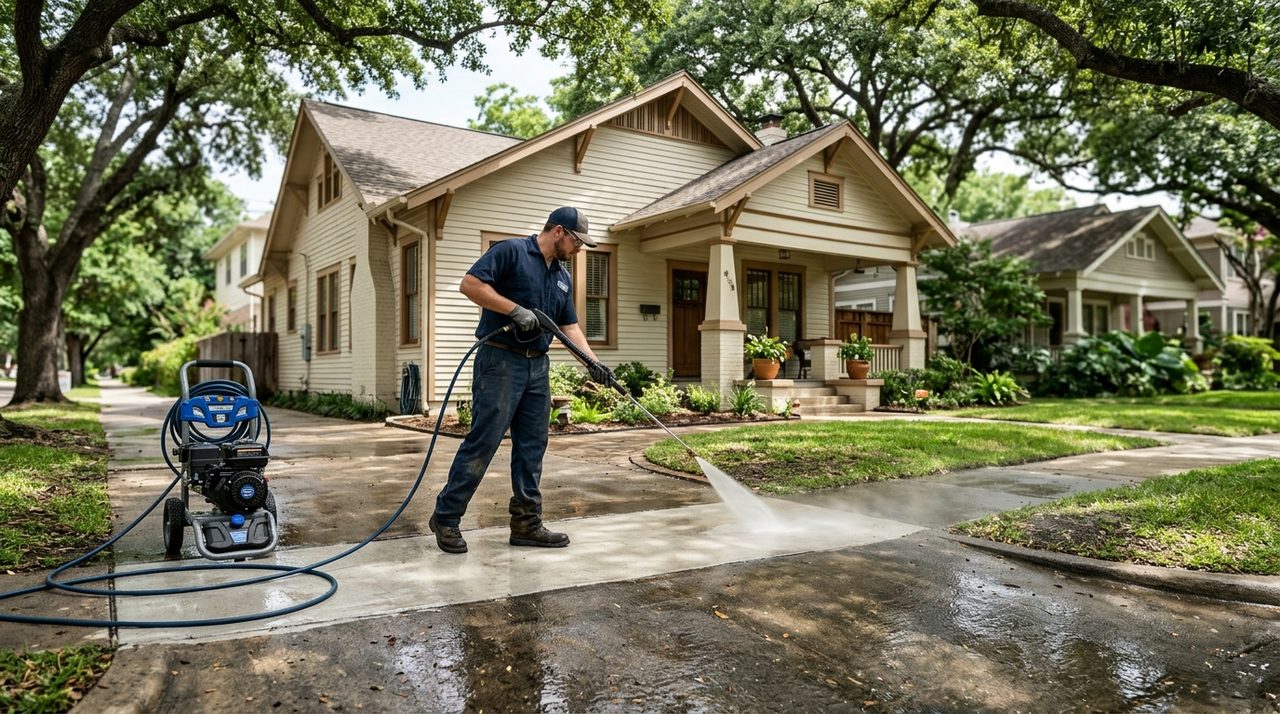
- Median home built
- 1980
- Median home value
- $226,911
- FEMA flood zone
- AE (high)
- Typical cost (est.)
- $250–$900
- Most common local issue
- Flood-line mud staining on 1970s–1980s brick condo facades near Brays Bayou
Ranked by verified Google rating × review volume × verification tier. How we rank →
Some highly-rated pros serve Medical Center from nearby and may not keep a Medical Center street address. Those are listed under "Also serving Medical Center" with their real city and distance, so you always know where each business is based.
Min rating:
10 resultsBased in Medical Center
Closed
2509 McClendon St, Houston, TX 77030
7019 Burkett St., Houston, TX 77021
Also serving Medical Center
Highly-rated pros based nearby who cover Medical Center. Distance shown from the Medical Center area.
Closed
Serving Medical Center Based in Braeswood · 1.5 mi away
Closed
Serving Medical Center Based in West University · 1.6 mi away
Closed
Serving Medical Center Based in West University · 1.9 mi away
Open Now
Serving Medical Center Based in Upper Kirby · 2.3 mi away
Open Now
Serving Medical Center Based in Upper Kirby · 2.4 mi away
Serving Medical Center Based in Galleria · 2.6 mi away
Closed
Serving Medical Center Based in Midtown · 3.3 mi away
Pressure Washing in Medical Center: What You Should Know
Flood-Line Staining on Aging Brick and Stucco Condo Exteriors
Why it matters to you
Garden-style condo complexes built in the 1970s–1980s along the Brays Bayou corridor sit in FEMA Zone AE, and events like Harvey (2017) and Beryl (2024) leave a visible 'bathtub ring' of mud, tannic staining, and organic residue on porous brick and painted stucco at the exact flood-water height — often 18–36 inches above grade. Because these buildings are shared-ownership structures, the staining affects common-area exteriors that the condo association is responsible for maintaining, not just individual units.
What a good pro does
A qualified operator will use a chemical pre-soak (alkaline detergent or sodium hypochlorite solution at appropriate dilution) to break down the organic and mineral components of flood-line staining before any pressure is applied, limiting surface PSI to protect the aged mortar joints typical of 1970s brick. On stucco facades, soft-wash technique (under 500 PSI with dwell time) prevents paint delamination. Because jobs on condo common areas involve detergent runoff, operators must ensure wash water does not discharge directly to storm drains per TCEQ stormwater rules.
Sources: FEMA National Flood Hazard Layer (NFHL), Texas Commission on Environmental Quality
Mandatory Condo and Townhome HOA Compliance Windows
Why it matters to you
Unlike most of the inner loop's single-family neighborhoods, nearly every residential unit in the Medical Center area — whether a mid-rise condo complex off Holcombe or a 3-story townhome row near Main Street — carries a mandatory association with active architectural standards. Algae-stained driveways, discolored entry walkways, and green-streaked fence panels on common areas can trigger written violation notices with cure windows as short as 30 days, and the association — not the individual owner — controls scheduling access to shared courtyards and parking decks.
What a good pro does
Before booking, homeowners in condos should confirm with their building management whether the association contracts exterior washing at the building level or whether individual owners may hire independently for limited-access areas like patios and balconies. For townhome owners, verify CC&Rs for any restrictions on cleaning agents or roofing pressure limits before signing a scope of work. Specific HOA rules should be verified via hoa.texas.gov or the recorded deed restriction document.
Sources: Local HOA / deed restrictions (see area profile)
Year-Round Black Algae on Shaded Townhome and Condo Roofs
Why it matters to you
The dense 3-story townhome infill built throughout the Medical Center area in the 1990s–2010s features architectural asphalt shingle roofs that, in Houston's 75%-plus average humidity, develop Gloeocapsa magma black streaking within 2–3 years — and the tight site spacing between townhome rows limits sun exposure, accelerating regrowth. At median home values around $226,000 and with many units owner-occupied by TMC employees on fixed schedules, a HOA roof-appearance notice creates real time pressure to act.
What a good pro does
Roof cleaning on these shingles must be performed via low-pressure soft-wash (under 500 PSI, ideally 100–200 PSI) using a sodium hypochlorite-based biocide that kills the algae colony rather than just rinsing surface discoloration — high-pressure washing granules off asphalt shingles voids manufacturer warranties and accelerates aging. A reputable operator will also apply a post-treatment algaecide rinse to extend the clean cycle beyond the typical 6–12 month Houston recolonization window. Texas does not license pressure washers as a standalone trade, but operators applying algaecide products classified as pesticides may require a Texas Department of Agriculture applicator credential.
Sources: Local HOA / deed restrictions (see area profile), Texas Commission on Environmental Quality
Efflorescence and Clay Staining on Slab-Level Concrete in Dense Condo Parking Areas
Why it matters to you
Medical Center's condo complexes and townhome developments sit on Houston's Beaumont clay, and the moisture cycling in this FEMA AE flood zone — saturated after storms, then baked dry in summer — wicks mineral salts upward through slab-on-grade concrete, depositing white efflorescence and red-clay mud staining on parking aprons, entry pads, and ground-floor walkways. In older 1970s–1980s complexes, the concrete itself is often original and has decades of oil drip, tire oxidation, and post-flood residue layered into a porous, spalled surface.
What a good pro does
Standard cold-water rinsing will not lift efflorescence or baked-in oil from aged concrete — effective treatment requires an acidic pre-treatment (dilute muriatic or phosphoric acid) for mineral deposits and a hot-water or degreaser application for oil staining, followed by pressure washing at 2,000–3,000 PSI with a surface cleaner attachment that prevents streaking on flat slabs. On jobs in condo parking areas where runoff flows toward storm drain inlets, TCEQ rules require that degreaser-laden wash water be contained and not allowed to enter the storm drain system, which in this area flows directly to Brays Bayou.
Sources: Texas Commission on Environmental Quality, FEMA National Flood Hazard Layer (NFHL)
Pressure Washing in Medical Center: What You Should Know
Hiring pressure washing in Medical Center? The Medical Center area is a patchwork of mid-century condos, newer townhome infill, and older single-family subdivisions, each with its own HOA or civic club governance. Situated in FEMA Zone AE high-flood-risk territory near Brays Bayou, flood mitigation and water damage remediation are recurring service needs. Contractors must navigate property-specific association rules, aging building systems in 1960s–1980s multifamily complexes, and modern code requirements for newer infill construction.
- Housing era
- 1960s–1980s multifamily and condo stock predominates, with significant 1990s–2020s townhome and infill construction
- Foundation
- Predominantly slab-on-grade
- Flood zone
- FEMA Zone AE (high flood risk) — source
- Permits
- City of Houston — Houston Permitting Center
Housing stock & systems
Building era
1960s–1980s multifamily and condo stock predominates, with significant 1990s–2020s townhome and infill construction; some pre-1950s single-family homes in adjacent subdivisions like Southgate and Old Braeswood.
Typical style
Garden-style condominiums (2–3 story brick/stucco), contemporary 3-story townhomes, mid-century ranch and traditional single-family homes, with newer large-lot replacement builds.
Foundations
Predominantly slab-on-grade; some older single-family homes may have pier-and-beam foundations.
Common systems
Older condos and apartments typically have original or once-updated central HVAC, copper or galvanized plumbing, and aging electrical panels; newer townhomes feature modern high-efficiency systems, PEX plumbing, and 200-amp electrical service.
What that means for repairs
Older 1970s–1980s condo units are frequently gut-renovated with updated kitchens, bathrooms, and HVAC systems. Mid-century single-family homes are either extensively remodeled or torn down for new construction. Flood damage repair and elevation projects are common given the area's flood history.
Permits & restrictions
Permit jurisdiction
City of Houston — Houston Permitting Center.
HOA & deed restrictions
No single overarching HOA exists. The area is a patchwork of mandatory condo/townhome associations for individual complexes and voluntary civic clubs or property owners associations for single-family subdivisions (e.g., Braeswood Place HOA, Southgate Civic Club). Virtually all condos and townhomes have mandatory associations with dues. Specific HOA details should be verified via hoa.texas.gov or deed restriction filings.
Historic districts
No City of Houston historic district designation confirmed for the core Medical Center residential area.
Contractor note
Contractors working on condos and townhomes must coordinate with the specific building's HOA or condo association for architectural approvals, insurance requirements, and common-area access. In the absence of citywide zoning, deed restrictions govern land use and exterior modifications on single-family lots.
Flood & weather
FEMA flood zone
FEMA Zone AE (high flood risk) — source: fema_nfhl. The Medical Center area sits in close proximity to Brays Bayou, which is the primary flood driver for the surrounding residential areas. Harris County Flood Control District projects have addressed some capacity issues, but the zone designation reflects ongoing significant flood risk.
Hurricane Harvey impact
Not confirmed with specific block-level Medical Center data from research provided. The broader Brays Bayou watershed experienced severe flooding during Hurricane Harvey (2017), and neighborhoods immediately surrounding the Medical Center — particularly those south and east near Holly Hall, Almeda, and Old Spanish Trail — are widely reported to have sustained significant flood damage. Check Harris County Flood Control District records for address-specific Harvey inundation data.
Heat & humidity load
Aging 1970s–1980s condo HVAC systems are stressed by sustained 95°F+ summer heat, making AC failures and refrigerant issues common peak-season calls. Flat-roof condo buildings are vulnerable to ponding and thermal expansion leaks. High humidity accelerates mold growth in flood-prone ground-floor units and older construction with poor vapor barriers.
Working with contractors here
Contractors in the Medical Center area most frequently handle HVAC replacement and repair in aging condo and apartment complexes, where original 1970s–1980s systems have reached or exceeded their useful life. Plumbing repiping is common in older buildings still running galvanized supply lines. Flood damage restoration — including drywall, flooring, and mold remediation — is a recurring need given the FEMA AE designation and Brays Bayou proximity. Newer townhome and infill work tends to involve finish-out customization and warranty repairs. Job scoping must account for HOA approval timelines, limited parking and staging areas in dense condo complexes, and coordination with building management for access to shared mechanical systems and common areas.
Local Tip
Always ask for a written estimate before work begins. Texas contractors are required to provide one on jobs over $1,000.
About Medical Center
The Medical Center area is a patchwork of mid-century condos, newer townhome infill, and older single-family subdivisions, each with its own HOA or civic club governance. Situated in FEMA Zone AE high-flood-risk territory near Brays Bayou, flood mitigation and water damage remediation are recurring service needs. Contractors must navigate property-specific association rules, aging building systems in 1960s–1980s multifamily complexes, and modern code requirements for newer infill construction.
- Median year built
- 1980
- Median home value
- $226,911
- Owner-occupied
- 33.3%
- Population
- 111,141
- Housing units
- 57,187
- Median income
- $52,305
Source: U.S. Census Bureau, ACS 5-Year 2023
Flood & storm risk
FEMA Zone AEHigh flood riskMuch of Medical Center maps to FEMA Zone AE (high flood risk), so flood-resilient detailing -- elevated equipment, water-tolerant materials, and drainage-first thinking -- is essential here, not optional; risk climbs sharply on blocks nearest Brays Bayou, where it varies parcel to parcel.
Source: FEMA National Flood Hazard Layer (NFHL). Flood zones vary by parcel — verify your individual FIRM panel.
Frequently Asked Questions
Do I need a City of Houston permit to pressure wash the exterior of my condo building near the Medical Center?
The City of Houston Permitting Center does not require a municipal permit for routine residential or condo exterior pressure washing — this holds for both single-family homes and multifamily buildings in the Medical Center area. Your bigger regulatory hurdle is TCEQ stormwater rules: if the operator uses chemical degreasers or algaecides, wash water cannot be allowed to flow into storm drains, which in this neighborhood drain directly toward Brays Bayou and ultimately Galveston Bay. Confirm with your operator that they have a containment and disposal plan before work begins on any large condo parking deck or common-area surface.
Sources: City of Houston Permitting CenterTexas Commission on Environmental Quality
My 1970s brick garden condo in the Medical Center is in FEMA Zone AE — are there any restrictions on how a pressure wash contractor handles water runoff after a flood-line cleaning job?
FEMA Zone AE designation affects your flood insurance and elevation requirements, but it does not itself restrict pressure wash methods — that is TCEQ territory. What matters here is that flood-line cleaning on AE-zone properties often involves chemical degreasers or biocides to cut through organic mud deposits, and TCEQ prohibits that chemically treated runoff from entering storm drains that flow to Brays Bayou. Reputable operators working near the bayou corridor should use berms or a wet-vac reclaim system to capture effluent, especially on jobs treating the lower brick courses of 1970s–1980s condo façades where flood staining is heaviest.
Sources: Texas Commission on Environmental QualityFEMA National Flood Hazard Layer (NFHL)
My townhome HOA in the Medical Center gave me a 30-day cure notice for algae staining on my front entry — is that timeline realistic to schedule and complete a soft-wash job?
For a standard 3-story townhome exterior soft-wash in the Medical Center area, most operators can complete the actual cleaning in a half to full day, and scheduling lead times in the area typically run one to three weeks depending on season — so a 30-day window is workable if you book immediately upon receiving the notice. Pull the violation letter and your association's CC&Rs before calling operators, because some Medical Center townhome associations specify approved chemical treatments or prohibit high-pressure washing on stucco, and you want to confirm the method in writing so you can document compliance.
Sources: Local HOA / deed restrictions (see area profile)
I own a pre-1950s pier-and-beam single-family home in Old Braeswood — does the foundation type change anything about how a pressure wash contractor should approach the driveway or perimeter?
Pier-and-beam foundations are less common in this corridor but do exist in pre-1950s Old Braeswood and Southgate homes, and they create one practical wrinkle: high-volume water directed at grade-level vents or along the perimeter beam can saturate the crawl space, especially on a property already in FEMA Zone AE with a high water table. A good operator will angle spray away from foundation vents and avoid pooling water along the perimeter beam line — ask specifically whether they adjust pressure and direction on pier-and-beam properties before signing off on the job.
What time of year is best to schedule exterior pressure washing for a Medical Center condo or townhome, given the humidity and storm season here?
Late winter through early spring — roughly February through April — is the practical sweet spot for Medical Center exteriors: humidity has dropped from its summer peak, Atlantic hurricane season has not yet started, and you get the clean surface ahead of peak mold-regrowth months. Scheduling in October or November after hurricane season closes is a solid second option, particularly if your building took wind-driven debris or any flood-water contact from a storm like Beryl (2024). Avoid scheduling immediately before a forecasted heavy rain event, since freshly applied post-wash biocides need 24–48 hours of dry dwell time to bond effectively on Houston's porous brick and stucco.
The condo association for my 1980s Medical Center building wants to see proof of insurance before letting a pressure wash operator work on common-area surfaces — what should I ask the contractor to provide?
Ask for a certificate of general liability insurance naming your condo association as an additional insured — most active Medical Center condo associations and their management companies require this for any vendor accessing common areas, and a reputable operator will have it ready. Also ask whether they carry pollution liability coverage, which is a separate endorsement that covers chemical spill or improper runoff claims; this matters on a TCEQ-regulated job where algaecides or degreasers are used on shared parking or pool deck surfaces. If the association has a specific vendor approval process, start that paperwork the same day you book, because HOA administrative review can add a week or more to your timeline even when the actual cleaning takes only a day.
Sources: Local HOA / deed restrictions (see area profile)Texas Commission on Environmental Quality