Serving The Heights Based in Lazybrook / Timbergrove · 1.3 mi away
Best Pressure Washing in The Heights
The Heights puts pressure washers to work on surfaces spanning 130 years of Houston construction — century-old painted-wood Craftsman bungalows on pier-and-beam foundations share the same block with stucco-clad slab-on-grade townhomes whose rooftop decks trap organic debris year-round in Harris County's notoriously humid air. Because portions of the neighborhood fall within City of Houston Historic Districts reviewed by the Houston Archaeological & Historical Commission (HAHC), even an exterior cleaning job can touch on material-compliance questions that don't exist anywhere else in the metro. This page breaks down exactly which surfaces and conditions drive the most pressure-washing headaches for Heights homeowners — and what a competent operator does differently here.
Verified against Google Business data
Updated 2026
See the 10 Pressure Washing Serving The Heights 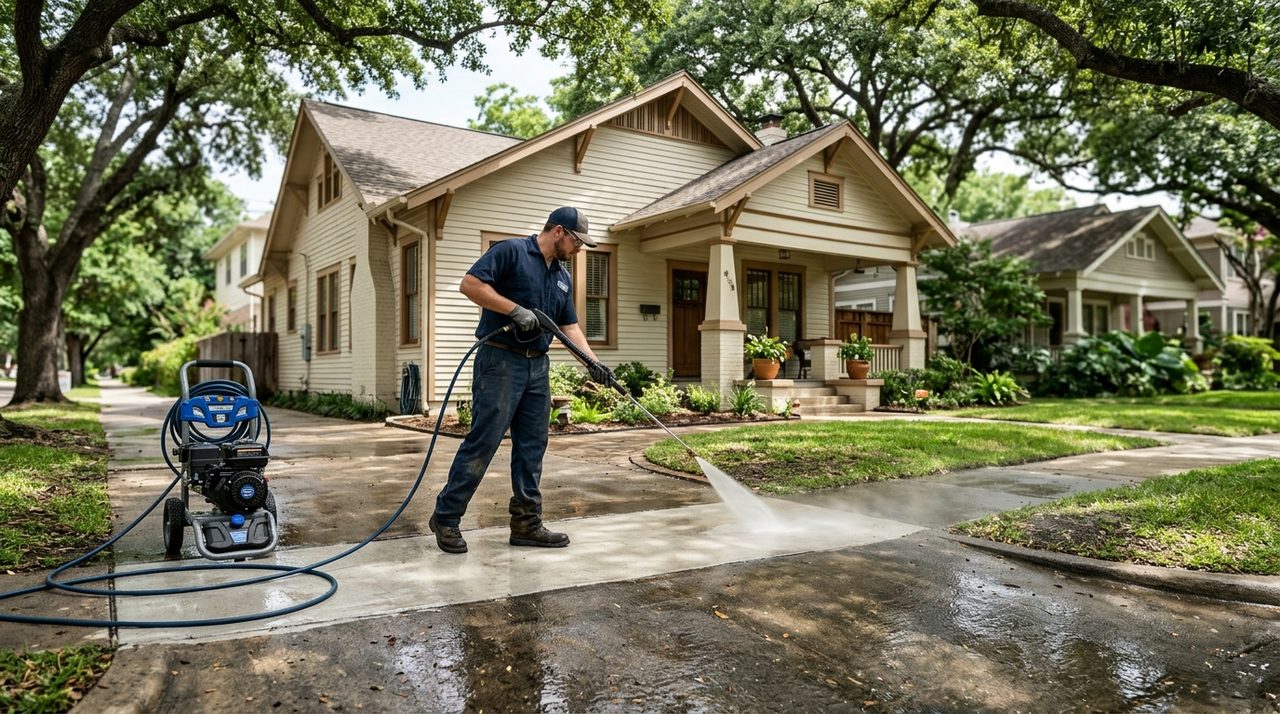
- Median home built
- 1978
- Median home value
- $513,961
- FEMA flood zone
- X (low)
- Typical cost (est.)
- $250–$900
- Most common local issue
- Black algae & mold on painted historic wood siding under mature tree canopy
Ranked by verified Google rating × review volume × verification tier. How we rank →
Some highly-rated pros serve The Heights from nearby and may not keep a The Heights street address. Those are listed under "Also serving The Heights" with their real city and distance, so you always know where each business is based.
Min rating:
10 resultsAlso serving The Heights
Highly-rated pros based nearby who cover The Heights. Distance shown from the The Heights area.
Open Now
Serving The Heights Based in Lazybrook / Timbergrove · 1.5 mi away
Closed
Serving The Heights Based in Lazybrook / Timbergrove · 2 mi away
Serving The Heights Based in Lazybrook / Timbergrove · 2 mi away
Closed
Serving The Heights Based in Lazybrook / Timbergrove · 2.1 mi away
Closed
Serving The Heights Based in Lazybrook / Timbergrove · 2.2 mi away
Closed
Serving The Heights Based in River Oaks · 2.3 mi away
Open Now
Serving The Heights Based in Independence Heights · 2.5 mi away
Serving The Heights Based in Lazybrook / Timbergrove · 2.8 mi away
Open Now
Serving The Heights Based in Midtown · 3.1 mi away
Pressure Washing in The Heights: What You Should Know
Mold & Black Algae on Painted Historic Wood Siding
Why it matters to you
The Heights' 1890s–1930s Craftsman bungalows were built with old-growth longleaf pine siding that, after a century of Houston's 75%-plus average humidity and dense tree canopy shade, becomes a near-ideal host for Gloeocapsa magma black algae and green mold. Homeowners on tree-lined blocks off Heights Boulevard or Yale Street often see siding go from clean to visibly streaked within eight to twelve months of washing. Because these homes are sometimes located within the Heights East, Heights West, or Heights South HAHC historic districts, failing paint caused by improper high-pressure cleaning is not just a cosmetic setback — it can trigger an HAHC review if the remediation requires replacing original siding materials.
What a good pro does
A qualified operator uses a low-pressure soft-wash approach (well under 500 PSI at the surface) paired with a sodium hypochlorite or quaternary ammonium biocide solution that kills algae at the root rather than just rinsing surface discoloration. Post-treatment with a mildewcide applied to wood and painted surfaces significantly extends clean intervals. Texas does not issue a state pressure-washing license through TDLR, but operators applying algaecide or biocide products classified as pesticides by the EPA are required to hold a Texas Department of Agriculture (TDA) pesticide applicator license — Heights homeowners should ask operators to confirm TDA credentials before any chemical application on their historic siding.
Sources: Local HOA / deed restrictions (see area profile), City of Houston Permitting Center
Organic Staining on Rooftop Decks and Townhome Stucco
Why it matters to you
The wave of 2-to-4-story stucco townhomes built across The Heights from the late 1990s through the 2010s introduced a surface type the neighborhood's century-old bungalows never had: exposed horizontal rooftop decks. Houston's 60-plus inches of annual rainfall deposit tannic leaf stains and algae mats on these decks, and the textured stucco cladding on townhome exteriors traps airborne mold spores at every surface irregularity. The May 2024 derecho deposited wind-driven debris across inner-loop neighborhoods, and Heights townhome owners who didn't clean their decks and stucco within weeks saw organic material begin to etch the surface. Many of these townhomes sit within small mandatory HOAs — Heights Abbey HOA and Studemont Heights POA are two examples — whose governing documents specify appearance standards with cure windows that can be as short as 30 days.
What a good pro does
Rooftop deck cleaning on Heights townhomes typically requires a two-stage approach: a low-pressure detergent pre-soak to lift tannic and algae staining, followed by a rinse calibrated carefully at deck drains to prevent detergent-laden water from entering the City of Houston storm sewer system, which discharges to White Oak Bayou. TCEQ regulations under the Texas Pollutant Discharge Elimination System (TPDES) prohibit detergent-bearing wash water from entering storm drains; a professional operator will wet-vacuum or divert runoff from deck drains and curb inlets rather than letting it flow freely into the street. Before scheduling work on townhomes inside a mandatory HOA, homeowners should pull the recorded covenants from the Harris County Clerk's office to confirm any soft-wash-only requirements that the HOA may have adopted.
Sources: Texas Commission on Environmental Quality, Local HOA / deed restrictions (see area profile)
Oil and Age Staining on Mixed-Era Concrete Driveways
Why it matters to you
Because The Heights contains housing from the 1890s through brand-new construction, driveway concrete ages vary wildly on the same street — some slabs are original mid-century pours that have absorbed decades of motor oil into an already-porous matrix, while newer townhome aprons are smoother but still subject to Houston's summer UV baking petroleum stains into the surface before the next rain event. Winter Storm Uri (2021) accelerated surface spalling on older concrete across Harris County, creating an even more porous profile that holds staining more aggressively. A standard cold-water rinse cannot lift baked-in oil from 30- or 40-year-old Heights driveway concrete; it requires hot-water equipment or a chemical degreaser pre-treatment.
What a good pro does
For aged Heights driveways, the right protocol is an alkaline degreaser applied and allowed to dwell before hot-water (180°F+) pressure washing at moderate PSI (1,200–1,800 at the nozzle) to lift oil without fracturing already-spalled concrete surfaces. Critically, degreasers qualify under TCEQ stormwater rules as chemical contaminants that cannot be allowed to run into the street and reach storm drain inlets; the operator must either contain runoff with berms and wet-vac it or schedule the job to drain toward a sanitary connection. The City of Houston does not require a municipal permit for residential driveway pressure washing itself, but the TCEQ TPDES compliance obligation applies regardless of permit status.
Sources: Texas Commission on Environmental Quality, City of Houston Permitting Center
Wood Fence Prep Across Heights' Rapidly Weathering Privacy Fences
Why it matters to you
The post-1990s townhome construction wave brought with it a large inventory of untreated pine privacy fences throughout The Heights, and Houston's combination of 100°F-plus summers, frequent heavy rain, and aggressive termite pressure means these fences gray and develop surface mold within 12 to 18 months without maintenance. Heights homeowners who want to restain or reseal a fence — a common spring project — must pressure-wash first, but weathered pine is far more vulnerable to grain splintering than new lumber. Over-pressure washing above 1,200 PSI on an already-gray, partially weathered board causes surface fibers to fray, reducing the fence's service life and making stain absorption uneven. On blocks nearest White Oak Bayou, fences frequently carry additional tannic flood debris staining from the bayou's periodic high-water events.
What a good pro does
An experienced Heights operator will use a wide-angle (40-degree) tip and keep pressure at or below 1,000 PSI on weathered pine, holding the wand at a consistent 12-to-18-inch standoff to clean uniformly without concentrating pressure on any one board. A sodium hypochlorite wood brightener applied after washing neutralizes graying and opens the wood grain for stain penetration — skipping this step is the most common reason a restain job looks uneven within a season. Fence washing runs approximately $0.35–$0.65 per linear foot in the Houston metro (estimate); Heights homeowners in one of the neighborhood's mandatory townhome HOAs should verify with their HOA board or recorded deed restrictions at the Harris County Clerk's office whether any specific fence finish or maintenance schedule is required before committing to a stain color after washing.
Sources: Local HOA / deed restrictions (see area profile), Texas Commission on Environmental Quality
Pressure Washing in The Heights: What You Should Know
Hiring pressure washing in The Heights? The Heights spans housing from the 1890s through brand-new construction, meaning contractors encounter pier-and-beam Craftsman cottages and modern slab-on-grade townhomes on the same block. Deed restrictions are common across most plats, and dozens of small mandatory HOAs govern newer townhome enclaves, so exterior work often requires checking recorded covenants at the Harris County Clerk's office. The mix of century-old galvanized plumbing and modern PEX systems makes thorough pre-job inspections essential.
- Housing era
- Mixed
- Foundation
- Mixed — older homes (pre-1950s) are predominantly pier-and-beam
- Flood zone
- FEMA Zone X (low flood risk) per the official NFHL API
- Permits
- Houston Permitting Center (City of Houston)
Housing stock & systems
Building era
Mixed: original 1890s–1930s bungalows, scattered mid-century infill (1940s–1960s), and a dominant wave of townhome and new single-family construction from the late 1990s through the 2010s.
Typical style
Historic Craftsman bungalows, Victorian/Queen Anne–inspired homes, contemporary 2-to-4-story townhomes with rooftop decks, and transitional new-build single-family homes with traditional exteriors and modern interiors.
Foundations
Mixed — older homes (pre-1950s) are predominantly pier-and-beam; newer townhomes and post-1990s construction are typically slab-on-grade.
Common systems
Older homes: original or retrofitted central HVAC, galvanized or cast-iron drain lines, knob-and-tube or cloth-wrapped wiring that may have been partially updated. Newer construction: modern central HVAC with high-efficiency units, PEX or copper plumbing, 200-amp electrical panels. Many renovated older homes have hybrid systems mixing old and new.
What that means for repairs
Tear-down-and-rebuild of older cottages for new single-family or townhome construction is extremely common. Remaining historic homes frequently undergo full gut renovations including foundation leveling, complete re-plumbing from galvanized to PEX, electrical panel upgrades, and HVAC modernization while preserving Craftsman exterior character.
Permits & restrictions
Permit jurisdiction
Houston Permitting Center (City of Houston).
HOA & deed restrictions
No single neighborhood-wide mandatory HOA. The Houston Heights Association (HHA) is a voluntary civic organization focused on deed restriction enforcement and community events. Numerous small mandatory HOAs/POAs exist for specific townhome and gated developments (e.g., Heights Abbey HOA, Studemont Heights POA). Deed restrictions are common across most original Heights plats and recorded with the Harris County Clerk.
Historic districts
Portions of the Heights fall within City of Houston Historic Districts (Heights East, Heights West, Heights South) subject to Houston Archaeological & Historical Commission (HAHC) review for exterior modifications and demolition. Exact boundaries should be confirmed with the HAHC before any exterior work.
Contractor note
Properties in HAHC-designated historic districts require a Certificate of Appropriateness for exterior changes, including roofing material, siding, windows, and fencing. Contractors should verify historic district status before quoting exterior work, as non-compliant modifications can result in stop-work orders and forced remediation.
Flood & weather
FEMA flood zone
FEMA Zone X (low flood risk) per the official NFHL API. However, proximity to White Oak Bayou along the southern and eastern edges of the Heights means localized street flooding and bayou overflow can affect properties near the waterway, particularly south of 11th Street.
Hurricane Harvey impact
Not confirmed with specific damage statistics from research. The Heights generally fared better than many Houston neighborhoods during Hurricane Harvey (2017) due to its slightly elevated terrain — the neighborhood was historically marketed as being higher than downtown Houston. However, areas near White Oak Bayou experienced flooding, and some low-lying streets saw significant water intrusion. Specific property impact should be verified through Harris County Flood Control District records.
Heat & humidity load
Pier-and-beam homes with older insulation and single-pane windows place extreme demands on HVAC systems during Houston summers. Crawl space moisture under pier-and-beam foundations promotes mold, wood rot, and pest issues. Newer townhomes with flat or low-slope roofs and rooftop decks require diligent roof drainage maintenance to prevent ponding and leaks during summer storms.
Working with contractors here
The Heights is one of Houston's most active markets for both renovation and new construction. Contractors most commonly handle foundation leveling and repair on pier-and-beam homes, whole-house re-plumbing to replace aging galvanized lines, and electrical upgrades from outdated panels and wiring to modern 200-amp service. Exterior work on historic district properties requires HAHC approval, adding lead time and material specification constraints that must be factored into bids. Townhome work frequently involves rooftop deck waterproofing, stucco repair, and shared-wall considerations that require coordination with adjacent owners or HOA boards. Given the extreme variation in housing age on a single block, contractors should never assume systems or foundation types based on neighboring properties — each home demands its own inspection.
Local Tip
Always ask for a written estimate before work begins. Texas contractors are required to provide one on jobs over $1,000.
About The Heights
The Heights spans housing from the 1890s through brand-new construction, meaning contractors encounter pier-and-beam Craftsman cottages and modern slab-on-grade townhomes on the same block. Deed restrictions are common across most plats, and dozens of small mandatory HOAs govern newer townhome enclaves, so exterior work often requires checking recorded covenants at the Harris County Clerk's office. The mix of century-old galvanized plumbing and modern PEX systems makes thorough pre-job inspections essential.
- Median year built
- 1978
- Median home value
- $513,961
- Owner-occupied
- 58.9%
- Population
- 76,262
- Housing units
- 38,599
- Median income
- $114,376
Source: U.S. Census Bureau, ACS 5-Year 2023
Flood & storm risk
FEMA Zone XLow flood riskMost of The Heights maps to FEMA Zone X (low mapped flood risk), but Houston's flash-flood reality means even low-risk blocks benefit from smart drainage and storm-hardened installs; risk climbs sharply on blocks nearest White Oak Bayou, where it varies parcel to parcel.
Source: FEMA National Flood Hazard Layer (NFHL). Flood zones vary by parcel — verify your individual FIRM panel.
Frequently Asked Questions
Do I need a permit from the City of Houston to pressure wash my Heights bungalow's exterior?
Routine residential pressure washing does not require a permit from the Houston Permitting Center — no permit application or inspection is triggered by washing siding, driveways, or fences. However, if your property falls within one of the Heights Historic Districts (Heights East, Heights West, or Heights South), confirm with the Houston Archaeological & Historical Commission that your cleaning method and any applied chemical treatments won't be considered an alteration requiring a Certificate of Appropriateness before work begins.
Sources: City of Houston Permitting Center
My 1910s pier-and-beam bungalow has original painted wood siding — will a pressure washer strip the paint or damage the wood even at low settings?
On century-old painted wood siding, even moderate pressure (above 500–600 PSI) can lift peeling paint, force water behind lap boards, and raise the wood grain — risks that compound on homes where the original wood has never been replaced and paint layers have built up over decades. A qualified operator should default to soft-wash technique (100–300 PSI with a diluted biocide solution) and do a small test patch first, especially on north-facing walls where wood is most weathered. Budget estimates for a full soft-wash on an average Heights bungalow run $250–$450, though heavily deteriorated surfaces or multi-story work will push costs higher.
My Heights townhome is in a small mandatory HOA — can the HOA force me to pressure wash, and do they restrict who I hire?
Many of the small mandatory HOAs and POAs governing townhome enclaves in the Heights (such as those along Studemont and Yale corridors) do include exterior appearance standards in their CC&Rs that can require cleaning within a set cure window, sometimes as short as 30 days after a written notice. Review your recorded covenants at the Harris County Clerk's office to see whether your HOA specifies approved methods or certified contractors — some restrict high-pressure washing on stucco or rooftop deck surfaces. The Houston Heights Association itself is voluntary and cannot issue binding compliance notices, so the enforcement authority depends entirely on your specific development's recorded restrictions.
Sources: Local HOA / deed restrictions (see area profile)
The Heights mostly maps to FEMA Zone X, so should I be worried about flood mud staining on my foundation-level siding even after a 'minor' storm?
Zone X indicates low mapped flood risk for most of the Heights, but blocks nearest White Oak Bayou shift to higher-risk zones parcel by parcel, and even Zone X streets in inner-loop Houston can see localized sheet flooding during intense rain events like the May 2024 derecho. Concrete block, brick, and fiber-cement at grade can absorb silty stormwater and develop a persistent gray-brown tide line that standard cold-water rinsing won't fully remove — chemical pre-treatment and hot-water equipment add an estimated 20–40% to a base wash price for those stain types. If you're unsure of your parcel's exact flood zone, check FEMA's Flood Map Service Center before assuming blanket Zone X protection.
Does a Heights pressure washing company need a special license in Texas to apply the algaecide treatments used for black algae on my roof or siding?
Texas does not issue a state license specifically for pressure washing, but operators who apply chemical algaecides or biocides that qualify as pesticides under state definitions may need a Texas Department of Agriculture (TDA) pesticide applicator license — ask any contractor directly whether their cleaning solutions trigger that requirement and whether their applicator is TDA-credentialed. Beyond licensing, TCEQ rules prohibit wastewater containing detergents or chemical cleaners from entering storm drains, which flow directly to Houston's bayou system, so a responsible operator should have a runoff containment plan for jobs using chemical treatments on your driveway or hardscape.
When is the best time of year to schedule a full exterior wash for a Heights home, and how often should it realistically be done?
Houston's humidity means there is no true 'off-season' for mold and algae growth, but late winter (February–March) or early fall (October) are practical windows — temperatures are moderate, tree pollen is lower, and you're positioned ahead of peak mold growth before summer's heat and rain accelerate regrowth. For a Heights bungalow under mature tree canopy — common on tree-lined streets throughout the neighborhood — annual soft-washing is a realistic maintenance interval; homes with less shade or newer stucco townhomes may stretch to every 18–24 months. Post-treatment biocide application after washing meaningfully extends that interval by inhibiting regrowth.