Open Now
9739 Birdsnest Ct, Spring, TX 77379
Champions Forest's brick two-stories, built mostly between 1975 and 1990 on slab-on-grade foundations over Harris County's expansive black clay, sit inside a FEMA Zone AE flood plain fed by Cypress Creek — meaning exterior surfaces here collect not just Houston's relentless humidity-driven algae but genuine flood-line staining and mineral wicking that many NW Harris County neighborhoods never see. Mandatory Architectural Control Committees govern every section of the subdivision, so the appearance pressure is real and documented: a single written violation notice can trigger a 30-day cure window. This page explains which pressure-washing problems are specific to Champions Forest's age, soil, and flood exposure, and what a competent operator must do differently here.
Ranked by verified Google rating × review volume × verification tier. How we rank →
Some highly-rated pros serve Champions Forest from nearby and may not keep a Champions Forest street address. Those are listed under "Also serving Champions Forest" with their real city and distance, so you always know where each business is based.
9739 Birdsnest Ct, Spring, TX 77379
9503 Empress Crossing Dr, Spring, TX 77379
8206 Glencliffe Ln, Houston, TX 77070
10901 Napoli Dr, Houston, TX 77070
16757 Squyres Rd #106, Spring, TX 77379
4464 W Cypress Villas Dr, Spring, TX 77379
18482 Kuykendahl Rd #538, Spring, TX 77379
Highly-rated pros based nearby who cover Champions Forest. Distance shown from the Champions Forest area.
Serving Champions Forest Based in Tomball · 2.8 mi away
Serving Champions Forest Based in Tomball · 3 mi away
Serving Champions Forest Based in Tomball · 3.8 mi away
Why it matters to you
Champions Forest sections that flooded during Harvey (2017) and again during Tropical Storm Beryl (2024) show a distinct bathtub-ring at the high-water mark on brick facades and mortar joints — a blend of tannic mud, clay-mineral deposits, and organic matter driven in from Cypress Creek's floodplain. On homes built in the 1970s and 1980s, the aged mortar is more porous than modern mixes, so those marks penetrate deeper and resist standard cold-water rinsing. Post-storm cleanup that skips chemical pre-treatment leaves a ghost stain that oxidizes darker over subsequent summers.
What a good pro does
A qualified operator will apply a low-pressure alkaline cleaner or sodium hypochlorite solution directly to the brick face, dwell for 5–10 minutes, and rinse with a wide-fan tip at 800–1,200 PSI — enough to flush the pores without eroding the mortar. Hot-water equipment adds roughly a 20–40 percent premium to the job estimate but is often the only way to clear heavy organic staining on 40-to-50-year-old brick in one visit. Because Champions Forest is unincorporated Harris County, no municipal pressure-washing permit is required, but any chemical waste containing degreasers or algaecides must be contained and cannot discharge to the street storm drain, which routes directly to Cypress Creek and eventually Galveston Bay.
Sources: FEMA National Flood Hazard Layer (NFHL), Texas Commission on Environmental Quality
Why it matters to you
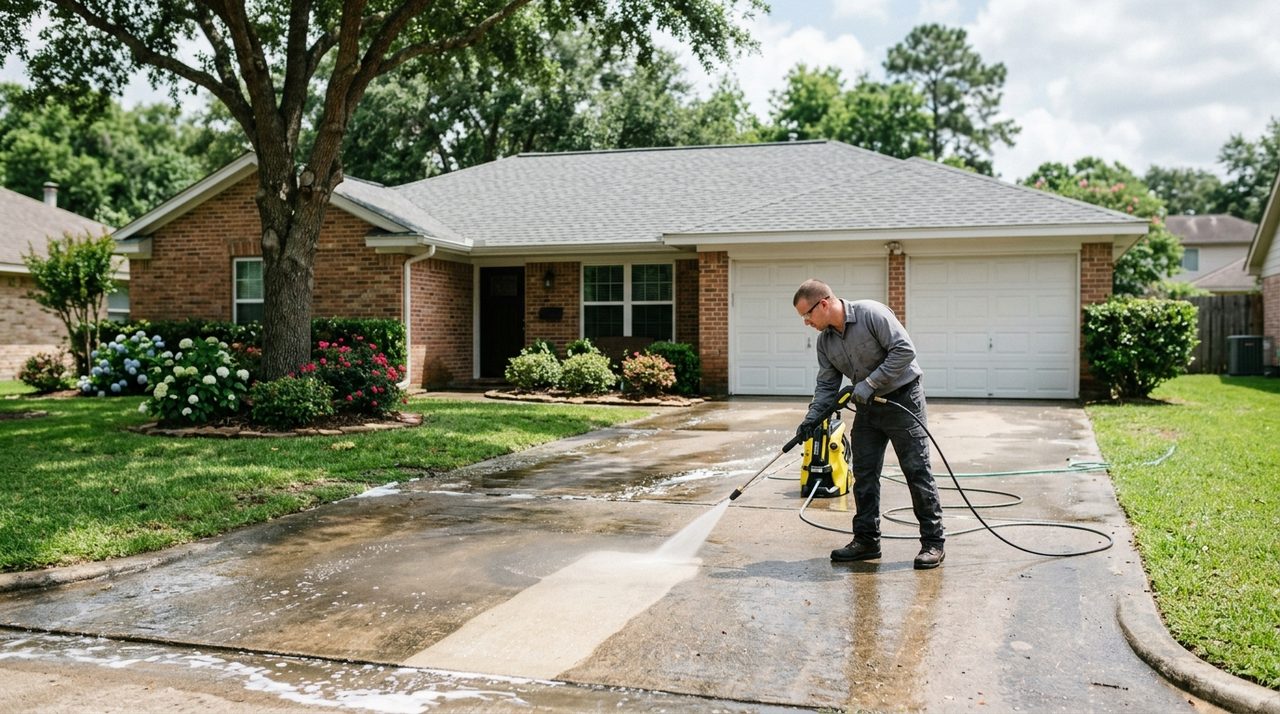
Champion Forest Fund, Inc. and the individual section HOAs — including the Eleven, Twelve, and Villas associations — each maintain active Architectural Control Committees that issue written notices for algae-blackened driveways, green-tinged wood fences, and visibly stained roofs. Cure windows can be as short as 30 days, and in a subdivision where 65 percent of homes are owner-occupied, an unresolved notice can complicate a future sale. Houston's average annual humidity above 75 percent means Gloeocapsa magma black streaks can recolonize a washed surface within a single year if no post-treatment biocide is applied.
What a good pro does
Homeowners should photograph the violation notice and confirm with their section's ACC exactly which surface triggered it before scheduling a wash — the required remedy for a discolored concrete driveway differs from one for a mossy roof. A reputable operator will apply a post-wash biocide or mildewcide to slow recolonization and can provide a written service record useful if the ACC requests proof of completion. Because Champions Forest is governed by Harris County rather than the City of Houston, the HOA's deed restrictions are the primary appearance authority here, not any municipal code.
Sources: Local HOA / deed restrictions (see area profile)
Why it matters to you
Driveways poured in the 1970s and 1980s over Harris County's Beaumont-series black clay have had four or five decades of moisture cycling beneath them. As that clay wets and dries, it wicks mineral salts upward through the slab, depositing white efflorescence along expansion joints and edges. The same cycles push red-clay mud to the surface after heavy rain, baking into the concrete under summer UV. Winter Storm Uri's 2021 freeze-thaw event accelerated surface spalling on many of these older slabs, opening new pores that now trap staining more aggressively than the original smooth surface did.
What a good pro does
Efflorescence requires an acidic pre-treatment — typically a diluted muriatic or phosphoric acid wash — applied before the pressure lance touches the concrete; skipping that step and relying on high pressure alone can drive the salts deeper rather than removing them. The operator should test a small area first on 40-to-50-year-old spalled concrete to confirm the slab can tolerate the cleaning chemistry without further surface loss. Texas does not require a state pressure-washing license, but operators applying acid-based or algaecide chemistry at concentrations that classify as pesticides under Texas Department of Agriculture rules must carry a TDA pesticide applicator credential.
Sources: Texas Commission on Environmental Quality, International Residential Code (as adopted by City of Houston)
Why it matters to you
Many Champions Forest homes still carry their original or first-replacement 3-tab asphalt shingle roofs from the 1990s, now 25-to-30 years old and approaching or past manufacturer lifespan. Houston's humidity means Gloeocapsa magma black streaking appears within two to three years of the last cleaning, which draws ACC attention on any street where one roof stands out against cleaner neighbors. Using a pressure washer above 500 PSI on granule-depleted shingles of this age strips the remaining protective coating, voids any residual warranty, and accelerates the leak timeline — potentially a costly mistake on a home that already sits in a FEMA Zone AE flood plain where interior water damage carries heavy insurance and remediation costs.
What a good pro does
The correct method is a dedicated low-pressure soft-wash: a sodium hypochlorite and surfactant solution applied at below 100 PSI through a downstream injector, dwelled long enough to kill the algae colony at the root, then rinsed gently. Reputable operators will document their PSI settings and chemical dilution ratios, which matters if a shingle manufacturer claim ever arises. Because Champions Forest is outside City of Houston limits, any ACC approval requirement and Harris County Engineering Office permit obligation for structural work applies separately — but routine roof soft-washing on an existing structure does not typically trigger a Harris County building permit.
Sources: Local HOA / deed restrictions (see area profile), FEMA National Flood Hazard Layer (NFHL), City of Houston Permitting Center
Hiring pressure washing in Champions Forest? Champions Forest is a large, multi-section subdivision in the Klein ISD area of northwest Harris County, built primarily from the mid-1970s through the late 1980s. Homeowners here deal with aging slab-on-grade foundations, original-era HVAC and plumbing systems that are reaching or past their expected lifespan, and FEMA AE flood zone designations that affect insurance requirements and exterior renovation planning. Multiple mandatory HOAs with architectural control committees govern exterior modifications, so contractors must factor in ACC approval timelines.
Building era
Primarily mid-1970s through late 1980s, with some later sections extending into the early 1990s.
Typical style
Traditional brick two-story homes with Colonial and Georgian influences; some single-story ranch-style homes and occasional Tudor and French traditional elevations.
Foundations
Slab-on-grade (regional inference for 1970s–1980s production homes in NW Harris County; confirm via HCAD or individual inspection).
Common systems
Original homes likely have R-22 refrigerant HVAC systems nearing or past replacement age, copper or galvanized steel supply plumbing transitioning to PEX in renovated homes, and 100–200 amp electrical panels that may need upgrading for modern loads.
What that means for repairs
Kitchen and bathroom remodels are common as homes from this era are updated to modern standards. HVAC full-system replacements are frequent due to age. Foundation repair and re-leveling are periodic needs given expansive clay soils and slab-on-grade construction. Post-Harvey flood damage repairs drove significant interior renovation activity in affected sections.
Permit jurisdiction
Harris County Engineering (unincorporated Harris County, Klein area — not within City of Houston limits).
HOA & deed restrictions
Mandatory property owners associations govern all sections. Sections 1–10 are governed by Champion Forest Fund, Inc. (Champion Forest HOA). Additional mandatory HOAs include Champion Forest Eleven HOA (161 lots), Champion Forest Twelve Homeowners Association Inc., and Champion Forest Villas HOA. All require Architectural Control Committee (ACC) approval for exterior modifications.
Historic districts
No City of Houston historic district designation confirmed.
Contractor note
Contractors must obtain Harris County permits for structural, mechanical, and electrical work and should coordinate ACC approval from the applicable section's HOA before beginning any exterior modifications. Work in the FEMA AE flood zone may require elevation certificates and floodplain development permits.
FEMA flood zone
FEMA Zone AE (high flood risk) — source: fema_nfhl. Champions Forest is situated in northwest Harris County near Cypress Creek, a major drainage corridor that has historically been associated with significant flooding events.
Hurricane Harvey impact
No official neighborhood-wide flood impact summary was found in available HOA or public records. Areas near Cypress Creek in northwest Harris County experienced significant Harvey flooding and subsequent buyout activity, but specific street-level impact within Champions Forest is not clearly documented in available sources. Homeowners should check Harris County Flood Control District records and individual property flood history for confirmation.
Heat & humidity load
Homes from the 1970s–80s with original insulation and single-pane windows face high cooling costs during Houston summers. Aging HVAC systems are under maximum stress from May through September, making this the peak period for emergency AC repair calls. Humidity management is critical to prevent mold in homes that experienced prior flooding or have insufficient attic ventilation.
Working with contractors here
Contractors working in Champions Forest most commonly handle HVAC replacements, foundation leveling, and plumbing re-pipes — all driven by the 40–50-year age of the housing stock. Kitchen and bath remodels are a strong secondary market as homeowners modernize dated interiors. Flood mitigation work, including elevated electrical panels, moisture barriers, and drainage improvements, is relevant given the AE flood zone designation. All exterior work requires ACC approval from the applicable section's HOA (Champion Forest Fund for Sections 1–10, or the respective section HOA), so contractors should build approval lead time into project schedules. Harris County permitting applies rather than City of Houston permits, which affects inspection scheduling and code requirements.
Local Tip
Always ask for a written estimate before work begins. Texas contractors are required to provide one on jobs over $1,000.
Champions Forest is a large, multi-section subdivision in the Klein ISD area of northwest Harris County, built primarily from the mid-1970s through the late 1980s. Homeowners here deal with aging slab-on-grade foundations, original-era HVAC and plumbing systems that are reaching or past their expected lifespan, and FEMA AE flood zone designations that affect insurance requirements and exterior renovation planning. Multiple mandatory HOAs with architectural control committees govern exterior modifications, so contractors must factor in ACC approval timelines.
Source: U.S. Census Bureau, ACS 5-Year 2023
Much of Champions Forest maps to FEMA Zone AE (high flood risk), so flood-resilient detailing -- elevated equipment, water-tolerant materials, and drainage-first thinking -- is essential here, not optional.
Source: FEMA National Flood Hazard Layer (NFHL). Flood zones vary by parcel — verify your individual FIRM panel.
Sources: Local HOA / deed restrictions (see area profile)