Closed
8901 Jameel Rd, Houston, TX 77040
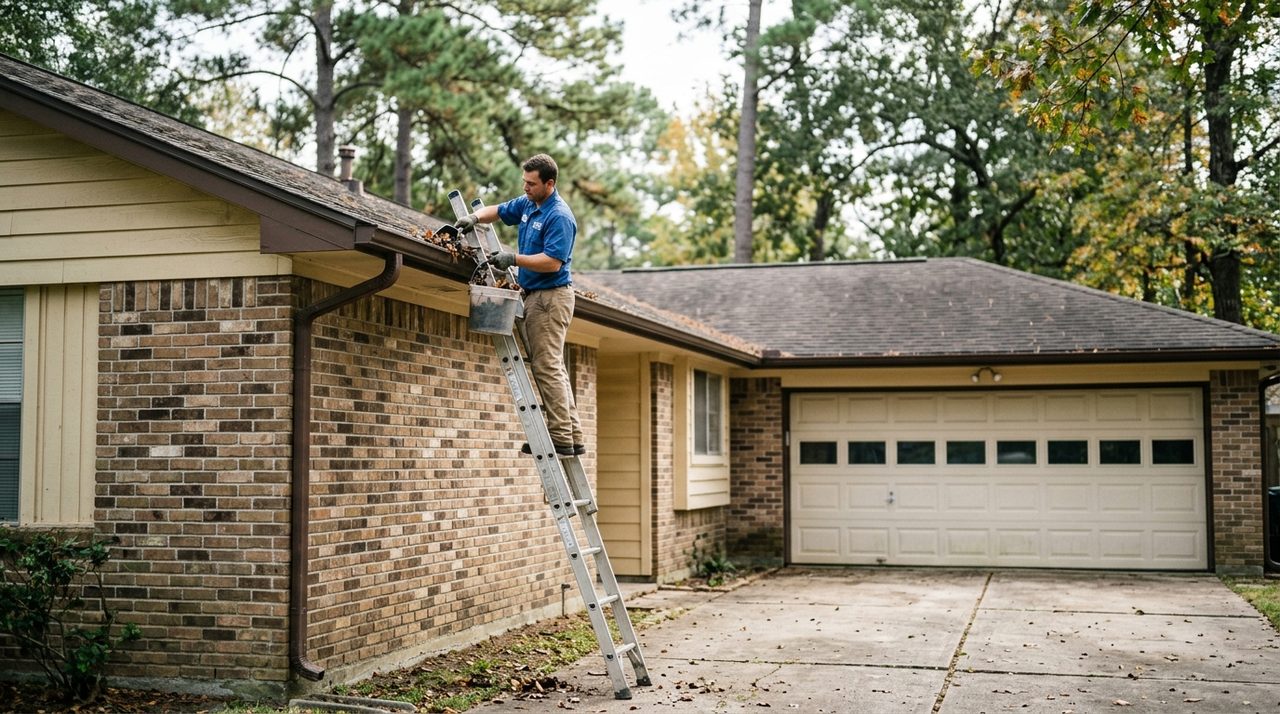
NW Houston's sprawl of 1980s–1990s brick subdivisions sits on some of Harris County's most reactive Houston Black clay, where a clogged gutter that overflows against a slab perimeter is not just a nuisance—it is a direct threat to a foundation that is likely 30-40 years old and already cycling through wet-dry shrink-swell stress. Add mandatory HOAs such as Memorial Northwest and Meadows of Northwest Park that issue violation notices for visible fascia staining, and gutter cleaning here carries financial and structural stakes that go well beyond a simple seasonal chore.
Ranked by verified Google rating × review volume × verification tier. How we rank →
Some highly-rated pros serve NW Houston from nearby and may not keep a NW Houston street address. Those are listed under "Also serving NW Houston" with their real city and distance, so you always know where each business is based.
8901 Jameel Rd, Houston, TX 77040
9519 Eblen Dr, Houston, TX 77040
Highly-rated pros based nearby who cover NW Houston. Distance shown from the NW Houston area.
Serving NW Houston Based in Jersey Village · 1.6 mi away
Serving NW Houston Based in Jersey Village · 1.7 mi away
Serving NW Houston Based in Brookhollow · 3.4 mi away
Serving NW Houston Based in Jersey Village · 3.8 mi away
Serving NW Houston Based in Jersey Village · 3.8 mi away
Serving NW Houston Based in Spring Branch · 4 mi away
Serving NW Houston Based in Brookhollow · 4.4 mi away
Serving NW Houston Based in Spring Branch · 5.1 mi away
Why it matters to you
The census median build year here is 1985, which means a large share of NW Houston roofs are carrying their second or third set of asphalt shingles—and those shingles shed granules heavily as they age and after each Harris County hail event. Those granules funnel straight into gutter channels and compact into concrete-hard plugs at the top elbow of every downspout, a failure point that leaf-blower-only services routinely miss. A blocked downspout on a FEMA Zone X500 lot—outside the 100-year floodplain but still exposed to heavy-rain runoff—means sheet flow directly against the slab.
What a good pro does
A thorough service on a 1980s–1990s NW Houston home should include hand-scooping compacted granule deposits at every downspout throat and running a pressure flush from the ground up to confirm full flow. Ask the technician to note granule volume as a proxy for remaining shingle life—it is a free data point on a roof that may be approaching end-of-life. No City of Houston or Harris County permit is required for cleaning or minor downspout repair.
Sources: FEMA National Flood Hazard Layer (NFHL), City of Houston Permitting Center
Why it matters to you
Virtually every post-1960 home in NW Houston sits on a concrete slab poured over Houston Black clay—soil that shrinks dramatically in drought and expands when re-wetted. A gutter that dumps water along the foundation drip line repeatedly saturates the narrow perimeter zone where clay movement translates directly into differential slab heave. With foundation repair one of the most common service calls in this part of the metro, spending a few hundred dollars on annual gutter cleaning is a rational hedge against pier-and-leveling bills that routinely reach five figures.
What a good pro does
After cleaning, a good technician will walk the downspout discharge points and confirm water is directed at least four to six feet from the foundation, either via splash blocks or extensions. On NW Houston lots with flat grades common to 1970s–1980s subdivision platting, improper discharge is as much of a problem as the clog itself. This work requires no permit under either the Houston Permitting Center or Harris County Engineering Department.
Sources: Harris County Flood Control District, City of Houston Permitting Center, International Residential Code (as adopted by City of Houston)
Why it matters to you
Subdivisions such as Memorial Northwest and Meadows of Northwest Park operate mandatory homeowners associations that inspect exteriors and send violation notices for visible debris spilling over gutters or the black organic streaking that algae-laden overflow leaves on white or beige fascia boards—colors common on the brick-and-siding traditional homes that dominate NW Houston. With roughly 54 percent owner-occupancy across the area, rental properties managed remotely are especially prone to accumulating these violations because no one is watching the roofline between inspections.
What a good pro does
Scheduling two cleanings per year—one in late spring after oak pollen catkins fall, one in November after nearby sweetgum and pecan trees drop—keeps gutters clear before HOA drive-through inspection cycles. Request a written service record each visit; some NW Houston HOAs accept documented maintenance logs as evidence of good-faith compliance when a violation notice is contested. Exterior gutter cleaning and minor fascia touch-up do not require HOA architectural committee approval, but gutter replacement or color change typically does—confirm with your specific association's deed restrictions before scheduling.
Sources: Local HOA / deed restrictions (see area profile), City of Houston Permitting Center
Why it matters to you
NW Houston took documented wind damage in both the May 2024 derecho and Hurricane Beryl in July 2024, events that snapped mature trees and stripped bark and small branches across the subdivisions. Those debris loads—bark chunks, Spanish moss clusters, and shingle granules shaken loose by wind—settle into gutters in hours and can more than triple a typical debris load. On homes with 150–200 linear feet of gutter common to two-story NW Houston builds, a post-storm clean is substantially more labor-intensive than a routine visit.
What a good pro does
Budget $300–$450 for a post-major-storm clean on a two-story NW Houston home versus the $175–$275 estimate for a routine two-story service; the extra cost reflects heavier debris volume, required downspout flushing, and time spent identifying hanger brackets or gutter seams stressed by wind and debris weight. Schedule within two to three weeks of the event if possible—demand spikes metro-wide after named storms and backlogs of four to six weeks are common. Texas has no state license for this trade, so confirm the contractor carries general liability insurance and workers' compensation before booking.
Sources: FEMA National Flood Hazard Layer (NFHL), Harris County Flood Control District
Hiring gutter cleaning in NW Houston? NW Houston encompasses dozens of separate subdivisions spanning construction eras from the 1960s through the 2010s, each with its own HOA and deed restrictions. Homeowners here typically manage aging slab-on-grade foundations on expansive clay soils, production-era HVAC systems, and roofing exposed to severe summer heat. Permit jurisdiction varies between the City of Houston and Harris County depending on whether the specific parcel falls inside or outside city limits.
Building era
1970s–2000s, with the largest concentration in the 1980s–1990s.
Typical style
Traditional suburban brick or brick-and-siding one- and two-story homes, Texas traditional with gables and attached garages.
Foundations
Concrete slab-on-grade (predominant for post-1960 tract housing in Harris County).
Common systems
Central A/C with forced-air gas furnaces typical of 1980s–1990s production builds; copper or CPVC supply lines with cast iron or PVC drains; 200-amp electrical panels in newer sections, 100-amp in older 1970s-era homes.
What that means for repairs
Kitchen and bath remodels are common in 1970s–1980s homes reaching 40+ years. Foundation repair due to expansive clay soils is frequent. Roof replacements cycle every 15–20 years due to hail and heat exposure. HOA architectural review is typically required before exterior modifications.
Permit jurisdiction
Mixed — parcels within Houston city limits use the Houston Permitting Center; unincorporated Harris County parcels (common in NW Houston) use Harris County Engineering Department. Verify annexation status per address.
HOA & deed restrictions
Most platted subdivisions have mandatory HOAs or POAs. Notable examples include Memorial Northwest Homeowners Association (mandatory for all property owners) and Meadows of Northwest Park HOA (mandatory). Older unplatted acreage tracts may lack formal HOAs. Confirm HOA status per property via deed records and the TREC HOA Management Certificate Database.
Historic districts
No City of Houston historic district designation confirmed.
Contractor note
Contractors must verify whether a specific address is inside Houston city limits or unincorporated Harris County, as permit requirements and inspection processes differ. Most subdivision HOAs require architectural committee approval before exterior work begins.
FEMA flood zone
FEMA Zone X500 (moderate flood risk) — source: fema_nfhl. Portions of NW Houston near Cypress Creek, White Oak Bayou tributaries, and low-lying creek corridors may carry higher localized flood risk; confirm zone by specific address.
Hurricane Harvey impact
Harvey impact varied significantly across NW Houston. Areas near Cypress Creek and low-lying bayou tributaries experienced serious structural flooding, while higher-ground subdivisions saw little to no flooding. No single characterization applies area-wide. Some NW Houston subdivisions faced post-Harvey HOA disputes including foreclosure actions over unpaid dues and legal costs.
Heat & humidity load
Prolonged 95°F+ heat and high humidity stress aging HVAC systems in 1980s–1990s homes, accelerating compressor failures and ductwork degradation in unconditioned attic spaces. Slab movement peaks during summer drought cycles on expansive clay soils, causing doors to stick and drywall cracks to appear.
Working with contractors here
The most common service calls in NW Houston involve foundation leveling and pier installation on expansive clay soils, HVAC system replacement in 1980s–1990s production homes, and composition shingle roof replacements after hail events. Plumbing repiping is increasingly common as original polybutylene and CPVC lines in 1980s–1990s homes reach end of life. Contractors should plan for HOA architectural review timelines before scheduling exterior work—approval can take two to six weeks depending on the subdivision. Because permit jurisdiction is split between Houston and Harris County, job scoping must begin with confirming the property's municipal status to ensure correct permits and inspections.
Local Tip
Always ask for a written estimate before work begins. Texas contractors are required to provide one on jobs over $1,000.
NW Houston encompasses dozens of separate subdivisions spanning construction eras from the 1960s through the 2010s, each with its own HOA and deed restrictions. Homeowners here typically manage aging slab-on-grade foundations on expansive clay soils, production-era HVAC systems, and roofing exposed to severe summer heat. Permit jurisdiction varies between the City of Houston and Harris County depending on whether the specific parcel falls inside or outside city limits.
Source: U.S. Census Bureau, ACS 5-Year 2023
NW Houston carries FEMA Zone X500 (moderate flood risk): outside the 100-year floodplain but inside the 500-year, so heavy-rain events still reach homes and flood-aware work pays off.
Source: FEMA National Flood Hazard Layer (NFHL). Flood zones vary by parcel — verify your individual FIRM panel.
For homeowners in NW Houston: beryl 2024 delivered multi-inch hourly rainfall totals across 500-year-zone neighborhoods that rarely flood but were overwhelmed by runoff — clear gutters are the first line of defense for keeping that surge away from your foundation. Ask your gutter professional to flush each downspout leader with a garden hose so any hidden blockage is found before the storm, not during it. In-city NW Houston work falls under City of Houston floodplain and permitting rules.
Straight-line winds load gutters with lateral force they aren't designed for, so a technician should walk your roofline after any severe event in NW Houston and refasten hangers that have pulled away from the fascia. Keeping the trough clear before the storm ensures that if a section does fail, water cascades off the edge rather than pooling behind a debris dam and soaking the soffit. In-city NW Houston work falls under City of Houston floodplain and permitting rules.
Ice that accumulates in a debris-clogged gutter refreezes overnight and expands, widening seam gaps and loosening end caps that then leak during the next rain. Schedule a pre-freeze cleaning in NW Houston so that water in the trough drains freely rather than pooling and cycling through the freeze-thaw process that damages aluminum and vinyl gutter stock. With a median build year of 1985, the older building stock here is more exposed to hard-freeze damage than newer construction. Confirm the current FEMA panel for your NW Houston parcel — the area maps to Zone X500, but adjacent lots can differ.
Sources: FEMA National Flood Hazard Layer (NFHL), Ready.gov -- Hurricanes, CenterPoint Energy -- Storm Center, City of Houston -- Emergency Preparedness, Ready.gov -- Winter Weather, Harris County Flood Control District
Houston-specific estimators to plan your project before you call a pro. All results are planning estimates — a licensed local pro confirms the details on site.
Disconnect & drain every outdoor hose bib
Remove hoses, drain the spigots, and cover each with an insulated faucet sock. Un-drained hose bibs are the #1 burst point in a Houston freeze.
Insulate exposed pipes in the attic & garage
Wrap any pipe in an unconditioned space (attic runs, garage walls) with foam sleeves. Houston homes rarely insulate these because they only matter a few nights a year — which is exactly why they burst.
Open cabinet doors & keep a pencil-width drip
On hard-freeze nights, open kitchen/bath cabinets so warm air reaches the pipes and let faucets on exterior walls drip to relieve pressure.
Protect the attic/garage water heater & its lines
An attic or garage tank sits in unconditioned space. Insulate the cold-inlet and hot-outlet lines and confirm the emergency drain pan is clear so a leak doesn't reach the ceiling.
This is a planning estimate only — actual requirements depend on an on-site assessment by a licensed Houston pro. If a pipe has already burst, shut off your main water supply and call a licensed Houston plumber immediately — freeze bursts flood fast.
Sources: City of Houston Permitting Center
Sources: FEMA National Flood Hazard Layer (NFHL)Harris County Flood Control District
Sources: Local HOA / deed restrictions (see area profile)