Open Now
11767 Katy Fwy #600, Houston, TX 77079
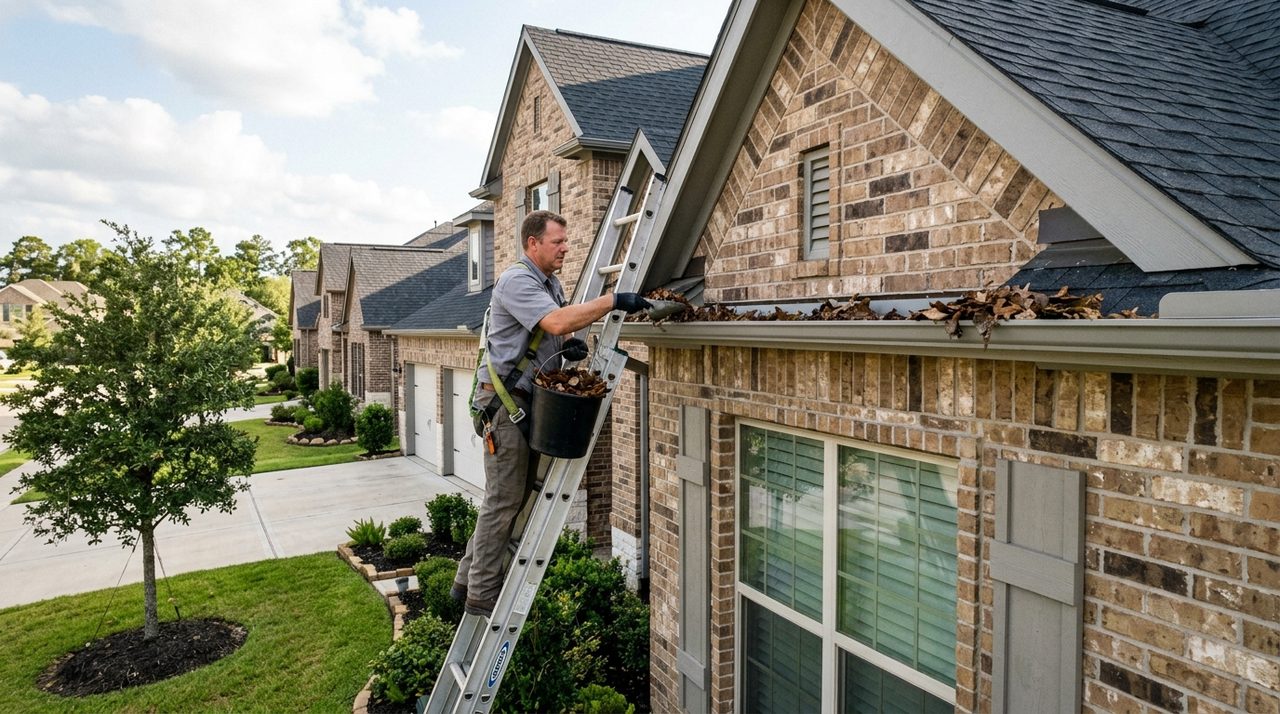
Energy Corridor homes sit in the drainage shadow of Addicks Reservoir and Buffalo Bayou, meaning a clogged gutter here isn't just a roof maintenance issue — overflowing water against a slab-on-grade foundation on Houston's expansive Black clay soil is a direct path toward differential settlement on houses that already range from 40- to 60-years-old. The district's patchwork of individual subdivision HOAs and deed restrictions adds another layer: visible debris overflow or fascia staining can trigger a violation notice even though there is no single umbrella HOA for the Corridor.
Ranked by verified Google rating × review volume × verification tier. How we rank →
Some highly-rated pros serve Energy Corridor from nearby and may not keep a Energy Corridor street address. Those are listed under "Also serving Energy Corridor" with their real city and distance, so you always know where each business is based.
11767 Katy Fwy #600, Houston, TX 77079
5707 Addicks Satsuma Rd, Houston, TX 77084
19728 Saums Rd #149, Houston, TX 77084
Highly-rated pros based nearby who cover Energy Corridor. Distance shown from the Energy Corridor area.
Serving Energy Corridor Based in Westchase · 2.4 mi away
Serving Energy Corridor Based in Alief · 3.2 mi away
Serving Energy Corridor Based in Westchase · 3.6 mi away
Serving Energy Corridor Based in Spring Branch · 4.7 mi away
Serving Energy Corridor Based in Spring Branch · 4.7 mi away
Serving Energy Corridor Based in Westchase · 4.7 mi away
Serving Energy Corridor Based in Westchase · 5.7 mi away
Why it matters to you
The Energy Corridor's median year-built is 1990, but large swaths of the district — particularly the ranch-style and traditional homes along the interior subdivisions — date from the 1960s through the 1980s when 3-tab asphalt shingles were standard. As those shingles age past the 20- to 30-year mark they shed granules at an accelerating rate, and those granules funnel straight into downspout top elbows where they compact into a concrete-hard plug that a leaf blower or garden hose flush cannot dislodge. The result is a gutter that looks clean from the ground but drains nowhere.
What a good pro does
A thorough cleaning on these homes should include a hand-inspection of every downspout elbow and a pressure flush from above, not just a top-of-gutter blow-out. The pro should note shingle granule volume in the debris bucket as a rough indicator of roof end-of-life — that finding is worth flagging to the homeowner. Routine gutter cleaning and minor repairs do not require a City of Houston permit, so no permitting delay is involved.
Sources: City of Houston Permitting Center
Why it matters to you
Nearly every home in the Energy Corridor sits on a slab-on-grade foundation over Houston's expansive Beaumont/Houston Black clay, which swells dramatically when wet and shrinks during dry spells. On blocks that already sit near Buffalo Bayou's drainage influence zone, the soil moisture cycle is more pronounced than in drier parts of the metro. A gutters-to-foundation overflow that repeatedly saturates the perimeter soil — particularly on the north or shaded sides of a home where evaporation is slow — compounds differential heave and can accelerate the cracking or settlement that many of these 40- to 60-year-old slabs are already experiencing.
What a good pro does
The cleaning crew should verify downspout extensions discharge at least four to six feet from the foundation perimeter and confirm that splash blocks or flex extensions haven't shifted. On Energy Corridor lots with minimal grade (common in the flat West Houston topography mapped by HCFCD), the pro should flag any downspout that terminates at grade against the foundation so the homeowner can address drainage slope independently.
Sources: Harris County Flood Control District, FEMA National Flood Hazard Layer (NFHL)
Why it matters to you
Hurricane Beryl made landfall in July 2024 and tracked directly over the Houston metro, depositing bark strips, snapped branch sections, and Spanish moss into gutters throughout West Houston including the Energy Corridor. The district's mature canopy — live oaks and loblolly pines common in subdivisions like Memorial Drive Acres — concentrates debris loads well above what a routine seasonal clean addresses. Because Beryl followed the May 2024 derecho by only weeks, many homeowners who deferred cleaning after the derecho faced a compounded debris mass by late summer 2024.
What a good pro does
After any named storm or high-wind event, schedule a cleaning specifically scoped as a post-storm service rather than a standard flush, since debris volume, embedded branch fragments, and possible shingle granule surge from impact damage all require hands-on removal rather than blower-only technique. Expect pricing in the $250–$450 range for larger two-story homes with heavy loads, consistent with post-hurricane market rates across the metro, and anticipate a one-to-three week wait as demand spikes across West Houston simultaneously.
Sources: Harris County Flood Control District
Why it matters to you
Unlike master-planned suburbs with a single HOA governing the entire community, the Energy Corridor's residential areas fall under individual subdivision deed restrictions and POAs — Memorial Drive Acres Section I operates its own mandatory POA, and several other subdivisions have separate architectural review processes with no coordination between them. White or light-colored fascia boards, common on the traditional and colonial-style homes in the district, make organic staining from gutter overflow highly visible and can generate a deed restriction violation notice even in subdivisions without a formally active HOA if a neighbor files a complaint under the recorded restrictions.
What a good pro does
When scheduling a cleaning, confirm which specific subdivision governs your block and whether that subdivision's deed restrictions address exterior maintenance, because requirements and enforcement intensity vary parcel-to-parcel across the Corridor. A cleaning that includes a fascia wipe-down and soffit inspection — not just gutter debris removal — addresses staining before it becomes a compliance issue. No City of Houston permit is required for this scope of work.
Sources: Local HOA / deed restrictions (see area profile), City of Houston Permitting Center
Hiring gutter cleaning in Energy Corridor? The Energy Corridor is a broad West Houston district encompassing multiple subdivisions rather than a single platted neighborhood, so home service needs vary significantly by block. Housing stock ranges from mid-century to newer infill construction, and homeowners must navigate a patchwork of deed restrictions and HOA requirements that differ by subdivision. Proximity to Addicks Reservoir and Buffalo Bayou drainage basins makes flood awareness essential even in lower-risk zones.
Building era
Mixed, primarily 1960s–1980s with newer infill and townhome development continuing through present.
Typical style
Heterogeneous — ranch, traditional, contemporary, and townhome styles all present across the district's many subdivisions.
Foundations
Predominantly slab-on-grade, consistent with broader Houston construction norms; some older homes near Memorial may have pier-and-beam.
Common systems
Older homes likely have original or first-generation replacement central HVAC, copper or galvanized plumbing depending on era, and electrical panels ranging from 100-amp to 200-amp. Newer construction typically features high-efficiency HVAC and PEX plumbing.
What that means for repairs
Older 1960s–1980s homes frequently undergo HVAC replacement, kitchen and bath remodeling, and plumbing repipes. Post-Harvey flood remediation and hardening drove significant renovation activity in flood-affected pockets. Newer townhome communities tend to require less structural renovation but may need cosmetic updates.
Permit jurisdiction
City of Houston Permitting Center for properties within Houston city limits, which covers most of the Energy Corridor. Properties outside city limits would fall under Harris County Engineering.
HOA & deed restrictions
Mixed HOA landscape — no single umbrella HOA governs the entire Energy Corridor. Individual subdivisions such as Memorial Drive Acres Section I have mandatory POAs/HOAs, while other areas operate under deed restrictions without an active mandatory association. The Energy Corridor District is a business/management district, not a residential HOA.
Historic districts
No City of Houston historic district designation confirmed for the Energy Corridor area.
Contractor note
Contractors must verify which specific subdivision's deed restrictions or HOA architectural review process applies before beginning exterior work, as rules vary significantly across the district. Always confirm the property is within Houston city limits for correct permit jurisdiction.
FEMA flood zone
FEMA Zone X (low flood risk) per official NFHL data. However, portions of the Energy Corridor sit near Buffalo Bayou and within the Addicks Reservoir influence zone, so flood risk can vary significantly by parcel. Homeowners should verify individual property flood status through HCFCD and FEMA maps.
Hurricane Harvey impact
District-wide Harvey flooding severity could not be confirmed from available research. Given proximity to Addicks Reservoir controlled-release zones and Buffalo Bayou drainage basins, some pockets within the Energy Corridor likely experienced significant flooding, but specific streets and depths require parcel-level flood documentation to verify.
Heat & humidity load
Houston's extreme summer heat and humidity stress aging HVAC systems common in 1970s–1980s housing stock. Older units may struggle with efficiency, driving high energy costs. Slab foundations are susceptible to soil movement during drought-to-rain cycles, and heavy summer storms can expose drainage deficiencies in older subdivisions.
Working with contractors here
Contractors in the Energy Corridor most commonly handle HVAC replacement and repair in aging 1970s–1980s homes, plumbing repipes from galvanized to PEX, and foundation repair driven by Houston's expansive clay soils. Post-Harvey flood remediation — including drywall replacement, mold remediation, and flood-proofing upgrades — has been a significant category of work in affected pockets near reservoir influence zones. Because the district encompasses many different subdivisions with varying deed restrictions and HOA requirements, contractors should confirm architectural review and approval processes before beginning any exterior modifications. Job scoping should account for the wide variation in housing age and condition across the district.
Local Tip
Always ask for a written estimate before work begins. Texas contractors are required to provide one on jobs over $1,000.
The Energy Corridor is a broad West Houston district encompassing multiple subdivisions rather than a single platted neighborhood, so home service needs vary significantly by block. Housing stock ranges from mid-century to newer infill construction, and homeowners must navigate a patchwork of deed restrictions and HOA requirements that differ by subdivision. Proximity to Addicks Reservoir and Buffalo Bayou drainage basins makes flood awareness essential even in lower-risk zones.
Source: U.S. Census Bureau, ACS 5-Year 2023
Most of Energy Corridor maps to FEMA Zone X (low mapped flood risk), but Houston's flash-flood reality means even low-risk blocks benefit from smart drainage and storm-hardened installs; risk climbs sharply on blocks nearest Buffalo Bayou and the Addicks/Barker reservoirs, where it varies parcel to parcel.
Source: FEMA National Flood Hazard Layer (NFHL). Flood zones vary by parcel — verify your individual FIRM panel.
Securing gutter spikes or replacing them with hex-head screws should be part of your pre-hurricane checklist in Energy Corridor, because Beryl 2024's straight-line gusts tore loose sections off homes that had never flooded at all. Once the storm passes, a quick debris-clearing visit prevents the standing organic matter that accelerates rust and seam separation in the humid Houston recovery period. Because Energy Corridor drains toward Buffalo Bayou and the Addicks/Barker reservoirs, block-level runoff can differ sharply from the mapped zone.
Hail from a severe Houston thunderstorm loads shingle granules into gutters within minutes, and a blocked downspout during the same storm causes fascia and soffit saturation that leads to rot within weeks. In Energy Corridor, where foundation flooding is less common, the main post-storm gutter priority is clearing granule accumulation before it compacts into a concrete-like plug at the elbow. Because Energy Corridor drains toward Buffalo Bayou and the Addicks/Barker reservoirs, block-level runoff can differ sharply from the mapped zone.
After a Houston hard freeze, walk the roofline and look for gutter sections that have pulled away from the fascia under ice weight, since even low-flood-risk homes in Energy Corridor can take on wall and soffit moisture from a detached run during the melt. Scheduling a post-freeze gutter inspection with a qualified professional catches hanger damage before it progresses through the wet spring. In-city Energy Corridor work falls under City of Houston floodplain and permitting rules.
Sources: FEMA National Flood Hazard Layer (NFHL), Ready.gov -- Hurricanes, CenterPoint Energy -- Storm Center, City of Houston -- Emergency Preparedness, Ready.gov -- Winter Weather, Harris County Flood Control District
Houston-specific estimators to plan your project before you call a pro. All results are planning estimates — a licensed local pro confirms the details on site.
Disconnect & drain every outdoor hose bib
Remove hoses, drain the spigots, and cover each with an insulated faucet sock. Un-drained hose bibs are the #1 burst point in a Houston freeze.
Insulate exposed pipes in the attic & garage
Wrap any pipe in an unconditioned space (attic runs, garage walls) with foam sleeves. Houston homes rarely insulate these because they only matter a few nights a year — which is exactly why they burst.
Open cabinet doors & keep a pencil-width drip
On hard-freeze nights, open kitchen/bath cabinets so warm air reaches the pipes and let faucets on exterior walls drip to relieve pressure.
Protect the attic/garage water heater & its lines
An attic or garage tank sits in unconditioned space. Insulate the cold-inlet and hot-outlet lines and confirm the emergency drain pan is clear so a leak doesn't reach the ceiling.
This is a planning estimate only — actual requirements depend on an on-site assessment by a licensed Houston pro. If a pipe has already burst, shut off your main water supply and call a licensed Houston plumber immediately — freeze bursts flood fast.
Sources: City of Houston Permitting Center
Sources: Local HOA / deed restrictions (see area profile)
Sources: FEMA National Flood Hazard Layer (NFHL)Harris County Flood Control District