Closed
2719 Avenue H, Rosenberg, TX 77471
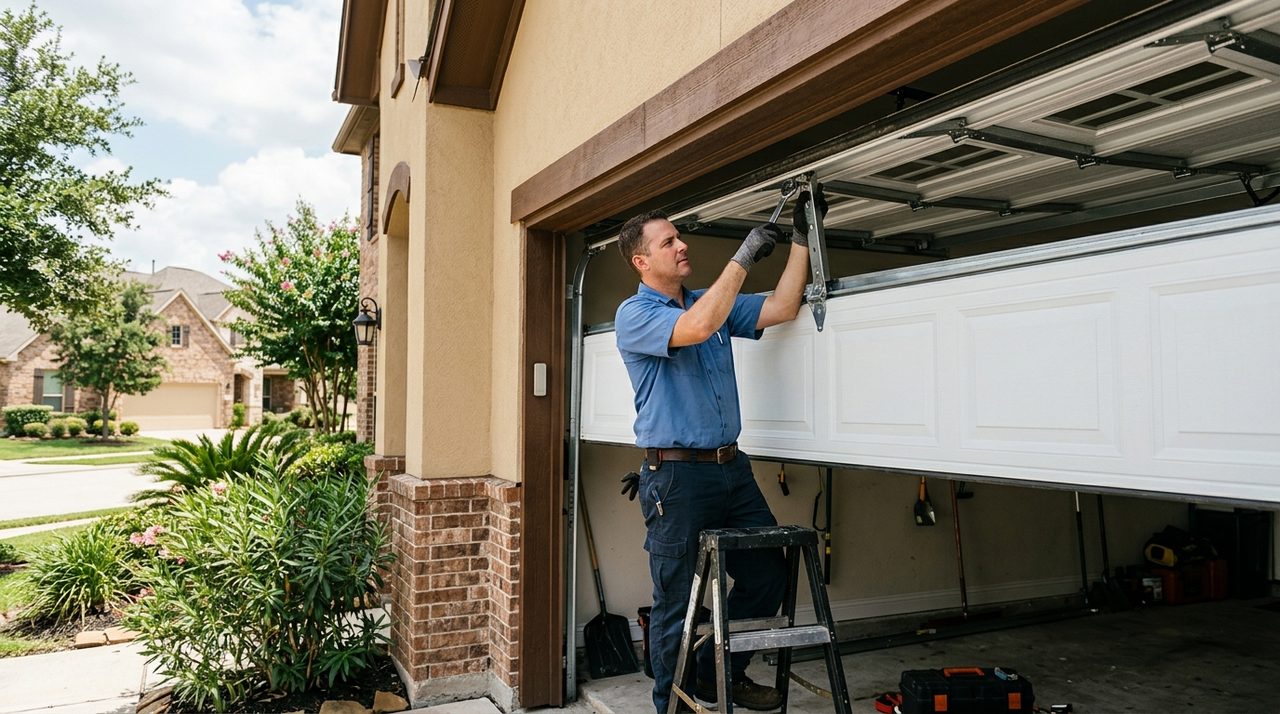
Rosenberg's garage doors face a split reality: mid-century ranch homes near the original Union Pacific rail corridor sit on Fort Bend County's expansive black clay, where seasonal soil movement quietly racks door frames year after year, while the production-builder homes filling subdivisions like Oaks of Rosenberg and The Preserve at Rosenberg answer to HOA architectural committees before any exterior replacement can begin. Fort Bend County's flat terrain and the city's median build year of 1994 (U.S. Census ACS 5-Year 2023) create a concentrated window of doors and openers now reaching or past their service life — exactly when spring corrosion and insulation shortfalls become expensive. This page details the three challenges that actually drive garage door calls in Rosenberg, along with realistic cost estimates and the correct permit path through the City of Rosenberg Building & Permitting Department.
Ranked by verified Google rating × review volume × verification tier. How we rank →
Some highly-rated pros serve Rosenberg from nearby and may not keep a Rosenberg street address. Those are listed under "Also serving Rosenberg" with their real city and distance, so you always know where each business is based.
2719 Avenue H, Rosenberg, TX 77471
24200 Southwest Fwy Suite 429, Rosenberg, TX 77471
1730 B F Terry Blvd, Rosenberg, TX 77471
Highly-rated pros based nearby who cover Rosenberg. Distance shown from the Rosenberg area.
Serving Rosenberg Based in Richmond · 3.1 mi away
Why it matters to you
Fort Bend County sits on the same Beaumont and Houston Black expansive clay series that plagues the broader SW Houston corridor. As that clay swells after heavy rain and shrinks during summer dry spells, the concrete slab-on-grade foundations common in Rosenberg's post-1970s production homes shift differentially — and the garage rough opening shifts with them. Homeowners in the older core near the historic downtown, where cumulative movement over 50-plus years is greatest, often find their door binding on one side, rollers jumping the track, or a persistent gap at the bottom corner that no seal adjustment fully fixes.
What a good pro does
A thorough pro will measure the rough opening at multiple points for out-of-square before touching any hardware, and will flag significant frame distortion to the homeowner before proceeding. If the opening is beyond the adjustment range of standard tracks, the correct fix involves a framing correction — not just readjusting the spring tension. Replacing a door that alters the structural opening requires a permit from the City of Rosenberg Building & Permitting Department for properties within city limits, or from Fort Bend County Engineering for unincorporated parcels; verify jurisdiction by address before scheduling.
Sources: Municipal permit office (see area profile), International Residential Code (as adopted by City of Houston)
Why it matters to you
Rosenberg sits roughly 35 miles southwest of Galveston Bay, close enough that the metro's year-round 65–70% relative humidity — regularly spiking above 90% in July and August — corrodes torsion springs, cables, bottom brackets, and hinges at an accelerated rate. For Rosenberg's large cohort of homes built in the 1990s and early 2000s (the city's census median build year is 1994), original hardware is now 25–30 years old and has cycled through hundreds of Houston summers without the corrosion-resistant coatings available in current products. Failure typically announces itself without warning: a loud crack at 6 a.m. and a door that won't move.
What a good pro does
When replacing springs on a Rosenberg home, a quality installer should specify oil-tempered springs with a galvanized or powder-coated finish rather than bare steel, and replace both springs simultaneously even if only one has broken — the second is equally fatigued. Cables, rollers, and bottom brackets on a door older than 15 years should be inspected in the same visit; replacing them proactively costs far less than an emergency call, which typically adds a $100–$175 dispatch fee on top of parts and labor. Mechanical repairs like spring replacement do not require a City of Rosenberg building permit.
Sources: Municipal permit office (see area profile)
Why it matters to you
Rosenberg's production-builder subdivisions lay out streets on a grid that frequently puts garage doors facing west or south — directly into the afternoon sun during Houston's 150-plus hours above 95°F each year. Original single-layer steel doors on homes from the 1990s and early 2000s carry an R-value near zero, turning an attached garage into a radiant oven that pushes heat into adjacent living spaces and forces the HVAC system to work harder all evening. For Rosenberg homeowners where residential cooling can account for roughly half of a summer electric bill, an uninsulated garage door is one of the most overlooked envelope gaps.
What a good pro does
Upgrading to a two-layer or three-layer insulated steel door rated R-13 to R-18 addresses the radiant gain directly and is one of the higher-ROI improvements on attached-garage homes. Look for doors carrying Energy Star certification where applicable, and confirm the U-factor and R-value are for the whole door assembly, not just the insulation core. If the replacement also means a new 20-amp dedicated circuit for the opener, that wiring work requires a TDLR-licensed electrician under Texas law.
Sources: ENERGY STAR / U.S. Dept. of Energy, Texas Department of Licensing & Regulation
Why it matters to you
The City of Houston has no zoning, and that permissive reputation sometimes leads Rosenberg homeowners to assume they can pick any door they like. In reality, the mandatory HOA communities in Rosenberg's newer master-planned subdivisions — including the Oaks of Rosenberg Community Association and The Preserve at Rosenberg Community Association — have recorded CC&Rs that specify permitted panel styles, colors, and sometimes materials. Ordering a carriage-house-style door with a faux-wood finish before getting architectural committee sign-off can result in a rejection letter, mandatory removal, and the cost of a second installation.
What a good pro does
Before measuring for a replacement, pull your deed and search Fort Bend County property records to confirm whether your subdivision's CC&Rs are active and enforced. Submit your door style, color, and material spec sheet — not just a verbal description — to the architectural review committee and get written approval. Only after that approval is in hand should you apply for a building permit from the City of Rosenberg Building & Permitting Department (for in-city properties) and schedule installation. Good local installers familiar with Fort Bend subdivisions will ask for HOA approval documentation before committing to an order.
Sources: Local HOA / deed restrictions (see area profile), Municipal permit office (see area profile)
Hiring garage door repair in Rosenberg? Rosenberg spans a historic railroad-era core surrounded by modern master-planned subdivisions, creating a wide range of home service needs from aging mid-century systems to newer production-builder homes. Homeowners must verify HOA status, deed restrictions, and flood exposure on a subdivision-by-subdivision basis, as conditions vary significantly across the city. Fort Bend County's expansive clay soils and flat terrain make foundation maintenance and drainage management recurring concerns for all eras of housing.
Building era
Mixed: mid-20th century homes near the original city core; 1990s–2020s production homes in surrounding master-planned subdivisions such as Oaks of Rosenberg and The Preserve at Rosenberg.
Typical style
Contemporary production-builder suburban (brick/stone veneer, 1- and 2-story, attached garages) in newer subdivisions; modest ranch and traditional styles in older core areas.
Foundations
Predominantly concrete slab-on-grade in post-1970s construction (inferred from regional practice); older pre-1960s homes near the city core may include pier-and-beam — confirm via Fort Bend CAD or inspection.
Common systems
Newer subdivisions: central HVAC (14+ SEER), copper/PEX plumbing, 200-amp electrical panels. Older core homes: original HVAC units potentially past service life, galvanized or copper plumbing, 100–150 amp panels potentially needing upgrades.
What that means for repairs
Older core-area homes frequently require electrical panel upgrades, re-plumbing from galvanized to PEX/copper, and HVAC replacement. Newer subdivision homes see cosmetic remodeling, patio additions, and fence replacements subject to HOA architectural review.
Permit jurisdiction
City of Rosenberg Building & Permitting Department for properties within city limits; Fort Bend County Engineering for unincorporated areas.
HOA & deed restrictions
Subdivision-specific. Newer master-planned communities such as Oaks of Rosenberg Community Association and The Preserve at Rosenberg Community Association have mandatory HOA/POA membership with recorded CC&Rs. Older inner-Rosenberg neighborhoods may have no HOA or only informal deed-restriction committees. Verify HOA status via deed, Fort Bend County property records, or the City of Rosenberg HOA contact list.
Historic districts
No historic district designation confirmed. Rosenberg's historic downtown area has heritage significance but no formal historic preservation overlay was identified in the research.
Contractor note
Contractors must determine whether a property falls within Rosenberg city limits or unincorporated Fort Bend County, as permit requirements and inspections differ. In HOA-governed subdivisions, architectural review committee approval is typically required before exterior work begins.
FEMA flood zone
FEMA Zone X (low flood risk) — source: fema_nfhl. Rosenberg is situated near the Brazos River, and localized flooding can occur along tributaries and drainage channels even in Zone X areas. Property-level flood risk should be verified via Fort Bend County Drainage District data.
Hurricane Harvey impact
Fort Bend County experienced severe regional flooding during Hurricane Harvey (2017), but specific street-level or subdivision-level flood data for Rosenberg neighborhoods was not confirmed in available research. Some areas near the Brazos River and low-lying drainage corridors likely experienced impacts, but which platted subdivisions flooded versus stayed dry cannot be stated definitively without FEMA loss data or City of Rosenberg floodplain reports.
Heat & humidity load
Extreme summer heat and humidity drive heavy HVAC demand across all housing eras. Slab-on-grade foundations on Fort Bend County's expansive clay soils are vulnerable to seasonal moisture cycling — prolonged summer drought followed by heavy rain events causes soil shrinkage and swelling that can lead to foundation movement. Proper drainage and foundation watering programs are commonly recommended.
Working with contractors here
Contractors in Rosenberg most commonly handle HVAC servicing and replacement, foundation repair due to expansive clay soils, and re-plumbing of older galvanized systems in the city's mid-century core. In newer master-planned subdivisions, work tends toward warranty-related repairs, fence and patio installations, and exterior modifications that require HOA architectural committee approval before proceeding. Roof replacements following hail and storm events are a steady demand driver across all eras. Contractors should verify permit jurisdiction (city vs. county) and HOA requirements early in the scoping process, as failing to obtain proper approvals can result in project delays and fines.
Local Tip
Always ask for a written estimate before work begins. Texas contractors are required to provide one on jobs over $1,000.
Rosenberg spans a historic railroad-era core surrounded by modern master-planned subdivisions, creating a wide range of home service needs from aging mid-century systems to newer production-builder homes. Homeowners must verify HOA status, deed restrictions, and flood exposure on a subdivision-by-subdivision basis, as conditions vary significantly across the city. Fort Bend County's expansive clay soils and flat terrain make foundation maintenance and drainage management recurring concerns for all eras of housing.
Source: U.S. Census Bureau, ACS 5-Year 2023
Most of Rosenberg maps to FEMA Zone X (low mapped flood risk), but Houston's flash-flood reality means even low-risk blocks benefit from smart drainage and storm-hardened installs; risk climbs sharply on blocks nearest the Brazos River, where it varies parcel to parcel.
Source: FEMA National Flood Hazard Layer (NFHL). Flood zones vary by parcel — verify your individual FIRM panel.
After Beryl 2024 knocked out power across low-flood Houston neighborhoods for more than a week, the value of a battery-backup garage-door opener became undeniable for residents in Rosenberg, TX. Schedule a pre-season inspection to confirm torsion springs, cables, and tracks are in working order so the door holds its structural position under sustained tropical winds without opener assistance. As a Fort Bend County community, Rosenberg may follow county rather than City of Houston storm rebuild rules.
Wind is the dominant severe-storm risk for garage doors in Rosenberg, TX, and the May 2024 derecho proved that Houston's low-flood-risk neighborhoods are not sheltered from 100-mph straight-line gusts that bow panels and strip tracks from door frames. A TDLR-licensed technician can install a retrofit bracing kit on an existing door for a fraction of full-replacement cost, buying meaningful wind resistance without a new-door budget. Confirm the current FEMA panel for your Rosenberg parcel — the area maps to Zone X, but adjacent lots can differ.
Garage doors in Rosenberg, TX are among the most vulnerable entry points to freezing temperatures during events like Uri 2021, when sustained sub-20°F air turned standard bottom seals brittle and cracked weatherstripping that had never experienced such cold. Replacing foam-based seals with cold-temperature-rated vinyl or rubber seals before winter, and adding an insulated door panel if the current door is uninsulated, keeps the garage from becoming a heat sink. Confirm the current FEMA panel for your Rosenberg parcel — the area maps to Zone X, but adjacent lots can differ.
Sources: FEMA National Flood Hazard Layer (NFHL), Ready.gov -- Hurricanes, CenterPoint Energy -- Storm Center, City of Houston -- Emergency Preparedness, Ready.gov -- Winter Weather, Harris County Flood Control District
Houston-specific estimators to plan your project before you call a pro. All results are planning estimates — a licensed local pro confirms the details on site.
Disconnect & drain every outdoor hose bib
Remove hoses, drain the spigots, and cover each with an insulated faucet sock. Un-drained hose bibs are the #1 burst point in a Houston freeze.
Insulate exposed pipes in the attic & garage
Wrap any pipe in an unconditioned space (attic runs, garage walls) with foam sleeves. Houston homes rarely insulate these because they only matter a few nights a year — which is exactly why they burst.
Open cabinet doors & keep a pencil-width drip
On hard-freeze nights, open kitchen/bath cabinets so warm air reaches the pipes and let faucets on exterior walls drip to relieve pressure.
Protect the attic/garage water heater & its lines
An attic or garage tank sits in unconditioned space. Insulate the cold-inlet and hot-outlet lines and confirm the emergency drain pan is clear so a leak doesn't reach the ceiling.
This is a planning estimate only — actual requirements depend on an on-site assessment by a licensed Houston pro. If a pipe has already burst, shut off your main water supply and call a licensed Houston plumber immediately — freeze bursts flood fast.
Sources: Municipal permit office (see area profile)
Sources: International Residential Code (as adopted by City of Houston)
Sources: FEMA National Flood Hazard Layer (NFHL)Harris County Flood Control District
Sources: Texas Windstorm Insurance Association (TWIA)International Residential Code (as adopted by City of Houston)
Sources: Local HOA / deed restrictions (see area profile)