Serving West University Based in Upper Kirby · 1.3 mi away
Best Foundation Repair in West University
West University Place's split personality — original 1930s–1950s pier-and-beam bungalows sitting alongside slab-on-grade custom homes built after the teardown booms of the 1980s–2000s — means foundation repair here is never one-size-fits-all. Houston Black clay soil runs under every lot regardless of construction era, and all work requires permits through West University Place's own independent permit office, not the City of Houston Permitting Center. Given median home values exceeding $1.35 million, even modest unchecked foundation movement carries outsized financial and resale consequences.
Verified against Google Business data
Updated 2026
See the 10 Foundation Repair Serving West University 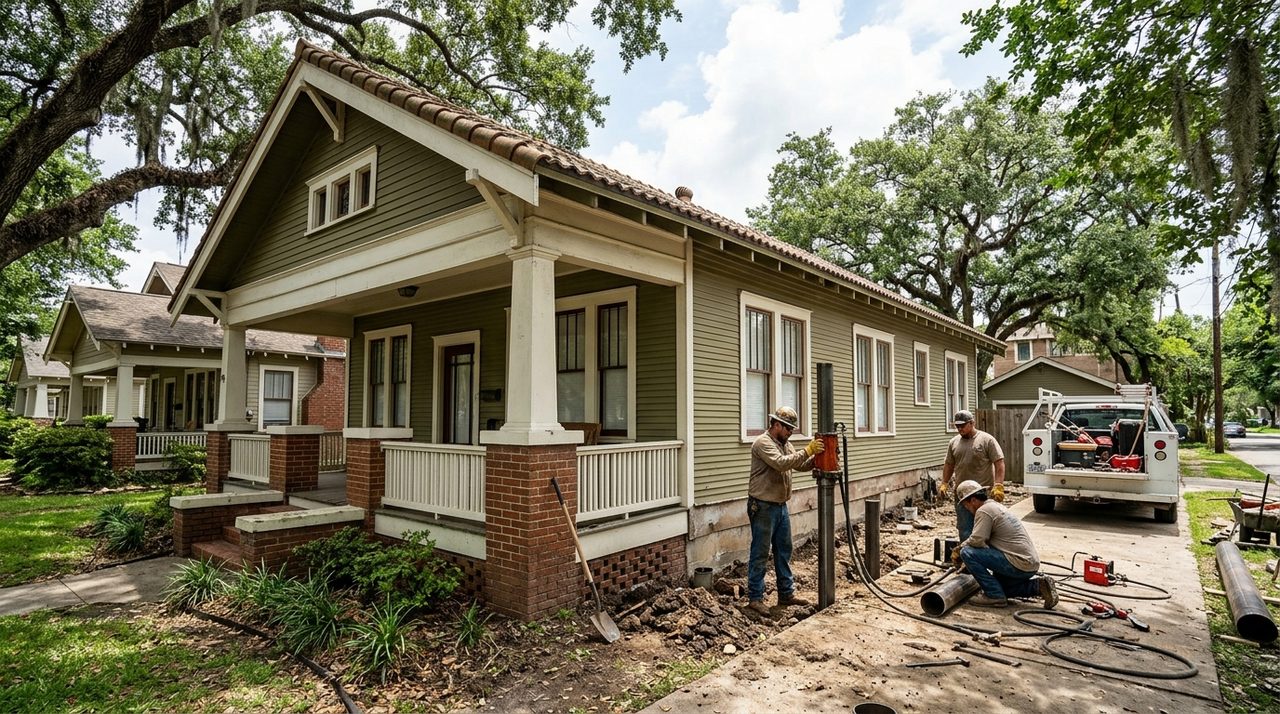
- Median home built
- 1993
- Median home value
- $1,354,300
- FEMA flood zone
- X500 (moderate)
- Typical cost (est.)
- $3,500–$25,000 depending on system type and pier count
- Most common local issue
- Expansive clay differential movement under mixed pier-and-beam and slab foundations from the 1930s–2000s housing eras
Ranked by verified Google rating × review volume × verification tier. How we rank →
Some highly-rated pros serve West University from nearby and may not keep a West University street address. Those are listed under "Also serving West University" with their real city and distance, so you always know where each business is based.
Min rating:
10 resultsAlso serving West University
Highly-rated pros based nearby who cover West University. Distance shown from the West University area.
Open Now
Serving West University Based in Upper Kirby · 1.4 mi away
Closed
Serving West University Based in Bellaire · 1.9 mi away
Closed
Serving West University Based in Bellaire · 2.2 mi away
Serving West University Based in Medical Center · 2.8 mi away
Closed
Serving West University Based in Bellaire · 2.9 mi away
Closed
Serving West University Based in River Oaks · 3.4 mi away
Closed
Serving West University Based in Braeswood · 3.4 mi away
Closed
Serving West University Based in Bellaire · 3.5 mi away
Closed
Serving West University Based in Tanglewood · 3.6 mi away
Foundation Repair in West University: What You Should Know
Two Foundation Types on the Same Block: Knowing What You Have Before You Spend a Dollar
Why it matters to you
West University's teardown-and-rebuild cycle has left blocks where a 1940s pier-and-beam cottage sits next to a 2002 slab-on-grade custom home. The repair strategies — and costs — for these two systems are completely different. Misidentifying your foundation type is the single most common reason West U homeowners receive repair proposals that are wrong for their house. Because West University Place is an independent municipality, foundation type is not always documented in Harris County records, and the city's permit files are the most reliable local reference.
What a good pro does
Before accepting any proposal, ask your contractor to physically confirm your foundation type — crawl-space access panel for pier-and-beam, or perimeter beam exposure for slab-on-grade. A reputable contractor will pull your permit history through the City of West University Place's building department, not guess. Pier-and-beam leveling (shimming or sister piers) is fundamentally different from slab underpinning with steel push piers or pressed pilings, and the correct scope depends entirely on what's actually under your home.
Sources: Municipal permit office (see area profile)
Houston Black Clay Under High-Value Lots: Seasonal Movement That Repeats Every Year
Why it matters to you
Houston Black clay soil underlies West University regardless of whether your home was built in 1947 or 2005. During the 2022–2023 La Niña drought cycle, perimeter soils pulled away from slab edges across the Inner Loop, and West U's mature live oaks and water oaks — many within 15–20 feet of foundations on the neighborhood's smaller historic lots — accelerated localized drying on the tree-facing sides. The result is differential movement: one corner of a slab may settle while another remains stable, cracking door frames, brick veneer, and interior drywall in patterns that return every dry season.
What a good pro does
A qualified foundation contractor should map crack patterns seasonally (not just at one visit) and evaluate soil moisture at multiple perimeter points before recommending repair. For West U's slab-on-grade homes, steel push pier underpinning at $1,200–$1,800 per pier (est.) reaches load-bearing soil below the active clay layer, while perimeter soaker-hose irrigation during dry months is the primary ongoing prevention tool. Tree-root proximity should be documented in writing as a contributing factor, particularly for heritage trees that West University Place zoning may restrict from removal.
Sources: Municipal permit office (see area profile), Harris County Flood Control District
Cast-Iron Under-Slab Drains and the Uri Legacy in Pre-1990 West U Homes
Why it matters to you
West University's surviving pre-1990 homes — including many of the remaining 1930s–1950s bungalows and early infill construction — often have cast-iron under-slab or under-floor drain lines that were vulnerable to Winter Storm Uri's freeze-burst cycle in February 2021. Many post-Uri repairs addressed visible interior wall damage but left cracked under-slab lines in place. Ongoing slow leaks from those lines saturate the clay directly beneath the foundation, causing localized heave followed by settlement as the soil structure deteriorates — a cycle that mimics, and can be confused with, pure clay-shrink movement.
What a good pro does
Before signing any foundation repair contract on a pre-1990 West U home, require a hydrostatic plumbing pressure test ($250–$400 est.) performed or overseen by a plumber licensed by the Texas State Board of Plumbing Examiners. If a leak is confirmed, the plumbing repair must be permitted and inspected through the City of West University Place's permit office — not Houston's — before foundation stabilization begins. Skipping this sequence means potentially re-doing repair work after the plumbing is addressed.
Sources: Texas State Board of Plumbing Examiners, Municipal permit office (see area profile)
West University Place Permits: A Separate Process Most Contractors Get Wrong
Why it matters to you
Because West University Place is an independent municipality completely outside Houston city limits, foundation repair permits must be pulled through the City of West University Place's own building department — not the City of Houston Development Services Department and not Harris County. Contractors who routinely work the Inner Loop but have not specifically permitted in West U may be unaware of the city's inspection sequencing, fee schedule, or documentation requirements. Unpermitted foundation work discovered during a resale inspection on a home worth north of $1 million creates both legal disclosure obligations under the TREC seller's disclosure form and potential lender complications.
What a good pro does
Verify permit status directly with the City of West University Place's building department — not through the contractor's verbal assurance. Require the contractor to provide the permit number and inspection sign-off before final payment is released. Texas does not issue a standalone state license for foundation repair contractors, so permit compliance and insurance verification (general liability plus workers' comp) are the primary consumer protections available. Get three written proposals with pier counts, depth specifications, and permit commitment before choosing a contractor.
Sources: Municipal permit office (see area profile), Texas Department of Licensing & Regulation
Foundation Repair in West University: What You Should Know
Hiring foundation repair in West University? West University Place is an independent municipality within the Inner Loop featuring a mix of original 1930s–1950s bungalows and larger custom homes built from the 1980s onward as teardown-rebuild cycles reshaped the neighborhood. Homeowners here navigate the city's own permitting process—separate from Houston's—and must account for aging systems in older homes alongside modern construction standards in newer builds. The tree-lined streets and high property values drive demand for premium finishes and careful code compliance.
- Housing era
- Mixed
- Foundation
- Not confirmed from available sources - likely mixed pier-and-beam on older pre-1950s homes and…
- Flood zone
- FEMA Zone X500 (moderate flood risk) per official NFHL data
- Permits
- City of West University Place (independent municipality - own permit office, not City of…
Housing stock & systems
Building era
Mixed: original homes from 1930s–1950s with significant infill and teardown-rebuild construction from the 1980s–2000s and continuing today.
Typical style
Traditional brick, Georgian/Colonial-influenced, neo-traditional custom homes (2-story), with some remaining early-20th-century bungalows and cottages.
Foundations
Not confirmed from available sources - likely mixed pier-and-beam on older pre-1950s homes and slab-on-grade on newer construction. Verify on a per-property basis.
Common systems
Older homes (1930s–1950s) may have original galvanized or cast-iron plumbing, outdated electrical panels, and window AC or early central HVAC. Newer construction (1980s–present) typically features copper or PEX plumbing, modern electrical, and high-efficiency central HVAC systems.
What that means for repairs
Teardown-and-rebuild activity has been the dominant renovation pattern for decades, replacing smaller original cottages with larger custom homes. Remaining older homes frequently undergo full-gut renovations including electrical rewiring, plumbing replacement, foundation repair, and HVAC modernization to meet current standards and market expectations.
Permits & restrictions
Permit jurisdiction
City of West University Place (independent municipality - own permit office, not City of Houston Permitting Center and not Harris County).
HOA & deed restrictions
No mandatory city-wide master HOA. West U functions as an independent municipality with its own zoning and code enforcement. Individual condo and townhome associations exist (e.g., The Oaks at West University Condominium Association), but most single-family homes have no HOA. Deed restrictions may exist on individual plats—check Harris County Clerk records for specific lots.
Historic districts
No City of Houston historic district designation applies. West University Place is an independent municipality outside Houston city limits, so HAHC Certificates of Appropriateness are not required. West U may have its own local design or zoning controls—check with the City of West University Place directly.
Contractor note
Contractors must pull permits through the City of West University Place, not through Houston or Harris County. West U's own inspectors enforce local codes, and the city's zoning and building requirements may differ from Houston's, so contractors unfamiliar with the jurisdiction should review local ordinances before bidding.
Flood & weather
FEMA flood zone
FEMA Zone X500 (moderate flood risk) per official NFHL data. West University Place sits between Brays Bayou to the south and Rice University to the east, with drainage flowing into Harris County Flood Control District channels.
Hurricane Harvey impact
Specific Harvey 2017 flood impact data for West University Place streets was not available in the research provided. The moderate flood risk zone designation and proximity to Brays Bayou suggest potential vulnerability, but confirmed street-level flooding details and repetitive-loss areas should be verified through HCFCD inundation maps and City of West University Place floodplain reports.
Heat & humidity load
Houston's extreme summer heat and humidity stress HVAC systems across all housing eras. Older pier-and-beam homes may experience moisture-related subfloor issues, while the mature tree canopy—a signature feature of West U—creates ongoing gutter maintenance demands and potential root intrusion into aging sewer lines.
Working with contractors here
Contractors in West University most commonly handle full-home renovations and teardown-rebuilds, driven by buyers acquiring older cottages on valuable lots and replacing them with larger custom homes. For surviving 1930s–1950s homes, foundation repair, whole-house repiping (replacing galvanized with copper or PEX), electrical panel upgrades, and HVAC replacement are frequent scopes. Newer 1990s–2000s homes generate demand for roof replacements, exterior paint, and kitchen/bath remodels as they reach their first major maintenance cycles. Job scoping must account for West University Place's independent permitting process, which can differ from Houston's in turnaround times and inspection requirements. The high-end market expectations in West U mean contractors should budget for premium materials and meticulous finish work.
Local Tip
Always ask for a written estimate before work begins. Texas contractors are required to provide one on jobs over $1,000.
About West University
West University Place is an independent municipality within the Inner Loop featuring a mix of original 1930s–1950s bungalows and larger custom homes built from the 1980s onward as teardown-rebuild cycles reshaped the neighborhood. Homeowners here navigate the city's own permitting process—separate from Houston's—and must account for aging systems in older homes alongside modern construction standards in newer builds. The tree-lined streets and high property values drive demand for premium finishes and careful code compliance.
- Median year built
- 1993
- Median home value
- $1,354,300
- Owner-occupied
- 72.4%
- Population
- 28,231
- Housing units
- 10,564
- Median income
- $215,708
Source: U.S. Census Bureau, ACS 5-Year 2023
Flood & storm risk
FEMA Zone X500Moderate flood riskWest University carries FEMA Zone X500 (moderate flood risk): outside the 100-year floodplain but inside the 500-year, so heavy-rain events still reach homes and flood-aware work pays off.
Source: FEMA National Flood Hazard Layer (NFHL). Flood zones vary by parcel — verify your individual FIRM panel.
Houston Storm Readiness in West University
Hurricane & flooding
Post-hurricane inspections in West University should include checking your weep screed and brick mortar joints for new horizontal cracking, which signals foundation movement driven by FEMA Zone X500 in the 500-year floodplain saturation rather than roof or wall damage alone. Catching pier settlement early — before a subsequent dry summer causes further shrinkage — is significantly less expensive than full mudjacking or complete pier replacement. Confirm the current FEMA panel for your West University parcel — the area maps to Zone X500, but adjacent lots can differ.
Severe storms & hail
In West University, the rapid soil saturation that follows a severe thunderstorm followed by a dry week creates exactly the wet-dry clay cycling that progressively moves foundations over time. Ask your licensed foundation contractor to map current slab elevation readings and compare them to any prior surveys, so you can catch incremental storm-to-storm settlement before it becomes a re-leveling project. In-city West University work falls under City of Houston floodplain and permitting rules.
Ice storms & freezes
During Winter Storm Uri, days of below-freezing temperatures caused the top layer of Houston's clay soils to stiffen and then consolidate unevenly as the thaw progressed, and West University properties with previous marginal foundation settlement saw measurable new movement. A pre-winter foundation inspection that confirms interior piers are fully loaded and shimmed correctly helps ensure your structure enters freeze season without pre-existing vulnerability. In-city West University work falls under City of Houston floodplain and permitting rules.
Sources: FEMA National Flood Hazard Layer (NFHL), Ready.gov -- Hurricanes, CenterPoint Energy -- Storm Center, City of Houston -- Emergency Preparedness, Ready.gov -- Winter Weather, Harris County Flood Control District
Free West University Tools & Calculators
Houston-specific estimators to plan your project before you call a pro. All results are planning estimates — a licensed local pro confirms the details on site.
Houston Soil & Tree Proximity Risk Calculator
Open full tool & FAQ →Grouped by mature root aggression & water demand.
Trunk center to the nearest exterior wall.
Moderate risk
The root zone likely reaches your foundation's soil during Houston's dry summers, when clay shrinks most. Watch for sticking doors and diagonal cracks, keep soil moisture even with a soaker hose during drought, and have a foundation pro evaluate if you see any movement.
Find a Houston foundation pro →This is a planning estimate only — actual requirements depend on an on-site assessment by a licensed Houston pro. Guidance is based on general species root behavior in expansive clay, not a soil test.
Houston Freeze Prep & Pipe Insulation Checklist
Open full tool & FAQ →Your freeze checklist — 4 tasks
- 1
Disconnect & drain every outdoor hose bib
Remove hoses, drain the spigots, and cover each with an insulated faucet sock. Un-drained hose bibs are the #1 burst point in a Houston freeze.
- 2
Insulate exposed pipes in the attic & garage
Wrap any pipe in an unconditioned space (attic runs, garage walls) with foam sleeves. Houston homes rarely insulate these because they only matter a few nights a year — which is exactly why they burst.
- 3
Open cabinet doors & keep a pencil-width drip
On hard-freeze nights, open kitchen/bath cabinets so warm air reaches the pipes and let faucets on exterior walls drip to relieve pressure.
- 4
Protect the attic/garage water heater & its lines
An attic or garage tank sits in unconditioned space. Insulate the cold-inlet and hot-outlet lines and confirm the emergency drain pan is clear so a leak doesn't reach the ceiling.
This is a planning estimate only — actual requirements depend on an on-site assessment by a licensed Houston pro. If a pipe has already burst, shut off your main water supply and call a licensed Houston plumber immediately — freeze bursts flood fast.
Frequently Asked Questions
Do I need a permit from the City of West University Place to have foundation piers installed, and how is that process different from Houston's?
Yes, foundation underpinning work in West University Place requires a permit through the City of West University Place's own permit office — not the City of Houston Permitting Center — and West U's inspectors enforce their own local code requirements and inspection scheduling. Many foundation contractors who primarily work in Houston or unincorporated Harris County are unfamiliar with West U's process and may either skip the permit entirely or cause delays by submitting incorrect documentation. Before signing any contract, confirm in writing that your contractor has previously pulled permits in West University Place and ask for the permit number once it is issued so you can verify status directly with the city.
Sources: Municipal permit office (see area profile)
My West U home was built in 1941 and still has the original pier-and-beam foundation. Do the same repair methods apply as for slab homes?
Pier-and-beam foundations — common in West University's surviving 1930s–1950s bungalows — are repaired very differently than slab-on-grade: instead of steel push piers driven from the perimeter, a pier-and-beam job typically involves replacing or sistering deteriorated wood piers, shimming or adding concrete pads under the beam grid, and sometimes adding cross-bracing, all accessed from the crawl space. This is a meaningful advantage because contractors can inspect and regrade support points without excavating around the exterior. However, on a home approaching 75–90 years old, the evaluation should also check whether original brick piers have cracked or settled unevenly from Houston Black clay movement before any shim work begins.
How does West University's FEMA Zone X500 flood designation affect what a foundation repair contractor should do differently here compared to a deeper-flood-risk neighborhood?
Zone X500 means West University sits outside the 100-year floodplain but inside the 500-year boundary, so standing water from heavy Gulf rain events — not full bayou flooding — is the realistic concern for foundations here. The practical implication for repair is that drainage grading around any repaired perimeter must direct water away from the slab or pier line effectively, because moderate but repeated saturation events can re-erode newly backfilled trench areas. Ask your contractor specifically how they will restore and slope the backfill after trenching, and whether they recommend adjusting your irrigation soaker hose placement to compensate for any grade changes made during the repair.
I'm buying a West University teardown-rebuild from the early 2000s — the seller disclosed prior foundation repair. What documentation should I ask for before closing?
Request the original permit number from the City of West University Place so you can confirm the repair was properly inspected and closed — not just contracted — since unpermitted or open-permit repairs become the buyer's liability and can surface on a resale inspection years later. You should also ask for the contractor's written scope showing pier count, pier depth, and pier type (pressed concrete piling versus steel push pier), because the two carry very different long-term performance profiles on Houston clay. Finally, request a transferable warranty document if one was issued; many reputable Houston-area foundation contractors offer 10-to-25-year transferable warranties, and confirming whether it transferred is a simple but often overlooked step.
Sources: Municipal permit office (see area profile)
What time of year is best to schedule foundation repair in West University, and does Houston's wet-dry cycle affect the timing?
Houston's expansive clay is most stable — meaning movement has temporarily equilibrated — in late fall through early winter, after the summer dry season has ended and before winter rains create new saturation differentials, making October through December a practical sweet spot for repair scheduling. Attempting repairs during a severe drought (as in 2022–2023) can mean the soil is still actively shrinking, so a pier depth that appears adequate in dry conditions may need to be extended once moisture returns; a good contractor will account for this in their pier-depth specifications rather than bidding to current conditions only. Avoid scheduling any perimeter trenching immediately after a prolonged heavy rain event, when saturated clay has low bearing capacity and trench walls are prone to collapse.
Texas doesn't have a state foundation-repair license — so how do I evaluate whether a contractor bidding my West U job is actually qualified?
Texas does not issue a standalone residential foundation repair license through TDLR, so credential-checking must focus on adjacent verifiable factors: confirm the contractor carries general liability and workers' compensation insurance (ask for certificates naming you as additionally insured), and verify they have a history of pulling and closing permits in West University Place specifically rather than just in the City of Houston. Because any under-slab plumbing work connected to the repair must involve a plumber licensed by TSBPE, ask upfront whether the contractor will coordinate a licensed plumber for that scope or whether you need to contract that separately. Getting three written proposals that each specify pier type, pier count, and installation depth — not just a lump-sum price — is the most reliable way to compare qualifications and catch low-ball bids that under-specify depth or omit hydrostatic plumbing testing.
Sources: Texas Department of Licensing & RegulationTexas State Board of Plumbing Examiners