Closed
Serving Montrose Based in River Oaks · 1 mi away
Montrose's block-by-block mix of 1920s–1940s pier-and-beam bungalows and post-2000 slab-on-grade townhomes means foundation repair here is rarely a single-answer problem — a contractor who specializes in pressed pilings for suburban slabs may be completely wrong for a 1930s craftsman sitting on wood posts over Houston Black clay. All work falls under the City of Houston Permitting Center, and any property in one of Montrose's locally designated historic districts adds a mandatory HAHC design-review layer before exterior trenching or underpinning can begin.
Ranked by verified Google rating × review volume × verification tier. How we rank →
Some highly-rated pros serve Montrose from nearby and may not keep a Montrose street address. Those are listed under "Also serving Montrose" with their real city and distance, so you always know where each business is based.
Highly-rated pros based nearby who cover Montrose. Distance shown from the Montrose area.
Serving Montrose Based in River Oaks · 1 mi away
Serving Montrose Based in Upper Kirby · 1.6 mi away
Serving Montrose Based in Upper Kirby · 1.8 mi away
Serving Montrose Based in Midtown · 2.1 mi away
Serving Montrose Based in Lazybrook / Timbergrove · 3.2 mi away
Serving Montrose Based in Lazybrook / Timbergrove · 3.4 mi away
Serving Montrose Based in Medical Center · 3.5 mi away
Serving Montrose Based in Lazybrook / Timbergrove · 3.8 mi away
Serving Montrose Based in The Heights · 4.2 mi away
Serving Montrose Based in Bellaire · 4.7 mi away
Why it matters to you
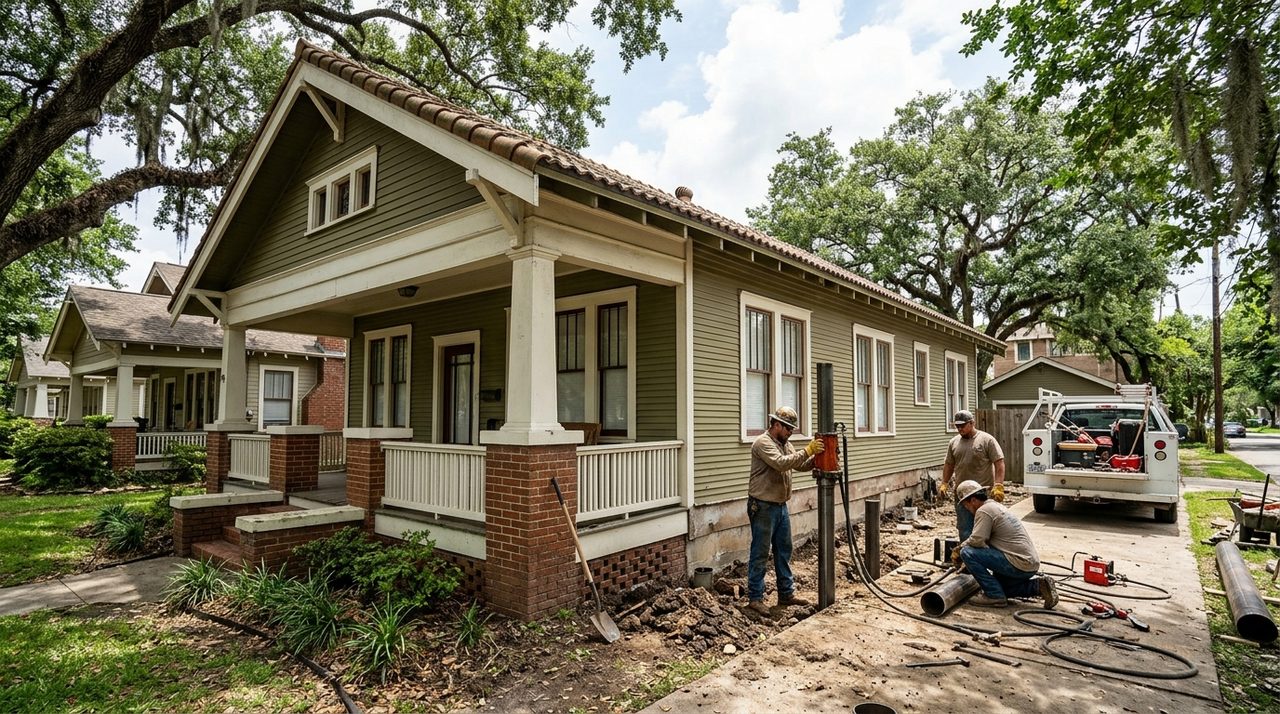
Montrose's original pre-war housing stock — Craftsman bungalows and cottages built in the 1920s through 1940s — sits on pier-and-beam foundations where wood posts bear directly on concrete or brick pad footings set into Houston Black clay. As that clay swells and shrinks through wet and dry cycles, individual posts shift at different rates, producing sloping floors, sticking doors, and cracked interior plaster that gets mistaken for cosmetic wear. Because each post can move independently, the pattern of damage often migrates seasonally rather than stabilizing, which homeowners sometimes address with repeated furniture shimming instead of diagnosis.
What a good pro does
A qualified contractor will perform a floor-level survey across multiple points, map which posts have dropped or rotated, and propose either steel adjustable pier replacement under the beam pockets or new concrete footings where the originals have crumbled. This scope requires a City of Houston structural repair permit through the Development Services Department; if any portion of the bungalow sits within a locally designated historic district, the contractor must obtain HAHC review before opening the crawl-space perimeter or altering visible foundation elements. Get three written proposals that specify pier count, depth, and footing dimensions — not just a lump-sum number.
Sources: City of Houston Permitting Center, Municipal permit office (see area profile)
Why it matters to you
Not every home in Montrose is pier-and-beam: 1970s–1980s apartment conversions and older ranch-style properties were built slab-on-grade with cast-iron drain lines running beneath the concrete. Winter Storm Uri (February 2021) cracked thousands of these lines across Houston's inner loop, and many Montrose properties received surface-level repairs — walls patched, floors re-tiled — while the under-slab pipe was left fractured. Slow, ongoing leaks from those lines saturate the clay directly beneath the slab, causing localized heave followed by settlement that looks identical to soil-driven movement but has a completely different fix.
What a good pro does
Before signing any foundation repair contract on a Montrose slab built before 1990, insist on a hydrostatic plumbing test (estimated $250–$400) performed or overseen by a plumber licensed by the Texas State Board of Plumbing Examiners. If the test reveals a leak, that pipe must be repaired first — underpinning over an active leak is money wasted. The City of Houston requires separate plumbing permits for any under-slab rerouting, distinct from the structural foundation permit.
Sources: Texas State Board of Plumbing Examiners, City of Houston Permitting Center, Municipal permit office (see area profile)
Why it matters to you
The wave of narrow-lot townhome construction in Montrose since the early 2000s produced slab-on-grade foundations on lots that were subdivided from older bungalow parcels, often stripping away the shade canopy and root systems that previously moderated soil moisture. Without mature trees or established landscaping, the Houston Black clay along these slab perimeters is highly exposed to the bake-and-crack cycle that La Niña drought years — including 2022–2023 — drive hard. When clay pulls away from the slab edge, it leaves a perimeter void; the next heavy rain rushes into that gap rather than soaking in gradually, eroding the beam seat and accelerating settlement.
What a good pro does
The most effective prevention is a timed soaker-hose system running along the foundation perimeter during extended dry periods, keeping the clay moisture content consistent. If voids have already formed, polyurethane foam injection (estimated $2,000–$5,000 for a moderate job) fills the gap without the weight penalty of traditional mudjacking and can be accessed from tight side-yard clearances common on Montrose townhome lots. Any underpinning work on these slabs requires a City of Houston foundation repair permit; contractors should also verify individual deed restrictions recorded at the Harris County Clerk's office, since some Montrose plats include setback rules that affect where equipment can be staged along the perimeter.
Sources: City of Houston Permitting Center, Local HOA / deed restrictions (see area profile)
Why it matters to you
Parts of Montrose fall within City of Houston locally designated historic districts, meaning exterior changes — including visible trenching around a foundation perimeter, removal of historic masonry piers, or alterations to a front porch slab — can trigger mandatory Houston Archaeological and Historical Commission design review before a permit is issued. Separately, Montrose has no single governing HOA, but individual plat covenants recorded at the Harris County Clerk's office vary dramatically from block to block and can impose restrictions on equipment access, exterior material changes, or construction hours that differ from neighboring properties on the same street. Homeowners who skip this research can face stop-work orders mid-project or resale disclosure problems if work was done without required approvals.
What a good pro does
Before scoping any exterior foundation repair in Montrose, the contractor should confirm parcel-level historic district status through the City of Houston Historic Preservation Office and pull the recorded deed restrictions at the Harris County Clerk's office — not rely on a neighbor's description of what is or isn't required. HAHC review adds weeks to the timeline for historic-district properties, so budget for that delay before scheduling a pier installation. Texas law requires sellers to disclose known foundation movement and completed repairs on the TREC disclosure form, making properly permitted and documented work a financial asset rather than a liability at resale.
Sources: Municipal permit office (see area profile), City of Houston Permitting Center, Local HOA / deed restrictions (see area profile)
Hiring foundation repair in Montrose? Montrose is one of Houston's most architecturally diverse inner-loop neighborhoods, with housing stock ranging from early-20th-century bungalows to modern townhomes and mid-rise condos. Homeowners and contractors must navigate a complex overlay of deed restrictions, possible historic district review, and varied foundation types that change block by block. The absence of a single mandatory HOA means individual plat covenants and city codes are the primary regulatory framework.
Building era
Mixed — ranging from 1920s–1940s original bungalows and cottages to 1970s–1980s apartment conversions and 2000s–present new-construction townhomes.
Typical style
Highly heterogeneous: Craftsman bungalows, mid-century ranch, Victorian-era homes, contemporary townhomes, and multi-family conversions coexist within the same blocks.
Foundations
Mixed — older homes are frequently pier-and-beam; newer townhomes and infill construction are typically slab-on-grade.
Common systems
Older pier-and-beam homes often have galvanized or cast-iron plumbing, outdated electrical panels, and window-unit or older central HVAC systems. Newer townhomes feature modern HVAC, PEX plumbing, and updated electrical. The wide era range means system conditions vary dramatically by property.
What that means for repairs
Renovation activity is extremely common due to the prevalence of aging bungalows on high-value lots. Whole-home gut renovations, kitchen and bath modernizations, and foundation leveling on pier-and-beam structures are frequent. New-construction townhome infill on subdivided lots is also a major activity driver.
Permit jurisdiction
City of Houston Permitting Center (Montrose is within Houston city limits).
HOA & deed restrictions
No single mandatory HOA governs all of Montrose. Specific sub-areas and condo regimes (e.g., Montrose Place Townhomes Owners Association, Montrose Place Homeowners Association) have mandatory membership. Deed restrictions are common and vary by plat — buyers and contractors should review recorded covenants at the Harris County Clerk's office.
Historic districts
Parts of Montrose fall within City of Houston locally designated historic districts, requiring HAHC design review and approval for exterior changes, demolitions, and new construction. Specific district names not confirmed in available research — check the City of Houston Historic Preservation Office for parcel-level status.
Contractor note
Contractors must verify whether a property sits within a locally designated historic district before beginning exterior work or demolition, as HAHC approval may be required. Additionally, individual deed restrictions may impose setback, height, or use limitations that differ from adjacent properties on the same street.
FEMA flood zone
FEMA Zone X (low flood risk) per official NFHL data. However, Montrose's proximity to Buffalo Bayou and various drainage channels means flood risk can vary sharply by block and lot elevation. Property-level flood zone verification is strongly recommended.
Hurricane Harvey impact
Neighborhood-wide Harvey flood impact could not be confirmed from available research. Montrose is an inner-loop area where flooding during Harvey varied significantly by block and proximity to bayous and drainage infrastructure. Homeowners should check individual property flood history through Harris County Flood Control District records and FEMA claim databases.
Heat & humidity load
Older pier-and-beam homes in Montrose are prone to moisture intrusion, subfloor mildew, and HVAC strain during Houston's extreme summer humidity. Aging galvanized plumbing in pre-war homes is susceptible to condensation-related corrosion. Modern townhomes with tight building envelopes benefit from efficient HVAC but may require dehumidification support.
Working with contractors here
Montrose's extreme housing diversity means contractors encounter everything from 1920s pier-and-beam bungalow foundation repair to cutting-edge townhome warranty work. Plumbing repiping is common in pre-war homes still running galvanized or cast-iron lines. Electrical panel upgrades are frequently needed in older homes not designed for modern load demands. Historic district properties require HAHC coordination, which can add weeks to project timelines for exterior work. Contractors should always pull deed restrictions before scoping additions or accessory structures, as setback and height limits vary from lot to lot even on the same block.
Local Tip
Always ask for a written estimate before work begins. Texas contractors are required to provide one on jobs over $1,000.
Montrose is one of Houston's most architecturally diverse inner-loop neighborhoods, with housing stock ranging from early-20th-century bungalows to modern townhomes and mid-rise condos. Homeowners and contractors must navigate a complex overlay of deed restrictions, possible historic district review, and varied foundation types that change block by block. The absence of a single mandatory HOA means individual plat covenants and city codes are the primary regulatory framework.
Source: U.S. Census Bureau, ACS 5-Year 2023
Most of Montrose maps to FEMA Zone X (low mapped flood risk), but Houston's flash-flood reality means even low-risk blocks benefit from smart drainage and storm-hardened installs.
Source: FEMA National Flood Hazard Layer (NFHL). Flood zones vary by parcel — verify your individual FIRM panel.
Wind-driven rain during a hurricane can saturate soil on the windward side of your home while the leeward side stays dry, creating differential moisture conditions beneath your slab that show up as sticking doors weeks later in Montrose. Schedule a Zip-Level elevation reading after any named storm passes so a foundation professional can distinguish normal seasonal movement from storm-induced settlement requiring pier work. In-city Montrose work falls under City of Houston floodplain and permitting rules.
Even with low mapped flood risk, Montrose is not immune to the localized sheet flow that accompanies a Houston severe thunderstorm, and repeated minor inundation at the foundation perimeter sustains the clay moisture that drives slow heave cycles. A pre-storm season inspection confirming that soil grade, splash blocks, and downspout extensions all direct water away from the slab is the most cost-effective foundation repair step you can take. In-city Montrose work falls under City of Houston floodplain and permitting rules.
Ice loading from roof accumulation during a hard freeze transfers compressive stress to your foundation corners, and in Montrose that added load on clay subgrade that has stiffened from cold can create corner settlement that persists after the thaw. A TDLR-licensed foundation contractor should inspect visible brick-to-foundation transitions and interior door frames after any multi-day freeze event, even if no pipe damage occurred. In-city Montrose work falls under City of Houston floodplain and permitting rules.
Sources: FEMA National Flood Hazard Layer (NFHL), Ready.gov -- Hurricanes, CenterPoint Energy -- Storm Center, City of Houston -- Emergency Preparedness, Ready.gov -- Winter Weather, Harris County Flood Control District
Houston-specific estimators to plan your project before you call a pro. All results are planning estimates — a licensed local pro confirms the details on site.
Grouped by mature root aggression & water demand.
Trunk center to the nearest exterior wall.
The root zone likely reaches your foundation's soil during Houston's dry summers, when clay shrinks most. Watch for sticking doors and diagonal cracks, keep soil moisture even with a soaker hose during drought, and have a foundation pro evaluate if you see any movement.
Find a Houston foundation pro →This is a planning estimate only — actual requirements depend on an on-site assessment by a licensed Houston pro. Guidance is based on general species root behavior in expansive clay, not a soil test.
Disconnect & drain every outdoor hose bib
Remove hoses, drain the spigots, and cover each with an insulated faucet sock. Un-drained hose bibs are the #1 burst point in a Houston freeze.
Insulate exposed pipes in the attic & garage
Wrap any pipe in an unconditioned space (attic runs, garage walls) with foam sleeves. Houston homes rarely insulate these because they only matter a few nights a year — which is exactly why they burst.
Open cabinet doors & keep a pencil-width drip
On hard-freeze nights, open kitchen/bath cabinets so warm air reaches the pipes and let faucets on exterior walls drip to relieve pressure.
Protect the attic/garage water heater & its lines
An attic or garage tank sits in unconditioned space. Insulate the cold-inlet and hot-outlet lines and confirm the emergency drain pan is clear so a leak doesn't reach the ceiling.
This is a planning estimate only — actual requirements depend on an on-site assessment by a licensed Houston pro. If a pipe has already burst, shut off your main water supply and call a licensed Houston plumber immediately — freeze bursts flood fast.
Sources: City of Houston Permitting Center
Sources: Municipal permit office (see area profile)
Sources: City of Houston Permitting CenterTexas State Board of Plumbing Examiners