21815 Katy Fwy Suite C121, Katy, TX 77450
Best Fence Builders in Cinco Ranch, TX
Cinco Ranch homeowners replacing or upgrading 20-to-30-year-old cedar fences face a three-layer compliance hurdle that catches many off guard: Fort Bend County permit requirements for the fence structure, plus mandatory pre-approval from either Cinco Ranch HOA I or Cinco Ranch Residential Association II before a single post goes in the ground — and the ACC review alone can take two to four weeks. Getting the sequence right, and choosing materials and installation methods that hold up in Fort Bend County's expansive clay soil and Gulf-coast wind corridor, is what separates a fence that lasts from one that leans, rots, or gets ordered removed at your expense.
Verified against Google Business data
Updated 2026
See the 10 Fence Builders Serving Cinco Ranch 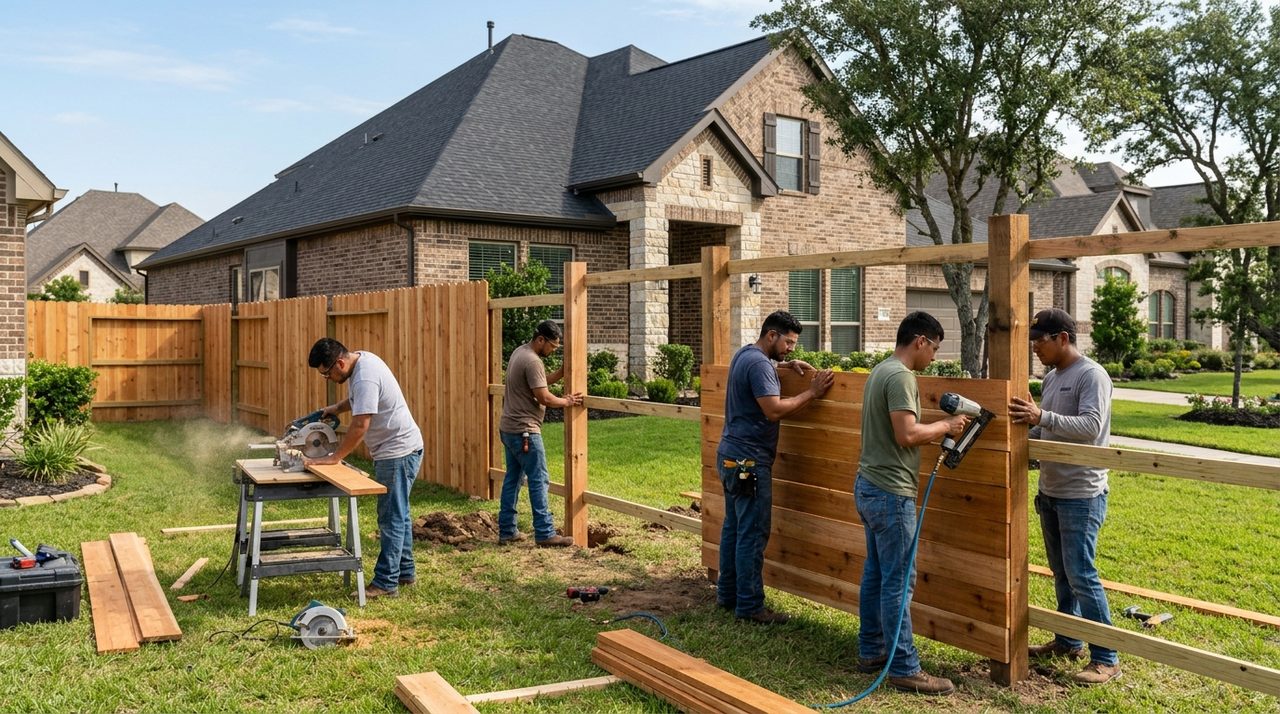
- Median home built
- 1997
- Median home value
- $459,500
- FEMA flood zone
- X (low)
- Typical cost (est.)
- $18–$30/lin. ft. cedar; $30–$55 ornamental iron
- Most common local issue
- HOA ACC approval required before any post is set
Ranked by verified Google rating × review volume × verification tier. How we rank →
Some highly-rated pros serve Cinco Ranch from nearby and may not keep a Cinco Ranch street address. Those are listed under "Also serving Cinco Ranch" with their real city and distance, so you always know where each business is based.
Min rating:
10 resultsBased in Cinco Ranch
Closed
302 Gentilly Dr, Katy, TX 77450
Closed
20501 Katy Fwy #100f, Katy, TX 77450
Closed
1706 Park Forest Dr, Katy, TX 77450
Closed
21455 Park Orchard Dr, Katy, TX 77450
21040 Highland Knolls Dr #200, Katy, TX 77450
418 William Morton Dr, Richmond, TX 77407
Also serving Cinco Ranch
Highly-rated pros based nearby who cover Cinco Ranch. Distance shown from the Cinco Ranch area.
Open Now
Serving Cinco Ranch Based in Katy · 0.9 mi away
Closed
Serving Cinco Ranch Based in Katy · 1.1 mi away
Closed
Serving Cinco Ranch Based in Katy · 1.8 mi away
Fence Builders in Cinco Ranch: What You Should Know
Dual HOA Approval Before Any Work Begins
Why it matters to you
Cinco Ranch is split between two sub-associations — HOA I east of Katy-Gaston Road and Residential Association II to the west — both operating under the master Cinco Residential Property Association. Deed restrictions legally dictate fence material (typically cedar, no street-facing chain-link), height, stain color, and board orientation. Homeowners who skip ACC pre-approval and start work risk a mandatory-removal order, with the rebuild cost coming entirely out of pocket.
What a good pro does
Before contacting any fence contractor, download the current Architectural Guidelines from your specific sub-association, confirm whether cedar board-on-board or a specific ornamental material is required for your section, and submit a complete ACC application — including a site plan, material spec sheet, and fence profile drawing. Only after written ACC approval in hand should you schedule a contractor; build that two-to-four-week review window into your project timeline from day one.
Sources: Local HOA / deed restrictions (see area profile)
Fort Bend County Permits for Fences Over Six Feet
Why it matters to you
Cinco Ranch sits in unincorporated Fort Bend County, so permitting runs through Fort Bend County Engineering and Development Services — not the City of Houston and not any incorporated municipal building department. Many homeowners (and out-of-area contractors) assume Houston-area fencing is a no-permit job, but county rules require permits for structures exceeding six feet, and uninspected work can result in stop-work orders or forced removal that voids any contractor warranty.
What a good pro does
Your fence contractor should pull the Fort Bend County permit before breaking ground and schedule the required inspection after installation is complete. Confirm the contractor lists a Fort Bend County address or is familiar with FBCEDS scheduling, since inspection timelines and fee structures differ from City of Houston processes. Keep your permit card on-site during installation — inspectors do make site visits in active Cinco Ranch subdivisions.
Sources: Municipal permit office (see area profile)
Fort Bend Clay Soil Causes Posts to Heave and Lean
Why it matters to you
The same Fort Bend County black-clay soils driving foundation repairs on Cinco Ranch's 1990s–2000s slab homes are equally brutal on fence posts. During dry Houston summers the clay shrinks; heavy fall or spring rain causes it to swell. Standard concrete collars poured at 18–24 inches depth can heave upward with the soil, leaving posts leaning within two to three years on lots that drain poorly — a common condition in Cinco Ranch's flatter western sections.
What a good pro does
Insist on posts set a minimum of 36 inches deep in Fort Bend clay, with a flared or belled concrete footing rather than a simple tube pour; the larger base resists upward displacement as the soil cycles. Mixing a gravel drainage layer beneath the footing further reduces moisture retention that triggers heave. Post replacement, if already needed, typically runs $150–$300 per post including concrete — catching lean early is far cheaper than waiting until rails and pickets fail as well.
Sources: International Residential Code (as adopted by City of Houston)
Wind-Load Risk from the West Houston Derecho Corridor
Why it matters to you
The May 2024 derecho tracked directly through the Katy–Sugar Land–Fort Bend corridor with gusts exceeding 100 mph in some pockets, and Hurricane Beryl in July 2024 added another round of straight-line wind damage. Cinco Ranch's broad, open streetscapes give privacy fences full wind exposure with few natural windbreaks; standard 6-foot board-on-board panels without wind-relief gaps or adequately embedded posts act as sails and fail in sections during these events, often taking out neighbor sections and triggering insurance disputes.
What a good pro does
Ask your contractor specifically about wind-relief design — either a spaced-picket pattern that allows airflow, or board-on-board with a deliberate gap between alternating boards — rather than a fully solid panel. Post embedment of at least one-third of total post length (24 inches minimum for a 6-foot fence, deeper on corner and gate posts) is the IRC baseline; a contractor experienced in post-Harvey and post-Beryl replacement work will typically go deeper on exposed Cinco Ranch lots. Full storm replacement for an average suburban lot in this area has run $3,000–$8,000 after recent events — wind-smart design upfront is the better investment.
Sources: Texas Windstorm Insurance Association (TWIA), International Residential Code (as adopted by City of Houston)
Fence Builders in Cinco Ranch: What You Should Know
Hiring fence builders in Cinco Ranch? Cinco Ranch is one of Houston's largest master-planned communities, featuring production-built suburban homes from the 1990s and 2000s now reaching the age where major system replacements become routine. Homeowners must navigate mandatory HOA architectural review alongside Fort Bend County permitting for exterior modifications, roofing, and additions. The predominantly slab-on-grade construction on Fort Bend County clay soils means foundation monitoring and drainage management are ongoing concerns.
- Housing era
- Primarily 1990s–2000s, with continued build-out into the early 2010s
- Foundation
- Likely predominantly slab-on-grade (consistent with 1990s–2000s Houston-area production building
- Flood zone
- FEMA Zone X (low flood risk) — source
- Permits
- Fort Bend County engineering and development services (unincorporated area — not City of Houston…
Housing stock & systems
Building era
Primarily 1990s–2000s, with continued build-out into the early 2010s.
Typical style
Conventional suburban traditional — brick and brick/stone two-story and single-story homes, with some Mediterranean/stucco accents.
Foundations
Likely predominantly slab-on-grade (consistent with 1990s–2000s Houston-area production building; not explicitly documented in sources reviewed).
Common systems
Central forced-air HVAC (typically 15–25 years old, many nearing or past replacement age), copper or CPVC supply plumbing, PVC drain lines, 200-amp electrical panels. Original HVAC units in 1990s-era sections are likely already replaced or due for replacement.
What that means for repairs
Kitchen and bathroom remodels are common as homes reach 20–30 years. HVAC replacements and roof replacements (composition shingle, 20-year cycle) are the most frequent major projects. All exterior modifications require HOA Architectural Control Committee approval before work begins.
Permits & restrictions
Permit jurisdiction
Fort Bend County engineering and development services (unincorporated area — not City of Houston or any incorporated municipality). MUD districts may also apply for certain infrastructure items.
HOA & deed restrictions
Mandatory dual HOA system: Cinco Ranch HOA I (east of Katy-Gaston Road) and Cinco Ranch Residential Association II, Inc. (west of Katy-Gaston Road), under the Cinco Residential Property Association master association. Deed restrictions and architectural guidelines are legally enforceable. ACC approval required for most exterior changes.
Historic districts
No City of Houston historic district designation confirmed. Cinco Ranch is in unincorporated Fort Bend County and is not subject to HAHC oversight.
Contractor note
Contractors must obtain Fort Bend County permits for structural, electrical, plumbing, and mechanical work, and homeowners must separately secure HOA ACC approval before exterior work begins. Failing to obtain ACC pre-approval can result in required removal of completed work at the homeowner's expense.
Flood & weather
FEMA flood zone
FEMA Zone X (low flood risk) — source: fema_nfhl. Cinco Ranch is largely outside FEMA special flood hazard areas. Some sections near Buffalo Bayou tributaries or detention basins may carry higher risk at the lot level; buyers should verify individual parcels with Fort Bend County floodplain data.
Hurricane Harvey impact
Cinco Ranch is characterized as mostly outside special flood hazard areas and is generally marketed as low flood risk. Broader Harvey-era media coverage referenced Katy-area and Barker Reservoir impacts, but sourced research did not identify specific Cinco Ranch streets or subsections with confirmed significant or recurring Harvey flooding. Lot-level flood history should be verified through Fort Bend County records and individual seller disclosures.
Heat & humidity load
Extreme summer heat drives heavy HVAC demand; aging 1990s-era systems in older sections are particularly vulnerable to compressor failure during sustained 95°F+ stretches. Slab foundations on expansive clay soils can shift during drought cycles, requiring foundation inspections and watering programs. Composition shingle roofs degrade faster under intense UV exposure, and 20-year replacements often come due at 15–18 years.
Working with contractors here
The most common contractor work in Cinco Ranch centers on aging-system replacements: HVAC changeouts, roof replacements, and water heater swaps for homes now 20–30 years old. Foundation repair and drainage improvement are steady demand drivers given the clay soil conditions and slab-on-grade construction. Kitchen and bathroom remodels are the leading interior renovation category as homeowners update original 1990s finishes. Contractors should factor HOA ACC review timelines into project schedules — exterior work proposals can take 2–4 weeks for approval, and non-compliant work may need to be undone. Permitting through Fort Bend County rather than the City of Houston means different inspection scheduling processes and fee structures than inner-loop Houston work.
Local Tip
Always ask for a written estimate before work begins. Texas contractors are required to provide one on jobs over $1,000.
About Cinco Ranch
Cinco Ranch is one of Houston's largest master-planned communities, featuring production-built suburban homes from the 1990s and 2000s now reaching the age where major system replacements become routine. Homeowners must navigate mandatory HOA architectural review alongside Fort Bend County permitting for exterior modifications, roofing, and additions. The predominantly slab-on-grade construction on Fort Bend County clay soils means foundation monitoring and drainage management are ongoing concerns.
- Median year built
- 1997
- Median home value
- $459,500
- Owner-occupied
- 72.5%
- Population
- 19,139
- Housing units
- 6,227
- Median income
- $157,395
Source: U.S. Census Bureau, ACS 5-Year 2023
Flood & storm risk
FEMA Zone XLow flood riskMost of Cinco Ranch maps to FEMA Zone X (low mapped flood risk), but Houston's flash-flood reality means even low-risk blocks benefit from smart drainage and storm-hardened installs.
Source: FEMA National Flood Hazard Layer (NFHL). Flood zones vary by parcel — verify your individual FIRM panel.
Frequently Asked Questions
Does Fort Bend County require a permit for a standard 6-foot cedar privacy fence in Cinco Ranch?
Fort Bend County's development services office handles permitting for unincorporated Cinco Ranch — this is not a City of Houston permit process and the rules differ. For fences at or under 6 feet, a permit is generally not required by the county, but you should confirm with Fort Bend County Engineering and Development Services directly because MUD district rules or deed restrictions can layer on additional requirements. Regardless of county thresholds, your HOA ACC approval is a separate, legally binding obligation that must be secured before any work starts.
Sources: Municipal permit office (see area profile)Local HOA / deed restrictions (see area profile)
My Cinco Ranch fence was installed in the late 1990s when the subdivision was first built — is that original era of installation a red flag for the posts?
Yes, a fence installed in 1995–2005 is now 20–30 years old and the original pressure-treated pine posts are almost certainly at or past their functional life in Fort Bend County's clay soil and Gulf humidity environment. Posts from that era were commonly set at 18–24 inch depths, which is shallow by today's recommendations for expansive clay, and repeated wet-dry shrink-swell cycles have had decades to work on the footings. Before replacing the fence boards only, have a fence contractor assess whether the posts themselves have rotted at the ground line or cracked concrete collars — replacing boards on failed posts is money wasted.
Which of the two Cinco Ranch HOAs do I deal with for fence approval, and how long does the process realistically take?
Your HOA depends on which side of Katy-Gaston Road your home sits: Cinco Ranch HOA I covers the east side, and Cinco Ranch Residential Association II, Inc. covers the west side, both under the Cinco Residential Property Association master association. ACC review for exterior changes like fences typically takes two to four weeks, so budget that lead time into your project schedule before signing a contractor contract — most fence builders in the area will not pull materials or set a start date until you can show written ACC approval. Submitting incomplete plans is the most common reason approvals drag past four weeks.
Sources: Local HOA / deed restrictions (see area profile)
Cinco Ranch is in FEMA Zone X — do I still have any flood-related restrictions on my fence design?
Being in Zone X means your parcel is outside the high-risk AE and floodway designations where HCFCD and floodplain administrators actively restrict solid fences as debris catchers, so you are not subject to those hard flood-zone fence prohibitions. That said, Fort Bend County's drainage easements — recorded on virtually every subdivision plat from the 1990s build-out era — frequently run along rear and side lot lines exactly where fence posts go, and a fence built over or into a drainage easement can trigger county enforcement regardless of flood zone status. Pull your recorded plat from Fort Bend County before finalizing the fence line.
Sources: FEMA National Flood Hazard Layer (NFHL)Harris County Flood Control District
What's a realistic cost estimate and timeline for replacing a full backyard cedar privacy fence on a typical Cinco Ranch lot?
For a standard 150-linear-foot backyard cedar board-on-board privacy fence in Cinco Ranch, installed cost estimates typically run $2,700–$4,500 based on Houston-metro rates of $18–$30 per linear foot — these are estimates and actual bids will vary by contractor and lumber pricing. Add $300–$900 per gate if you need a single or double drive gate. Timeline-wise, factor in two to four weeks for HOA ACC approval before work can start, then one to three days of actual installation once materials are staged; summer and early-fall demand after storm season tends to back up scheduling, so submitting ACC paperwork and getting contractor quotes simultaneously is the practical move.
Sources: Local HOA / deed restrictions (see area profile)
Does the Cinco Ranch HOA mandate specific fence materials or restrict chain-link facing the street?
The Cinco Ranch deed restrictions are typical of Houston-area master-planned communities from the 1990s in prohibiting chain-link fencing on street-facing sides and commonly mandating cedar wood or specific approved alternatives in terms of material and finish — but the exact current standards are controlled by your specific sub-association's architectural guidelines, which do get updated. Before ordering any materials, download the current ACC submittal requirements directly from your HOA management portal or contact the Cinco Ranch management office, because a contractor who last worked the neighborhood two years ago may be quoting materials that no longer meet the current approved list.
Sources: Local HOA / deed restrictions (see area profile)