Closed
18810 Tomato St, Spring, TX 77379
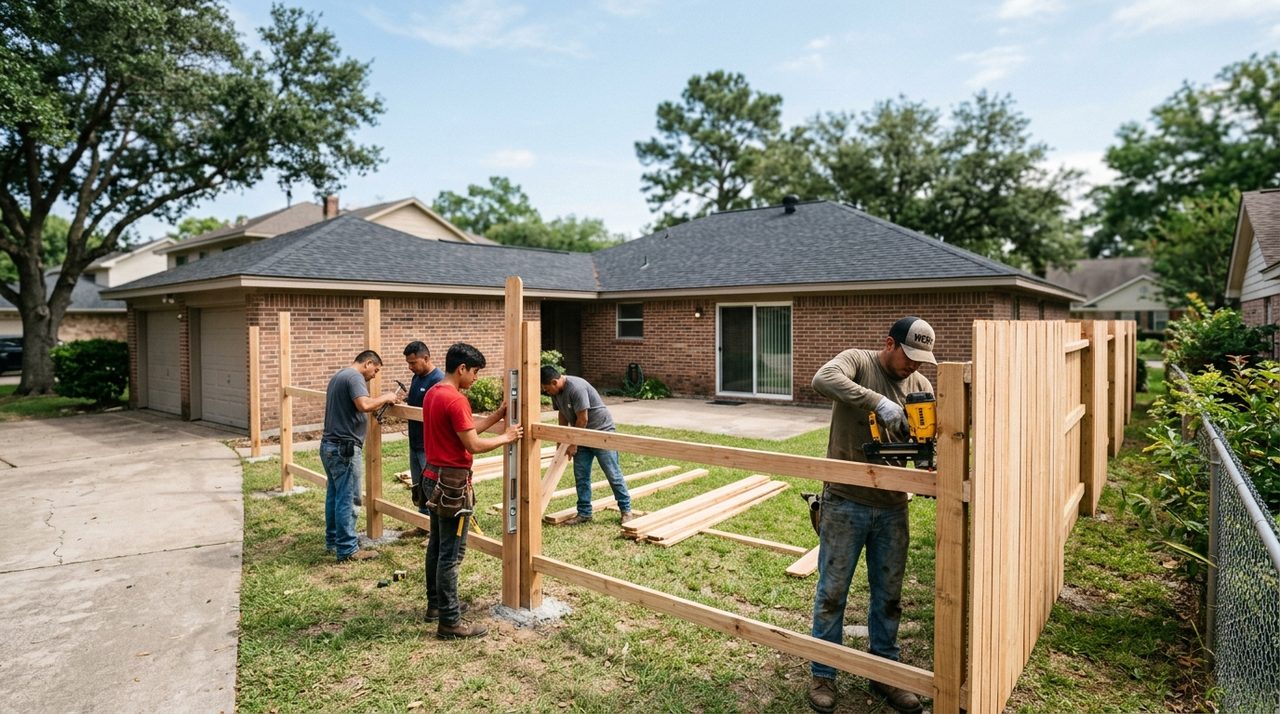
Champions Forest homeowners replacing or installing fences face a specific combination of pressures that most northwest Harris County neighborhoods share but that hit harder here: FEMA AE flood zone restrictions along the Cypress Creek corridor limit what solid fencing you can build on low-lying lots, mandatory Architectural Control Committee approval from multiple section HOAs adds weeks to your project timeline, and the native Houston Black clay that sits under these 1970s–80s slab-on-grade lots will eventually push a standard concrete-encased post off plumb. Understanding these three realities before you hire anyone will save you from fines, forced removals, and leaning fences within five years.
Ranked by verified Google rating × review volume × verification tier. How we rank →
Some highly-rated pros serve Champions Forest from nearby and may not keep a Champions Forest street address. Those are listed under "Also serving Champions Forest" with their real city and distance, so you always know where each business is based.
18810 Tomato St, Spring, TX 77379
20150 Kuykendahl Rd #300, Spring, TX 77379
12018 Louetta Rd, Houston, TX 77070
18102 Shadow Valley Dr, Spring, TX 77379
9528 Louetta Rd, Spring, TX 77379
6747 Theall Rd, Houston, TX 77066
Highly-rated pros based nearby who cover Champions Forest. Distance shown from the Champions Forest area.
Serving Champions Forest Based in Jersey Village · 2.4 mi away
Serving Champions Forest Based in Jersey Village · 2.8 mi away
Serving Champions Forest Based in Jersey Village · 4.4 mi away
Serving Champions Forest Based in Tomball · 5.3 mi away
Why it matters to you
Every section of Champions Forest — Sections 1–10 under Champion Forest Fund, Inc., plus Champion Forest Eleven, Twelve, and Villas HOAs — requires Architectural Control Committee sign-off before any fence installation or replacement. These aren't advisory suggestions: violations can result in mandatory removal at the homeowner's expense and ongoing fines. In practice, ACC review can take two to six weeks, and approval often specifies cedar material, maximum height (commonly 6 ft), board orientation, and whether the finished side must face outward toward the street or adjacent lots.
What a good pro does
A qualified fence contractor working in Champions Forest will ask you for your specific section number at the first meeting, pull the recorded deed restrictions for that section to confirm allowable materials and heights, and help you prepare the site plan and material spec sheet the ACC requires. They should build a minimum four-week ACC lead time into the project schedule and should not begin any site work — not even 811 locates — until written ACC approval is in hand, since starting without it is the most common reason homeowners here face forced-removal orders.
Sources: Local HOA / deed restrictions (see area profile)
Why it matters to you
Significant portions of Champions Forest sit in FEMA Zone AE, the high-risk flood designation tied to the Cypress Creek floodplain that caused widespread damage during Hurricane Harvey in 2017. Harris County Flood Control District actively enforces restrictions on solid fences — standard 6-ft board-on-board cedar panels — within floodways and floodplains because solid panels trap debris and raise upstream water levels during flood events, potentially worsening damage to neighboring properties. If your lot backs to a drainage easement, a detention pond, or any HCFCD-regulated channel, a solid privacy fence along that rear property line may be prohibited outright or require a floodplain development permit from Harris County.
What a good pro does
Before quoting materials, a knowledgeable contractor will verify your lot's FEMA flood zone panel and check for HCFCD drainage easements on your recorded plat — both are public records available through Harris County Appraisal District and HCFCD's floodplain map viewer. For lots in Zone AE, open-style alternatives like wrought iron or ornamental aluminum (estimated $30–$55 per linear foot installed) allow water and debris to pass through and are almost always approvable where solid wood is not. If any work falls within a floodplain, Harris County Engineering issues the floodplain development permit, separate from any structural permit.
Sources: FEMA National Flood Hazard Layer (NFHL), Harris County Flood Control District, Municipal permit office (see area profile)
Why it matters to you
The native Beaumont and Houston Black clay series underlying Champions Forest's 1970s–80s slab-on-grade lots shrinks dramatically during Harris County's hot, dry summers and then swells rapidly when fall rains arrive — a cycle that exerts enormous lateral and vertical pressure on concrete-encased fence posts. Fence contractors who use standard 24-inch-deep footings in small Sakrete tubes routinely see posts heave or lean within three to five years in this area, particularly along fence runs with poor surface drainage where standing water accelerates the clay's moisture swing. Many of the original cedar fences installed when these homes were built in the late 1970s and 1980s have been replaced at least once for exactly this reason.
What a good pro does
An experienced installer working on Champions Forest clay soil will set posts in deeper, larger-diameter concrete footings — typically 36 inches deep and at least 10 inches in diameter — and will taper the top of the concrete dome above grade so water sheds away from the post rather than pooling. For corner and gate posts that take the most lateral load, some contractors use drive-in helical post anchors that grip below the active clay layer rather than relying on concrete alone. Expect post-and-footing replacement on an aging fence to run $150–$300 per post as an estimated cost; asking a bidder how they address clay movement is a quick way to screen for local experience.
Sources: International Residential Code (as adopted by City of Houston)
Why it matters to you
Champions Forest is in unincorporated Harris County within the Klein area, which means the City of Houston's building department has no jurisdiction here. Homeowners who search 'Houston fence permit' and assume COH rules apply can end up misinformed about height thresholds, setback requirements, and inspection procedures. Harris County Engineering handles structural permits for this area, and its requirements differ from City of Houston's in ways that matter: height limits, allowable setbacks from property lines, and the inspection scheduling process all follow Harris County's own standards rather than COH code.
What a good pro does
Your contractor should pull any required permits through Harris County Engineering, not the City of Houston permit office, and should provide you with the permit number before work begins so you can verify it independently. Note that ACC approval from your HOA section and the Harris County permit are two entirely separate processes that run on different timelines — ACC approval does not substitute for a county permit, and a county permit does not satisfy ACC requirements. Contractors who conflate the two or skip one are a red flag in this neighborhood.
Sources: Municipal permit office (see area profile), Local HOA / deed restrictions (see area profile)
Hiring fence builders in Champions Forest? Champions Forest is a large, multi-section subdivision in the Klein ISD area of northwest Harris County, built primarily from the mid-1970s through the late 1980s. Homeowners here deal with aging slab-on-grade foundations, original-era HVAC and plumbing systems that are reaching or past their expected lifespan, and FEMA AE flood zone designations that affect insurance requirements and exterior renovation planning. Multiple mandatory HOAs with architectural control committees govern exterior modifications, so contractors must factor in ACC approval timelines.
Building era
Primarily mid-1970s through late 1980s, with some later sections extending into the early 1990s.
Typical style
Traditional brick two-story homes with Colonial and Georgian influences; some single-story ranch-style homes and occasional Tudor and French traditional elevations.
Foundations
Slab-on-grade (regional inference for 1970s–1980s production homes in NW Harris County; confirm via HCAD or individual inspection).
Common systems
Original homes likely have R-22 refrigerant HVAC systems nearing or past replacement age, copper or galvanized steel supply plumbing transitioning to PEX in renovated homes, and 100–200 amp electrical panels that may need upgrading for modern loads.
What that means for repairs
Kitchen and bathroom remodels are common as homes from this era are updated to modern standards. HVAC full-system replacements are frequent due to age. Foundation repair and re-leveling are periodic needs given expansive clay soils and slab-on-grade construction. Post-Harvey flood damage repairs drove significant interior renovation activity in affected sections.
Permit jurisdiction
Harris County Engineering (unincorporated Harris County, Klein area — not within City of Houston limits).
HOA & deed restrictions
Mandatory property owners associations govern all sections. Sections 1–10 are governed by Champion Forest Fund, Inc. (Champion Forest HOA). Additional mandatory HOAs include Champion Forest Eleven HOA (161 lots), Champion Forest Twelve Homeowners Association Inc., and Champion Forest Villas HOA. All require Architectural Control Committee (ACC) approval for exterior modifications.
Historic districts
No City of Houston historic district designation confirmed.
Contractor note
Contractors must obtain Harris County permits for structural, mechanical, and electrical work and should coordinate ACC approval from the applicable section's HOA before beginning any exterior modifications. Work in the FEMA AE flood zone may require elevation certificates and floodplain development permits.
FEMA flood zone
FEMA Zone AE (high flood risk) — source: fema_nfhl. Champions Forest is situated in northwest Harris County near Cypress Creek, a major drainage corridor that has historically been associated with significant flooding events.
Hurricane Harvey impact
No official neighborhood-wide flood impact summary was found in available HOA or public records. Areas near Cypress Creek in northwest Harris County experienced significant Harvey flooding and subsequent buyout activity, but specific street-level impact within Champions Forest is not clearly documented in available sources. Homeowners should check Harris County Flood Control District records and individual property flood history for confirmation.
Heat & humidity load
Homes from the 1970s–80s with original insulation and single-pane windows face high cooling costs during Houston summers. Aging HVAC systems are under maximum stress from May through September, making this the peak period for emergency AC repair calls. Humidity management is critical to prevent mold in homes that experienced prior flooding or have insufficient attic ventilation.
Working with contractors here
Contractors working in Champions Forest most commonly handle HVAC replacements, foundation leveling, and plumbing re-pipes — all driven by the 40–50-year age of the housing stock. Kitchen and bath remodels are a strong secondary market as homeowners modernize dated interiors. Flood mitigation work, including elevated electrical panels, moisture barriers, and drainage improvements, is relevant given the AE flood zone designation. All exterior work requires ACC approval from the applicable section's HOA (Champion Forest Fund for Sections 1–10, or the respective section HOA), so contractors should build approval lead time into project schedules. Harris County permitting applies rather than City of Houston permits, which affects inspection scheduling and code requirements.
Local Tip
Always ask for a written estimate before work begins. Texas contractors are required to provide one on jobs over $1,000.
Champions Forest is a large, multi-section subdivision in the Klein ISD area of northwest Harris County, built primarily from the mid-1970s through the late 1980s. Homeowners here deal with aging slab-on-grade foundations, original-era HVAC and plumbing systems that are reaching or past their expected lifespan, and FEMA AE flood zone designations that affect insurance requirements and exterior renovation planning. Multiple mandatory HOAs with architectural control committees govern exterior modifications, so contractors must factor in ACC approval timelines.
Source: U.S. Census Bureau, ACS 5-Year 2023
Much of Champions Forest maps to FEMA Zone AE (high flood risk), so flood-resilient detailing -- elevated equipment, water-tolerant materials, and drainage-first thinking -- is essential here, not optional.
Source: FEMA National Flood Hazard Layer (NFHL). Flood zones vary by parcel — verify your individual FIRM panel.
Sources: Municipal permit office (see area profile)FEMA National Flood Hazard Layer (NFHL)
Sources: Harris County Flood Control District
Sources: Local HOA / deed restrictions (see area profile)
Sources: FEMA National Flood Hazard Layer (NFHL)Harris County Flood Control District