Closed
10218 Bassoon Dr, Houston, TX 77025
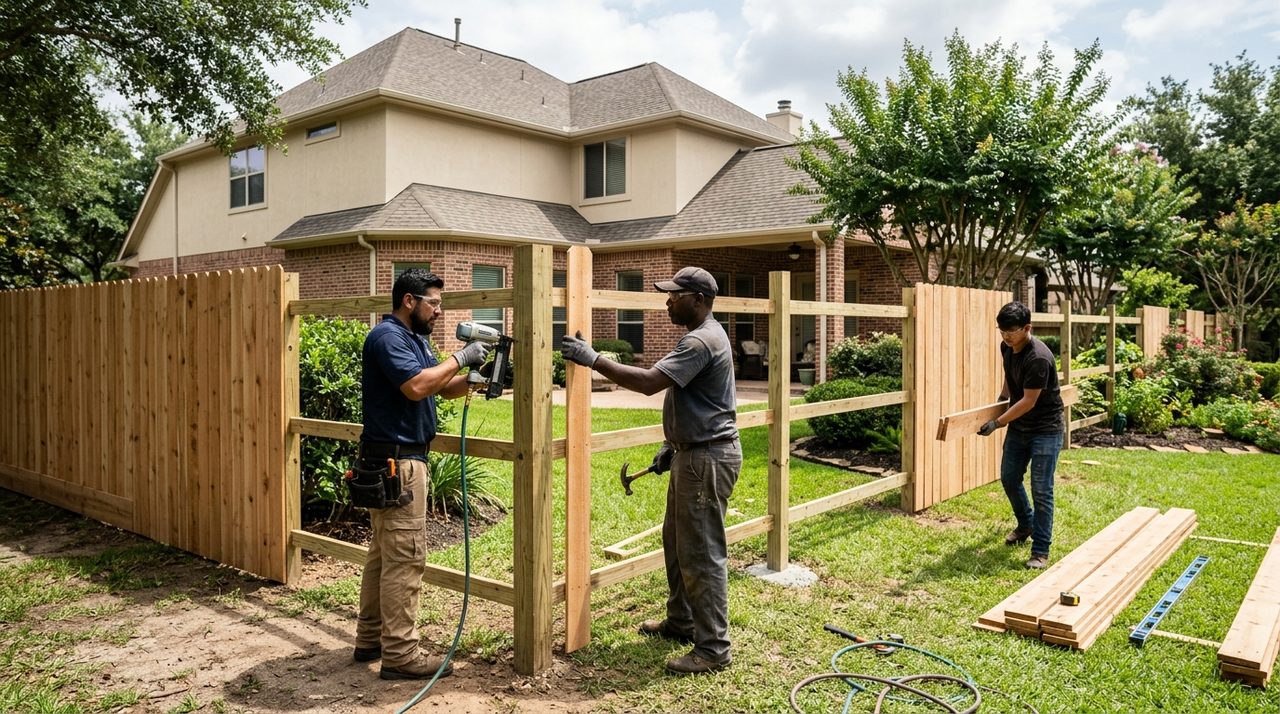
Braeswood sits directly along Brays Bayou in FEMA Zone AE, which means a fence here isn't just a property boundary — it's a potential flood-damage multiplier if sized or positioned incorrectly. Between HCFCD drainage easements recorded on most plats, the section-by-section HOA patchwork overseen by BPHA and smaller associations, and City of Houston permit requirements, putting up even a basic cedar privacy fence in Braeswood requires more upfront homework than nearly anywhere else in southwest Houston.
Ranked by verified Google rating × review volume × verification tier. How we rank →
Some highly-rated pros serve Braeswood from nearby and may not keep a Braeswood street address. Those are listed under "Also serving Braeswood" with their real city and distance, so you always know where each business is based.
10218 Bassoon Dr, Houston, TX 77025
Highly-rated pros based nearby who cover Braeswood. Distance shown from the Braeswood area.
Serving Braeswood Based in Medical Center · 1.2 mi away
Serving Braeswood Based in Bellaire · 2.4 mi away
Serving Braeswood Based in Meyerland · 2.9 mi away
Serving Braeswood Based in Bellaire · 3 mi away
Serving Braeswood Based in Bellaire · 3.2 mi away
Serving Braeswood Based in Bellaire · 3.2 mi away
Serving Braeswood Based in Sharpstown · 3.4 mi away
Serving Braeswood Based in Westbury · 4.2 mi away
Serving Braeswood Based in Meyerland · 4.3 mi away
Why it matters to you
Because much of Braeswood maps to FEMA Zone AE — with risk rising sharply on lots nearest Brays Bayou — a standard 6-ft board-on-board cedar privacy fence can function as a debris dam during overflows, raising water levels against your home and neighboring properties. HCFCD actively enforces restrictions on solid fences within floodways and floodplain easements post-Harvey, and a fence installed without floodplain administrator review can trigger forced removal at the homeowner's expense.
What a good pro does
A fence builder working in Braeswood should pull your parcel's flood map and HCFCD drainage easement records before quoting any material. In AE-mapped backyards adjacent to the bayou, open-profile designs — spaced-picket wood, wrought-iron, or ornamental aluminum — are the correct choice because they allow floodwaters and debris to pass through rather than impound. The City of Houston Permitting Center's floodplain development desk reviews fence permits on AE lots, so the permit application itself is the mechanism to confirm compliant design.
Sources: FEMA National Flood Hazard Layer (NFHL), Harris County Flood Control District, City of Houston Permitting Center
Why it matters to you
Braeswood's original ranch-era lots sit on Houston Black clay that has been repeatedly saturated and dried out through decades of Brays Bayou flooding events, including Harvey 2017 and Beryl 2024. This boom-and-bust moisture cycle causes fence posts set in standard 18–24-inch concrete collars to heave and lean within a few seasons — a problem the neighborhood's many remaining original 1950s–1960s homes face on lots where the clay has been especially worked by repeated inundation.
What a good pro does
A knowledgeable installer in Braeswood should set posts in concrete footings drilled to at least 36 inches and use a post-and-foam or post-only method (without a solid concrete collar at the surface) on parcels where standing water is common after rain, so hydrostatic pressure has somewhere to relieve rather than cracking the footing. For wood posts specifically, pressure-treated pine rated for ground contact (UC4B minimum) is the baseline; cedar posts at grade are not adequate for Braeswood's saturation conditions. Post replacement alone runs $150–$300 per post including concrete — budgeting for proper depth upfront avoids that cost within two to three years.
Sources: Harris County Flood Control District, International Residential Code (as adopted by City of Houston)
Why it matters to you
Unlike master-planned suburbs with a single set of deed restrictions, Braeswood is governed by a patchwork of associations — Braeswood Place Homeowners Association (BPHA) with its section-by-section reconstitution effort, the Seventy-Six Fifty-Five South Braeswood HOA, individual plat restrictions, and condominium HOAs on infill lots. A cedar fence that is fully compliant on one block may violate material, height, or street-facing finish rules two lots away. The ~54.9% owner-occupancy rate means rental and investor-owned properties sometimes skip HOA review, leading to forced-removal orders that fall on the next owner.
What a good pro does
Before any deposit is paid, request a copy of the deed restrictions recorded for your specific lot (available through Harris County Clerk's real property records) and submit for architectural review from whichever association governs your section. A fence builder familiar with Braeswood should ask for this documentation as a standard project prerequisite, not an afterthought. HOA approval is legally separate from the City of Houston building permit — you need both if your fence exceeds six feet or falls within a restricted section.
Sources: Local HOA / deed restrictions (see area profile), City of Houston Permitting Center
Why it matters to you
Houston's year-round humidity already shortens the lifespan of untreated or under-treated wood fencing, but Braeswood's repeatedly flooded lots compound the problem dramatically. Original ranch-era homes on blocks closest to Brays Bayou frequently have grade levels only inches above street elevation, meaning post bases sit in intermittently damp or waterlogged soil for weeks after heavy rain — conditions where standard pine fence posts can show significant rot within three to four years rather than the seven to ten years typical in drier parts of the metro.
What a good pro does
On Braeswood lots with documented flood history or low-lying grades, the most cost-effective long-term fence is ornamental aluminum or powder-coated steel, which eliminates wood-rot risk entirely and still satisfies most open-profile floodplain requirements. If cedar or treated pine is specified for aesthetic or HOA reasons, posts should use a steel-sleeve surface-mount system anchored into concrete rather than buried wood, keeping organic material entirely above grade. Estimated installed cost for ornamental aluminum in the Houston metro runs $30–$55 per linear foot — a premium over cedar's $18–$30, but often recovered in avoided replacement costs within a single decade on a flood-zone lot.
Sources: FEMA National Flood Hazard Layer (NFHL), Harris County Flood Control District
Hiring fence builders in Braeswood? Braeswood straddles Brays Bayou in southwest Houston, placing flood mitigation at the center of virtually every home service decision. The neighborhood's mix of original 1950s–1960s ranch homes and post-flood teardown rebuilds means contractors encounter widely varying foundation types, electrical panels, and plumbing systems on a single block. Multiple mandatory HOAs and recorded deed restrictions add a layer of compliance review before exterior modifications.
Building era
1950s–1960s original construction with significant teardown/infill waves in the late 1990s–2010s, accelerating after repeated flood events.
Typical style
Original one-story ranch and mid-century traditional homes alongside newer two-story traditional, transitional, and soft Mediterranean custom infill.
Foundations
Mixed — older homes include both pier-and-beam and slab-on-grade; virtually all post-1990s infill and rebuilds are slab-on-grade (not explicitly documented for this neighborhood; based on typical Houston-area patterns).
Common systems
Original homes may have galvanized or cast-iron drain lines, R-22 HVAC systems, and Federal Pacific or Zinsco electrical panels. Rebuilt homes typically feature PEX or copper plumbing, modern high-SEER HVAC, and 200-amp panels. Mixed vintage makes system audits essential.
What that means for repairs
Post-flood teardown-and-rebuild is the dominant renovation activity, often involving full elevation of new structures. Remaining original ranch homes frequently undergo foundation repair, re-plumbing with PEX, HVAC replacement, and flood-damage remediation including mold abatement and drywall replacement.
Permit jurisdiction
City of Houston — Houston Permitting Center.
HOA & deed restrictions
Braeswood Place Homeowners Association (BPHA) operates as a mandatory-membership POA for certain sections of Braeswood Place, with a section-by-section reconstitution effort underway. Additional smaller mandatory HOAs exist (e.g., Seventy-Six Fifty-Five South Braeswood HOA). The broader Braeswood corridor is a patchwork of multiple associations, condo/townhome HOAs, and some individually restricted plats with no single umbrella organization.
Historic districts
No City of Houston historic district designation confirmed.
Contractor note
Contractors must verify which HOA or POA governs a specific lot before exterior work, as deed restrictions vary section by section. Elevation and flood-proofing projects may trigger additional City of Houston floodplain development permits and FEMA Substantial Improvement/Substantial Damage reviews.
FEMA flood zone
FEMA Zone AE (high flood risk) — source: fema_nfhl. The neighborhood is situated along Brays Bayou, one of Houston's most flood-prone waterways, with direct exposure to bayou overflow during major rain events.
Hurricane Harvey impact
Braeswood and the adjacent Braeswood Place area along Brays Bayou were among the hardest-hit neighborhoods during Hurricane Harvey (2017), consistent with severe flooding also experienced during the Memorial Day 2015 and Tax Day 2016 flood events. Widespread home inundation triggered a major wave of teardowns, elevations, and full rebuilds throughout the corridor. Specific block-level inundation depths were not confirmed in available research but are well-documented in FEMA and Harris County Flood Control District records.
Heat & humidity load
High heat and humidity stress aging HVAC systems in original 1950s–1960s homes, many of which still run undersized or outdated units. Mold recurrence is a persistent concern in previously flooded structures, particularly in pier-and-beam crawl spaces and behind repaired drywall. Summer storms can re-saturate soils near the bayou, exacerbating foundation movement on clay soils.
Working with contractors here
Flood remediation and prevention dominate the contractor workload in Braeswood — from mold abatement and drywall replacement in previously inundated homes to full structural elevation of new builds. Foundation repair is common on original 1950s–1960s slab and pier-and-beam homes settling on expansive clay soils worsened by repeated saturation cycles. Re-plumbing from galvanized or cast-iron to PEX and upgrading electrical panels from original 100-amp service are frequent companion scopes on older homes. Contractors should scope every project with flood history in mind: verify whether a property has triggered FEMA Substantial Improvement thresholds, which can mandate elevation or floodproofing for any renovation exceeding 50% of the structure's market value. The section-by-section HOA and deed restriction landscape means exterior modification approvals — fencing, roofing material, paint colors — require lot-specific verification before work begins.
Local Tip
Always ask for a written estimate before work begins. Texas contractors are required to provide one on jobs over $1,000.
Braeswood straddles Brays Bayou in southwest Houston, placing flood mitigation at the center of virtually every home service decision. The neighborhood's mix of original 1950s–1960s ranch homes and post-flood teardown rebuilds means contractors encounter widely varying foundation types, electrical panels, and plumbing systems on a single block. Multiple mandatory HOAs and recorded deed restrictions add a layer of compliance review before exterior modifications.
Source: U.S. Census Bureau, ACS 5-Year 2023
Much of Braeswood maps to FEMA Zone AE (high flood risk), so flood-resilient detailing -- elevated equipment, water-tolerant materials, and drainage-first thinking -- is essential here, not optional; risk climbs sharply on blocks nearest Brays Bayou, where it varies parcel to parcel.
Source: FEMA National Flood Hazard Layer (NFHL). Flood zones vary by parcel — verify your individual FIRM panel.
Sources: City of Houston Permitting CenterFEMA National Flood Hazard Layer (NFHL)
Sources: Harris County Flood Control District
Sources: Local HOA / deed restrictions (see area profile)
Sources: FEMA National Flood Hazard Layer (NFHL)Harris County Flood Control District