Open Now
13225 FM 529, Houston, TX 77041
Jersey Village's 1960s–1980s slab-on-grade homes sit squarely in FEMA Zone AE along White Oak Bayou tributaries, meaning carpet here has likely seen flood water — and the pre-treatment and post-cleaning protocols that matter are driven by contamination risk, not just surface soil. With a housing stock that averaged construction around 1991 per Census data and thinner original vapor barriers common in that era, slab moisture migration adds a second, invisible layer of challenge that most budget cleaning quotes never address.
Ranked by verified Google rating × review volume × verification tier. How we rank →
Some highly-rated pros serve Jersey Village from nearby and may not keep a Jersey Village street address. Those are listed under "Also serving Jersey Village" with their real city and distance, so you always know where each business is based.
13225 FM 529, Houston, TX 77041
9130 Meadow Vista Blvd, Houston, TX 77064
6529 Cunningham Rd Suite 2205, Houston, TX 77041
6830 N Eldridge Pkwy #208, Houston, TX 77041
11500 FM 1960 W Suite #106, Houston, TX 77065
5710 Brittmoore Rd, Houston, TX 77041
Highly-rated pros based nearby who cover Jersey Village. Distance shown from the Jersey Village area.
Serving Jersey Village Based in NW Houston · 0.4 mi away
Serving Jersey Village Based in NW Houston · 1.3 mi away
Serving Jersey Village Based in NW Houston · 4.3 mi away
Serving Jersey Village Based in NW Houston · 4.6 mi away
Why it matters to you
Most of Jersey Village falls within FEMA Zone AE, the highest mapped flood-risk designation, and White Oak Bayou has pushed Category 2 and Category 3 water into hundreds of ranch-style brick homes here during Harvey (2017) and again during Beryl (2024). Carpet and pad saturated by gray or black water harbor bacterial and mold contamination that hot-water extraction alone cannot eliminate — yet homeowners under financial pressure after a flood frequently request cleaning rather than the removal and replacement that IICRC S500 protocols require for Category 2 and 3 events.
What a good pro does
A qualified technician should use a probe moisture meter on the pad before quoting any cleaning job in Jersey Village and should document water classification under IICRC S500 standards. If the pad tested positive for Category 2 or 3 exposure, honest practice means advising removal rather than cleaning — and any antimicrobial treatment that is performed should be documented with IICRC Water Damage Restoration Technician certification, since insurers handling post-flood claims in Harris County routinely require that paperwork. Post-flood assessment and IICRC-compliant documentation typically add $75–$200 to the base cleaning quote (estimate).
Sources: IICRC (water/mold restoration standards), FEMA National Flood Hazard Layer (NFHL), Harris County Flood Control District
Why it matters to you
Virtually every home in Jersey Village rests on a concrete slab over Houston-series Beaumont clay — expansive soil that heaves seasonally and keeps the slab itself damp through much of the year. Homes built in the 1960s through early 1980s were constructed with thinner or degraded vapor barriers that no longer reliably block concrete moisture vapor transmission, which can exceed 3 lbs per 1,000 sq ft per 24 hours. This moisture saturates carpet pad from below, and a technician who skips pad-moisture testing will leave what appears to be a clean, damp carpet that re-releases a musty odor within 48 hours — particularly during Jersey Village's oppressively humid Gulf summers.
What a good pro does
Ask any carpet cleaning company you hire in Jersey Village whether they carry a pin-type or capacitance probe meter for testing pad and subfloor moisture before and after extraction. A thorough technician will set up air movers and, if possible, run the home's AC on its driest setting to pull humidity down during drying — Houston's ambient RH of 75–90 percent in summer means passive drying alone rarely gets carpet dry fast enough to prevent wicking. If probe readings remain elevated post-cleaning, the honest recommendation is pad replacement rather than a second cleaning pass.
Why it matters to you
Winter Storm Uri (February 2021) ruptured pipes in an enormous share of Jersey Village's aging galvanized and copper plumbing — the same plumbing systems that are already flagged as candidates for replacement in homes of this era. Many homeowners had emergency water extraction performed in the chaos of contractor backlogs but never completed professional carpet cleaning and pad replacement because labor and materials were scarce for months afterward. That means a meaningful share of the city's occupied homes still have carpet carrying embedded calcium scale from hard-water intrusion, drywall dust from storm repairs, and microbial residue that re-activates as allergens and odors every humid summer.
What a good pro does
If you moved into a Jersey Village home after 2021 or skipped professional remediation after Uri, have the technician perform a pre-inspection that includes both UV light scanning for organic contamination and a sub-pad moisture probe test before quoting. Enzyme pretreatment plus an antimicrobial rinse is the appropriate protocol for Uri-residue carpet, not a standard single-pass hot-water extraction. Whole-house jobs in Jersey Village's 1,800–2,500 sq ft ranch and two-story homes with enzyme treatment and deodorizer typically run $300–$550 (estimate), and that investment is more justified here than in newer builds that replaced all flooring post-storm.
Sources: IICRC (water/mold restoration standards), Harris County Flood Control District
Why it matters to you
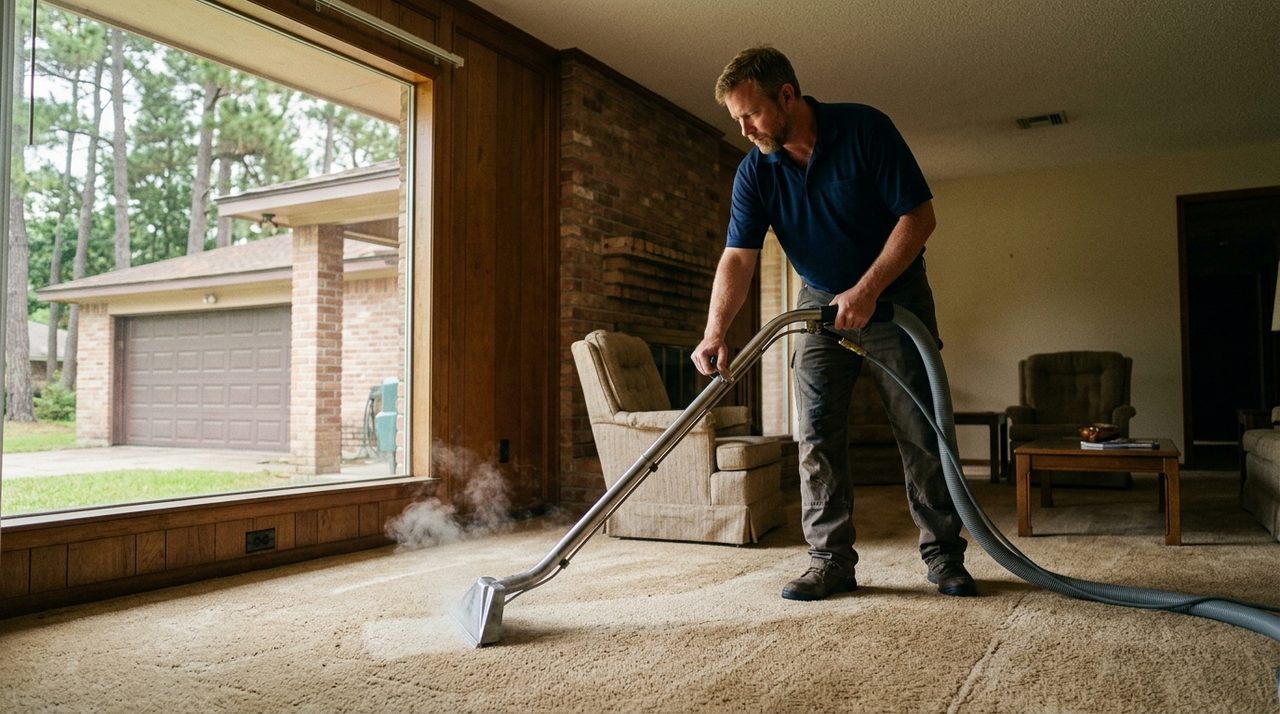
Jersey Village sits on Houston-series Beaumont clay — a dark, iron-rich soil that bonds aggressively to synthetic carpet fibers under the repeated wet-dry cycles that northwest Harris County sees after storms. The neighborhood's ranch-style homes typically have direct garage-to-living entries and no mudroom buffer, meaning clay-laden shoes deposit reddish-gray soil straight onto carpet in hallways and family rooms. After multiple Houston storm seasons, that clay has been ground below fiber tips into the backing and will not release under a standard single-pass hot-water extraction.
What a good pro does
A properly scoped cleaning job for a Jersey Village home with visible clay tracking requires a high-alkalinity pre-spray applied with adequate dwell time, followed by mechanical agitation with a counter-rotating brush tool before hot-water extraction begins — not a spray-and-extract shortcut. Fiber type matters too: the older nylon and polyester carpet common in 1970s–1980s production homes in this neighborhood responds well to alkaline pre-sprays, but the technician should confirm fiber type before selecting chemistry. Standard hot-water extraction alone on heavy clay tracking in these homes will resurface the same gray shadow within a week.
Hiring carpet cleaning in Jersey Village? Jersey Village is an independent municipality with a housing stock predominantly built between the 1960s and 1980s, featuring ranch-style and traditional brick homes on concrete slab foundations. Homeowners face significant flood risk due to proximity to White Oak Bayou and tributaries, making drainage, foundation maintenance, and flood mitigation among the most critical home service needs. The city handles its own code enforcement and permitting, so contractors must work through the City of Jersey Village rather than Houston or Harris County offices.
Building era
1960s–1980s, with some later infill construction.
Typical style
Ranch-style and traditional two-story brick homes with attached garages; suburban production architecture typical of northwest Houston.
Foundations
Slab-on-grade (dominant); pier-and-beam may exist on rare older or custom structures but is not documented.
Common systems
Original homes likely have copper or galvanized steel plumbing (transitioning to CPVC/PEX in later builds), R-22 refrigerant HVAC systems nearing or past end of life, and 100–200 amp electrical panels. Many systems in this era are candidates for full replacement.
What that means for repairs
Kitchen and bathroom remodels are common as homeowners update 40–60-year-old finishes. Re-piping from galvanized to PEX, HVAC upgrades to modern refrigerant systems, and flood-related restoration work (raised electrical panels, moisture-resistant materials) are frequent renovation drivers.
Permit jurisdiction
City of Jersey Village Permitting (independent municipality – permits are not issued through Houston Permitting Center or Harris County).
HOA & deed restrictions
No mandatory city-wide HOA for core Jersey Village neighborhoods; property standards are enforced through city code enforcement and deed restrictions. The Park at Jersey Village HOA exists but appears to be a separate, newer subdivision not located in the traditional Jersey Village city limits. Specific section-level deed restrictions may exist but were not confirmed in public records.
Historic districts
No City of Houston historic district designation confirmed. Jersey Village is an independent city and not subject to HAHC review.
Contractor note
Contractors must obtain permits through the City of Jersey Village, which has its own building codes, inspections, and zoning requirements separate from both Houston and Harris County. Familiarity with the city's specific permit process and code enforcement standards is essential.
FEMA flood zone
FEMA Zone AE (high flood risk) — source: fema_nfhl. Jersey Village is situated near White Oak Bayou and associated tributaries, placing much of the community in a designated high-risk floodplain with base flood elevations established.
Hurricane Harvey impact
Jersey Village is in a bayou-adjacent northwest Harris County area that experienced flooding during Hurricane Harvey, though a precise street-by-street damage assessment specific to the City of Jersey Village was not confirmed in available public records. The White Oak Bayou corridor and tributaries in this area flooded significantly. Homeowners should check HCFCD flood layers, FEMA FIRM maps, and property-level flood loss history (CLUE reports) for individual address risk.
Heat & humidity load
Houston's extreme summer heat and humidity place heavy demand on aging HVAC systems common in 1960s–80s homes, often triggering emergency repairs or full system replacements. Slab foundations in clay-heavy soils can shift with summer drought cycles, and prolonged moisture from summer storms combined with Zone AE flood risk can lead to mold, moisture intrusion, and recurring drainage issues.
Working with contractors here
Contractors in Jersey Village most commonly work on HVAC replacement, re-piping, foundation repair, and flood damage restoration driven by the aging 1960s–80s housing stock and high flood risk. Slab foundation repair is a frequent need as expansive clay soils shift seasonally, and many homes still have original galvanized plumbing requiring full re-pipes. Flood mitigation work—including raising electrical panels, installing sump systems, and replacing flood-damaged drywall and flooring with moisture-resistant materials—is a significant segment of the local market. Because Jersey Village is an incorporated city with its own permitting authority, contractors unfamiliar with the area should budget time for the city's specific inspection and permit processes rather than defaulting to Houston or Harris County procedures. Roofing and exterior work on 40–60-year-old brick veneer homes is also common, particularly after severe weather events.
Local Tip
Always ask for a written estimate before work begins. Texas contractors are required to provide one on jobs over $1,000.
Jersey Village is an independent municipality with a housing stock predominantly built between the 1960s and 1980s, featuring ranch-style and traditional brick homes on concrete slab foundations. Homeowners face significant flood risk due to proximity to White Oak Bayou and tributaries, making drainage, foundation maintenance, and flood mitigation among the most critical home service needs. The city handles its own code enforcement and permitting, so contractors must work through the City of Jersey Village rather than Houston or Harris County offices.
Source: U.S. Census Bureau, ACS 5-Year 2023
Much of Jersey Village maps to FEMA Zone AE (high flood risk), so flood-resilient detailing -- elevated equipment, water-tolerant materials, and drainage-first thinking -- is essential here, not optional.
Source: FEMA National Flood Hazard Layer (NFHL). Flood zones vary by parcel — verify your individual FIRM panel.
Sources: IICRC (water/mold restoration standards)FEMA National Flood Hazard Layer (NFHL)
Sources: Local HOA / deed restrictions (see area profile)