Closed
229 N 16th St, La Porte, TX 77571
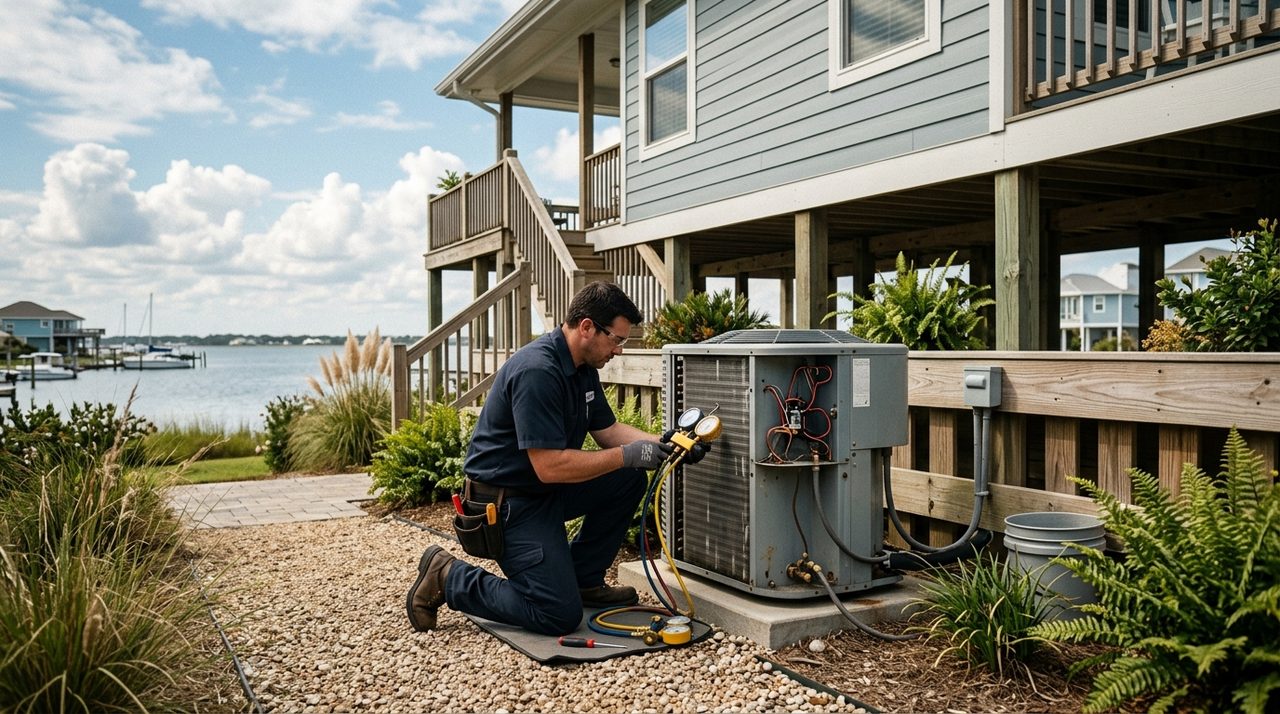
La Porte sits hard against Galveston Bay, meaning every outdoor condenser unit battles a cocktail of salt-laden Gulf air, petrochemical particulate from the Ship Channel corridor, and the relentless humidity that pushes relative humidity above 90% for much of the summer — conditions that corrode coil fins and contactors faster than nearly anywhere else in the Houston metro. With a census median year built of 1983, the majority of La Porte's housing stock is old enough to be running equipment that predates modern refrigerants, and those systems are now showing the cumulative stress of storms from Harvey through Beryl. Permits for any HVAC replacement or new installation must be pulled through the City of La Porte Building and Permits Department — not Harris County, not the City of Houston — and subdivision HOAs like Morgan's Landing add an architectural review layer on top of that.
Ranked by verified Google rating × review volume × verification tier. How we rank →
Some highly-rated pros serve La Porte from nearby and may not keep a La Porte street address. Those are listed under "Also serving La Porte" with their real city and distance, so you always know where each business is based.
229 N 16th St, La Porte, TX 77571
825 W C St, La Porte, TX 77571
1814 Hwy 146 South, Suite 200, La Porte, TX 77571
10407 Spencer Hwy, La Porte, TX 77571
1701 S Broadway St, La Porte, TX 77571
9902 Spencer Hwy, La Porte, TX 77571
Highly-rated pros based nearby who cover La Porte. Distance shown from the La Porte area.
Serving La Porte Based in Deer Park · 5.6 mi away
Serving La Porte Based in Baytown · 5.6 mi away
Serving La Porte Based in Seabrook · 6.2 mi away
Why it matters to you
La Porte's position along Galveston Bay exposes condenser coils to salt-laden onshore breezes year-round, while prevailing winds from the Ship Channel corridor deposit fine petrochemical particulate on fin surfaces. On older ranch-era homes from the 1950s–1970s near the bayfront, original copper line sets are already compromised, and corroded coil fins dramatically reduce heat-exchange efficiency — driving up your electricity bill months before the unit actually fails. Even newer units in communities like Morgan's Landing show accelerated fin deterioration compared to inland Harris County neighborhoods.
What a good pro does
A qualified technician should inspect and clean condenser coils with a pH-neutral coil cleaner rated for coastal environments at least once a year — not just a standard rinse — and apply a corrosion-inhibiting coil coating designed for salt-air exposure. Outdoor unit pads should be checked for leveling at the same visit, since La Porte's Gulf Coast clay soil shifts seasonally. Any replacement equipment should be specified with a coastal or 'C' corrosion-protection rating from the manufacturer, and the work must be permitted through the City of La Porte Building and Permits Department.
Sources: Municipal permit office (see area profile), Texas Department of Licensing & Regulation
Why it matters to you
La Porte's census median year built of 1983 places a large share of its housing stock squarely in the R-22 era, and many of those original systems — particularly in the 1980s–2000s brick-and-siding tract homes that dominate the city's suburban expansion areas — are still running. The EPA's phaseout of R-22 production took effect January 2020, and reclaimed R-22 in the Houston market now commonly runs $80–$150 per pound, meaning a single leak repair on a typical 3-ton system can cost $600–$1,500 or more in refrigerant alone — often exceeding the economic logic of repair versus replace. Homeowners who had patchwork top-offs done after Winter Storm Uri in 2021 may be facing the same leak again.
What a good pro does
Ask your technician to perform an electronic leak search before authorizing any refrigerant addition; if the leak is at the coil or line set, a full system replacement with modern R-410A or R-32 equipment will almost always pencil out better than repeated R-22 purchases. TDLR-licensed contractors are required to recover existing refrigerant properly under EPA Section 608 rules before replacing equipment. Replacement permits are pulled through La Porte's own permit office, and the inspection timeline there differs from both Houston and unincorporated Harris County — confirm scheduling with your contractor at the time of proposal.
Sources: Texas Department of Licensing & Regulation, Municipal permit office (see area profile), ENERGY STAR / U.S. Dept. of Energy
Why it matters to you
Virtually all post-1960 La Porte homes sit on slab-on-grade foundations, which means there is no crawl space to catch overflow when a condensate drain line clogs — water backs up into the air handler pan and can intrude directly into interior flooring, drywall, and sub-slab areas before a homeowner notices. La Porte's bayfront humidity, which regularly exceeds 90% relative humidity for extended summer stretches, means evaporator coils are producing far more condensate than systems in drier climates, and drain lines clog with algae and biofilm multiple times per season in many homes. Air handlers tucked into interior closets — common in La Porte's single-story ranch floor plans — have no floor drain to catch overflow, making a secondary pan with a float switch critical.
What a good pro does
A proper Houston-area HVAC tune-up should include flushing the primary condensate line with a biocide solution, inspecting the secondary pan for standing water or corrosion, and — if not already present — wiring a float switch that shuts the system down before a pan overflows. This is a $95–$225 service call that prevents thousands in water damage. If your air handler lacks a secondary pan entirely, ask your technician about adding one; any modification that involves disconnecting refrigerant lines requires a TDLR-licensed technician and, depending on scope, a City of La Porte mechanical permit.
Sources: Texas Department of Licensing & Regulation, Municipal permit office (see area profile), FEMA National Flood Hazard Layer (NFHL)
Why it matters to you
If your home is in Morgan's Landing or Pelican Bay — two of La Porte's mandatory-HOA communities — replacing a condenser unit is not just a permit-and-install job. Both communities enforce deed restrictions that typically require condenser units to be screened from street view, and Morgan's Landing's architectural review committee must approve exterior modifications before work begins. Homeowners who skip HOA pre-approval and install a replacement unit on a new pad location — sometimes necessary when the old pad has settled unevenly due to clay soil movement — can face fines, mandatory relocation of the unit, or both.
What a good pro does
Before signing a replacement contract, pull your subdivision's CC&Rs from the Harris County Clerk records or your HOA management portal and confirm what screening or placement rules apply to mechanical equipment. Submit an architectural review request to Morgan's Landing's ARC with a site sketch showing the unit location, proposed screening material, and dimensions — this process typically takes 7–14 days, so plan accordingly to avoid gaps in cooling during peak summer. Your TDLR-licensed contractor must also pull a City of La Porte mechanical permit separately, since HOA approval does not substitute for the city inspection.
Sources: Local HOA / deed restrictions (see area profile), Municipal permit office (see area profile), Texas Department of Licensing & Regulation
Hiring ac repair in La Porte? La Porte is an incorporated city along Galveston Bay with housing stock ranging from 1950s ranch homes to modern master-planned communities like Morgan's Landing. Homeowners face a mix of coastal humidity challenges, slab foundation maintenance, and subdivision-specific HOA requirements that vary widely across the city. Proximity to petrochemical facilities and the bay means exterior materials and HVAC systems require extra attention to corrosion and salt-air exposure.
Building era
1950s–1970s in older core neighborhoods; 1980s–2000s suburban expansion; 2010s–present in master-planned communities like Morgan's Landing.
Typical style
Single-story ranch and bungalow styles in older areas; two-story brick-and-siding tract homes from the 1980s–2000s; contemporary Texas traditional brick/stone homes in newer planned communities.
Foundations
Predominantly slab-on-grade for post-1960 construction; some pier-and-beam in pre-1960 homes near the historic core and bayfront areas.
Common systems
Central AC is universal; older homes (1950s–1970s) may have original copper or galvanized plumbing and outdated electrical panels requiring upgrades; newer subdivisions use PEX plumbing and modern 200-amp electrical service.
What that means for repairs
Older ranch homes near the historic core frequently undergo kitchen and bathroom remodels, plumbing re-pipes from galvanized to PEX, and electrical panel upgrades. Exterior hardening against coastal humidity and storm damage is common across all eras. Newer homes in Morgan's Landing and similar communities see relatively little renovation but may need cosmetic updates and landscaping work.
Permit jurisdiction
City of La Porte Building and Permits Department (incorporated city with its own permitting authority).
HOA & deed restrictions
No city-wide HOA. Individual subdivisions vary: Morgan's Landing has a mandatory HOA with assessments, deed restriction enforcement, and community amenities. Pelican Bay also has a mandatory HOA. Older central La Porte neighborhoods may have recorded deed restrictions but no active HOA or only a voluntary civic association. Property-specific verification through the deed and Harris County Clerk records is necessary.
Historic districts
No City of Houston historic district designation confirmed. La Porte is a separate incorporated city and is not subject to HAHC oversight.
Contractor note
Contractors must pull permits through the City of La Porte, not Harris County or Houston. Subdivision-specific HOA architectural review committees (e.g., Morgan's Landing) may require pre-approval for exterior modifications, fencing, and roofing material changes before work begins.
FEMA flood zone
FEMA Zone X (low flood risk) per official NFHL data. However, La Porte is bay-adjacent and low-lying; individual parcels closer to Galveston Bay, Taylor Bayou, or drainage channels may carry higher flood designations. Property-specific FEMA panel review is recommended.
Hurricane Harvey impact
La Porte experienced flooding during Hurricane Harvey (2017), particularly in low-lying areas near the bay and along drainage channels. Specific street-level flood data for individual La Porte subdivisions was not confirmed in available research; homeowners should consult Harris County Flood Control District records and the city's post-Harvey damage assessments for parcel-level detail. Bay-adjacent properties and older neighborhoods with inadequate drainage infrastructure were generally more affected.
Heat & humidity load
Extreme heat and humidity combined with salt-air proximity to Galveston Bay accelerate exterior paint failure, metal corrosion on HVAC condensers and fasteners, and mold growth in poorly ventilated attics and crawlspaces. HVAC systems run near-continuously from May through October, making seasonal maintenance and refrigerant checks critical. Pier-and-beam homes in older areas are particularly susceptible to moisture-related subfloor and joist deterioration.
Working with contractors here
Contractors in La Porte most commonly handle HVAC maintenance and replacement, re-roofing after storm damage, plumbing re-pipes in 1950s–1970s homes, and foundation repair on slab-on-grade structures affected by expansive Gulf Coast clay soils. Coastal humidity and salt-air exposure drive significant exterior painting, siding repair, and metal corrosion remediation work. In newer communities like Morgan's Landing, work tends toward warranty-era cosmetic items, fence installation, and landscape hardscaping, but HOA architectural committee approval is typically required before starting. For older La Porte homes, electrical panel upgrades from outdated fuse boxes to modern breaker panels are a frequent scope item. Contractors should confirm La Porte city permit requirements early in the bidding process, as turnaround times and inspection schedules differ from Houston and unincorporated Harris County.
Local Tip
Always ask for a written estimate before work begins. Texas contractors are required to provide one on jobs over $1,000.
La Porte is an incorporated city along Galveston Bay with housing stock ranging from 1950s ranch homes to modern master-planned communities like Morgan's Landing. Homeowners face a mix of coastal humidity challenges, slab foundation maintenance, and subdivision-specific HOA requirements that vary widely across the city. Proximity to petrochemical facilities and the bay means exterior materials and HVAC systems require extra attention to corrosion and salt-air exposure.
Source: U.S. Census Bureau, ACS 5-Year 2023
Most of La Porte maps to FEMA Zone X (low mapped flood risk), but Houston's flash-flood reality means even low-risk blocks benefit from smart drainage and storm-hardened installs; risk climbs sharply on blocks nearest Galveston Bay, where it varies parcel to parcel.
Source: FEMA National Flood Hazard Layer (NFHL). Flood zones vary by parcel — verify your individual FIRM panel.
Power-surge damage to HVAC control boards is one of the costliest hurricane aftermaths in La Porte, TX; install a dedicated whole-system surge protector rated for your unit's tonnage at the disconnect box before the season opens. CenterPoint's distribution lines in lower-risk areas often restore power with significant voltage spikes, and an unprotected board can fail the moment the grid comes back. As a Harris County community, La Porte may follow county rather than City of Houston storm rebuild rules.
The May 2024 derecho proved that even lower-risk areas like La Porte, TX are not immune to structural damage: flying debris punctured condenser coil cabinets on streets with no flooding history at all. Inspect your condenser cabinet panels for dents or breaches after any significant storm, and cover exposed refrigerant components with UV-stable foam insulation before a technician can arrive. As a Harris County community, La Porte may follow county rather than City of Houston storm rebuild rules.
In lower-flood-risk areas like La Porte, TX, the primary Uri 2021 HVAC failure mode was loss of heating entirely when heat-pump defrost boards were overwhelmed — verify that your backup heat strips are energized and pulling correct amperage with a quick licensed-technician check every fall, because a failed heat strip during a power-restored freeze night leaves the house unprotected. CenterPoint's rotating outage schedule during Uri meant systems that failed had no repair window for days. With a median build year of 1983, the older building stock here is more exposed to hard-freeze damage than newer construction. Confirm the current FEMA panel for your La Porte parcel — the area maps to Zone X, but adjacent lots can differ.
Sources: FEMA National Flood Hazard Layer (NFHL), Ready.gov -- Hurricanes, CenterPoint Energy -- Storm Center, City of Houston -- Emergency Preparedness, Ready.gov -- Winter Weather, Harris County Flood Control District
Houston-specific estimators to plan your project before you call a pro. All results are planning estimates — a licensed local pro confirms the details on site.
Living space you want cooled (400–10,000 sq ft).
Recommended nominal size
Estimated cooling load
This is a planning estimate only — actual requirements depend on an on-site assessment by a licensed Houston pro. Houston's humidity and long cooling season make an oversized unit a common, costly mistake — it short-cycles and never dehumidifies. A licensed contractor confirms sizing with a full Manual J calculation.
Disconnect & drain every outdoor hose bib
Remove hoses, drain the spigots, and cover each with an insulated faucet sock. Un-drained hose bibs are the #1 burst point in a Houston freeze.
Insulate exposed pipes in the attic & garage
Wrap any pipe in an unconditioned space (attic runs, garage walls) with foam sleeves. Houston homes rarely insulate these because they only matter a few nights a year — which is exactly why they burst.
Open cabinet doors & keep a pencil-width drip
On hard-freeze nights, open kitchen/bath cabinets so warm air reaches the pipes and let faucets on exterior walls drip to relieve pressure.
Protect the attic/garage water heater & its lines
An attic or garage tank sits in unconditioned space. Insulate the cold-inlet and hot-outlet lines and confirm the emergency drain pan is clear so a leak doesn't reach the ceiling.
This is a planning estimate only — actual requirements depend on an on-site assessment by a licensed Houston pro. If a pipe has already burst, shut off your main water supply and call a licensed Houston plumber immediately — freeze bursts flood fast.
Sources: Municipal permit office (see area profile)Texas Department of Licensing & Regulation
Sources: Municipal permit office (see area profile)
Sources: Local HOA / deed restrictions (see area profile)Municipal permit office (see area profile)