Open Now
16910 Texas Ave ste a10, Webster, TX 77598
Webster's predominantly 1970s–1990s slab-on-grade homes on Harris County's expansive coastal clay soils face a deceptively layered water-damage picture: most parcels map to FEMA Zone X, yet blocks nearest Clear Creek carry parcel-level flood exposure that spikes without warning, and even interior plumbing or wind-driven rain events leave moisture trapped between slabs and bottom plates for weeks in Houston's 74%-humidity environment. Because Webster is an independently incorporated city, every demolition, plumbing, and electrical permit tied to a restoration project must run through the City of Webster's own permit office—not Houston's, not Harris County's—a detail that can stall insurance-claim timelines if a contractor routes paperwork to the wrong jurisdiction. Understanding where your 1980s ranch sits relative to Clear Creek, how old flex ductwork responds to saturation, and which subdivision HOA controls exterior demo work are the three questions that separate a clean restoration outcome from one that lingers.
Ranked by verified Google rating × review volume × verification tier. How we rank →
Some highly-rated pros serve Webster from nearby and may not keep a Webster street address. Those are listed under "Also serving Webster" with their real city and distance, so you always know where each business is based.
16910 Texas Ave ste a10, Webster, TX 77598
15502 Galveston Rd #204, Webster, TX 77598
315B Odyssey Dr, Webster, TX 77598
711 W Bay Area Blvd #103, Webster, TX 77598
Highly-rated pros based nearby who cover Webster. Distance shown from the Webster area.
Serving Webster Based in Clear Lake · 1.7 mi away
Serving Webster Based in Clear Lake · 1.9 mi away
Serving Webster Based in League City · 2.5 mi away
Serving Webster Based in League City · 2.7 mi away
Serving Webster Based in League City · 2.7 mi away
Why it matters to you
The median Webster home was built around 1992 on slab-on-grade construction directly atop Harris County's expansive black clay soils. When any water event—whether a plumbing line failure, a window-flange breach during a storm, or a short-duration Clear Creek overflow on the lowest-lying blocks—saturates the slab perimeter, the clay holds moisture against the concrete long after you've dried the visible floor surface. In a 1,600-square-foot 1985 ranch with original drywall and OSB bottom plates, that residual moisture wicks upward for weeks, quietly promoting microbial growth behind intact walls.
What a good pro does
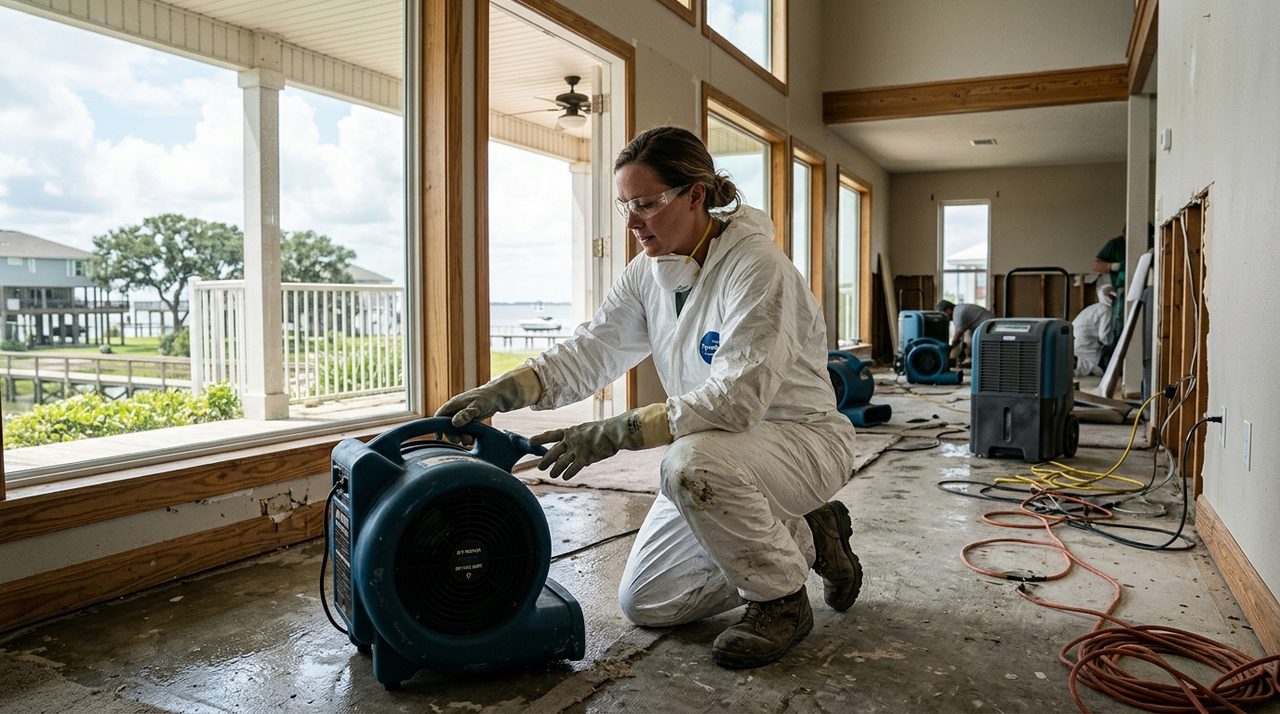
A qualified restoration contractor will deploy penetrating moisture meters and thermal imaging cameras along every exterior wall line and interior slab edge—not just in visibly wet rooms—before setting commercial desiccant or refrigerant drying equipment. Drying protocols under IICRC S500 require documenting daily psychrometric readings until all assemblies reach established drying goals; for Webster's clay-soil slabs, that often means 5–7 days of active drying rather than the 2–3 days common in pier-and-beam construction. Any mold remediation work that results must be performed by a TDLR-licensed Mold Remediation Contractor.
Sources: IICRC (water/mold restoration standards), Texas Department of Licensing & Regulation, Harris County Flood Control District
Why it matters to you
Webster's large stock of 1970s–1990s homes frequently retains original or once-replaced flex duct systems with fiberglass-lined interior insulation. When a water event—broken supply line, roof breach during a Gulf-strengthened storm, or even sustained high humidity after a flood—introduces moisture into the air handler or a duct trunk, the fibrous insulation holds water invisible from outside the duct jacket. Houston's average summer relative humidity above 70% and sustained 90°F+ attic temperatures create Aspergillus and Cladosporium growth conditions inside saturated duct runs within 48–72 hours of a water event.
What a good pro does
Restoration scope for any Webster home with pre-2000 flex duct that experienced water infiltration should include a full duct inspection with borescope imaging, not just a visual check at registers. Contaminated flex duct sections typically require full replacement rather than cleaning, because the inner liner cannot be adequately dried or sanitized in place. HVAC duct replacement work in Webster requires a permit through the City of Webster's permit office; a restoration contractor typically coordinates that permit alongside the demolition permit, while a TDLR-licensed HVAC technician performs the mechanical work.
Sources: IICRC (water/mold restoration standards), Texas Department of Licensing & Regulation, Municipal permit office (see area profile)
Why it matters to you
Most of Webster maps to FEMA Zone X—the low-mapped-risk designation—which can create a false sense of security for homeowners near the Clear Creek corridor on the city's south and east edges. FEMA flood maps are drawn at the community scale and can leave individual parcels within a few hundred feet of the creek at materially higher inundation risk than the map color suggests; Harris County Flood Control District data shows Clear Creek has repeatedly overtopped during tropical and stalled-front events. A homeowner whose 1988 slab sits three blocks from the creek may have experienced standing water during Harvey 2017 or Beryl 2024 despite a Zone X designation on paper.
What a good pro does
Before scoping any restoration project on a Webster parcel near Clear Creek, a thorough contractor will pull the HCFCD floodplain mapping data for the specific parcel address—not just the FEMA panel—to assess whether the loss meets Category 3 (black water, sewage-contaminated bayou/creek overflow) classification under IICRC S500. Category 3 losses require demolition of porous materials to at least 12 inches above the observed flood line, a scope that insurers sometimes push back on; contractors must document water source, testing results, and the HCFCD mapping to defend the full scope. All demolition permits must be pulled through the City of Webster.
Sources: FEMA National Flood Hazard Layer (NFHL), Harris County Flood Control District, IICRC (water/mold restoration standards), Municipal permit office (see area profile)
Why it matters to you
Webster has no single city-wide HOA, but master-planned communities like Edgewater—built in the 2000s and 2010s—carry mandatory HOA architectural controls that technically apply to exterior work including dumpster placement, visible material removal, and re-cladding choices. The IICRC S500 standard calls for drying initiation within 24–48 hours of a water event to prevent a Category 2 (gray water) loss from escalating to Category 3; if an HOA review process for exterior demo or a street-parked dumpster drags past that window, microbial growth conditions are already established. Homeowners in Edgewater and similar communities may not realize their HOA declaration imposes this requirement even in an emergency.
What a good pro does
Before a water event occurs, Edgewater and newer-community homeowners should locate their HOA declaration—searchable via the Harris County real property records or the TREC HOA Management Certificate database—and identify the emergency-work provision, which many HOA declarations include as a carve-out for urgent health-and-safety situations. A restoration contractor experienced in Webster subdivisions will document the emergency nature of the work in writing to the HOA simultaneously with mobilization, rather than waiting for approval before starting interior mitigation. The City of Webster demolition permit still must be obtained regardless of HOA status.
Sources: Local HOA / deed restrictions (see area profile), IICRC (water/mold restoration standards), Municipal permit office (see area profile)
Hiring water & flood restoration in Webster? Webster is a small incorporated city in SE Harris County near Clear Lake and the NASA corridor, with housing stock ranging from 1950s-era homes in the original town grid to 2000s master-planned communities like Edgewater. Homeowners here deal with aging slab-on-grade foundations on coastal clay soils, subdivision-specific deed restrictions, and proximity to Clear Creek floodplain areas. Permitting runs through the City of Webster rather than Houston or Harris County, which contractors must account for in project planning.
Building era
Mixed: some mid-century (1950s–1960s) in the original town grid, with the majority built from the 1970s through the 1990s; newer infill, townhomes, and master-planned sections (e.g., Edgewater) date to the 2000s–2010s.
Typical style
Single-story and 1.5-story ranch/suburban traditional brick homes dominate older subdivisions; newer sections feature contemporary suburban traditional and Mediterranean-influenced designs; townhomes and garden-style condos near NASA Rd 1 and I-45 are typically contemporary stucco/brick construction.
Foundations
Predominantly slab-on-grade for post-1960 suburban construction; pier-and-beam may exist in some older or custom structures but is uncommon.
Common systems
1970s–1990s homes typically have original or once-replaced central HVAC systems, copper or CPVC plumbing (some older homes may have galvanized supply lines), and 100–200 amp electrical panels. Newer 2000s construction features modern HVAC with higher SEER ratings and PEX plumbing.
What that means for repairs
Kitchen and bath remodels in 1970s–1990s homes are common as these properties age past the 30–40 year mark. HVAC replacements, slab foundation repair on expansive clay soils, and re-roofing after storm damage are frequent projects. Newer communities like Edgewater require HOA architectural approval before exterior modifications.
Permit jurisdiction
City of Webster Permitting (Webster is an incorporated city with its own permit authority).
HOA & deed restrictions
No single city-wide HOA exists. HOAs and POAs operate on a subdivision-by-subdivision basis. Master-planned communities like Edgewater have mandatory HOAs with architectural controls and dues. Condo complexes have mandatory council-of-co-owners associations. Some older platted areas may have lapsed or inactive deed restrictions. Confirm HOA status per property via Harris County real property records or the TREC HOA Management Certificate database.
Historic districts
No City of Houston historic district designation confirmed. Webster is an independently incorporated city with no known local historic district overlay.
Contractor note
Contractors must pull permits through the City of Webster, not Houston or Harris County. Each subdivision may have its own HOA architectural review process that must be satisfied before exterior work begins, particularly in Edgewater and newer communities.
FEMA flood zone
FEMA Zone X (low flood risk) per official NFHL data. However, properties near Clear Creek along Webster's southern boundary may fall within higher-risk flood zones; homeowners in those areas should verify their specific parcel's FEMA designation. Clear Creek has historically been a source of localized flooding in the region.
Hurricane Harvey impact
SE Harris County, including the Clear Creek and Clear Lake corridor, experienced significant rainfall and localized flooding during Harvey, particularly near bayous and the Clear Creek floodplain. However, the worst catastrophic structural flooding in Harris County was concentrated in other areas (Addicks/Barker, Greens Bayou). No city-level official dataset specifically quantifying the number of flooded Webster homes was identified; impact appears to have been moderate and concentrated near low-lying drainage areas rather than catastrophic across the entire city.
Heat & humidity load
Houston's extreme summer heat and humidity drive heavy HVAC demand, especially in 1970s–1990s homes with aging or undersized systems. Slab-on-grade foundations on coastal clay soils are subject to seasonal expansion and contraction, making foundation monitoring and proper drainage maintenance critical during dry summer periods. Coastal proximity increases salt air corrosion risk on exterior metal components and roofing fasteners.
Working with contractors here
Contractors in Webster most commonly handle HVAC replacements, foundation repairs, and re-roofing on the large stock of 1970s–1990s suburban homes that have reached or exceeded their major system lifespans. Slab foundation issues driven by expansive clay soils are a recurring concern, particularly after extended dry spells followed by heavy rain. Kitchen and bath remodels are popular in these aging homes, often requiring updated plumbing and electrical to meet current code. In newer communities like Edgewater, contractors should expect HOA architectural review requirements and potentially stricter material and design specifications. Because Webster is independently incorporated, all permits must go through the City of Webster rather than Houston or Harris County, which can affect timelines and inspection scheduling.
Local Tip
Always ask for a written estimate before work begins. Texas contractors are required to provide one on jobs over $1,000.
Webster is a small incorporated city in SE Harris County near Clear Lake and the NASA corridor, with housing stock ranging from 1950s-era homes in the original town grid to 2000s master-planned communities like Edgewater. Homeowners here deal with aging slab-on-grade foundations on coastal clay soils, subdivision-specific deed restrictions, and proximity to Clear Creek floodplain areas. Permitting runs through the City of Webster rather than Houston or Harris County, which contractors must account for in project planning.
Source: U.S. Census Bureau, ACS 5-Year 2023
Most of Webster maps to FEMA Zone X (low mapped flood risk), but Houston's flash-flood reality means even low-risk blocks benefit from smart drainage and storm-hardened installs; risk climbs sharply on blocks nearest Clear Creek, where it varies parcel to parcel.
Source: FEMA National Flood Hazard Layer (NFHL). Flood zones vary by parcel — verify your individual FIRM panel.
Water-restoration companies serving Webster, TX can install or recommend backflow prevention add-ons on floor drains and advise on contents-elevation strategies that limit category-2 water contact during a tropical event. The May 2024 derecho reminded Houston homeowners that extreme rain is not exclusive to named hurricanes, making year-round readiness essential. Because Webster drains toward Clear Creek, block-level runoff can differ sharply from the mapped zone.
For homeowners in Webster, TX: the May 2024 derecho caused widespread roof-deck separation across Houston, and the subsequent rainfall introduced water into attic insulation that retained moisture for weeks — a restoration contractor with desiccant drying equipment can address these attic assemblies that conventional fans cannot reach. Documenting the drying process with daily moisture logs also supports insurance claims for wind-and-water combined losses. As a Harris County community, Webster may follow county rather than City of Houston storm rebuild rules.
A hard freeze in Webster, TX can split a single supply line and deposit 50 or more gallons of water into a ceiling assembly before a homeowner locates the shutoff, and that volume requires more than fans and open windows to dry safely. Texas law under TDLR requires mold assessors and remediators to hold specific licenses, so verify your restoration contractor's credentials before you need them under emergency conditions. As a Harris County community, Webster may follow county rather than City of Houston storm rebuild rules.
Sources: FEMA National Flood Hazard Layer (NFHL), Ready.gov -- Hurricanes, CenterPoint Energy -- Storm Center, City of Houston -- Emergency Preparedness, Ready.gov -- Winter Weather, Harris County Flood Control District
Houston-specific estimators to plan your project before you call a pro. All results are planning estimates — a licensed local pro confirms the details on site.
Disconnect & drain every outdoor hose bib
Remove hoses, drain the spigots, and cover each with an insulated faucet sock. Un-drained hose bibs are the #1 burst point in a Houston freeze.
Insulate exposed pipes in the attic & garage
Wrap any pipe in an unconditioned space (attic runs, garage walls) with foam sleeves. Houston homes rarely insulate these because they only matter a few nights a year — which is exactly why they burst.
Open cabinet doors & keep a pencil-width drip
On hard-freeze nights, open kitchen/bath cabinets so warm air reaches the pipes and let faucets on exterior walls drip to relieve pressure.
Protect the attic/garage water heater & its lines
An attic or garage tank sits in unconditioned space. Insulate the cold-inlet and hot-outlet lines and confirm the emergency drain pan is clear so a leak doesn't reach the ceiling.
This is a planning estimate only — actual requirements depend on an on-site assessment by a licensed Houston pro. If a pipe has already burst, shut off your main water supply and call a licensed Houston plumber immediately — freeze bursts flood fast.
Sources: Municipal permit office (see area profile)Texas State Board of Plumbing Examiners
Sources: FEMA National Flood Hazard Layer (NFHL)IICRC (water/mold restoration standards)
Sources: Texas Department of Licensing & RegulationTexas State Board of Plumbing Examiners
Sources: EPA Lead Renovation, Repair and Painting (RRP) RuleTexas State Board of Plumbing Examiners
Sources: Local HOA / deed restrictions (see area profile)IICRC (water/mold restoration standards)