Closed
21074 Brazos Dr, New Caney, TX 77357
Porter is an unincorporated Montgomery County patchwork of 1970s acreage homes, 1990s–2000s tract subdivisions, and brand-new Valley Ranch production builds — all sitting on FEMA Zone X parcels that still flood hard during stalled Gulf moisture events, as the area's clay-heavy soils drain slowly and overwhelm undersized MUD storm systems. Because there is no city permit office here, every restoration permit routes through Montgomery County Engineering, and subdivision-specific HOA architectural review requirements in communities like Valley Ranch add a second approval layer that can stall time-critical drying work. This page explains the specific moisture, permit, and housing-system traps that Porter homeowners face when water gets in — and what a qualified restoration contractor should do about each.
Ranked by verified Google rating × review volume × verification tier. How we rank →
Some highly-rated pros serve Porter from nearby and may not keep a Porter street address. Those are listed under "Also serving Porter" with their real city and distance, so you always know where each business is based.
21074 Brazos Dr, New Caney, TX 77357
25139 Colette St, Porter, TX 77365
20931 Lazy Creek Dr, New Caney, TX 77357
24936 Plantation Estates Ln, Porter, TX 77365
Highly-rated pros based nearby who cover Porter. Distance shown from the Porter area.
Serving Porter Based in Kingwood · 2.6 mi away
Serving Porter Based in Kingwood · 2.8 mi away
Serving Porter Based in Kingwood · 3.6 mi away
Serving Porter Based in Kingwood · 3.6 mi away
Serving Porter Based in Kingwood · 3.6 mi away
Serving Porter Based in Kingwood · 3.7 mi away
Why it matters to you
The majority of Porter's established subdivisions were built between the mid-1980s and early 2000s on conventional concrete slab-on-grade foundations. When MUD storm infrastructure is overwhelmed during a stalled tropical moisture event — common in summer and fall — floodwater pools against slab perimeters for 12–36 hours. Montgomery County's clay-dominant soils hold water against the foundation long after the street clears, allowing moisture to wick into bottom plates, OSB sheathing, and drywall for weeks after visible water has receded, which is a longer drying timeline than most homeowners expect.
What a good pro does
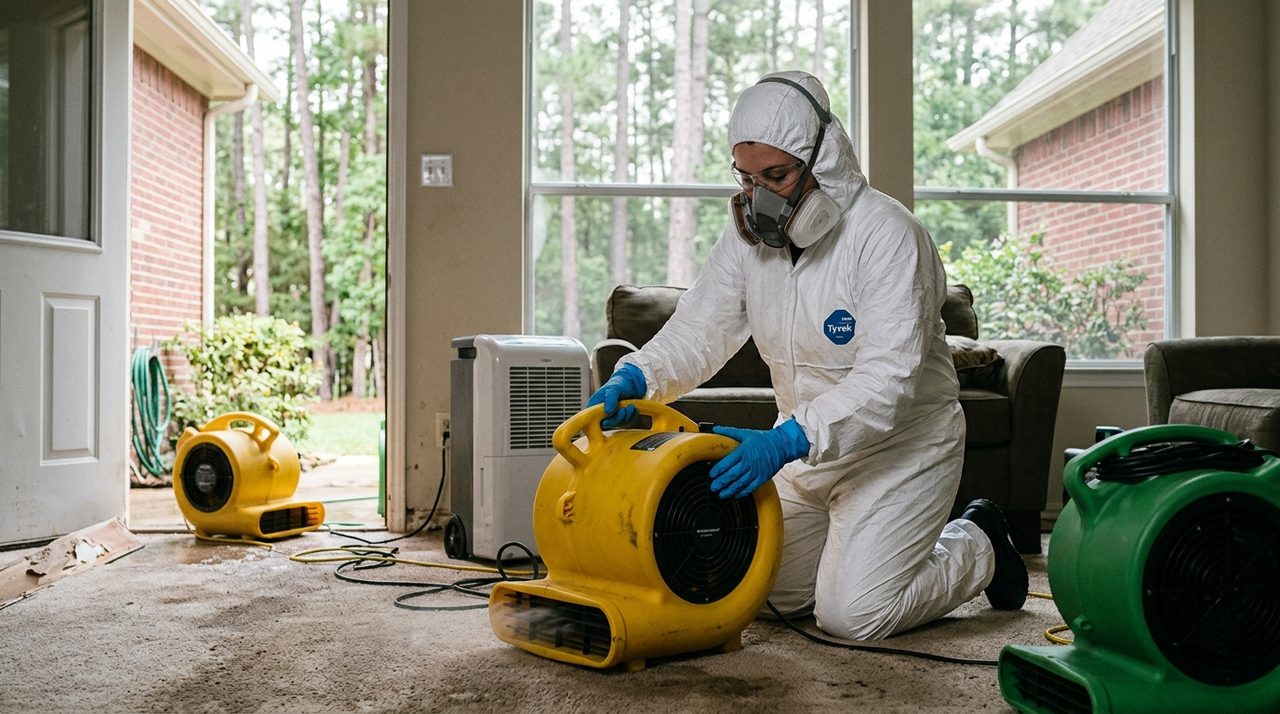
A qualified restoration contractor will deploy penetrating moisture meters and thermal imaging cameras to map the full wicking zone, not just the visibly wet area. Structural drying equipment — industrial dehumidifiers and air movers positioned per IICRC S500 psychrometric guidelines — must run continuously until all readings fall below standard baselines; cutting equipment runtime early to save money is the single most common cause of secondary mold growth in Porter's humid summer conditions. Montgomery County Engineering requires a demolition permit for any structural material removal, so the contractor should pull that permit before opening walls.
Sources: IICRC (water/mold restoration standards), FEMA National Flood Hazard Layer (NFHL), Municipal permit office (see area profile)
Why it matters to you
Porter's 1980s–1990s homes commonly retain original or once-replaced flex duct systems with fiberglass batt insulation jacketing — materials that absorb and hold moisture efficiently. When even a few inches of flash-flood water enters and the HVAC system keeps running (or restarts quickly after power is restored), warm humid air is pulled through wet duct insulation, creating conditions where Cladosporium and Aspergillus colonies can establish within 48–72 hours per IICRC S500 timelines. Houston's ambient relative humidity of roughly 74 percent makes outside air no help in stopping that process.
What a good pro does
A thorough restoration scope for any Porter home with pre-2000 flex duct should include a full duct moisture inspection — not just the air handler cabinet — using borescopes or direct access cuts at key supply runs. Any flex duct segment showing moisture intrusion or biological growth should be replaced, not dried in place; the fibrous insulation cannot be reliably dried to below-threshold moisture content in Houston's climate. The HVAC technician performing any duct work must be properly licensed, and if electrical components in the air handler were exposed to water, a TDLR-licensed electrician must sign off before the system restarts.
Sources: IICRC (water/mold restoration standards), Texas Department of Licensing & Regulation, Texas State Board of Plumbing Examiners
Why it matters to you
Winter Storm Uri (February 2021) hit Montgomery County hard, and many Porter homes — particularly those in older subdivisions with supply lines routed through unconditioned attic space or in exterior wall cavities without adequate insulation — experienced burst pipes. A significant share of homeowners made visible surface repairs: replaced drywall patches, repainted, moved on. However, if the wall cavity was not professionally dried to IICRC S500 standards before it was closed, residual moisture behind intact drywall can sustain slow-growing mold colonies that go undetected for years. Restoration contractors called in for an entirely different water event frequently uncover this gray or black wall discoloration when they open walls.
What a good pro does
Before reconstruction begins on any Porter home built before 2010, especially one that had a documented or suspected Uri claim, ask the contractor to probe suspect exterior walls and attic plumbing chases with a pin-type moisture meter. If readings are elevated, thermal imaging can locate the moisture boundary without unnecessary demolition. Any confirmed mold remediation requires a TDLR-licensed Mold Remediation Contractor (MRC) under Texas Occupations Code Chapter 1958 — this is a state licensing requirement regardless of job size — and affected areas must pass a post-remediation clearance test before new drywall is installed.
Sources: Texas Department of Licensing & Regulation, IICRC (water/mold restoration standards), EPA Lead Renovation, Repair and Painting (RRP) Rule
Why it matters to you
Porter's master-planned communities — Valley Ranch being the largest and most active example — impose mandatory HOA architectural control committee (ACC) review on exterior work, including dumpster placement, exposed sheathing, and re-cladding material choices. The IICRC S500 standard identifies 24–48 hours as the critical window to begin drying and demolition before a Category 2 water loss escalates toward Category 3 contamination conditions, but ACC approval timelines in these communities can run several days to a week under normal processes. A homeowner in Valley Ranch dealing with flooded exterior walls or wind-driven rain intrusion through brick veneer weep holes faces a real conflict between best-practice drying timelines and private covenant requirements.
What a good pro does
Contact your HOA management company the same day water damage is confirmed — not after you hire a contractor — and request emergency ACC consideration in writing, documenting the date and the active damage. Many ACC bylaws have an emergency provision that shortens review to 24–48 hours for active water intrusion; invoking it formally creates a paper trail that also helps with insurance documentation. Your restoration contractor should simultaneously pull the required demolition permit from Montgomery County Engineering so that county and HOA approvals can proceed in parallel rather than sequentially, avoiding compounded delays.
Sources: Local HOA / deed restrictions (see area profile), IICRC (water/mold restoration standards), Municipal permit office (see area profile)
Hiring water & flood restoration in Porter? Porter is a sprawling, unincorporated Montgomery County area composed of dozens of individual subdivisions—some master-planned with mandatory HOAs, others completely unrestricted rural tracts. Housing ranges from 1970s-era homes on acreage to brand-new production builds in communities like Valley Ranch. Homeowners must navigate county-level permitting and widely varying deed restrictions, making it essential to verify rules at the subdivision level before any project.
Building era
1970s–2020s, with significant growth from the 1990s through 2010s and ongoing new construction.
Typical style
Mix of traditional single-family brick and frame homes in older plats, and newer production-style traditional homes in master-planned communities.
Foundations
Predominantly concrete slab-on-grade for post-1960 construction; some pier-and-beam in older or custom rural builds — specific subdivision data not confirmed.
Common systems
Newer homes typically feature central HVAC with high-SEER units, PEX or copper plumbing, and 200-amp electrical panels; older 1970s–1990s homes may have original R-22 HVAC systems, galvanized or CPVC plumbing, and 100–150-amp panels.
What that means for repairs
Older subdivisions see HVAC replacements, re-plumbing from galvanized to PEX, and kitchen/bath remodels. Unrestricted acreage tracts attract new construction, additions, and outbuilding projects. Master-planned communities focus on cosmetic updates and energy efficiency upgrades.
Permit jurisdiction
Montgomery County Engineering and applicable special utility districts (MUDs). Not within City of Houston or any incorporated city permit jurisdiction.
HOA & deed restrictions
Varies widely by subdivision. Valley Ranch HOA is mandatory for all property owners. North Country Homeowners Association, Inc. operates as a subdivision HOA. The Highlands is governed by a mandatory HOA. Many properties in broader Porter have no HOA at all. Confirm for any specific property via deed records or TREC HOA management-certificate database.
Historic districts
No historic district designation confirmed. Porter is in unincorporated Montgomery County with no City of Houston HAHC jurisdiction.
Contractor note
Contractors must obtain permits through Montgomery County rather than a city permit office. Additionally, many subdivisions require separate HOA architectural review committee (ACC) approval before exterior work begins, so contractors should verify both county and private-covenant requirements for each job.
FEMA flood zone
FEMA Zone X (low flood risk) per official NFHL data. However, properties near the East Fork of the San Jacinto River and its tributaries may carry higher risk; confirm flood zone at the parcel level as conditions vary across this large unincorporated area.
Hurricane Harvey impact
Parts of Montgomery County, including areas along the San Jacinto River and its tributaries, experienced flooding during Hurricane Harvey. Subdivision-specific or street-level Harvey impact data for the broader Porter area was not confirmed in available sources. Property-specific flood history should be verified through FEMA NFIP records and the Montgomery County floodplain administrator.
Heat & humidity load
Extreme summer heat and humidity drive heavy HVAC demand; older 1970s–1990s systems may struggle with efficiency. Slab foundations on expansive clay soils can shift during prolonged dry spells, and homes on rural lots with septic systems face additional stress during saturated-soil conditions in late summer storms.
Working with contractors here
Porter's wide range of housing ages means contractors encounter everything from 1970s-era galvanized re-pipes and aging R-22 HVAC changeouts to warranty work in brand-new master-planned communities. Unrestricted acreage properties frequently generate new-build, barndominium, and accessory-structure projects that require Montgomery County permitting and septic coordination. In HOA-governed subdivisions like Valley Ranch and North Country, exterior projects require ACC approval in addition to county permits, and contractors should budget time for that review process. The area's rapid growth means utility infrastructure varies—some neighborhoods are served by MUDs with specific tap and connection standards that affect plumbing and site work. Job scoping should always include verifying the specific subdivision's HOA status, applicable deed restrictions, and whether the property is on municipal water/sewer or septic.
Local Tip
Always ask for a written estimate before work begins. Texas contractors are required to provide one on jobs over $1,000.
Porter is a sprawling, unincorporated Montgomery County area composed of dozens of individual subdivisions—some master-planned with mandatory HOAs, others completely unrestricted rural tracts. Housing ranges from 1970s-era homes on acreage to brand-new production builds in communities like Valley Ranch. Homeowners must navigate county-level permitting and widely varying deed restrictions, making it essential to verify rules at the subdivision level before any project.
Source: U.S. Census Bureau, ACS 5-Year 2023
Most of Porter maps to FEMA Zone X (low mapped flood risk), but Houston's flash-flood reality means even low-risk blocks benefit from smart drainage and storm-hardened installs.
Source: FEMA National Flood Hazard Layer (NFHL). Flood zones vary by parcel — verify your individual FIRM panel.
Zone X mapping offers no guarantee in Houston's flat topography, so have a water-restoration contractor identify the fastest flood-entry paths into your Porter, TX home — typically garage thresholds, HVAC closets, and exterior door sweeps — and pre-stage extraction equipment contacts. Acting in the first 24 hours after inundation is the difference between a dryout and a full mold remediation. As a Montgomery County community, Porter may follow county rather than City of Houston storm rebuild rules.
Even in low-flood-mapped areas of Porter, TX, intense thunderstorm rainfall can overwhelm gutter systems and force water through foundation weep holes or into slab expansion joints, creating sub-floor moisture that feeds mold undetected. An IICRC-certified water-restoration technician can use penetrating moisture meters to confirm whether a post-storm inspection is clear or whether targeted structural drying is needed. Confirm the current FEMA panel for your Porter parcel — the area maps to Zone X, but adjacent lots can differ.
Homes in lower-flood-risk areas of Porter, TX are not immune to the interior water losses Uri 2021 caused — burst attic supply lines and failed icemaker connections caused extensive drywall and flooring damage regardless of floodplain designation. A water-restoration contractor can extract standing water, remove wet flooring, and place structural drying equipment within the window that prevents a straightforward dryout from escalating to mold remediation. As a Montgomery County community, Porter may follow county rather than City of Houston storm rebuild rules.
Sources: FEMA National Flood Hazard Layer (NFHL), Ready.gov -- Hurricanes, CenterPoint Energy -- Storm Center, City of Houston -- Emergency Preparedness, Ready.gov -- Winter Weather, Harris County Flood Control District
Houston-specific estimators to plan your project before you call a pro. All results are planning estimates — a licensed local pro confirms the details on site.
Disconnect & drain every outdoor hose bib
Remove hoses, drain the spigots, and cover each with an insulated faucet sock. Un-drained hose bibs are the #1 burst point in a Houston freeze.
Insulate exposed pipes in the attic & garage
Wrap any pipe in an unconditioned space (attic runs, garage walls) with foam sleeves. Houston homes rarely insulate these because they only matter a few nights a year — which is exactly why they burst.
Open cabinet doors & keep a pencil-width drip
On hard-freeze nights, open kitchen/bath cabinets so warm air reaches the pipes and let faucets on exterior walls drip to relieve pressure.
Protect the attic/garage water heater & its lines
An attic or garage tank sits in unconditioned space. Insulate the cold-inlet and hot-outlet lines and confirm the emergency drain pan is clear so a leak doesn't reach the ceiling.
This is a planning estimate only — actual requirements depend on an on-site assessment by a licensed Houston pro. If a pipe has already burst, shut off your main water supply and call a licensed Houston plumber immediately — freeze bursts flood fast.
Sources: IICRC (water/mold restoration standards)Municipal permit office (see area profile)
Sources: FEMA National Flood Hazard Layer (NFHL)IICRC (water/mold restoration standards)
Sources: IICRC (water/mold restoration standards)Local HOA / deed restrictions (see area profile)
Sources: Texas State Board of Plumbing ExaminersTexas Department of Licensing & Regulation