Open Now
Serving Highlands Based in Baytown · 2.5 mi away
Highlands is an unincorporated northeast Harris County community where 1960s–1980s ranch homes on slab foundations sit within striking distance of the San Jacinto River and Cedar Bayou — two waterways that can push floodwater onto parcels that FEMA maps as Zone X with little warning. When inundation hits, restoration work here falls under Harris County Engineering Department permitting, not City of Houston rules, and the area's aging galvanized plumbing, early-generation flex duct, and original drywall create compounding damage scenarios that a generic restoration scope will miss.
Ranked by verified Google rating × review volume × verification tier. How we rank →
Some highly-rated pros serve Highlands from nearby and may not keep a Highlands street address. Those are listed under "Also serving Highlands" with their real city and distance, so you always know where each business is based.
Highly-rated pros based nearby who cover Highlands. Distance shown from the Highlands area.
Serving Highlands Based in Baytown · 2.5 mi away
Serving Highlands Based in Baytown · 4.4 mi away
Serving Highlands Based in Baytown · 5.3 mi away
Serving Highlands Based in Baytown · 6 mi away
Serving Highlands Based in Baytown · 6.4 mi away
Serving Highlands Based in Baytown · 7.5 mi away
Serving Highlands Based in Galena Park · 8.1 mi away
Serving Highlands Based in NE Houston · 9.4 mi away
Why it matters to you
Many Highlands parcels sit in FEMA Zone X on paper, yet the San Jacinto River and Cedar Bayou can overtop banks during tropical stalls or heavy fronts and push water onto those same blocks — a reality that Harvey 2017 and later Beryl 2024 demonstrated for east Harris County communities. Because FEMA flood maps are drawn at a coarse scale, individual lots near either waterway may carry far more exposure than their designation suggests, and homeowners who skip flood insurance based on Zone X status are often unpleasantly surprised. The 1960s–1980s slab construction dominant in Highlands sits at or near grade, giving floodwater almost no threshold to overcome before entering the living space.
What a good pro does
Before scoping any restoration job, a qualified contractor should verify the parcel's actual floodplain status through HCFCD's online flood map viewer rather than relying solely on the FEMA firm panel, since Harris County has its own updated mapping data. If inundation depth exceeded 12 inches or duration exceeded 24 hours — common on low-lying blocks near the river — the loss almost certainly qualifies as Category 3 (black water) under IICRC S500 standards, requiring full demo of porous materials to at least 12 inches above the flood line and documented water-source testing to defend that scope with the insurer.
Sources: Harris County Flood Control District, FEMA National Flood Hazard Layer (NFHL), IICRC (water/mold restoration standards)
Why it matters to you
Highlands homes built between 1960 and 1985 — which make up the bulk of the housing stock and align closely with the community's Census median year built of 1978 — sit on conventional (non-post-tension) concrete slab-on-grade foundations surrounded by Houston's expansive clay soil. After any flood event, that clay holds water against the slab perimeter for weeks, continuously wicking moisture into the bottom plates of exterior walls and the lower courses of drywall long after standing water has been extracted. Homeowners who rent equipment and DIY the extraction often dry the visible floor surface while leaving wall cavities saturated, setting up mold growth within 48–72 hours in Highlands' ambient summer humidity.
What a good pro does
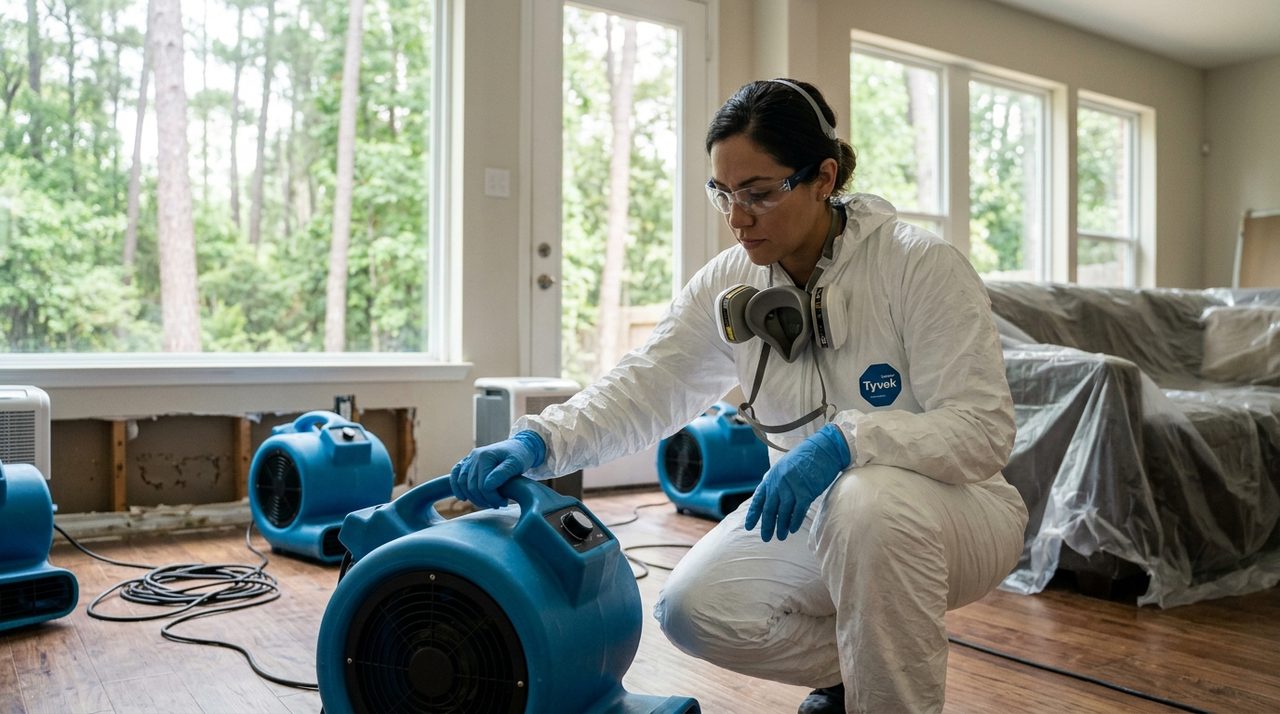
Professional structural drying in a Highlands ranch home requires moisture mapping with calibrated meters and thermal imaging along every exterior wall, not just the obviously wet rooms. Drying equipment — commercial dehumidifiers and injectidry wall-cavity systems — typically needs to run for five to ten days in east Harris County's climate, with daily readings documented per IICRC S500 protocols. Any contractor pulling a demolition permit for this work does so through the Harris County Engineering Department, not a City of Houston permit office; inspection scheduling and code interpretation differ, so restoration firms unfamiliar with unincorporated county permitting can cause costly delays.
Sources: IICRC (water/mold restoration standards), Harris County Flood Control District
Why it matters to you
A large share of Highlands homes still carry original or first-generation replacement HVAC systems with flex duct runs — many dating to the 1970s and 1980s — installed in attics or in some cases routed through slab chases in the older pier-and-beam structures closer to the bayou. When floodwater enters these homes, duct insulation absorbs moisture rapidly; with Highlands' summer outdoor temperatures above 90°F and average relative humidity near 74%, Aspergillus and Cladosporium colonies can establish inside saturated flex duct within 48 to 72 hours of inundation. Running the HVAC system to 'dry things out' — a common homeowner instinct — distributes spores throughout the house before the problem is identified.
What a good pro does
A thorough restoration scope for a Highlands home with pre-2000 flex duct should include a post-flood duct inspection using borescope or access cuts, and the contractor should advise the homeowner not to operate the air handler until clearance is given. If duct insulation shows visible saturation or microbial growth, replacement is typically more cost-effective than attempted drying. Any firm performing mold assessment or remediation in Texas must hold a TDLR-issued Mold Assessment Consultant (MAC) or Mold Remediation Contractor (MRC) license under Texas Occupations Code Chapter 1958; homeowners should request license numbers before signing a remediation contract.
Sources: IICRC (water/mold restoration standards), Texas Department of Licensing & Regulation, Texas Commission on Environmental Quality
Why it matters to you
Because Highlands is unincorporated Harris County, restoration and reconstruction permits are issued through the Harris County Engineering Department — a process that operates on different forms, fee schedules, and inspection cadences than the City of Houston's permit office. More critically, Harris County enforces FEMA's Substantial Improvement rule: if the cost of restoring (or improving) a flood-damaged structure in a Special Flood Hazard Area exceeds 50 percent of the structure's pre-damage market value, the entire building must be brought into compliance with current floodplain management standards, which typically means elevating the structure. With a Census median home value of approximately $191,400 in Highlands, even a moderate Category 3 gut-renovation costing $40,000–$60,000 can approach or cross that threshold on lower-value parcels, triggering elevation requirements that dramatically change the project scope and cost.
What a good pro does
Homeowners in Highlands should ask their restoration contractor to identify the parcel's floodplain designation through HCFCD before any reconstruction work begins and to compare the estimated restoration cost against the structure's assessed value. The Harris County Engineering Department can provide a Substantial Improvement determination; getting this in writing before pulling permits avoids mid-project surprises. The restoration contractor typically pulls the demolition permit, while licensed plumbers (TSBPE-licensed) and electricians (TDLR-licensed) pull their own trade permits — all routed through the county, not any municipal office.
Sources: Harris County Flood Control District, FEMA National Flood Hazard Layer (NFHL), Texas State Board of Plumbing Examiners, Texas Department of Licensing & Regulation
Hiring water & flood restoration in Highlands? Highlands is an unincorporated community in northeast Harris County with a housing stock dominated by 1960s–1980s ranch-style homes on slab foundations. Proximity to the San Jacinto River and Cedar Bayou creates significant flood risk for many parcels despite some areas mapping outside the 100-year floodplain. Homeowners here frequently need foundation work, aging HVAC replacement, and flood-related repairs, with permits handled through Harris County rather than the City of Houston.
Building era
Primarily 1960s–1980s, with scattered pre-1960 homes and post-2000 infill.
Typical style
One-story ranch and traditional brick homes with low-pitch roofs and attached carports or garages; some manufactured/mobile homes on larger rural lots.
Foundations
Predominantly concrete slab-on-grade; pier-and-beam found on older pre-1960 structures and homes in low-lying areas near bayous and the San Jacinto River.
Common systems
Original or first-generation replacement central HVAC systems; copper or galvanized steel plumbing in older homes transitioning to PEX in renovations; 100–150 amp electrical panels common in pre-1980s homes, often in need of upgrade.
What that means for repairs
Kitchen and bathroom updates are common as original finishes from the 1960s–1970s age out. Flood damage remediation drives significant gut-renovation and elevation work in lower-lying parcels. Electrical panel upgrades are frequently triggered by insurance requirements or HVAC replacements.
Permit jurisdiction
Harris County Engineering Department (unincorporated Harris County).
HOA & deed restrictions
No single area-wide mandatory HOA exists for Highlands. HOA presence is subdivision-specific; many properties have no HOA but may have recorded deed restrictions at the plat or lot level. Verify HOA status on a parcel-by-parcel basis through Harris County Clerk records.
Historic districts
No City of Houston historic district designation confirmed. Highlands is unincorporated Harris County with no known local historic protections.
Contractor note
Highlands is unincorporated, so Harris County building codes and permitting apply rather than City of Houston rules. Contractors should verify floodplain status for each parcel through HCFCD, as substantial improvement thresholds may trigger elevation or flood-proofing requirements even if the sampled point shows Zone X.
FEMA flood zone
FEMA Zone X (low flood risk) at the sampled point per official NFHL API. However, the Highlands area includes significant 100-year and 500-year floodplain zones near the San Jacinto River and Cedar Bayou channels. Flood risk varies dramatically by parcel; individual FEMA determinations should be obtained for any specific property.
Hurricane Harvey impact
East Harris County near the San Jacinto River experienced significant flooding during Hurricane Harvey in 2017. While public summaries do not explicitly isolate Highlands by name with street-level detail, the community's proximity to the San Jacinto River and Cedar Bayou strongly suggests moderate to significant impact in low-lying portions. Not confirmed at the street level — check Harris County Flood Control District records and individual property disclosure histories.
Heat & humidity load
Aging HVAC systems in 1960s–1980s homes struggle with Houston's extreme summer heat and humidity, driving high service call volume from May through October. Poor attic ventilation and original single-pane windows in unrenovated homes increase cooling loads. Humidity-related issues including mold, wood rot, and condensation in ductwork are common given proximity to waterways.
Working with contractors here
Contractors in Highlands most commonly handle HVAC replacement, re-roofing, plumbing re-pipes, and foundation repair on aging 1960s–1980s slab homes. Flood damage restoration and mold remediation are recurring specialties given the area's proximity to the San Jacinto River and low-lying bayou corridors. Many homes still have original galvanized plumbing and undersized electrical panels, so whole-house re-pipes and panel upgrades are frequent companion jobs during renovations. Scoping should account for the mix of slab and pier-and-beam foundations, as access and repair methods differ significantly. Because the area is unincorporated, contractors must navigate Harris County permitting processes, which differ from City of Houston requirements in inspection scheduling and code interpretations.
Local Tip
Always ask for a written estimate before work begins. Texas contractors are required to provide one on jobs over $1,000.
Highlands is an unincorporated community in northeast Harris County with a housing stock dominated by 1960s–1980s ranch-style homes on slab foundations. Proximity to the San Jacinto River and Cedar Bayou creates significant flood risk for many parcels despite some areas mapping outside the 100-year floodplain. Homeowners here frequently need foundation work, aging HVAC replacement, and flood-related repairs, with permits handled through Harris County rather than the City of Houston.
Source: U.S. Census Bureau, ACS 5-Year 2023
Most of Highlands maps to FEMA Zone X (low mapped flood risk), but Houston's flash-flood reality means even low-risk blocks benefit from smart drainage and storm-hardened installs; risk climbs sharply on blocks nearest the San Jacinto River, where it varies parcel to parcel.
Source: FEMA National Flood Hazard Layer (NFHL). Flood zones vary by parcel — verify your individual FIRM panel.
Before hurricane season, commission a moisture baseline scan from an IICRC-certified restoration firm so any post-storm water intrusion in Highlands, TX can be quantified and documented for your insurer immediately. Beryl 2024 showed that even low-mapped-risk neighborhoods saw flash flooding that saturated flooring assemblies within hours of peak rainfall. Because Highlands drains toward the San Jacinto River, block-level runoff can differ sharply from the mapped zone.
Even in low-flood-mapped areas of Highlands, TX, intense thunderstorm rainfall can overwhelm gutter systems and force water through foundation weep holes or into slab expansion joints, creating sub-floor moisture that feeds mold undetected. An IICRC-certified water-restoration technician can use penetrating moisture meters to confirm whether a post-storm inspection is clear or whether targeted structural drying is needed. As a Harris County community, Highlands may follow county rather than City of Houston storm rebuild rules.
A hard freeze in Highlands, TX can split a single supply line and deposit 50 or more gallons of water into a ceiling assembly before a homeowner locates the shutoff, and that volume requires more than fans and open windows to dry safely. Texas law under TDLR requires mold assessors and remediators to hold specific licenses, so verify your restoration contractor's credentials before you need them under emergency conditions. With a median build year of 1978, the older building stock here is more exposed to hard-freeze damage than newer construction. Because Highlands drains toward the San Jacinto River, block-level runoff can differ sharply from the mapped zone.
Sources: FEMA National Flood Hazard Layer (NFHL), Ready.gov -- Hurricanes, CenterPoint Energy -- Storm Center, City of Houston -- Emergency Preparedness, Ready.gov -- Winter Weather, Harris County Flood Control District
Houston-specific estimators to plan your project before you call a pro. All results are planning estimates — a licensed local pro confirms the details on site.
Disconnect & drain every outdoor hose bib
Remove hoses, drain the spigots, and cover each with an insulated faucet sock. Un-drained hose bibs are the #1 burst point in a Houston freeze.
Insulate exposed pipes in the attic & garage
Wrap any pipe in an unconditioned space (attic runs, garage walls) with foam sleeves. Houston homes rarely insulate these because they only matter a few nights a year — which is exactly why they burst.
Open cabinet doors & keep a pencil-width drip
On hard-freeze nights, open kitchen/bath cabinets so warm air reaches the pipes and let faucets on exterior walls drip to relieve pressure.
Protect the attic/garage water heater & its lines
An attic or garage tank sits in unconditioned space. Insulate the cold-inlet and hot-outlet lines and confirm the emergency drain pan is clear so a leak doesn't reach the ceiling.
This is a planning estimate only — actual requirements depend on an on-site assessment by a licensed Houston pro. If a pipe has already burst, shut off your main water supply and call a licensed Houston plumber immediately — freeze bursts flood fast.
Sources: Harris County Flood Control DistrictMunicipal permit office (see area profile)
Sources: FEMA National Flood Hazard Layer (NFHL)Harris County Flood Control District
Sources: Texas Department of Licensing & RegulationIICRC (water/mold restoration standards)
Sources: IICRC (water/mold restoration standards)Harris County Flood Control District
Sources: Local HOA / deed restrictions (see area profile)IICRC (water/mold restoration standards)