Closed
4906 Luella Ave, Deer Park, TX 77536
Deer Park's housing stock — predominantly 1950s-through-1980s brick veneer ranch homes on slab-on-grade foundations — sits on the same expansive Harris County clay that wicks moisture against slab edges for weeks after any water intrusion event, whether from a burst galvanized supply line, wind-driven rain through aging window flanges, or the flash flooding that reaches even FEMA Zone X blocks during stalled Gulf storms. Although Deer Park maps largely outside mapped floodplains, the mid-century construction era means original plumbing, aging flex ductwork, and pre-1990s electrical panels are in play whenever restoration contractors open walls — and every permit for that work must run through the City of Deer Park's own Building Inspections Department, not Houston or Harris County.
Ranked by verified Google rating × review volume × verification tier. How we rank →
Some highly-rated pros serve Deer Park from nearby and may not keep a Deer Park street address. Those are listed under "Also serving Deer Park" with their real city and distance, so you always know where each business is based.
4906 Luella Ave, Deer Park, TX 77536
130 W San Augustine St, Deer Park, TX 77536
Highly-rated pros based nearby who cover Deer Park. Distance shown from the Deer Park area.
Serving Deer Park Based in Pasadena · 4.1 mi away
Serving Deer Park Based in South Houston · 4.8 mi away
Serving Deer Park Based in La Porte · 5 mi away
Serving Deer Park Based in South Houston · 5.1 mi away
Serving Deer Park Based in Galena Park · 5.5 mi away
Serving Deer Park Based in South Houston · 5.6 mi away
Serving Deer Park Based in South Houston · 6 mi away
Serving Deer Park Based in Baytown · 7.4 mi away
Why it matters to you
Deer Park homes built before roughly 1975 frequently retain their original galvanized steel supply lines, which corrode from the inside out and can fail suddenly — releasing water into wall cavities and against the slab perimeter for hours or days before a homeowner notices a pressure drop. Because slab-on-grade construction offers no crawl space for inspection, water saturates the bottom plate and drywall from below, and Houston Black clay soil holds that moisture against the concrete edge long after extraction equipment pulls standing water from living spaces.
What a good pro does
A qualified restoration contractor begins with thermal imaging and calibrated moisture meters to map the full extent of saturation behind walls and along the slab perimeter — not just the visibly wet area. If plumbing repairs are part of the scope, a TSBPE-licensed plumber must pull a separate trade permit through the City of Deer Park Building Inspections Department; the restoration contractor typically pulls the demolition permit concurrently so structural drying and demo can proceed without waiting on sequential inspections.
Sources: Texas State Board of Plumbing Examiners, Municipal permit office (see area profile), IICRC (water/mold restoration standards)
Why it matters to you
Many Deer Park homes from the 1970s and 1980s still run original or early-replacement flex duct, whose fiberglass insulation jacket absorbs and retains moisture rapidly. Even a moderate pipe-burst or wind-driven rain intrusion — without any visible flooding — can saturate duct sections when an HVAC system continues to run, circulating humid air through damaged insulation. Deer Park's Gulf Coast humidity, which routinely exceeds 74% relative humidity, means Aspergillus and Cladosporium colonies can establish within 48 to 72 hours of initial wetting.
What a good pro does
Restoration pros should inspect all flex duct runs with moisture probes before closing any wall cavity, and scope duct replacement — not just surface cleaning — where insulation saturation is confirmed. Any firm performing mold assessment or remediation in Texas must hold a TDLR-issued Mold Assessment Consultant or Mold Remediation Contractor license; homeowners in Deer Park should verify that license before signing a remediation authorization.
Sources: Texas Department of Licensing & Regulation, IICRC (water/mold restoration standards), Texas Commission on Environmental Quality
Why it matters to you
The brick veneer ranch construction dominant in Deer Park's mid-century subdivisions relies on weep holes and air gaps that, when window flanges or sealants age past 30-plus years, allow wind-driven rain from Gulf-track storms and derechos — including the May 2024 event — to migrate into wall sheathing without producing any visible interior flooding. A homeowner may see only a small stain near a window frame while the wall cavity behind holds weeks of trapped moisture, a scenario that is especially common in Deer Park's pre-1990 homes where original caulk and flashing have never been replaced.
What a good pro does
Effective assessment requires a contractor to use both an infrared camera and a pin-style moisture meter on every exterior wall face after a storm event, tracing the intrusion path from the roof deck downward through sheathing to the bottom plate. Because this work frequently exposes deteriorated electrical wiring or junction boxes in pre-1980 homes, any electrical repairs uncovered during demo require a TDLR-licensed electrician pulling a separate trade permit through the City of Deer Park's permit office.
Sources: IICRC (water/mold restoration standards), Texas Department of Licensing & Regulation, Municipal permit office (see area profile)
Why it matters to you
Deer Park is an independent incorporated city with its own Building Inspections Department, and restoration contractors unfamiliar with the SE Houston suburb corridor sometimes attempt to route demolition or trade permits through the City of Houston or Harris County — both of which have no jurisdiction here. A mis-filed permit application delays the Certificate of Completion that most homeowners' insurance carriers require to close a claim, extending the period a home sits partially demoed and exposed to Deer Park's high ambient humidity.
What a good pro does
Before any structural demo or trade work begins, the restoration contractor must confirm jurisdiction with the City of Deer Park Building Inspections Department and obtain the correct demolition permit locally; plumbing and electrical subcontractors pull their own trade permits from the same office on their own licenses. Homeowners in HOA-governed subdivisions such as Villages of Deer Park or Deer Park Estates should also confirm whether the association requires notification or approval before exterior dumpster placement or visible material removal, since HOA review timelines do not pause the IICRC S500 48-hour drying window.
Sources: Municipal permit office (see area profile), Local HOA / deed restrictions (see area profile), IICRC (water/mold restoration standards)
Hiring water & flood restoration in Deer Park? Deer Park is an incorporated city east of Houston with a housing stock built primarily from the 1950s through the 1980s. Homeowners here contend with aging HVAC systems, original plumbing in older homes, and foundation maintenance on slab-on-grade construction typical of coastal plain development. The mix of HOA-governed subdivisions and unrestricted older neighborhoods means contractor requirements vary block by block.
Building era
1950s–1980s, with some later infill development through the 1990s and 2000s.
Typical style
One- and two-story brick veneer ranch and traditional suburban tract homes.
Foundations
Slab-on-grade (inferred from era and region; not formally documented in public records).
Common systems
Older homes likely have original galvanized or copper plumbing, R-22 refrigerant HVAC systems nearing or past end of life, and fuse or early breaker-panel electrical in pre-1970s builds. Homes from the 1980s onward more commonly have copper supply lines and 200-amp panels.
What that means for repairs
Kitchen and bath remodels, HVAC system replacements (R-22 to R-410A conversions), and re-piping of galvanized lines are common in the older mid-century housing stock. Some homeowners undertake foundation leveling due to expansive clay soils.
Permit jurisdiction
City of Deer Park Building Inspections Department (independent incorporated city with its own permitting office).
HOA & deed restrictions
HOA status is subdivision-specific. Confirmed mandatory HOAs include Villages of Deer Park Homeowner Association, Inc. and Deer Park Estates Homeowners Association. Many older platted areas have no organized HOA and market homes with no HOA fees. Deed restrictions likely exist in platted subdivisions but no city-wide compilation is publicly available.
Historic districts
No City of Houston or local historic district designation confirmed. Deer Park is an independent incorporated city and does not fall under HAHC jurisdiction.
Contractor note
Contractors must pull permits through the City of Deer Park, not Houston or Harris County. HOA-governed subdivisions such as Villages of Deer Park and Deer Park Estates may require architectural review or pre-approval for exterior modifications.
FEMA flood zone
FEMA Zone X (low flood risk) per official NFHL data. Deer Park sits on relatively flat terrain in southeast Harris County near the San Jacinto River basin and Buffalo Bayou watershed; localized drainage issues may still occur despite the Zone X designation.
Hurricane Harvey impact
Research indicates Deer Park experienced some flooding during Hurricane Harvey but was not among the most catastrophically impacted areas in Harris County. No verifiable official source naming specific repeatedly flooded streets within Deer Park was identified. Homeowners should consult Harris County Flood Control District repetitive-loss maps and FEMA records for parcel-level flood history.
Heat & humidity load
Prolonged summer heat and humidity stress aging HVAC systems common in 1950s–1980s homes. Condensation and moisture intrusion can cause attic mold and soffit deterioration in brick veneer construction. Slab-on-grade foundations on expansive clay soils are susceptible to seasonal movement during summer drought cycles.
Working with contractors here
The most common contractor work in Deer Park involves HVAC replacement on mid-century and 1980s-era systems, whole-house re-piping of galvanized supply lines, and slab foundation repair driven by clay soil movement. Roof replacements are frequent given the age of the housing stock and Gulf Coast storm exposure. Contractors should confirm whether a property falls within an HOA-governed subdivision, as Villages of Deer Park and Deer Park Estates enforce appearance standards. All permits must be pulled through the City of Deer Park's own building department, which maintains separate inspection schedules and code interpretations from Houston or Harris County.
Local Tip
Always ask for a written estimate before work begins. Texas contractors are required to provide one on jobs over $1,000.
Deer Park is an incorporated city east of Houston with a housing stock built primarily from the 1950s through the 1980s. Homeowners here contend with aging HVAC systems, original plumbing in older homes, and foundation maintenance on slab-on-grade construction typical of coastal plain development. The mix of HOA-governed subdivisions and unrestricted older neighborhoods means contractor requirements vary block by block.
Source: U.S. Census Bureau, ACS 5-Year 2023
Most of Deer Park maps to FEMA Zone X (low mapped flood risk), but Houston's flash-flood reality means even low-risk blocks benefit from smart drainage and storm-hardened installs.
Source: FEMA National Flood Hazard Layer (NFHL). Flood zones vary by parcel — verify your individual FIRM panel.
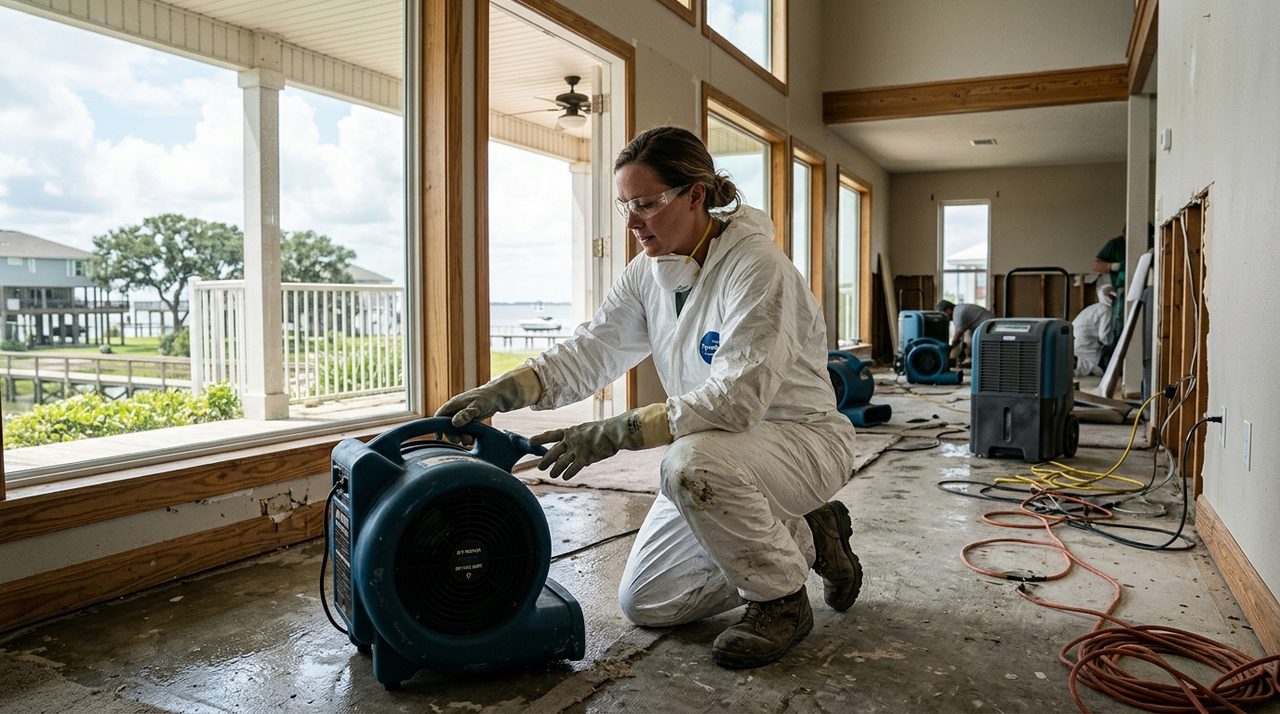
Water-restoration companies serving Deer Park, TX can install or recommend backflow prevention add-ons on floor drains and advise on contents-elevation strategies that limit category-2 water contact during a tropical event. The May 2024 derecho reminded Houston homeowners that extreme rain is not exclusive to named hurricanes, making year-round readiness essential. Confirm the current FEMA panel for your Deer Park parcel — the area maps to Zone X, but adjacent lots can differ.
Straight-line winds exceeding 80 mph, as recorded during the 2024 derecho, broke seals on sliding glass doors and drove water into flooring assemblies throughout Deer Park, TX neighborhoods with no prior flood history. Contact a licensed Texas restoration firm — TDLR regulates their mold-assessment and remediation work — to inspect and dry any affected areas before summer humidity accelerates microbial growth. Confirm the current FEMA panel for your Deer Park parcel — the area maps to Zone X, but adjacent lots can differ.
A hard freeze in Deer Park, TX can split a single supply line and deposit 50 or more gallons of water into a ceiling assembly before a homeowner locates the shutoff, and that volume requires more than fans and open windows to dry safely. Texas law under TDLR requires mold assessors and remediators to hold specific licenses, so verify your restoration contractor's credentials before you need them under emergency conditions. With a median build year of 1981, the older building stock here is more exposed to hard-freeze damage than newer construction. Confirm the current FEMA panel for your Deer Park parcel — the area maps to Zone X, but adjacent lots can differ.
Sources: FEMA National Flood Hazard Layer (NFHL), Ready.gov -- Hurricanes, CenterPoint Energy -- Storm Center, City of Houston -- Emergency Preparedness, Ready.gov -- Winter Weather, Harris County Flood Control District
Houston-specific estimators to plan your project before you call a pro. All results are planning estimates — a licensed local pro confirms the details on site.
Disconnect & drain every outdoor hose bib
Remove hoses, drain the spigots, and cover each with an insulated faucet sock. Un-drained hose bibs are the #1 burst point in a Houston freeze.
Insulate exposed pipes in the attic & garage
Wrap any pipe in an unconditioned space (attic runs, garage walls) with foam sleeves. Houston homes rarely insulate these because they only matter a few nights a year — which is exactly why they burst.
Open cabinet doors & keep a pencil-width drip
On hard-freeze nights, open kitchen/bath cabinets so warm air reaches the pipes and let faucets on exterior walls drip to relieve pressure.
Protect the attic/garage water heater & its lines
An attic or garage tank sits in unconditioned space. Insulate the cold-inlet and hot-outlet lines and confirm the emergency drain pan is clear so a leak doesn't reach the ceiling.
This is a planning estimate only — actual requirements depend on an on-site assessment by a licensed Houston pro. If a pipe has already burst, shut off your main water supply and call a licensed Houston plumber immediately — freeze bursts flood fast.
Sources: Municipal permit office (see area profile)
Sources: Texas State Board of Plumbing ExaminersMunicipal permit office (see area profile)
Sources: Local HOA / deed restrictions (see area profile)IICRC (water/mold restoration standards)