Closed
Serving Briargrove Based in Tanglewood · 0.3 mi away
Briargrove's 1950s housing stock — a mix of original mid-century construction and extensively remodeled homes on Houston's expansive Beaumont clay — creates a specific water-damage profile that differs sharply from newer subdivisions: older galvanized drain lines and copper supply pipes fail in ways that go undetected inside wall cavities for weeks, and the neighborhood's active mandatory HOA adds a procedural layer to emergency demo work that can compress the 24–48 hour drying window IICRC S500 requires. While most Briargrove parcels map to FEMA Zone X and carry low mapped flood risk, flash flooding from Houston's intense Gulf-fed rain events and plumbing failures internal to aging homes are the dominant damage drivers here.
Ranked by verified Google rating × review volume × verification tier. How we rank →
Some highly-rated pros serve Briargrove from nearby and may not keep a Briargrove street address. Those are listed under "Also serving Briargrove" with their real city and distance, so you always know where each business is based.
Highly-rated pros based nearby who cover Briargrove. Distance shown from the Briargrove area.
Serving Briargrove Based in Tanglewood · 0.3 mi away
Serving Briargrove Based in Tanglewood · 1.3 mi away
Serving Briargrove Based in Tanglewood · 1.5 mi away
Serving Briargrove Based in Tanglewood · 2.1 mi away
Serving Briargrove Based in Tanglewood · 2.1 mi away
Serving Briargrove Based in Bellaire · 2.3 mi away
Serving Briargrove Based in Galleria · 2.7 mi away
Serving Briargrove Based in Bellaire · 2.7 mi away
Serving Briargrove Based in Sharpstown · 2.8 mi away
Serving Briargrove Based in Spring Branch · 2.8 mi away
Why it matters to you
Briargrove's original 1950s supply and drain lines — galvanized steel and early copper — are well past their design life, and many have been enclosed inside walls during the neighborhood's wave of whole-home remodels. A slow pinhole leak or failed joint can saturate drywall, insulation, and the bottom plate for months before a homeowner notices a stain or odor, by which time mold colonization is already underway in Houston's 70-plus percent average relative humidity. In partially renovated homes, new drywall may sit directly against original framing that has cycled through moisture damage multiple times.
What a good pro does
A qualified restoration contractor will use thermal imaging cameras and calibrated moisture meters to map the full extent of saturation before any demo begins — critical in Briargrove homes where a modern kitchen addition may share a wall with original 1950s framing. Work touching supply lines requires a TSBPE-licensed plumber, and any structural demo or work on electrical panels exposed during opening walls requires City of Houston trade permits pulled through the Houston Permitting Center before work starts.
Sources: IICRC (water/mold restoration standards), Texas State Board of Plumbing Examiners, City of Houston Permitting Center
Why it matters to you
The Briargrove Homeowners Association actively enforces deed restrictions, and exterior work — including dumpster placement for demo debris, removal of exterior cladding, and visible equipment staging — can technically require HOA review even during an emergency water loss. Because IICRC S500 standards call for drying equipment to be deployed and demolition of saturated materials to begin within 24–48 hours to prevent Category 2 water from progressing to a mold-generating situation, any delay for HOA approvals directly raises remediation costs and health risk.
What a good pro does
Before breaking any walls, your restoration contractor should notify the Briargrove HOA in writing the same day the loss is discovered, documenting the emergency nature of the scope; most HOA governing documents include emergency exception language, but you need a written record. The contractor should simultaneously pull the City of Houston demolition permit so structural work isn't further delayed once HOA communication is established — these two tracks must run in parallel, not sequentially.
Sources: IICRC (water/mold restoration standards), Local HOA / deed restrictions (see area profile), City of Houston Permitting Center
Why it matters to you
Winter Storm Uri (February 2021) hit Briargrove hard: 1950s homes with supply lines routed through unconditioned attic chases and exterior-adjacent walls — common in that era's construction — experienced freeze-burst failures at high rates. Many owners patched drywall and moved on, but inadequate cavity drying left residual moisture behind intact finishes. Restoration contractors called for a new, unrelated water loss in Briargrove regularly discover Uri-era mold colonies behind drywall that was never properly dried — a hidden liability that must be remediated before new repairs can proceed.
What a good pro does
Any restoration scope in Briargrove should include a pre-work thermal and moisture scan of attic-adjacent walls and ceiling planes, not just the area of the current loss. If Uri-era microbial growth is found, a contractor holding a TDLR-issued Mold Remediation Contractor (MRC) license must perform the remediation under Texas Occupations Code Chapter 1958 before reconstruction begins; layering new drywall over active mold growth is both a code violation and a future liability.
Sources: Texas Department of Licensing & Regulation, IICRC (water/mold restoration standards), EPA Lead Renovation, Repair and Painting (RRP) Rule
Why it matters to you
Briargrove's original mid-century homes predate the 1978 federal ban on residential lead paint and the widespread removal of asbestos-containing materials from construction products; homes that have not been fully gut-remodeled are likely to contain both in original drywall joint compound, floor tile mastics, and exterior coatings. A water loss that requires demo of these materials — a near certainty in any significant pipe-burst or flood event — triggers EPA RRP rules and TCEQ asbestos regulations that govern how materials are tested, handled, and disposed of, adding both cost and timeline to the restoration scope.
What a good pro does
Before demolition begins in any pre-1980 Briargrove home, a certified inspector should collect samples of suspect materials; results typically return within 24–48 hours from accredited labs and are required to finalize the demo scope for the City of Houston permit application. Your restoration contractor should factor abatement costs into the initial estimate — skipping this step risks regulatory fines and can invalidate your insurance claim if improper disposal is later documented.
Sources: EPA Lead Renovation, Repair and Painting (RRP) Rule, Texas Commission on Environmental Quality, City of Houston Permitting Center
Hiring water & flood restoration in Briargrove? Briargrove is a well-established 1950s subdivision in west Houston with tree-lined streets, an active mandatory HOA, and a housing stock that increasingly blends original mid-century construction with significant modern updates. Homeowners here frequently navigate renovation projects that must satisfy both City of Houston permitting requirements and Briargrove HOA deed restrictions. The aging infrastructure—plumbing, electrical, and HVAC—drives steady demand for upgrades and whole-home remodels.
Building era
1950s, with ongoing renovations and some teardown-rebuilds in subsequent decades.
Typical style
Older homes with modern updates; specific architectural style breakdown (ranch, traditional, mid-century modern) not confirmed in available research.
Foundations
Not confirmed - check with local inspectors; both slab-on-grade and pier-and-beam are common in 1950s-era Houston subdivisions.
Common systems
Homes of this era typically feature galvanized or cast-iron drain lines, copper supply piping, older electrical panels (potentially 100-amp or fuse boxes in un-renovated homes), and central HVAC systems that may have been retrofitted or replaced multiple times.
What that means for repairs
Significant teardown and rebuild activity is common in established west Houston neighborhoods like Briargrove, alongside whole-home remodels that modernize kitchens, bathrooms, and mechanical systems while preserving lot footprints under HOA guidelines.
Permit jurisdiction
City of Houston Permitting Center (Briargrove is within Houston city limits).
HOA & deed restrictions
Mandatory HOA: Briargrove Homeowners Association, Inc. (also referenced as Briargrove Property Owners Association). The association actively enforces deed restrictions and community rules. Specific recorded deed restriction details not confirmed - check Harris County Clerk records.
Historic districts
No City of Houston historic district designation confirmed.
Contractor note
Contractors must obtain City of Houston permits for structural, electrical, plumbing, and mechanical work, and should verify project plans comply with Briargrove HOA deed restrictions before beginning exterior modifications or new construction.
FEMA flood zone
FEMA Zone X (low flood risk) - source: fema_nfhl. Briargrove is located in west Houston; specific bayou or creek proximity details were not confirmed in available research.
Hurricane Harvey impact
Specific Hurricane Harvey (2017) flooding data for Briargrove was not confirmed in available research. Recurring flood-prone streets or blocks could not be identified from provided sources. Homeowners should check Harris County Flood Control District records and individual property flood history for site-specific risk.
Heat & humidity load
Houston's extreme summer heat and humidity place heavy demands on HVAC systems in 1950s-era homes, which may have inadequate insulation, single-pane windows, or undersized ductwork. Contractors should expect high seasonal demand for AC repairs, attic insulation upgrades, and weatherization work. Foundation movement from clay soil expansion and contraction during summer drought cycles is also a recurring concern.
Working with contractors here
Briargrove's 1950s housing stock generates consistent demand for plumbing re-pipes (replacing galvanized and cast-iron lines), electrical panel upgrades, and HVAC system replacements. Whole-home remodels and teardown-rebuilds are common as homeowners invest in modernizing aging properties on desirable lots. Contractors should be prepared to coordinate with the Briargrove HOA on exterior work, including fencing, roofing materials, and driveway modifications. Foundation repair is a frequent need given the age of homes and Houston's expansive clay soils. Job scoping should account for potential asbestos or lead paint in original construction materials, requiring proper testing and abatement procedures.
Local Tip
Always ask for a written estimate before work begins. Texas contractors are required to provide one on jobs over $1,000.
Briargrove is a well-established 1950s subdivision in west Houston with tree-lined streets, an active mandatory HOA, and a housing stock that increasingly blends original mid-century construction with significant modern updates. Homeowners here frequently navigate renovation projects that must satisfy both City of Houston permitting requirements and Briargrove HOA deed restrictions. The aging infrastructure—plumbing, electrical, and HVAC—drives steady demand for upgrades and whole-home remodels.
Source: U.S. Census Bureau, ACS 5-Year 2023
Most of Briargrove maps to FEMA Zone X (low mapped flood risk), but Houston's flash-flood reality means even low-risk blocks benefit from smart drainage and storm-hardened installs.
Source: FEMA National Flood Hazard Layer (NFHL). Flood zones vary by parcel — verify your individual FIRM panel.
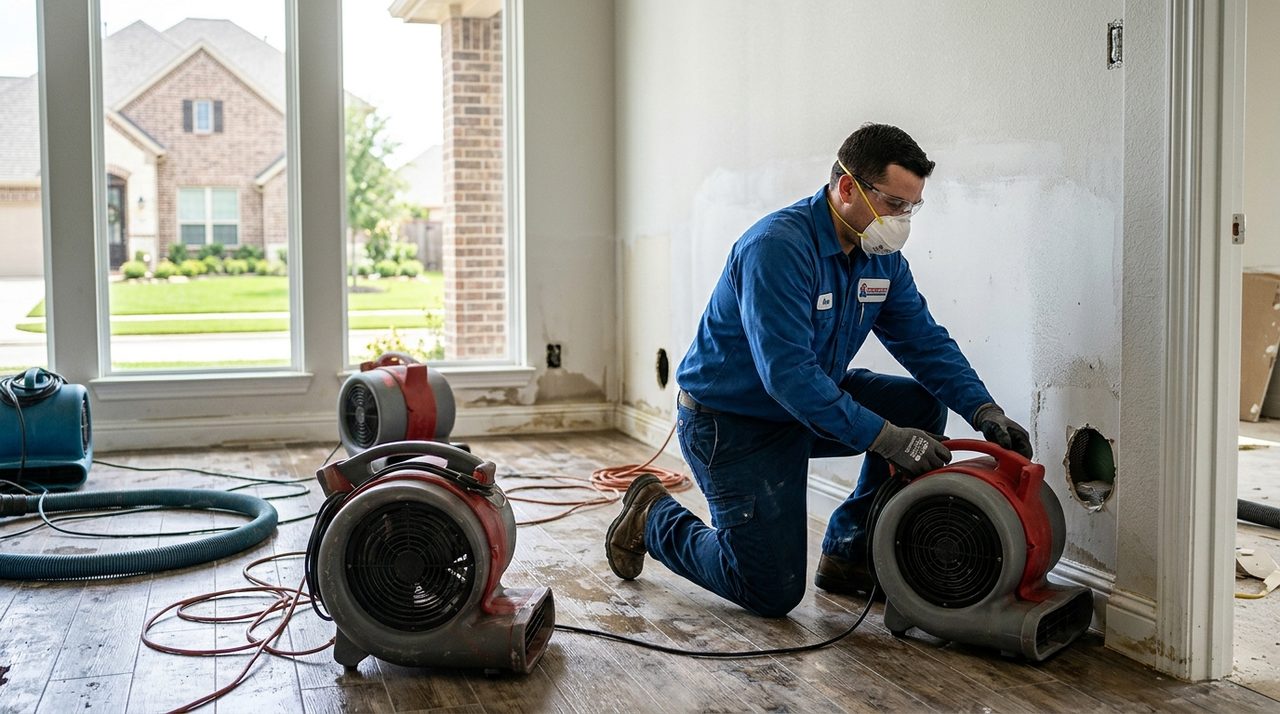
Water-restoration companies serving Briargrove can install or recommend backflow prevention add-ons on floor drains and advise on contents-elevation strategies that limit category-2 water contact during a tropical event. The May 2024 derecho reminded Houston homeowners that extreme rain is not exclusive to named hurricanes, making year-round readiness essential. In-city Briargrove work falls under City of Houston floodplain and permitting rules.
For homeowners in Briargrove: the May 2024 derecho caused widespread roof-deck separation across Houston, and the subsequent rainfall introduced water into attic insulation that retained moisture for weeks — a restoration contractor with desiccant drying equipment can address these attic assemblies that conventional fans cannot reach. Documenting the drying process with daily moisture logs also supports insurance claims for wind-and-water combined losses. In-city Briargrove work falls under City of Houston floodplain and permitting rules.
Homes in lower-flood-risk areas of Briargrove are not immune to the interior water losses Uri 2021 caused — burst attic supply lines and failed icemaker connections caused extensive drywall and flooring damage regardless of floodplain designation. A water-restoration contractor can extract standing water, remove wet flooring, and place structural drying equipment within the window that prevents a straightforward dryout from escalating to mold remediation. With a median build year of 1978, the older building stock here is more exposed to hard-freeze damage than newer construction. Confirm the current FEMA panel for your Briargrove parcel — the area maps to Zone X, but adjacent lots can differ.
Sources: FEMA National Flood Hazard Layer (NFHL), Ready.gov -- Hurricanes, CenterPoint Energy -- Storm Center, City of Houston -- Emergency Preparedness, Ready.gov -- Winter Weather, Harris County Flood Control District
Houston-specific estimators to plan your project before you call a pro. All results are planning estimates — a licensed local pro confirms the details on site.
Disconnect & drain every outdoor hose bib
Remove hoses, drain the spigots, and cover each with an insulated faucet sock. Un-drained hose bibs are the #1 burst point in a Houston freeze.
Insulate exposed pipes in the attic & garage
Wrap any pipe in an unconditioned space (attic runs, garage walls) with foam sleeves. Houston homes rarely insulate these because they only matter a few nights a year — which is exactly why they burst.
Open cabinet doors & keep a pencil-width drip
On hard-freeze nights, open kitchen/bath cabinets so warm air reaches the pipes and let faucets on exterior walls drip to relieve pressure.
Protect the attic/garage water heater & its lines
An attic or garage tank sits in unconditioned space. Insulate the cold-inlet and hot-outlet lines and confirm the emergency drain pan is clear so a leak doesn't reach the ceiling.
This is a planning estimate only — actual requirements depend on an on-site assessment by a licensed Houston pro. If a pipe has already burst, shut off your main water supply and call a licensed Houston plumber immediately — freeze bursts flood fast.
Sources: City of Houston Permitting Center
Sources: IICRC (water/mold restoration standards)FEMA National Flood Hazard Layer (NFHL)
Sources: Texas Department of Licensing & RegulationCity of Houston Permitting Center
Sources: City of Houston Permitting Center