Open Now
Serving Sharpstown Based in Bellaire · 2.1 mi away
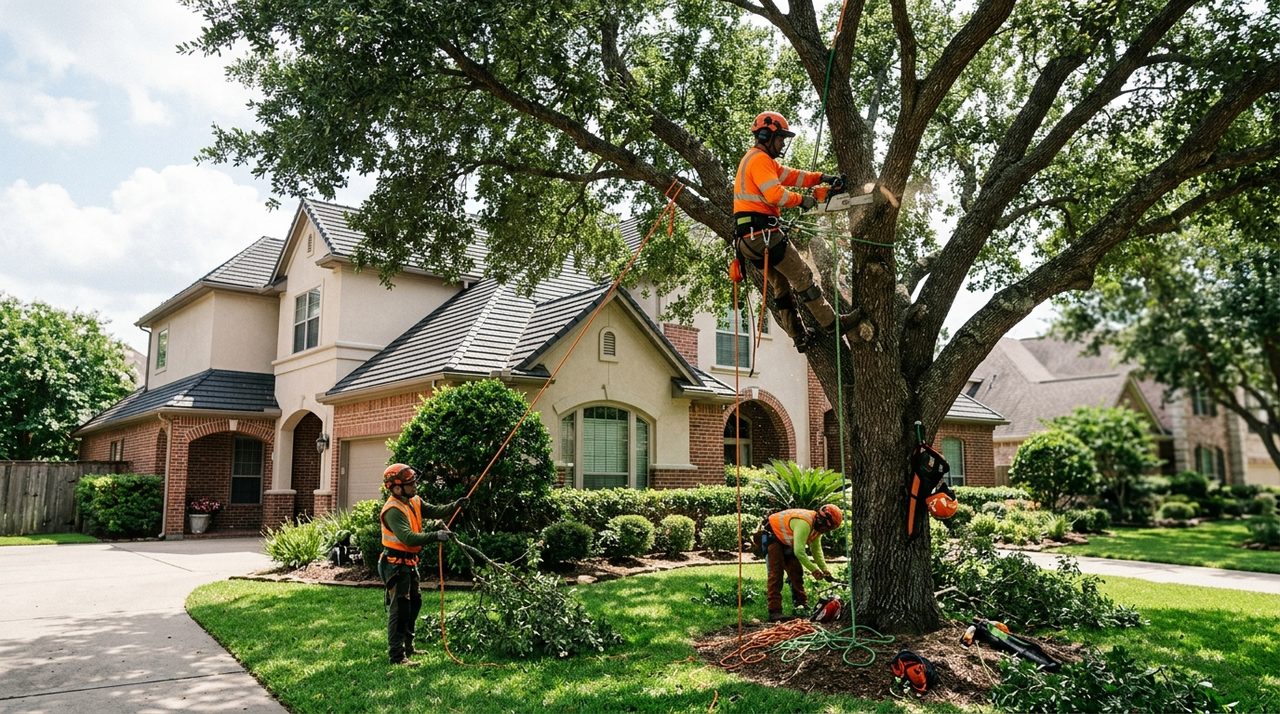
Sharpstown's late-1950s and 1960s ranch homes sit on concrete slabs over expansive Houston clay, and the neighborhood's mature water oaks and Chinese tallow trees — many now 50-plus years old — are in constant slow-motion conflict with those slabs, aging cast-iron drain lines, and the concrete driveways that define the streetscape. Because Sharpstown falls entirely within City of Houston limits under Council Districts F and J, Houston Public Works is the permit authority and routine private-property tree removal does not require a city permit — but the Sharpstown Civic Association's deed restrictions on exterior appearance mean homeowners should verify any replanting or landscaping plan before the stump grinder leaves the yard.
Ranked by verified Google rating × review volume × verification tier. How we rank →
Some highly-rated pros serve Sharpstown from nearby and may not keep a Sharpstown street address. Those are listed under "Also serving Sharpstown" with their real city and distance, so you always know where each business is based.
Highly-rated pros based nearby who cover Sharpstown. Distance shown from the Sharpstown area.
Serving Sharpstown Based in Bellaire · 2.1 mi away
Serving Sharpstown Based in Missouri City · 2.5 mi away
Serving Sharpstown Based in Missouri City · 2.6 mi away
Serving Sharpstown Based in Missouri City · 3.9 mi away
Serving Sharpstown Based in Stafford · 4.1 mi away
Serving Sharpstown Based in Missouri City · 4.3 mi away
Serving Sharpstown Based in Missouri City · 4.7 mi away
Serving Sharpstown Based in Braeswood · 5 mi away
Serving Sharpstown Based in Braeswood · 5 mi away
Serving Sharpstown Based in Tanglewood · 5.1 mi away
Why it matters to you
Sharpstown homes built between 1957 and 1968 were plumbed with cast-iron drain lines that are now at or beyond their useful life — and the water oaks and Chinese tallow trees that have grown up alongside those homes are exactly the species that send fine roots hunting for moisture through the micro-cracks that naturally develop in aging cast iron. On a single-story ranch slab, the sewer lateral exits the foundation at grade level, leaving very little buffer between an aggressive root system and the pipe. A backed-up drain or a camera scope showing root intrusion is often the first sign that a tree removal decision can no longer wait.
What a good pro does
A qualified arborist should assess the tree's proximity to the known lateral path — typically running from the kitchen or back bathroom toward the alley or street — before removal. After the tree is down, stump grinding to at least 12 inches below grade is essential to interrupt regrowth, especially with tallow. Homeowners should then schedule a cast-iron pipe camera inspection with a licensed plumber, since root removal from the tree does not repair any existing pipe compromise.
Sources: City of Houston Permitting Center, Texas Commission on Environmental Quality
Why it matters to you
Sharpstown's alley corridors, undeveloped corner lots, and the disturbed soils left by decades of piecemeal utility work are ideal germination ground for Chinese tallow (Triadica sebifera), a state-listed Texas invasive that grows five or more feet per year and regrows aggressively from stumps if not treated. A 10-inch-diameter tallow cut flush to grade will send up a dozen new shoots within a single growing season — the homeowner who paid for removal finds themselves with a multi-stem thicket within two years. The tree's wood is also problematic: some municipal green-waste and recycling facilities refuse tallow biomass to prevent seed spread.
What a good pro does
Reputable crews treating tallow in Sharpstown will grind the stump well below grade and apply an appropriately labeled cut-surface herbicide immediately after felling — timing matters because the treatment window is very short. Confirm before booking that the crew has a plan for the wood: some Sharpstown haulers will take it to a landfill rather than a composting facility to comply with invasive-species best practices. The Sharpstown Civic Association's deed restrictions govern exterior landscaping, so confirm any replanting plan aligns with those guidelines before the project closes.
Sources: Local HOA / deed restrictions (see area profile), Texas Commission on Environmental Quality
Why it matters to you
The May 2024 derecho, with straight-line winds exceeding 100 mph across SW Houston, toppled and damaged trees throughout Sharpstown's older canopy — water oaks and post oaks with root systems already stressed by decades of clay-soil expansion and contraction were particularly vulnerable. Hurricane Beryl followed in July 2024, compounding the backlog. In the weeks after either event, Houston-area tree crews were booked solid and out-of-state operators without local references moved through the neighborhood aggressively, accepting cash deposits and, in some cases, not completing work. Sharpstown's owner-occupancy rate of roughly 22.5% (ACS 2023) means a large share of residents are renters, but landlords and owner-occupants alike were caught in the same pricing surge.
What a good pro does
Budgeting at the high end of any range — and expecting post-storm premiums of 40 to 80 percent above normal — is prudent any time a named event has hit the metro within the previous 60 days. Before paying a deposit, verify that the crew carries adequate liability insurance by requesting a certificate naming you as an additional interested party, and check the ISA (International Society of Arboriculture) Certified Arborist lookup to confirm credentials. The City of Houston does not require a tree-removal permit on private property, so a contractor claiming otherwise to justify extra paperwork fees is a red flag.
Sources: City of Houston Permitting Center, FEMA National Flood Hazard Layer (NFHL)
Why it matters to you
Sharpstown's single-story ranch homes have low-pitch rooflines and brick veneer that absorb substantial solar heat load on Houston's west and southwest exposures — routinely over 3,500 cooling degree days per year. A mature water oak or live oak that has grown to shade the AC condenser pad or the west-facing wall of a mid-century ranch is doing measurable thermal work, potentially cutting cooling costs by 15 to 25 percent. Homeowners focused on a foundation crack or root conflict sometimes don't price that energy consequence into their removal decision until the first July electric bill after the tree is gone.
What a good pro does
Before committing to full removal of a large shade tree on Sharpstown's west or southwest exposure, ask the arborist to evaluate whether structural pruning or root barriers can address the immediate problem while preserving the canopy. If removal is the only safe option, plan a replacement tree on the same exposure — drought-tolerant native species like cedar elm or Texas live oak establish well in Harris County clay — and consider adding window film or exterior shading on the exposed wall while the replacement grows. Discuss replanting species and placement with the Sharpstown Civic Association before planting anything visible from the street.
Sources: Local HOA / deed restrictions (see area profile), City of Houston Permitting Center
Hiring tree removal in Sharpstown? Sharpstown is one of Houston's earliest master-planned communities, with most homes dating to the late 1950s and 1960s. Homeowners here face the typical aging-systems trifecta: original cast-iron drain lines approaching or past their useful life, aging HVAC systems struggling with Houston summers, and slab foundations susceptible to differential settlement in expansive clay soils. Deed restrictions enforced by the Sharpstown Civic Association govern exterior modifications, so contractors should verify compliance before beginning visible work.
Building era
Mid-1950s through 1960s (median year built 1959).
Typical style
Post-war ranch and mid-century suburban — predominantly single-story, low-pitch rooflines, brick veneer.
Foundations
Predominantly concrete slab-on-grade (inferred from era and regional building patterns; some earliest sections may have pier-and-beam).
Common systems
Original homes likely have galvanized steel or cast-iron drain lines, copper supply lines, R-22 refrigerant HVAC systems (many now replaced), and fuse panels or early breaker panels upgraded over time to 200-amp service. Older homes may still have original single-pane aluminum windows.
What that means for repairs
Kitchen and bathroom remodels are common as homeowners update 60+ year-old layouts. Foundation repair and re-piping (replacing cast-iron drains with PVC) are frequent major projects. Many homes have had incremental upgrades — roof replacements, HVAC conversions to R-410A, and window upgrades — but full gut renovations are also seen as investors enter the market.
Permit jurisdiction
City of Houston Permitting Center (Houston Public Works). Sharpstown is within City of Houston limits, Council Districts F and J.
HOA & deed restrictions
Sharpstown Civic Association serves as the primary neighborhood organization for deed restriction enforcement and architectural control. Membership dues are voluntary (approximately $90/year plus optional security fee), but deed restrictions run with the land and are enforceable regardless of membership. Individual condo and townhome complexes within Sharpstown (e.g., Sharpstown Green Condominium Association) may have separate mandatory HOAs.
Historic districts
No City of Houston historic district designation confirmed. Sharpstown does not appear on HAHC-designated district lists and does not require Certificates of Appropriateness for exterior work.
Contractor note
Contractors must pull permits through the City of Houston Permitting Center. Exterior modifications — fences, paint colors, carport additions — should be checked against Sharpstown deed restrictions enforced by the Sharpstown Civic Association before work begins.
FEMA flood zone
FEMA Zone X (low flood risk) per official NFHL data. No specific bayou or creek proximity concerns were identified in available research for the core Sharpstown single-family areas.
Hurricane Harvey impact
Sharpstown did not appear among the highest-profile catastrophically flooded neighborhoods during Hurricane Harvey. Localized street ponding and some home flooding may have occurred, but specific street-level impact data for Sharpstown was not confirmed in available sources. Not confirmed at the parcel level — homeowners should check Harris County Flood Control District records for individual property flood history.
Heat & humidity load
1950s–60s homes with original insulation and single-pane windows place heavy loads on HVAC systems during Houston's extended cooling season (May–October). Slab-on-grade foundations are susceptible to differential movement during summer drought cycles as expansive clay soils shrink, which can crack plumbing lines running beneath or through the slab. Contractors should anticipate high demand for HVAC tune-ups, duct sealing, and attic insulation upgrades.
Working with contractors here
The most common service calls in Sharpstown involve foundation evaluation and repair, cast-iron drain line replacement (re-piping to PVC), and HVAC system replacement on homes still running original or second-generation equipment. Roof replacements are frequent given the age of the housing stock and Houston's hail exposure. Because Sharpstown was built as a mass-production subdivision, floor plans repeat across many blocks, which allows experienced contractors to develop efficient scoping templates. However, six decades of piecemeal upgrades mean electrical panels, plumbing materials, and HVAC configurations can vary significantly even between identical floor plans — thorough pre-job inspections are essential. Contractors should also be aware that the Sharpstown Civic Association actively enforces deed restrictions on exterior appearance, so visible work such as siding, fencing, or accessory structures should be verified for compliance before installation.
Local Tip
Always ask for a written estimate before work begins. Texas contractors are required to provide one on jobs over $1,000.
Sharpstown is one of Houston's earliest master-planned communities, with most homes dating to the late 1950s and 1960s. Homeowners here face the typical aging-systems trifecta: original cast-iron drain lines approaching or past their useful life, aging HVAC systems struggling with Houston summers, and slab foundations susceptible to differential settlement in expansive clay soils. Deed restrictions enforced by the Sharpstown Civic Association govern exterior modifications, so contractors should verify compliance before beginning visible work.
Source: U.S. Census Bureau, ACS 5-Year 2023
Most of Sharpstown maps to FEMA Zone X (low mapped flood risk), but Houston's flash-flood reality means even low-risk blocks benefit from smart drainage and storm-hardened installs.
Source: FEMA National Flood Hazard Layer (NFHL). Flood zones vary by parcel — verify your individual FIRM panel.
Wind is the primary tree hazard in lower-risk Sharpstown neighborhoods during a Gulf hurricane, so focus pre-storm efforts on removing dead or structurally weak trees that could reach your roof line or power drop. A TDLR-licensed contractor can perform a hazard assessment and complete removal well before a storm's 72-hour watch window, when crews become unavailable across the Houston metro. Confirm the current FEMA panel for your Sharpstown parcel — the area maps to Zone X, but adjacent lots can differ.
Proactive removal of trees with significant deadwood or structural defects in Sharpstown costs a fraction of the emergency extraction and roof repair that follows a thunderstorm failure. Severe storms in the Houston area can produce 70-plus mph gusts with almost no advance warning, which means the pre-storm window is the only realistic time to act before a low-flood-risk yard becomes a debris field. Confirm the current FEMA panel for your Sharpstown parcel — the area maps to Zone X, but adjacent lots can differ.
The most actionable winter prep for tree removal in Sharpstown is removing any tree or large limb that hangs directly over a roofline, vehicle parking area, or power service drop before the first freeze advisory. Ice adds weight faster than most homeowners expect, and Houston trees that have never experienced sustained ice loading have no adaptive resilience to that stress. With a median build year of 1976, the older building stock here is more exposed to hard-freeze damage than newer construction. Confirm the current FEMA panel for your Sharpstown parcel — the area maps to Zone X, but adjacent lots can differ.
Sources: FEMA National Flood Hazard Layer (NFHL), Ready.gov -- Hurricanes, CenterPoint Energy -- Storm Center, City of Houston -- Emergency Preparedness, Ready.gov -- Winter Weather, Harris County Flood Control District
Houston-specific estimators to plan your project before you call a pro. All results are planning estimates — a licensed local pro confirms the details on site.
Grouped by mature root aggression & water demand.
Trunk center to the nearest exterior wall.
The root zone likely reaches your foundation's soil during Houston's dry summers, when clay shrinks most. Watch for sticking doors and diagonal cracks, keep soil moisture even with a soaker hose during drought, and have a foundation pro evaluate if you see any movement.
Find a Houston foundation pro →This is a planning estimate only — actual requirements depend on an on-site assessment by a licensed Houston pro. Guidance is based on general species root behavior in expansive clay, not a soil test.
Disconnect & drain every outdoor hose bib
Remove hoses, drain the spigots, and cover each with an insulated faucet sock. Un-drained hose bibs are the #1 burst point in a Houston freeze.
Insulate exposed pipes in the attic & garage
Wrap any pipe in an unconditioned space (attic runs, garage walls) with foam sleeves. Houston homes rarely insulate these because they only matter a few nights a year — which is exactly why they burst.
Open cabinet doors & keep a pencil-width drip
On hard-freeze nights, open kitchen/bath cabinets so warm air reaches the pipes and let faucets on exterior walls drip to relieve pressure.
Protect the attic/garage water heater & its lines
An attic or garage tank sits in unconditioned space. Insulate the cold-inlet and hot-outlet lines and confirm the emergency drain pan is clear so a leak doesn't reach the ceiling.
This is a planning estimate only — actual requirements depend on an on-site assessment by a licensed Houston pro. If a pipe has already burst, shut off your main water supply and call a licensed Houston plumber immediately — freeze bursts flood fast.
Sources: City of Houston Permitting CenterLocal HOA / deed restrictions (see area profile)
Sources: FEMA National Flood Hazard Layer (NFHL)Local HOA / deed restrictions (see area profile)
Sources: Local HOA / deed restrictions (see area profile)