Closed
Serving Rice Military Based in River Oaks · 0.9 mi away
Rice Military's dense townhome grid — mostly 1990s–2010s slab-on-grade construction packed onto tight Inner Loop lots — leaves little margin for error when a tree needs to come down: cranes can't reach over shared walls, stumps sit a few feet from neighboring foundations, and project-level HOAs may require written approval before a chainsaw starts. Add Buffalo Bayou's proximity and the fact that even Zone X parcels near the water saw dramatic drainage impacts from the May 2024 derecho, and tree removal here demands more planning than in a typical suburban yard.
Ranked by verified Google rating × review volume × verification tier. How we rank →
Some highly-rated pros serve Rice Military from nearby and may not keep a Rice Military street address. Those are listed under "Also serving Rice Military" with their real city and distance, so you always know where each business is based.
Highly-rated pros based nearby who cover Rice Military. Distance shown from the Rice Military area.
Serving Rice Military Based in River Oaks · 0.9 mi away
Serving Rice Military Based in Lazybrook / Timbergrove · 2.5 mi away
Serving Rice Military Based in Lazybrook / Timbergrove · 2.5 mi away
Serving Rice Military Based in Galleria · 2.6 mi away
Serving Rice Military Based in Galleria · 2.8 mi away
Serving Rice Military Based in West University · 2.9 mi away
Serving Rice Military Based in The Heights · 3.2 mi away
Serving Rice Military Based in Lazybrook / Timbergrove · 3.9 mi away
Serving Rice Military Based in Tanglewood · 4.4 mi away
Serving Rice Military Based in Brookhollow · 5 mi away
Why it matters to you
Rice Military has no single neighborhood-wide HOA — instead, each townhome development (like Courtyards of Detering Place and similar complexes) maintains its own mandatory POA or HOA with separate architectural standards. Removing even a small tree in a shared courtyard or along a zero-lot-line property boundary without written approval can trigger fines or forced replanting under those deed restrictions, which must be confirmed parcel by parcel through Harris County Clerk records.
What a good pro does
Before scheduling any removal, a thorough contractor will ask you to pull your specific development's CC&Rs from Harris County Clerk records, identify whether your HOA requires an Architectural Review Committee submission, and wait for written sign-off. Approval timelines vary by complex; plan for at least two to four weeks if a board meeting is required. The City of Houston does not itself require a homeowner permit for private-property tree removal, so the HOA gate is the only formal approval hurdle for most Rice Military parcels.
Sources: Local HOA / deed restrictions (see area profile), City of Houston Permitting Center
Why it matters to you
Three-story attached townhomes in Rice Military sit on lots with setbacks as tight as three to five feet from neighboring structures. A mid-size water oak or Chinese tallow that has volunteered along a fence line simply cannot be felled in a conventional direction without hitting stucco cladding, a rooftop deck railing, or a neighbor's HVAC condenser. Conventional felling is not a realistic option for the majority of tree work here.
What a good pro does
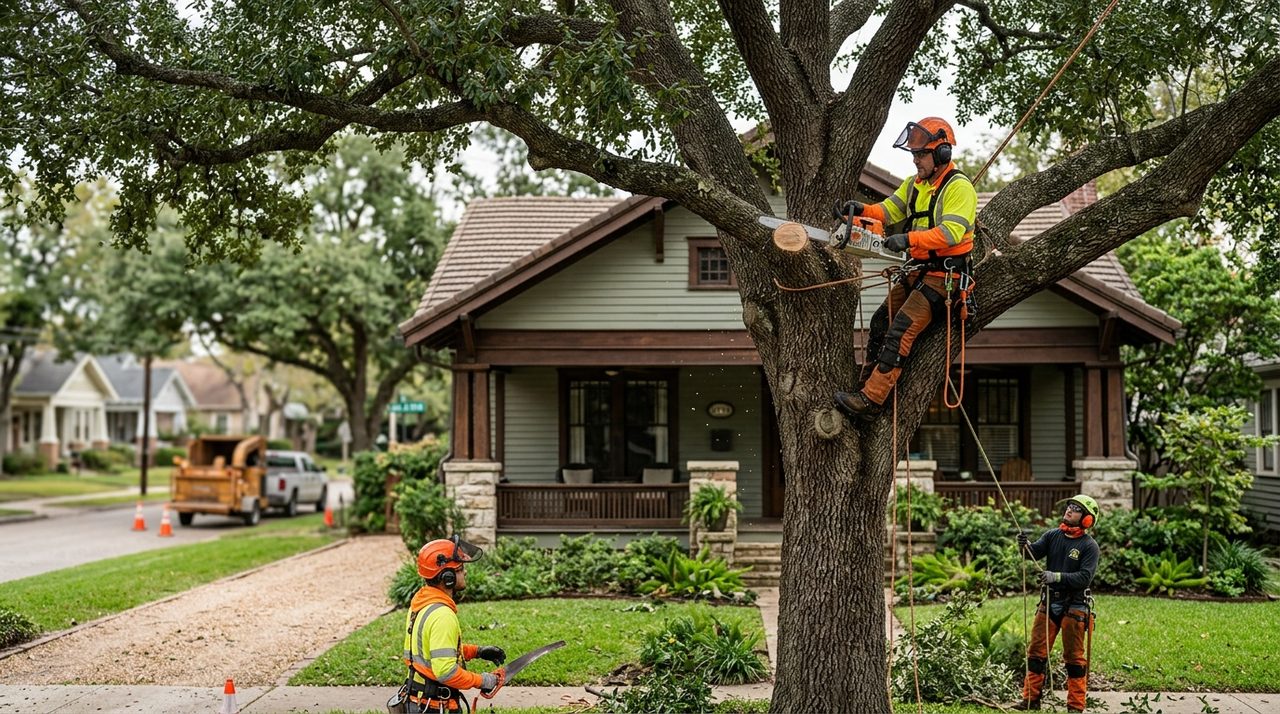
Qualified crews working in this footprint use sectional rigging — climbing the tree, cutting in controlled pieces, and lowering each section by rope to a ground handler — rather than dropping. This approach takes more crew time and raises per-tree cost; a mid-size tree (25–50 ft) that might run $750–$1,200 in an open suburban yard can realistically cost $1,400–$2,000 or more in a tight townhome cluster. Verify the contractor carries adequate liability coverage before work begins, since proximity to shared walls amplifies the cost of any equipment contact.
Sources: City of Houston Permitting Center
Why it matters to you
Buffalo Bayou's disturbed-soil banks are prime territory for Chinese tallow (Triadica sebifera), a state-listed invasive in Texas that seeds aggressively into neighboring yards from the bayou corridor running just south of Rice Military. The tree grows five or more feet per year and develops a root system that cracks the concrete flatwork surrounding townhome driveways and shared walkways. Stumps that are simply cut flush will resprout vigorously within a single growing season.
What a good pro does
Proper removal requires stump grinding to at least eight inches below grade — budget an additional $150–$300 per stump beyond the removal quote — followed by an herbicide treatment to the cambium layer or ground surface, which a contractor familiar with TCEQ guidelines on invasive management can advise on. Because tallow wood is often refused by standard green-waste recyclers, confirm disposal logistics before the job starts so debris doesn't sit on your curb through multiple garbage cycles.
Sources: Texas Commission on Environmental Quality, Harris County Flood Control District
Why it matters to you
The May 2024 derecho tracked directly through the Inner Loop with 100-plus mph straight-line winds, downing trees across Rice Military and creating a weeks-long backlog across every reputable Houston tree company. During that window, out-of-state crews with no local insurance or ISA credentials advertised aggressively in the neighborhood. On a block of attached townhomes, hiring an uninsured crew to remove a storm-split tree overhanging three units is a significant liability risk for every property owner involved.
What a good pro does
In the weeks following any named storm or major wind event, add 40–80 percent to normal cost estimates when budgeting. Prioritize contractors who can provide a current certificate of liability insurance (ask for it in writing, naming your address) and who hold ISA Certified Arborist credentials — ISA certification is the recognized voluntary standard in Texas, since the state has no licensing requirement for tree work through TDLR. Waiting two to four weeks post-storm often brings both better pricing and a more vetted contractor pool.
Sources: City of Houston Permitting Center
Hiring tree removal in Rice Military? Rice Military is a townhome-dominated Inner Loop neighborhood where most homes were built between the mid-1990s and 2010s on slab foundations. Homeowners typically deal with project-specific HOA requirements for exterior modifications, and the neighborhood's proximity to Buffalo Bayou makes flood risk and drainage a critical consideration for any ground-level work. Contractors should expect tight lot setbacks, shared walls, and rooftop deck maintenance as recurring service drivers.
Building era
1990s–2010s (dominant); scattered pre-1960s bungalows remain.
Typical style
Three-story attached and freestanding contemporary townhomes with stucco, brick, or mixed-material exteriors; roof decks common.
Foundations
Predominantly slab-on-grade for newer townhomes; remaining older bungalows may be pier-and-beam.
Common systems
Forced-air HVAC systems (typically 15–25 years old on earlier builds), copper or PEX plumbing, 200-amp electrical panels standard on townhome construction of this era.
What that means for repairs
Kitchen and bathroom remodels in first-generation 1990s townhomes are increasingly common as these units age. Roof deck waterproofing, stucco repair, and HVAC replacement on original equipment drive significant service demand. Some older bungalows are demolished for new townhome construction, requiring full demolition and new-build permitting.
Permit jurisdiction
City of Houston – Houston Permitting Center.
HOA & deed restrictions
No single mandatory master HOA for the neighborhood. The Rice Military Civic Club (RMCC) is a voluntary civic organization. Most individual townhome developments have their own mandatory HOAs or POAs (e.g., Courtyards of Detering Place). Deed restrictions are common at the project/subdivision level and must be confirmed per property via Harris County Clerk records.
Historic districts
No City of Houston historic district designation confirmed.
Contractor note
Contractors must verify the specific townhome development's HOA rules before beginning exterior work, as each project-level HOA may impose different architectural standards, color palettes, and material requirements. City of Houston permits are required for structural, electrical, plumbing, and mechanical work.
FEMA flood zone
FEMA Zone X (low flood risk) per official NFHL data. However, Rice Military is bounded on the south by Buffalo Bayou, and flood risk varies significantly at the parcel level. Elevation certificates and Harris County Flood Control District inundation maps should be consulted for properties near the bayou or at lower elevations.
Hurricane Harvey impact
Specific Harvey 2017 inundation data for Rice Military streets was not confirmed in available research. The neighborhood's adjacency to Buffalo Bayou—which experienced significant Harvey flooding—means some properties likely saw impact, but parcel-level documentation was not available. Local real estate professionals consistently flag flood risk and elevation as primary due-diligence items, suggesting meaningful flood history. Property-specific Harvey impact should be verified through Harris County Flood Control District records and individual elevation certificates.
Heat & humidity load
Three-story townhomes with roof decks experience extreme heat loading on upper floors during Houston summers, driving high HVAC demand and potential compressor strain. Flat or low-slope rooftop deck membranes are vulnerable to UV degradation and thermal cycling. Stucco exteriors may develop hairline cracks from thermal expansion, allowing moisture intrusion if not maintained.
Working with contractors here
Rice Military contractors most commonly handle HVAC replacements and maintenance on aging 1990s–2000s townhome systems, rooftop deck waterproofing and re-coating, and stucco facade repair. The dense townhome layout with minimal setbacks creates access challenges for exterior work, often requiring coordination with adjacent property owners or HOAs for scaffolding and equipment staging. Ground-floor flood mitigation—including backflow prevention, sump pump installation, and water-resistant finishing for garage-level spaces—is an important service category given Buffalo Bayou proximity. Contractors should confirm the specific development's HOA approval process before scoping exterior projects, as requirements vary significantly between complexes within the same neighborhood.
Local Tip
Always ask for a written estimate before work begins. Texas contractors are required to provide one on jobs over $1,000.
Rice Military is a townhome-dominated Inner Loop neighborhood where most homes were built between the mid-1990s and 2010s on slab foundations. Homeowners typically deal with project-specific HOA requirements for exterior modifications, and the neighborhood's proximity to Buffalo Bayou makes flood risk and drainage a critical consideration for any ground-level work. Contractors should expect tight lot setbacks, shared walls, and rooftop deck maintenance as recurring service drivers.
Source: U.S. Census Bureau, ACS 5-Year 2023
Most of Rice Military maps to FEMA Zone X (low mapped flood risk), but Houston's flash-flood reality means even low-risk blocks benefit from smart drainage and storm-hardened installs; risk climbs sharply on blocks nearest Buffalo Bayou, where it varies parcel to parcel.
Source: FEMA National Flood Hazard Layer (NFHL). Flood zones vary by parcel — verify your individual FIRM panel.
Beryl 2024 left tens of thousands of trees down across the Houston area, and lower-flood-risk zones like Rice Military were not spared from wind-throw damage that crushed vehicles, fences, and rooflines. Scheduling removal of any large tree with a cavity, dead crown, or proximity to your home now means you are not competing for post-storm crews when wait times stretch to weeks. In-city Rice Military work falls under City of Houston floodplain and permitting rules.
Proactive removal of trees with significant deadwood or structural defects in Rice Military costs a fraction of the emergency extraction and roof repair that follows a thunderstorm failure. Severe storms in the Houston area can produce 70-plus mph gusts with almost no advance warning, which means the pre-storm window is the only realistic time to act before a low-flood-risk yard becomes a debris field. Because Rice Military drains toward Buffalo Bayou, block-level runoff can differ sharply from the mapped zone.
Freeze-cracked bark and split branch unions caused by Uri 2021 left thousands of Houston-area trees with compromised structural integrity that persisted well into subsequent years, so Rice Military homeowners should request a post-freeze assessment even if no immediate failure occurred. A licensed contractor can identify cold-induced damage that will accelerate decay and create a hazard within one to three growing seasons. In-city Rice Military work falls under City of Houston floodplain and permitting rules.
Sources: FEMA National Flood Hazard Layer (NFHL), Ready.gov -- Hurricanes, CenterPoint Energy -- Storm Center, City of Houston -- Emergency Preparedness, Ready.gov -- Winter Weather, Harris County Flood Control District
Houston-specific estimators to plan your project before you call a pro. All results are planning estimates — a licensed local pro confirms the details on site.
Grouped by mature root aggression & water demand.
Trunk center to the nearest exterior wall.
The root zone likely reaches your foundation's soil during Houston's dry summers, when clay shrinks most. Watch for sticking doors and diagonal cracks, keep soil moisture even with a soaker hose during drought, and have a foundation pro evaluate if you see any movement.
Find a Houston foundation pro →This is a planning estimate only — actual requirements depend on an on-site assessment by a licensed Houston pro. Guidance is based on general species root behavior in expansive clay, not a soil test.
Disconnect & drain every outdoor hose bib
Remove hoses, drain the spigots, and cover each with an insulated faucet sock. Un-drained hose bibs are the #1 burst point in a Houston freeze.
Insulate exposed pipes in the attic & garage
Wrap any pipe in an unconditioned space (attic runs, garage walls) with foam sleeves. Houston homes rarely insulate these because they only matter a few nights a year — which is exactly why they burst.
Open cabinet doors & keep a pencil-width drip
On hard-freeze nights, open kitchen/bath cabinets so warm air reaches the pipes and let faucets on exterior walls drip to relieve pressure.
Protect the attic/garage water heater & its lines
An attic or garage tank sits in unconditioned space. Insulate the cold-inlet and hot-outlet lines and confirm the emergency drain pan is clear so a leak doesn't reach the ceiling.
This is a planning estimate only — actual requirements depend on an on-site assessment by a licensed Houston pro. If a pipe has already burst, shut off your main water supply and call a licensed Houston plumber immediately — freeze bursts flood fast.
Sources: City of Houston Permitting CenterLocal HOA / deed restrictions (see area profile)
Sources: Local HOA / deed restrictions (see area profile)
Sources: FEMA National Flood Hazard Layer (NFHL)City of Houston Permitting Center