Closed
21200 FM 362, Waller, TX 77484
Waller, TX sits on Waller County's native Vertisol clay northwest of Houston, where a split permit landscape—City of Waller for incorporated parcels, Waller County engineering for the unincorporated remainder—means your solar installer must confirm jurisdiction before pulling a single permit. The area's median home was built in 1987 and its mix of aging rural properties and newer Beacon Hill-era subdivisions creates genuinely different installation scenarios within the same zip code, from undersized electrical panels on older ranch homes to HOA-gated deed restrictions in newer communities. This page explains the four issues that actually drive cost and timeline for a solar project in Waller.
Ranked by verified Google rating × review volume × verification tier. How we rank →
Some highly-rated pros serve Waller from nearby and may not keep a Waller street address. Those are listed under "Also serving Waller" with their real city and distance, so you always know where each business is based.
21200 FM 362, Waller, TX 77484
Highly-rated pros based nearby who cover Waller. Distance shown from the Waller area.
Serving Waller Based in Hempstead · 8.3 mi away
Serving Waller Based in Hempstead · 9.5 mi away
Why it matters to you
Unlike Houston suburbs with clear municipal boundaries, Waller's incorporated city limits and the surrounding unincorporated Waller County territory share the same mailing addresses and ZIP codes. A solar installer who files with the wrong authority—say, submitting to Waller County engineering when the parcel actually falls within City of Waller jurisdiction—can trigger a project restart, adding weeks to an interconnection timeline that already requires CenterPoint Energy approval before the system can be energized.
What a good pro does
A qualified installer will look up the parcel's official jurisdiction in Waller County's appraisal district records before any submittal, then pull the correct electrical and building permits from the applicable office. All permitted Texas solar installations require a licensed master electrician to pull the permit under TDLR rules, so verify your contractor's TDLR Electrical Contractor license number and confirm it is active before signing a contract.
Sources: Municipal permit office (see area profile), Texas Department of Licensing & Regulation
Why it matters to you
Waller County sits squarely on the same Houston–Beaumont Black clay Vertisol series that covers most of the Katy Prairie, and that soil swells up to four inches seasonally. Homeowners on larger rural lots in unincorporated Waller County often prefer ground-mount arrays to avoid roof penetrations, but standard helical pier or concrete-ballasted footing specs designed for flatter-swelling Great Plains soils routinely misalign within two to three years on this clay, voiding manufacturer tilt warranties and requiring costly re-leveling.
What a good pro does
On Waller County clay, a responsible installer specifies footings engineered to local geotechnical conditions—deeper piers or grade-beam designs that account for seasonal heave—rather than off-the-shelf specs. Expect ground-mount systems here to run an estimated 20–35% more per watt than a comparable roof-mount due to the engineered footing and underground conduit trenching requirements; get that scope itemized in writing before signing.
Sources: International Residential Code (as adopted by City of Houston), FEMA National Flood Hazard Layer (NFHL)
Why it matters to you
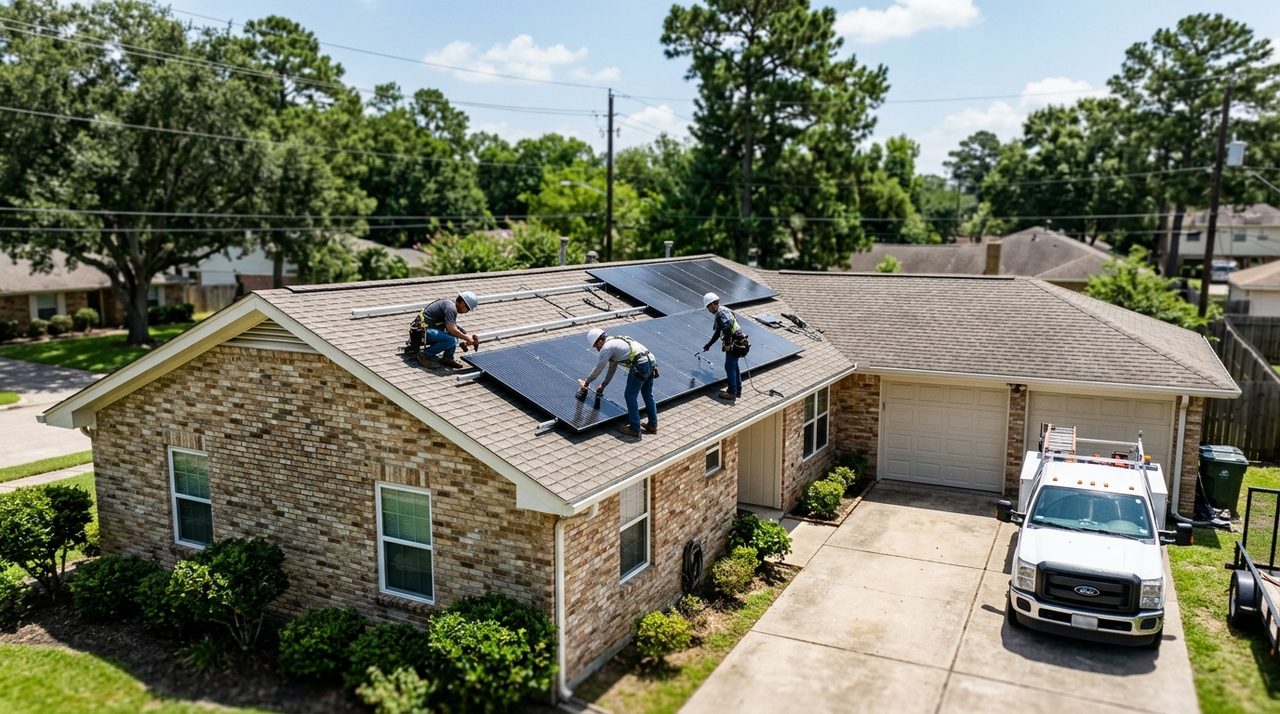
Waller's Census median year built is 1987, meaning a substantial share of the housing stock is approaching or past 35 years old. Houston's UV index of 10–11 and summer humidity degrade standard 3-tab asphalt shingles in 12–15 years rather than the rated 20–25, so a roof installed in the early 2000s on one of these homes may already be at end of life. An installer who mounts a 25-year panel array on a borderline roof is setting up a homeowner for an estimated $8,000–$14,000 panel-removal-and-reinstall bill when a re-roof becomes unavoidable within five years—a cost that is almost never disclosed upfront.
What a good pro does
Before finalizing any proposal, a thorough installer should document roof age and condition—ideally with photos and remaining shingle life estimate—and factor in a re-roof if the roof is older than 12–15 years. If a re-roof is needed first, bundling it with the solar project allows flashing and penetration work to be done once correctly, and a licensed roofing contractor should coordinate directly with the solar crew on underlayment and flashing specs.
Sources: International Residential Code (as adopted by City of Houston), ENERGY STAR / U.S. Dept. of Energy
Why it matters to you
Waller sits in the same climate band as greater Houston, with roughly 3,000 cooling degree days annually and a summer that runs from May through September. A typical 2,200-square-foot home here will use 1,400–1,800 kWh per month during peak cooling months, and older 1980s-era rural homes with minimal attic insulation run even higher. Installers who use national average consumption figures instead of your actual CenterPoint billing history routinely design systems that offset only 40–50% of real load rather than the 80–100% they quote.
What a good pro does
Insist that your installer pull 12 months of CenterPoint interval usage data—not just a bill average—before finalizing system size. For older Waller homes with a pool pump, aging HVAC, or plans to add an EV charger, model those loads explicitly. A NABCEP-certified PV Installation Professional has the training to perform a load analysis calibrated to actual Houston climate data rather than generic national tables.
Sources: North American Board of Certified Energy Practitioners (NABCEP), ENERGY STAR / U.S. Dept. of Energy
Hiring solar installers in Waller? Waller sits in unincorporated and incorporated areas of Waller County northwest of Houston, featuring a mix of older rural properties and newer subdivision development. Homeowners here benefit from relatively low flood risk but should verify deed restrictions and permit jurisdiction on a parcel-by-parcel basis, as the regulatory landscape varies significantly across the area.
Building era
Not confirmed - housing stock spans multiple decades, with newer construction (2010s–2020s) appearing in subdivisions like Beacon Hill alongside older rural properties.
Typical style
Not confirmed - likely a mix of ranch-style homes on larger lots and newer suburban construction in master-planned communities.
Foundations
Not confirmed - slab-on-grade is typical for newer construction in the region; older properties may include pier-and-beam.
Common systems
Not confirmed - newer homes likely feature modern central HVAC and PEX plumbing; older rural properties may have aging systems requiring updates.
What that means for repairs
Not confirmed - older rural properties in the area likely drive demand for system upgrades (HVAC, plumbing, electrical), while newer subdivision homes may require cosmetic updates and outdoor living additions.
Permit jurisdiction
Not confirmed with certainty. Properties within the City of Waller would use the City of Waller permit office; properties in unincorporated Waller County would fall under Waller County engineering. Verify jurisdiction by parcel address.
HOA & deed restrictions
Not confirmed - some subdivisions in the Waller area may have mandatory HOAs or POAs, but no specific HOA was identified for the broader Waller community. Check deed and Waller County real property records or the TREC HOA Management Certificate database.
Historic districts
No City of Houston historic district designation confirmed. Waller is outside the City of Houston and HAHC jurisdiction.
Contractor note
Contractors should verify whether each job site falls within the City of Waller or unincorporated Waller County, as permit requirements and inspection processes differ. Deed restrictions, if any, should be confirmed through Waller County Clerk records before beginning exterior modifications.
FEMA flood zone
FEMA Zone X (low flood risk) - source: fema_nfhl. Specific bayou or creek proximity for individual parcels should be verified, but the overall area carries minimal federally designated flood risk.
Hurricane Harvey impact
Not confirmed - no street-level flood data or Harvey inundation records were found for the specific Waller neighborhood area. Check Harris County and Waller County flood claim records for parcel-specific Harvey impact.
Heat & humidity load
Houston-area summers bring sustained high heat and humidity. Homes in Waller, particularly older rural structures, may experience increased HVAC strain, moisture intrusion issues, and foundation movement during prolonged dry spells. Newer subdivision homes benefit from modern insulation and drainage but still require regular HVAC maintenance and attic ventilation checks.
Working with contractors here
Contractors working in Waller encounter a split market: newer subdivision homes needing warranty-era repairs, outdoor living additions, and fence installations, alongside older rural properties requiring full system overhauls including HVAC replacement, re-plumbing, and electrical panel upgrades. The low flood risk reduces demand for flood mitigation work, but foundation monitoring remains important given the expansive clay soils common across Waller County. Job scoping should account for potentially longer material delivery times given the area's distance from central Houston supply hubs, and contractors must confirm the applicable permit jurisdiction before starting work.
Local Tip
Always ask for a written estimate before work begins. Texas contractors are required to provide one on jobs over $1,000.
Waller sits in unincorporated and incorporated areas of Waller County northwest of Houston, featuring a mix of older rural properties and newer subdivision development. Homeowners here benefit from relatively low flood risk but should verify deed restrictions and permit jurisdiction on a parcel-by-parcel basis, as the regulatory landscape varies significantly across the area.
Source: U.S. Census Bureau, ACS 5-Year 2023
Most of Waller maps to FEMA Zone X (low mapped flood risk), but Houston's flash-flood reality means even low-risk blocks benefit from smart drainage and storm-hardened installs.
Source: FEMA National Flood Hazard Layer (NFHL). Flood zones vary by parcel — verify your individual FIRM panel.
Wind damage, not flooding, is the primary hurricane threat for solar systems in lower-risk Waller, TX, so prioritize a pre-season inspection confirming your racking's hurricane-rated uplift capacity meets the local design wind speed in the City of Houston building code. Loose or improperly torqued rail clamps were a leading cause of panel loss across the metro after Beryl 2024's sustained tropical-force winds. As a Waller County community, Waller may follow county rather than City of Houston storm rebuild rules.
Hail damage to solar panels in Waller, TX is often invisible from the ground but detectable through performance monitoring — if your system's daily output drops noticeably after a storm, that is a signal to request a licensed inspection before the damage compounds. Cracked panel glass also creates a ground-fault risk that your inverter's built-in GFCI may flag as an error code. As a Waller County community, Waller may follow county rather than City of Houston storm rebuild rules.
Ice accumulation temporarily cuts solar panel output in Waller, TX, but the larger freeze-related risk for solar homeowners is an inverter or battery enclosure mounted in an uninsulated garage or attic space exposed to sub-freezing temperatures — equipment manufacturers specify minimum operating temperatures, and falling below them can cause shutdowns or permanent damage. Ask your installer to confirm all system components are within their rated temperature range before the next hard freeze. Confirm the current FEMA panel for your Waller parcel — the area maps to Zone X, but adjacent lots can differ.
Sources: FEMA National Flood Hazard Layer (NFHL), Ready.gov -- Hurricanes, CenterPoint Energy -- Storm Center, City of Houston -- Emergency Preparedness, Ready.gov -- Winter Weather, Harris County Flood Control District
Houston-specific estimators to plan your project before you call a pro. All results are planning estimates — a licensed local pro confirms the details on site.
Disconnect & drain every outdoor hose bib
Remove hoses, drain the spigots, and cover each with an insulated faucet sock. Un-drained hose bibs are the #1 burst point in a Houston freeze.
Insulate exposed pipes in the attic & garage
Wrap any pipe in an unconditioned space (attic runs, garage walls) with foam sleeves. Houston homes rarely insulate these because they only matter a few nights a year — which is exactly why they burst.
Open cabinet doors & keep a pencil-width drip
On hard-freeze nights, open kitchen/bath cabinets so warm air reaches the pipes and let faucets on exterior walls drip to relieve pressure.
Protect the attic/garage water heater & its lines
An attic or garage tank sits in unconditioned space. Insulate the cold-inlet and hot-outlet lines and confirm the emergency drain pan is clear so a leak doesn't reach the ceiling.
This is a planning estimate only — actual requirements depend on an on-site assessment by a licensed Houston pro. If a pipe has already burst, shut off your main water supply and call a licensed Houston plumber immediately — freeze bursts flood fast.
Sources: Texas Department of Licensing & RegulationMunicipal permit office (see area profile)
Sources: Texas Department of Licensing & RegulationInternational Residential Code (as adopted by City of Houston)
Sources: Local HOA / deed restrictions (see area profile)
Sources: Municipal permit office (see area profile)
Sources: Texas Department of Licensing & RegulationNorth American Board of Certified Energy Practitioners (NABCEP)