Closed
5301 Polk St building 14 F14, Houston, TX 77023
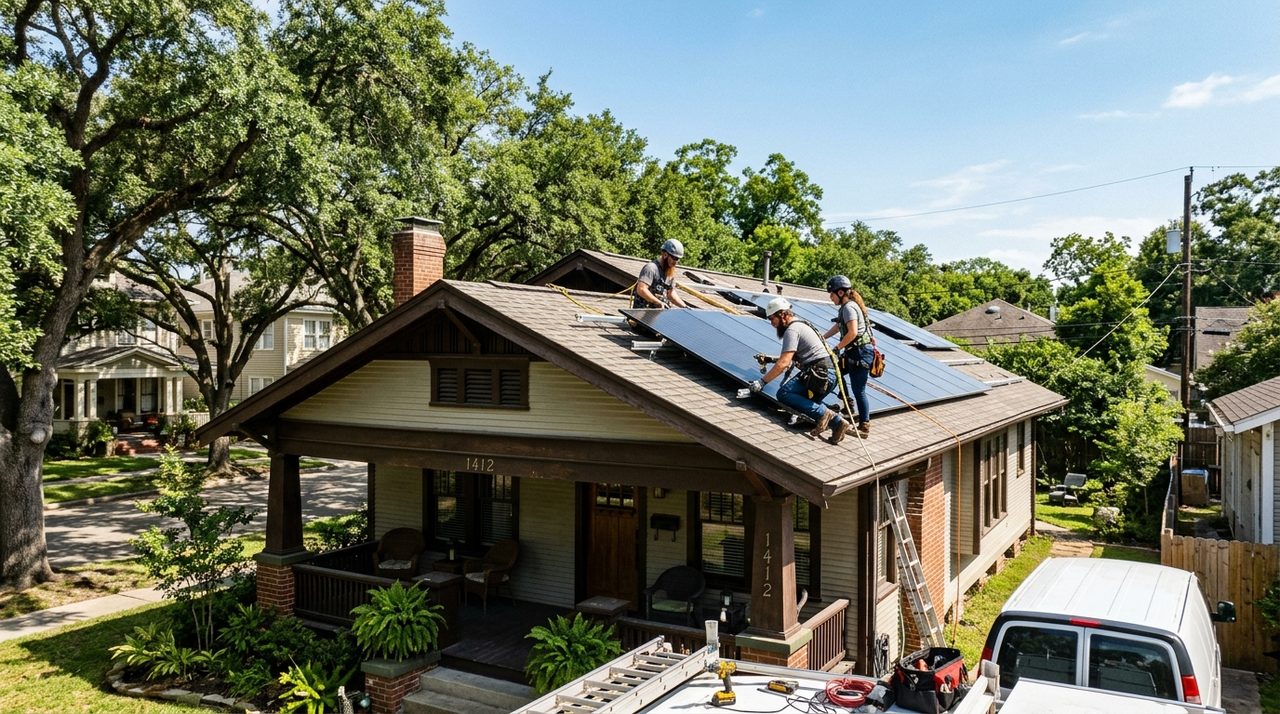
EaDo's rapid townhome infill has layered brand-new 200-amp panels and modern rooflines on top of a neighborhood where the next parcel over might be a 1960s legacy structure with outdated wiring and a flat or low-slope roof — both extremes change what a solar installation actually costs and requires. Every EaDo project starts with a parcel-level audit: which development HOA (if any) governs exterior changes, what the roof age and pitch look like on that specific lot, and how the City of Houston Permitting Center queue will affect your timeline. Getting those answers upfront is what separates a smooth City of Houston-permitted install from a project that stalls mid-construction.
Ranked by verified Google rating × review volume × verification tier. How we rank →
Some highly-rated pros serve EaDo from nearby and may not keep a EaDo street address. Those are listed under "Also serving EaDo" with their real city and distance, so you always know where each business is based.
5301 Polk St building 14 F14, Houston, TX 77023
5433 Kelley St, Houston, TX 77026
Highly-rated pros based nearby who cover EaDo. Distance shown from the EaDo area.
Serving EaDo Based in Midtown · 1.2 mi away
Serving EaDo Based in Midtown · 1.3 mi away
Serving EaDo Based in Midtown · 1.3 mi away
Serving EaDo Based in Midtown · 1.4 mi away
Serving EaDo Based in Midtown · 1.5 mi away
Serving EaDo Based in Medical Center · 4 mi away
Serving EaDo Based in Lazybrook / Timbergrove · 4.3 mi away
Why it matters to you
EaDo has no single neighborhood-wide HOA, but dozens of development-specific associations — including EaDo Square Townhome Association and EADO Edge Homeowners Association — each with their own architectural review requirements for exterior modifications. Texas Property Code §202.010 protects your right to install solar, but it also allows HOAs to require placement that is 'not visible from the street,' which on a dense townhome lot with a street-facing primary slope can force a rear or east-facing array that cuts production by 15–25% compared to optimal south-facing. Adjacent properties in EaDo may operate under entirely different deed restrictions, so your neighbor's approved install is not a guarantee yours will follow the same rules.
What a good pro does
A qualified installer will pull Harris County Clerk deed restriction records and contact your specific development HOA for written architectural approval before submitting any permit. They should model the production impact of any HOA-mandated orientation change and show you that adjusted output figure — not the optimal-south number — so you can make an informed financial decision. The permit itself goes through the City of Houston Permitting Center, which requires a licensed master electrician on the pull, independent of HOA approval timing.
Sources: Local HOA / deed restrictions (see area profile), Municipal permit office (see area profile), Texas Department of Licensing & Regulation
Why it matters to you
While newer EaDo townhomes typically come with 200-amp panels suited for solar interconnection, the older single-family and commercial-conversion structures scattered through the neighborhood — many dating to the 1960s and 1970s given the census median year built of 1970 — frequently have 100-amp or even 60-amp service that cannot safely support a grid-tied solar array plus battery backup. Attempting to interconnect a modern inverter to undersized service creates a code violation and a real fire risk, and CenterPoint will reject the interconnection application until the panel meets current standards.
What a good pro does
Before any racking goes on the roof, a reputable installer performs a service entrance inspection and confirms the panel amperage, breaker condition, and grounding meet current NEC requirements as adopted by the City of Houston. If an upgrade is needed, expect to add $2,000–$5,000 (est.) to the project budget for a licensed master electrician to pull a separate electrical permit through the Houston Permitting Center. TDLR requires that all electrical work on a permitted solar project be performed or supervised by a licensed electrical contractor — verify that credential before signing any contract.
Sources: Texas Department of Licensing & Regulation, Municipal permit office (see area profile), International Residential Code (as adopted by City of Houston)
Why it matters to you
Legacy structures in EaDo frequently have flat or very low-slope roofs — common on the brick ranch and commercial-hybrid buildings that predate the current infill wave. Houston averages 52 inches of rain annually and routinely delivers 10-plus-inch single-storm events; ballasted racking on these roofs ponds water around mounting bases, accelerates membrane degradation, and generates warranty disputes between the roofing contractor and solar installer within three to five years. The combination of Houston's UV index averaging 10–11 and high summer humidity also degrades standard modified-bitumen and TPO membranes faster than manufacturers' rated lifespans assume.
What a good pro does
A thorough installer will measure roof slope, inspect membrane condition and age, and provide a written assessment of whether the roof can support a 25-year array without a re-roof first. If the membrane is within five years of end of life, coordinating a roof replacement before installation — typically $8,000–$18,000 (est.) depending on material and pitch — eliminates the costly remove-and-reinstall scenario later. On confirmed low-slope roofs, installers should specify penetration-based attachments with certified waterproofing boots rather than ballasted systems, and document the install method in the City of Houston permit submittal.
Sources: Municipal permit office (see area profile), International Residential Code (as adopted by City of Houston), ENERGY STAR / U.S. Dept. of Energy
Why it matters to you
EaDo's newer multi-story townhomes pack 2,000-plus square feet into tight footprints with significant glass exposure, west-facing walls absorbing afternoon heat, and urban heat island effect from surrounding commercial and concrete surfaces — all of which drive cooling loads above national norms. A typical Houston home of that size uses 1,400–1,800 kWh per month during peak cooling months, and installers who size systems using national average consumption data rather than CenterPoint historical interval data routinely deliver arrays that offset only 40–50% of actual load instead of the 80–100% promised in the sales presentation.
What a good pro does
Insist that your installer pull at least 12 months of your actual CenterPoint usage data — available through your online account or a signed data-release authorization — and size the array against your real peak months, not a generic Houston average. For townhomes with roof area limited by the footprint and shared walls, an honest production model may show that full offset requires a battery-paired system to shift grid draw to off-peak hours, which adds $10,000–$14,000 (est.) per battery unit installed but changes the economics meaningfully. NABCEP-certified installers are trained in accurate load analysis; ask to see the production model and the assumptions behind it before signing.
Sources: North American Board of Certified Energy Practitioners (NABCEP), ENERGY STAR / U.S. Dept. of Energy, Texas Department of Licensing & Regulation
Hiring solar installers in EaDo? EaDo is a fast-evolving Inner Loop neighborhood dominated by newer townhome and condo developments interspersed with older commercial and residential parcels. Homeowners must verify HOA obligations, deed restrictions, and flood risk on a parcel-by-parcel basis, as there is no single neighborhood-wide governing structure. Contractors working here encounter a wide range of building vintages and systems, from brand-new construction to legacy structures requiring full-system upgrades.
Building era
Not confirmed from available sources — significant newer infill (2010s–2020s townhomes) alongside older legacy structures of varied vintage.
Typical style
Not confirmed neighborhood-wide — newer stock is predominantly modern townhome and condo construction; older parcels vary.
Foundations
Not confirmed — newer townhomes typically slab-on-grade, but older structures may include pier-and-beam; verify per parcel.
Common systems
Newer townhomes typically feature modern HVAC (high-efficiency split systems), PEX or copper plumbing, and updated electrical panels; older structures may have outdated systems requiring upgrades.
What that means for repairs
Renovation activity is driven by older parcels being redeveloped or updated to match the neighborhood's rapid gentrification. Interior remodels, full gut-rehabs of legacy structures, and new-build townhome fit-outs are all common.
Permit jurisdiction
City of Houston — Houston Permitting Center.
HOA & deed restrictions
No single neighborhood-wide mandatory HOA. Multiple development-specific mandatory HOAs exist, including EaDo Square Townhome Association and EADO Edge Homeowners Association. Many older single-family lots have no HOA. Deed restrictions vary by subdivision — check Harris County Clerk records for specific parcels.
Historic districts
No City of Houston historic district designation confirmed. Check the City of Houston historic-district map and parcel records for site-specific status.
Contractor note
Contractors must determine whether a specific property falls under a development HOA with architectural review requirements before beginning exterior work. Always verify deed restrictions and HOA bylaws at the parcel level, as adjacent properties may have entirely different governing structures.
FEMA flood zone
FEMA Zone X (low flood risk). EaDo is located east of Downtown Houston in proximity to Buffalo Bayou and its tributaries; while the FEMA designation indicates low risk, site-specific elevation and drainage conditions should be verified, especially for parcels closer to bayou corridors.
Hurricane Harvey impact
Not confirmed from available research whether EaDo experienced significant flooding during Hurricane Harvey 2017. Flood impact should be evaluated parcel-by-parcel using FEMA flood maps, elevation certificates, and Harris County Flood Control District records. No specific recurring-flood streets were identified in research.
Heat & humidity load
Houston's extreme summer heat and humidity place heavy demand on HVAC systems in newer townhomes with large window expanses and flat roofs. Newer construction generally handles moisture well, but older structures may face condensation, mold, and drainage issues. Flat-roof townhome designs require vigilant roof maintenance and drainage inspections during heavy summer rain events.
Working with contractors here
Contractors in EaDo most commonly work on newer townhome warranty-period punch lists, HVAC optimization for multi-story townhome layouts, and full renovations of older legacy structures being brought up to modern standards. The mix of building vintages means job scoping must account for whether a property is a 2020s new-build with builder-grade finishes or an older structure potentially requiring foundation evaluation, re-plumbing, and electrical panel upgrades. Multi-story townhome access can present challenges for exterior work, particularly with tight lot lines and shared walls. Contractors should always confirm HOA approval requirements before exterior modifications, as development-specific HOAs may require architectural review even for seemingly minor changes.
Local Tip
Always ask for a written estimate before work begins. Texas contractors are required to provide one on jobs over $1,000.
EaDo is a fast-evolving Inner Loop neighborhood dominated by newer townhome and condo developments interspersed with older commercial and residential parcels. Homeowners must verify HOA obligations, deed restrictions, and flood risk on a parcel-by-parcel basis, as there is no single neighborhood-wide governing structure. Contractors working here encounter a wide range of building vintages and systems, from brand-new construction to legacy structures requiring full-system upgrades.
Source: U.S. Census Bureau, ACS 5-Year 2023
Most of EaDo maps to FEMA Zone X (low mapped flood risk), but Houston's flash-flood reality means even low-risk blocks benefit from smart drainage and storm-hardened installs; risk climbs sharply on blocks nearest Buffalo Bayou, where it varies parcel to parcel.
Source: FEMA National Flood Hazard Layer (NFHL). Flood zones vary by parcel — verify your individual FIRM panel.
Wind damage, not flooding, is the primary hurricane threat for solar systems in lower-risk EaDo, so prioritize a pre-season inspection confirming your racking's hurricane-rated uplift capacity meets the local design wind speed in the City of Houston building code. Loose or improperly torqued rail clamps were a leading cause of panel loss across the metro after Beryl 2024's sustained tropical-force winds. Much of the housing stock predates modern wind codes (median build year 1970), so retrofits matter more here. Confirm the current FEMA panel for your EaDo parcel — the area maps to Zone X, but adjacent lots can differ.
Hail damage to solar panels in EaDo is often invisible from the ground but detectable through performance monitoring — if your system's daily output drops noticeably after a storm, that is a signal to request a licensed inspection before the damage compounds. Cracked panel glass also creates a ground-fault risk that your inverter's built-in GFCI may flag as an error code. Confirm the current FEMA panel for your EaDo parcel — the area maps to Zone X, but adjacent lots can differ.
Winter Storm Uri demonstrated that even low-flood-risk areas of the Houston metro face multi-day power outages when the ERCOT grid is stressed; solar homeowners in EaDo should test their battery backup system's automatic transfer function annually, ideally before December, to confirm it will island critical loads smoothly if the grid fails during a freeze. A TDLR-licensed solar technician can perform this test and verify that the rapid-shutdown system resets correctly when grid power is restored. With a median build year of 1970, the older building stock here is more exposed to hard-freeze damage than newer construction. In-city EaDo work falls under City of Houston floodplain and permitting rules.
Sources: FEMA National Flood Hazard Layer (NFHL), Ready.gov -- Hurricanes, CenterPoint Energy -- Storm Center, City of Houston -- Emergency Preparedness, Ready.gov -- Winter Weather, Harris County Flood Control District
Houston-specific estimators to plan your project before you call a pro. All results are planning estimates — a licensed local pro confirms the details on site.
Disconnect & drain every outdoor hose bib
Remove hoses, drain the spigots, and cover each with an insulated faucet sock. Un-drained hose bibs are the #1 burst point in a Houston freeze.
Insulate exposed pipes in the attic & garage
Wrap any pipe in an unconditioned space (attic runs, garage walls) with foam sleeves. Houston homes rarely insulate these because they only matter a few nights a year — which is exactly why they burst.
Open cabinet doors & keep a pencil-width drip
On hard-freeze nights, open kitchen/bath cabinets so warm air reaches the pipes and let faucets on exterior walls drip to relieve pressure.
Protect the attic/garage water heater & its lines
An attic or garage tank sits in unconditioned space. Insulate the cold-inlet and hot-outlet lines and confirm the emergency drain pan is clear so a leak doesn't reach the ceiling.
This is a planning estimate only — actual requirements depend on an on-site assessment by a licensed Houston pro. If a pipe has already burst, shut off your main water supply and call a licensed Houston plumber immediately — freeze bursts flood fast.
Sources: City of Houston Permitting CenterMunicipal permit office (see area profile)
Sources: Municipal permit office (see area profile)
Sources: Texas Department of Licensing & RegulationNorth American Board of Certified Energy Practitioners (NABCEP)