11011 Brooklet Dr Ste 340, Houston, TX 77099
Best Solar Installers in Alief
Alief's thousands of 1970s–1990s ranch-style homes on Houston Black clay sit inside City of Houston permit jurisdiction—meaning your solar project must clear the COH Permitting Center and a CenterPoint Energy interconnection queue before a single watt flows back to the grid. With a census median build year of 1986 and many original roofs now approaching or past their useful life, Alief homeowners face a layered decision: assess the roof, the electrical panel, and subdivision-level deed restrictions before committing to an array.
Verified against Google Business data
Updated 2026
See the 10 Solar Installers Serving Alief 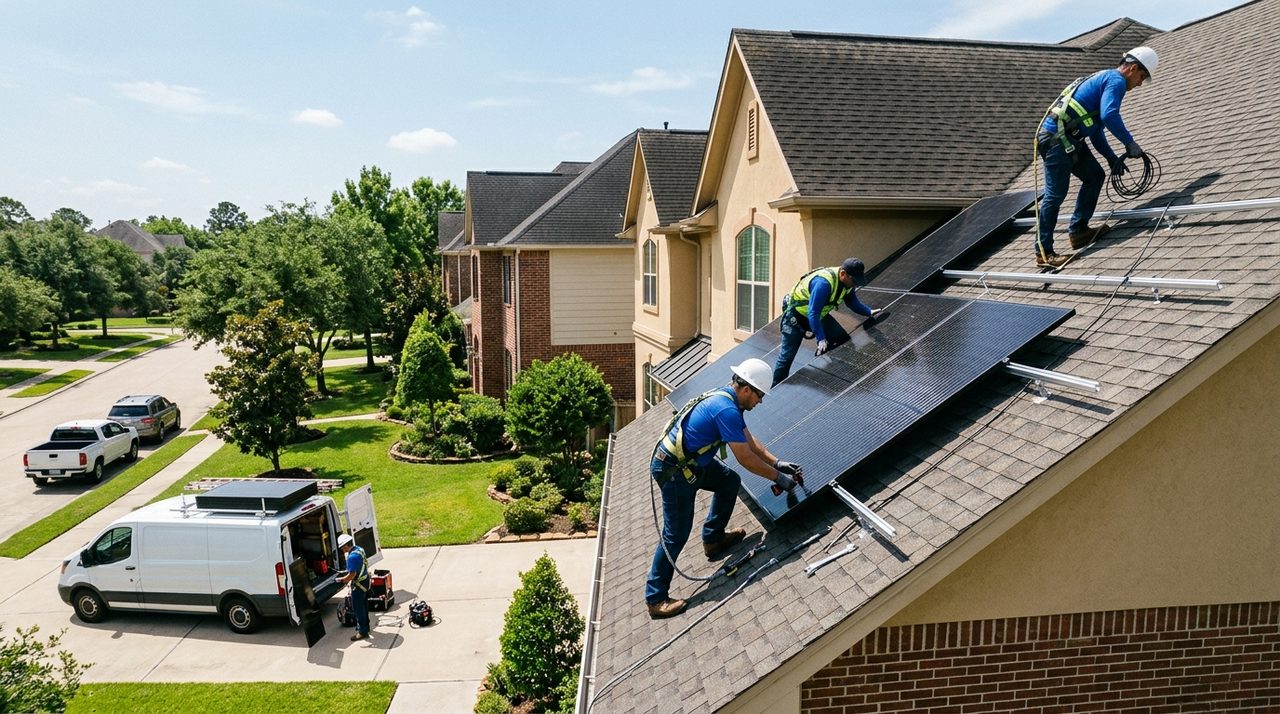
- Median home built
- 1986
- Median home value
- $203,097
- FEMA flood zone
- X500 (moderate)
- Typical system cost (est., before 30% ITC)
- $22,000–$35,000 for 8–10 kW
- Most common local issue
- Aging roofs (median build 1986) requiring replacement before panel mounting
Ranked by verified Google rating × review volume × verification tier. How we rank →
Some highly-rated pros serve Alief from nearby and may not keep a Alief street address. Those are listed under "Also serving Alief" with their real city and distance, so you always know where each business is based.
Min rating:
10 resultsBased in Alief
Also serving Alief
Highly-rated pros based nearby who cover Alief. Distance shown from the Alief area.
Closed
Serving Alief Based in Briargrove · 3.5 mi away
Closed
Serving Alief Based in Sharpstown · 4 mi away
Closed
Serving Alief Based in Stafford · 5.1 mi away
Open Now
Serving Alief Based in Meyerland · 5.5 mi away
Serving Alief Based in Energy Corridor · 5.6 mi away
Closed
Serving Alief Based in Spring Branch · 5.6 mi away
Closed
Serving Alief Based in Bellaire · 5.7 mi away
Closed
Serving Alief Based in Spring Branch · 5.8 mi away
Closed
Serving Alief Based in Bellaire · 5.9 mi away
Solar Installers in Alief: What You Should Know
Alief's 1986-Era Roofs Are Running Out of Time Beneath a 25-Year Panel Array
Why it matters to you
With a neighborhood median build year of 1986, many Alief homes carry original or early-replacement 3-tab asphalt shingles that Houston's combination of 95°F+ heat, UV index averaging 10–11, and Gulf humidity degrades in 12–15 years rather than the rated 20–25. Mounting a panel array on a roof that has 5 or fewer years of useful life left means paying $8,000–$14,000 (estimated) to remove and reinstall panels for a re-roof—a cost most installers do not volunteer upfront.
What a good pro does
Before signing a solar contract, request a written roof-age assessment from the installer or an independent roofer. A qualified installer will document shingle condition in the structural submittal to the City of Houston Permitting Center and will not mount racking until remaining roof life exceeds the panel warranty term. If a re-roof is needed first, get that scope in writing as a separate line item so you can compare bids.
Sources: City of Houston Permitting Center, International Residential Code (as adopted by City of Houston)
Subdivision-by-Subdivision HOA Rules Can Quietly Shrink Your Array's Output
Why it matters to you
Alief has no single area-wide HOA—some subdivisions such as Park West have mandatory architectural review boards while others operate only through civic clubs with no binding authority. Texas Property Code §202.010 protects your right to install solar, but it also allows HOAs to require placement that keeps panels 'not visible from the street,' which in Alief's typical east-west-oriented ranch lots can force an east-facing or rear-slope layout that cuts production 15–25% compared to an optimal south-facing array.
What a good pro does
Pull your subdivision's deed restrictions from Harris County deed records before getting quotes so installers can model the production impact of a restricted placement. A good installer will provide side-by-side energy yield estimates for compliant versus optimal orientations. If your subdivision has no active HOA, get that confirmed in writing so the installer does not over-engineer the submittal process.
Sources: Local HOA / deed restrictions (see area profile), City of Houston Permitting Center
Pre-2000 Electrical Panels in Older Alief Homes Block Battery Integration
Why it matters to you
Alief homes built in the 1970s and 1980s commonly have 100A or early 150A panels that lack the capacity headroom required by post-Uri battery systems such as Tesla Powerwall or Enphase IQ Battery. Beyond capacity, City of Houston and CenterPoint's interconnection tariff for storage-paired systems requires a separate metering application that adds 6–10 weeks to a project timeline—and that clock does not start until the electrical permit is active at the COH Permitting Center.
What a good pro does
Ask any installer to pull your CenterPoint account's 12-month usage data and inspect your existing panel before quoting. If a panel upgrade to 200A is required, it must be performed by a master electrician licensed through TDLR and permitted through the City of Houston—confirm this is included in the project scope and not a surprise add-on after contract signing.
Sources: Texas Department of Licensing & Regulation, City of Houston Permitting Center, Municipal permit office (see area profile)
Houston's 9-Month Cooling Season Means Undersized Systems Are the Norm, Not the Exception
Why it matters to you
Alief's dense residential blocks, older insulation standards in 1970s–1980s construction, and FEMA Zone X500 designation (which means elevated humidity from recurring heavy-rain events) combine to push monthly electricity use to 1,400–1,800 kWh during June–September. Installers who size systems using national average consumption figures rather than your actual CenterPoint billing history routinely deliver arrays that offset only 40–50% of real load instead of the 80–100% marketed.
What a good pro does
Provide at least 12 months of CenterPoint billing statements to every installer you interview and require that the production estimate be modeled against your actual peak-summer usage, not a regional average. NABCEP-certified installers are trained in site-specific load analysis; verifying that credential through NABCEP's public directory adds a meaningful quality screen for Alief homeowners making a $22,000–$35,000 (estimated) commitment.
Sources: North American Board of Certified Energy Practitioners (NABCEP), ENERGY STAR / U.S. Dept. of Energy, FEMA National Flood Hazard Layer (NFHL)
Solar Installers in Alief: What You Should Know
Hiring solar installers in Alief? Alief is a large, diverse area in southwest Houston encompassing dozens of individual subdivisions, each with its own governance structure, housing stock, and deed restrictions. Homeowners should verify their specific subdivision's HOA status, deed restrictions, and flood history at the parcel level rather than relying on area-wide generalizations. The moderate flood risk zone and aging housing stock across many tracts drive significant demand for plumbing, foundation, and weatherproofing services.
- Housing era
- Not confirmed at the neighborhood-wide level — varies by subdivision
- Foundation
- Primarily slab-on-grade, consistent with Houston-area construction norms, but not universally confirmed across all Alief…
- Flood zone
- FEMA Zone X500 (moderate flood risk) — source
- Permits
- City of Houston Permitting Center (Alief is generally within Houston city limits, though boundary…
Housing stock & systems
Building era
Not confirmed at the neighborhood-wide level — varies by subdivision. Many tracts developed from the 1970s through 1990s, but this should be verified tract-by-tract.
Typical style
Not confirmed — Alief includes a mix of single-family ranch-style homes, townhomes, and multi-family units depending on the subdivision.
Foundations
Primarily slab-on-grade, consistent with Houston-area construction norms, but not universally confirmed across all Alief subdivisions.
Common systems
Homes from the 1970s–1990s era typically feature central HVAC systems that may need replacement, copper or galvanized plumbing (older tracts), and electrical panels that may require upgrading to modern standards.
What that means for repairs
Not confirmed at the area-wide level. Given the likely age range of housing stock, common renovation activity likely includes HVAC replacement, re-piping from galvanized to PEX or copper, roof replacement, and kitchen/bath modernization.
Permits & restrictions
Permit jurisdiction
City of Houston Permitting Center (Alief is generally within Houston city limits, though boundary verification is recommended for any specific address).
HOA & deed restrictions
No single area-wide HOA governs Alief. Some subdivisions have mandatory HOAs (e.g., Park West Community Association, Inc.). Others are organized only through civic clubs or the Alief Super Neighborhood Council, which is a community forum, not an HOA. Check Harris County deed records for the specific subdivision.
Historic districts
No City of Houston historic district designation confirmed. No evidence found that any part of Alief requires HAHC Certificates of Appropriateness.
Contractor note
Contractors must verify the specific subdivision's HOA requirements before beginning exterior work, as rules vary dramatically across Alief. Confirm the property is within Houston city limits for correct permitting jurisdiction.
Flood & weather
FEMA flood zone
FEMA Zone X500 (moderate flood risk) — source: fema_nfhl. Alief is situated in southwest Houston; proximity to specific bayous or drainage channels should be verified at the parcel level.
Hurricane Harvey impact
Specific Harvey 2017 impact data for Alief was not confirmed through available research. Flood impact varied by subdivision and street; homeowners and contractors should check parcel-level flood history using Harris County Flood Control District tools and FEMA flood claim records rather than relying on area-wide assumptions.
Heat & humidity load
Houston's extreme summer heat and humidity place heavy demand on HVAC systems, particularly in older homes with less efficient equipment. Slab foundations in clay soils are susceptible to movement during prolonged dry spells, and moisture intrusion risks increase during summer storm events.
Working with contractors here
Alief's large geographic footprint and subdivision-by-subdivision variability mean contractors must scope each job individually rather than assuming uniform conditions. Older homes from the 1970s–1980s commonly need re-piping, electrical panel upgrades, and HVAC replacement. Foundation repair is a recurring need given Houston's expansive clay soils and the moderate flood risk designation. Exterior work such as siding, roofing, and fencing may be subject to HOA architectural review in some subdivisions but not others, so pre-job verification is essential. Language diversity in the area may also be a practical consideration for customer-facing contractors.
Local Tip
Always ask for a written estimate before work begins. Texas contractors are required to provide one on jobs over $1,000.
About Alief
Alief is a large, diverse area in southwest Houston encompassing dozens of individual subdivisions, each with its own governance structure, housing stock, and deed restrictions. Homeowners should verify their specific subdivision's HOA status, deed restrictions, and flood history at the parcel level rather than relying on area-wide generalizations. The moderate flood risk zone and aging housing stock across many tracts drive significant demand for plumbing, foundation, and weatherproofing services.
- Median year built
- 1986
- Median home value
- $203,097
- Owner-occupied
- 46.8%
- Population
- 240,064
- Housing units
- 87,097
- Median income
- $56,939
Source: U.S. Census Bureau, ACS 5-Year 2023
Flood & storm risk
FEMA Zone X500Moderate flood riskAlief carries FEMA Zone X500 (moderate flood risk): outside the 100-year floodplain but inside the 500-year, so heavy-rain events still reach homes and flood-aware work pays off.
Source: FEMA National Flood Hazard Layer (NFHL). Flood zones vary by parcel — verify your individual FIRM panel.
Houston Storm Readiness in Alief
Hurricane & flooding
Even in Alief's Zone X500 designation, Gulf hurricanes push heavy rainfall that can overwhelm drainage quickly, so have your solar installer confirm all roof penetrations and flashing around racking feet are sealed with marine-grade sealant rated for 130+ mph wind-driven rain. A compromised roof seal under racking is one of the most common post-hurricane water-intrusion paths in the Houston metro. Confirm the current FEMA panel for your Alief parcel — the area maps to Zone X500, but adjacent lots can differ.
Severe storms & hail
Straight-line winds from the May 2024 derecho lifted panels off roofs where racking hardware was under-torqued or where lag bolts missed the rafter; in Alief, schedule an annual hardware inspection with a licensed solar installer to confirm all attachment points remain structurally sound. A panel that lifts even slightly can tear roofing membrane and create a water-intrusion path that persists long after the storm. In-city Alief work falls under City of Houston floodplain and permitting rules.
Ice storms & freezes
A hard freeze in Alief can cause conduit carrying solar wiring along an exterior wall to contract and stress fittings; before winter, ask your TDLR-licensed installer to inspect any exposed conduit runs and confirm all fittings are properly supported to prevent a disconnect that would take the array offline. Keeping the solar system fully operational through a Uri-style freeze event is critical if your battery backup is your primary source of heat-sustaining power. In-city Alief work falls under City of Houston floodplain and permitting rules.
Sources: FEMA National Flood Hazard Layer (NFHL), Ready.gov -- Hurricanes, CenterPoint Energy -- Storm Center, City of Houston -- Emergency Preparedness, Ready.gov -- Winter Weather, Harris County Flood Control District
Free Alief Tools & Calculators
Houston-specific estimators to plan your project before you call a pro. All results are planning estimates — a licensed local pro confirms the details on site.
Houston Freeze Prep & Pipe Insulation Checklist
Open full tool & FAQ →Your freeze checklist — 4 tasks
- 1
Disconnect & drain every outdoor hose bib
Remove hoses, drain the spigots, and cover each with an insulated faucet sock. Un-drained hose bibs are the #1 burst point in a Houston freeze.
- 2
Insulate exposed pipes in the attic & garage
Wrap any pipe in an unconditioned space (attic runs, garage walls) with foam sleeves. Houston homes rarely insulate these because they only matter a few nights a year — which is exactly why they burst.
- 3
Open cabinet doors & keep a pencil-width drip
On hard-freeze nights, open kitchen/bath cabinets so warm air reaches the pipes and let faucets on exterior walls drip to relieve pressure.
- 4
Protect the attic/garage water heater & its lines
An attic or garage tank sits in unconditioned space. Insulate the cold-inlet and hot-outlet lines and confirm the emergency drain pan is clear so a leak doesn't reach the ceiling.
This is a planning estimate only — actual requirements depend on an on-site assessment by a licensed Houston pro. If a pipe has already burst, shut off your main water supply and call a licensed Houston plumber immediately — freeze bursts flood fast.
Frequently Asked Questions
Do I need a permit from the City of Houston to install solar panels on my Alief home, and how long does that process take?
Yes — because most Alief addresses fall within Houston city limits, your solar installation permit is issued by the City of Houston Permitting Center, not Harris County. COH electrical and building permit review for residential solar typically runs 2–4 weeks (estimate), after which you still need CenterPoint Energy interconnection approval before the system can export power, adding another 4–8 weeks in the current queue. Confirm your specific address is inside city limits before your contractor submits, since a handful of Alief parcels near the western boundary may fall in unincorporated Harris County, which uses a separate permit office.
Sources: City of Houston Permitting CenterMunicipal permit office (see area profile)
My Alief home was built in the early 1980s and still has the original electrical panel — will that cause problems getting a solar system permitted?
Older 100-amp or undersized panels common in 1970s–1980s Alief homes typically must be upgraded to at least 200 amps before a solar installation can be permitted under current electrical code, and the upgrade itself requires a separate COH electrical permit pulled by a TDLR-licensed master electrician. Budget an estimated $2,500–$5,000 for the panel upgrade in addition to your solar costs, and expect the upgrade permit to add 1–3 weeks to your overall timeline. Any installer who quotes you a system without first auditing the panel is skipping a step that will surface at inspection.
Sources: Texas Department of Licensing & RegulationCity of Houston Permitting Center
Alief gets serious rain — does my home's FEMA Zone X500 flood designation affect how a solar installer should design or mount the system?
Zone X500 means your property sits outside the 100-year floodplain but inside the 500-year boundary, so the roof itself is not at risk of inundation, but heavy rain events regularly stress low-slope or aged roof membranes common on 1980s Alief ranch homes. An installer should verify that all roof penetrations are flashed to IBC standards and that racking rail designs account for Houston's routine 10-inch-plus single-storm events so water doesn't pond around attachment points and accelerate shingle degradation under the array. Ask your installer specifically whether their flashing warranty covers storm-driven water intrusion, not just leaks under normal rain.
Sources: FEMA National Flood Hazard Layer (NFHL)International Residential Code (as adopted by City of Houston)
How do I find out if my specific Alief subdivision has deed restrictions that could affect where I place my solar panels?
Alief has no single area-wide HOA — governance varies subdivision by subdivision, so your first step is pulling your deed and any recorded restrictions from the Harris County Clerk's online records portal, which is free and searchable by address. Texas Property Code Section 202.010 guarantees your right to install solar but allows an HOA to require placement not visible from the street, which on many Alief lots with north-facing street frontage can push panels to a south-facing rear slope — actually favorable for production. If your subdivision is governed by an organization like Park West Community Association, submit a written architectural review request before signing any installer contract to avoid costly re-designs.
Sources: Local HOA / deed restrictions (see area profile)
Is fall or winter the best time to start a solar project in Alief so the system is running before peak cooling season?
Starting your project between October and January gives you the best chance of having the system fully permitted, interconnected, and energized before Houston's punishing June–September cooling season, when your electricity bills are highest and the payback math is most favorable. COH permit queues and CenterPoint interconnection backlogs tend to ease somewhat in the winter months compared to the spring rush when many homeowners start projects after seeing their first summer bills. A system installed and activated by April can capture full production during the shoulder months of May and the peak June–September window, maximizing first-year offset against Alief's high cooling loads.
What credential should I verify before hiring a solar installer in Alief, and is there a separate Texas solar license?
Texas does not issue a dedicated solar license — the legal requirement is that the electrical work be performed under a valid Electrical Contractor license issued by TDLR, with a licensed master electrician pulling the COH permit. Beyond that legal floor, look for NABCEP PV Installation Professional certification, which is the nationally recognized solar-specific credential and signals the installer has passed a rigorous competency exam rather than just meeting a basic electrical license threshold. Ask for both the TDLR license number and the NABCEP certificate number, and verify each on their respective public registries before signing a contract.
Sources: Texas Department of Licensing & RegulationNorth American Board of Certified Energy Practitioners (NABCEP)