Closed
23552 FM1314 Ste. 106, Porter, TX 77365
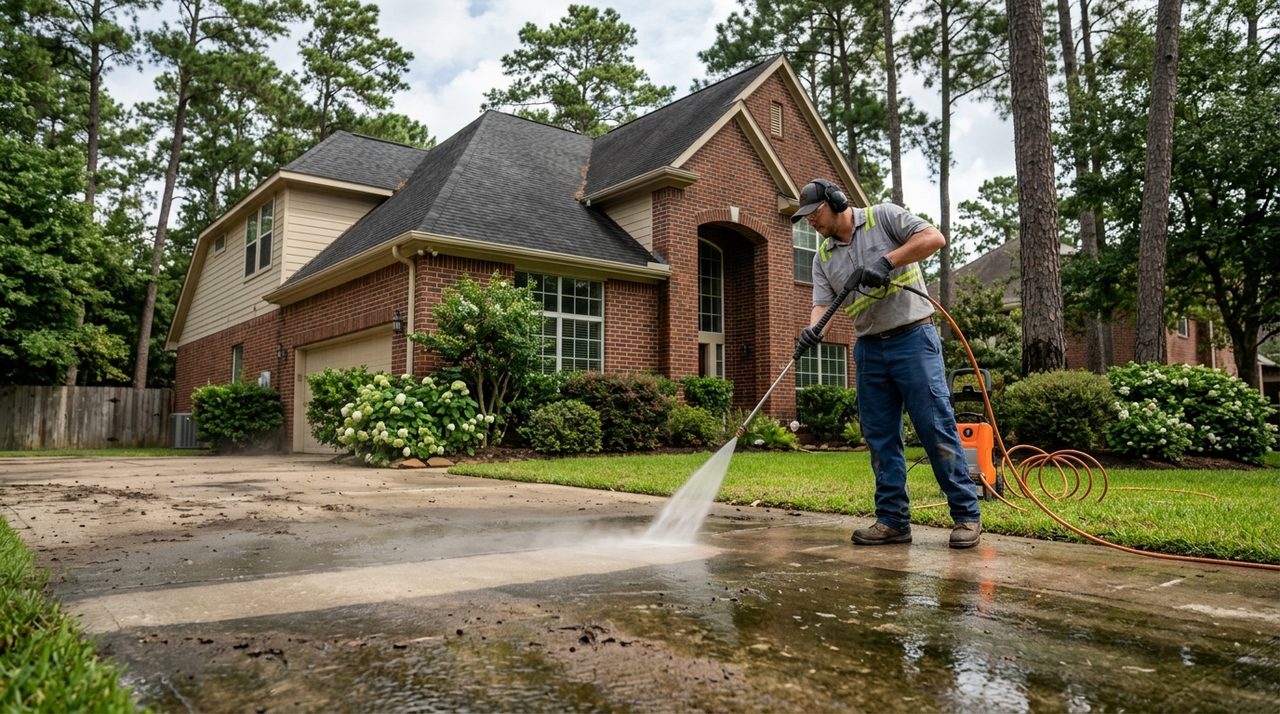
Porter's patchwork of 1970s acreage homes, 1990s–2000s brick subdivisions, and brand-new Valley Ranch production builds means exterior surfaces age at wildly different rates — and Montgomery County's humidity, clay-heavy soil, and mature tree canopy across older plats combine to accelerate mold, efflorescence, and organic staining on every surface type. Because Porter is unincorporated, there is no city permit office to call: pressure washing falls outside county permit requirements, but homeowners in HOA-governed communities like Valley Ranch and North Country must still check subdivision-level deed restrictions before work begins.
Ranked by verified Google rating × review volume × verification tier. How we rank →
Some highly-rated pros serve Porter from nearby and may not keep a Porter street address. Those are listed under "Also serving Porter" with their real city and distance, so you always know where each business is based.
23552 FM1314 Ste. 106, Porter, TX 77365
25432 E Loop 494, Porter, TX 77365
20696 Canterbury Ln, Porter, TX 77365
21315 W Knox Dr Trlr 1, Porter, TX 77365
23434 Heidi Ln, New Caney, TX 77357
Highly-rated pros based nearby who cover Porter. Distance shown from the Porter area.
Serving Porter Based in Kingwood · 3.2 mi away
Serving Porter Based in Humble · 3.9 mi away
Serving Porter Based in Humble · 4.8 mi away
Serving Porter Based in Kingwood · 4.8 mi away
Serving Porter Based in Humble · 6.9 mi away
Why it matters to you
Porter homeowners in Valley Ranch and North Country face mandatory HOA architectural review committees that issue written violation notices for algae-stained driveways, discolored fences, and green-streaked siding — sometimes with 30-day cure windows. Unlike inner-Loop Houston neighborhoods where HOA density is lower, a significant share of Porter's post-2000 production-build subdivisions carry active CC&Rs, yet there is no incorporated city code office to clarify gray areas: the homeowner is solely responsible for reconciling deed-restriction language with any cleaning method chosen.
What a good pro does
Before scheduling, pull your subdivision's CC&Rs from the TREC HOA management-certificate database or deed records and confirm whether soft-wash chemicals require ACC pre-approval. A good operator will provide a written scope noting PSI levels and cleaning agents used — documentation that satisfies most ACC review requirements and protects you if a neighbor files a complaint. Because Texas has no state pressure-washing license, liability insurance is the primary credential to verify.
Sources: Local HOA / deed restrictions (see area profile)
Why it matters to you
Porter's older 1970s–1990s subdivisions often sit under established pine and hardwood canopy that keeps siding, driveways, and fences damp for hours after rain — ideal conditions for Gloeocapsa magma black algae and green mold to colonize surfaces. The problem is not limited to vintage homes: newer production builds in master-planned sections commonly use vinyl or Hardie-plank siding that traps humidity at grade level, and Montgomery County's position northeast of Houston keeps annual rainfall well above 50 inches with humidity regularly exceeding 75%.
What a good pro does
Effective treatment on both older brick exteriors and newer composite siding requires a low-pressure soft-wash with a sodium hypochlorite-based or quaternary ammonium biocide rather than raw water pressure, which spreads spores without killing them. Post-wash application of a mold-inhibiting surfactant extends clean intervals from the typical 6–12 months toward 18–24 months — a meaningful difference for homeowners managing large acreage lots or long fence runs. Note that concentrated algaecides applied at pesticidal concentrations may require the operator to hold a Texas Department of Agriculture pesticide applicator license.
Why it matters to you
The vast majority of Porter's post-1960 homes sit on concrete slab-on-grade foundations poured directly over Montgomery County's expansive clay soils. Seasonal wet-dry cycles cause these soils to wick mineral salts upward through the slab and out onto driveway aprons and patios, leaving white efflorescence deposits and red-clay mud staining that standard cold-water rinsing cannot lift. The problem is compounded on 1970s–1990s driveways where surface spalling — accelerated by Winter Storm Uri's 2021 freeze-thaw cycles — has opened pores that trap staining deeper in the concrete.
What a good pro does
Pre-treating with a dilute acid wash (muriatic or phosphoric acid solution) dissolves mineral salt deposits before pressure washing and is the only reliable way to address deep efflorescence on aged slabs. Operators should test a small section first on older concrete, as spalled surfaces etch more aggressively than sound ones. Hot-water pressure washing at 180–200°F further emulsifies clay-based staining and is worth requesting on any driveway that has not been cleaned in three or more years — budget an estimated 20–40% premium over standard cold-water service for chemical pre-treatment and hot-water equipment.
Sources: International Residential Code (as adopted by City of Houston)
Why it matters to you
Porter's mid-vintage subdivisions — built through the 1990s and 2000s boom — are densely fenced with untreated southern yellow pine privacy fencing that now sits in the 15-to-30-year age range. At that age, the combination of Porter's 100°F+ summers, frequent heavy rain, and high termite pressure from Montgomery County's East Texas-adjacent environment causes boards to gray, crack, and develop mold colonies along the bottom rails. Owners of these properties often face hundreds of linear feet of fence that needs cleaning before staining or sealing can restore the wood and push replacement further out.
What a good pro does
Effective fence washing on weathered pine means keeping pressure below 1,200 PSI — higher settings splinter the grain of aged wood and drive water deeper into cracks, accelerating rot rather than preventing it. A downstream-injection low-pressure pre-soak with a wood-safe mold cleaner, followed by a controlled fan-tip rinse, removes green mold without raising the grain. At an estimated $0.35–$0.65 per linear foot, a 300-linear-foot fence job runs roughly $105–$200 for washing alone, with staining quoted separately — confirm scope in writing so the cleaning and coating stages are priced independently and not bundled in a way that cuts corners on dry time.
Sources: International Residential Code (as adopted by City of Houston)
Hiring pressure washing in Porter? Porter is a sprawling, unincorporated Montgomery County area composed of dozens of individual subdivisions—some master-planned with mandatory HOAs, others completely unrestricted rural tracts. Housing ranges from 1970s-era homes on acreage to brand-new production builds in communities like Valley Ranch. Homeowners must navigate county-level permitting and widely varying deed restrictions, making it essential to verify rules at the subdivision level before any project.
Building era
1970s–2020s, with significant growth from the 1990s through 2010s and ongoing new construction.
Typical style
Mix of traditional single-family brick and frame homes in older plats, and newer production-style traditional homes in master-planned communities.
Foundations
Predominantly concrete slab-on-grade for post-1960 construction; some pier-and-beam in older or custom rural builds — specific subdivision data not confirmed.
Common systems
Newer homes typically feature central HVAC with high-SEER units, PEX or copper plumbing, and 200-amp electrical panels; older 1970s–1990s homes may have original R-22 HVAC systems, galvanized or CPVC plumbing, and 100–150-amp panels.
What that means for repairs
Older subdivisions see HVAC replacements, re-plumbing from galvanized to PEX, and kitchen/bath remodels. Unrestricted acreage tracts attract new construction, additions, and outbuilding projects. Master-planned communities focus on cosmetic updates and energy efficiency upgrades.
Permit jurisdiction
Montgomery County Engineering and applicable special utility districts (MUDs). Not within City of Houston or any incorporated city permit jurisdiction.
HOA & deed restrictions
Varies widely by subdivision. Valley Ranch HOA is mandatory for all property owners. North Country Homeowners Association, Inc. operates as a subdivision HOA. The Highlands is governed by a mandatory HOA. Many properties in broader Porter have no HOA at all. Confirm for any specific property via deed records or TREC HOA management-certificate database.
Historic districts
No historic district designation confirmed. Porter is in unincorporated Montgomery County with no City of Houston HAHC jurisdiction.
Contractor note
Contractors must obtain permits through Montgomery County rather than a city permit office. Additionally, many subdivisions require separate HOA architectural review committee (ACC) approval before exterior work begins, so contractors should verify both county and private-covenant requirements for each job.
FEMA flood zone
FEMA Zone X (low flood risk) per official NFHL data. However, properties near the East Fork of the San Jacinto River and its tributaries may carry higher risk; confirm flood zone at the parcel level as conditions vary across this large unincorporated area.
Hurricane Harvey impact
Parts of Montgomery County, including areas along the San Jacinto River and its tributaries, experienced flooding during Hurricane Harvey. Subdivision-specific or street-level Harvey impact data for the broader Porter area was not confirmed in available sources. Property-specific flood history should be verified through FEMA NFIP records and the Montgomery County floodplain administrator.
Heat & humidity load
Extreme summer heat and humidity drive heavy HVAC demand; older 1970s–1990s systems may struggle with efficiency. Slab foundations on expansive clay soils can shift during prolonged dry spells, and homes on rural lots with septic systems face additional stress during saturated-soil conditions in late summer storms.
Working with contractors here
Porter's wide range of housing ages means contractors encounter everything from 1970s-era galvanized re-pipes and aging R-22 HVAC changeouts to warranty work in brand-new master-planned communities. Unrestricted acreage properties frequently generate new-build, barndominium, and accessory-structure projects that require Montgomery County permitting and septic coordination. In HOA-governed subdivisions like Valley Ranch and North Country, exterior projects require ACC approval in addition to county permits, and contractors should budget time for that review process. The area's rapid growth means utility infrastructure varies—some neighborhoods are served by MUDs with specific tap and connection standards that affect plumbing and site work. Job scoping should always include verifying the specific subdivision's HOA status, applicable deed restrictions, and whether the property is on municipal water/sewer or septic.
Local Tip
Always ask for a written estimate before work begins. Texas contractors are required to provide one on jobs over $1,000.
Porter is a sprawling, unincorporated Montgomery County area composed of dozens of individual subdivisions—some master-planned with mandatory HOAs, others completely unrestricted rural tracts. Housing ranges from 1970s-era homes on acreage to brand-new production builds in communities like Valley Ranch. Homeowners must navigate county-level permitting and widely varying deed restrictions, making it essential to verify rules at the subdivision level before any project.
Source: U.S. Census Bureau, ACS 5-Year 2023
Most of Porter maps to FEMA Zone X (low mapped flood risk), but Houston's flash-flood reality means even low-risk blocks benefit from smart drainage and storm-hardened installs.
Source: FEMA National Flood Hazard Layer (NFHL). Flood zones vary by parcel — verify your individual FIRM panel.
Sources: Local HOA / deed restrictions (see area profile)
Sources: Local HOA / deed restrictions (see area profile)Texas Commission on Environmental Quality