Open Now
11200 Broadway St Suite 2743, Pearland, TX 77584
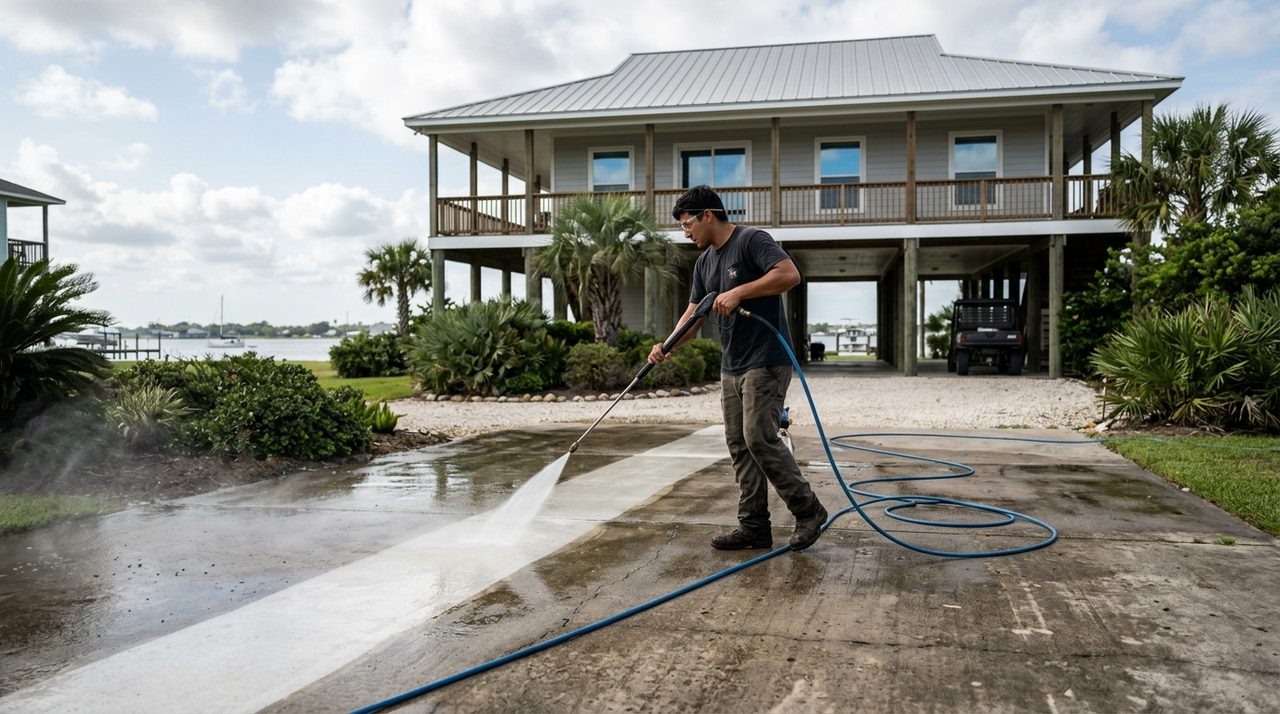
Pearland's wave of 1990s–2010s brick-veneer homes on post-tensioned concrete slabs creates a specific pressure-washing landscape: Brazoria County's expansive black clay pulls mineral salts through driveways and foundation-level brick year after year, while mandatory HOA architectural review committees in subdivisions like Silverlake and Springfield issue violation notices the moment algae stains become visible from the street. Understanding what surfaces can tolerate high pressure — and which require chemical soft-wash — matters more here than in older Houston neighborhoods, because these production homes share nearly identical aging timelines and their composition asphalt shingle roofs are right in the window where granule loss from improper cleaning becomes a real warranty and insurance issue.
Ranked by verified Google rating × review volume × verification tier. How we rank →
Some highly-rated pros serve Pearland from nearby and may not keep a Pearland street address. Those are listed under "Also serving Pearland" with their real city and distance, so you always know where each business is based.
11200 Broadway St Suite 2743, Pearland, TX 77584
4000 Bailey Rd b20, Pearland, TX 77584
7123 W Broadway St, Pearland, TX 77581
2800 E Broadway St C, Pearland, TX 77581
12510 Eiker Rd, Pearland, TX 77581
11233 Shadow Creek Pkwy Ste 307, Pearland, TX 77584
3503 Lockheed St Suite A, Pearland, TX 77581
Highly-rated pros based nearby who cover Pearland. Distance shown from the Pearland area.
Serving Pearland Based in Alvin · 4.5 mi away
Serving Pearland Based in South Houston · 5 mi away
Serving Pearland Based in South Houston · 6.1 mi away
Why it matters to you
Pearland sits squarely on Brazoria County's Houston Black clay — one of the most expansive soil series in the country — and virtually every post-tensioned slab here cycles through wet-season heave and dry-season shrinkage annually. That moisture movement wicks mineral salts up through the concrete slab and into the brick veneer at foundation level, leaving chalky white efflorescence deposits and reddish-clay mud staining on driveways and lower-course brick that a standard garden-hose rinse cannot touch. Homes built between 1995 and 2010 with original unsealed concrete driveways are especially prone because the surface has had two or more decades to absorb and release these mineral deposits.
What a good pro does
A qualified Pearland operator will apply a diluted muriatic-acid or specialized efflorescence remover as a pre-soak, allow dwell time, then use moderate-pressure (1,200–1,800 PSI) flat-surface cleaning — not a raw high-pressure lance — to lift deposits without fracturing the mortar joints on brick veneer. Post-cleaning, a penetrating concrete or masonry sealer slows re-wicking through the next wet season. Texas does not require a state trade license specifically for pressure washing, but if the efflorescence remover product qualifies as a regulated pesticide or biocide under Texas Department of Agriculture criteria, the applicator needs a TDA pesticide applicator credential.
Why it matters to you
The vast majority of Pearland's subdivisions — including Silverlake, Shadow Creek Ranch, and dozens of others developed by national builders in the 2000s — carry recorded CC&Rs enforced by active architectural review committees. Green algae on a concrete driveway, black Gloeocapsa magma streaks on a roof, or mildewed fence boards can all generate a formal written violation with a cure window as short as 30 days. Because Pearland's subdivision roofs are predominantly architectural or 3-tab asphalt shingles now 10–25 years old, homeowners sometimes make the problem worse by renting a consumer pressure washer and blasting the shingles — stripping granules and creating a warranty issue in the rush to satisfy the HOA.
What a good pro does
Homeowners should request the specific HOA violation language before hiring, because some Pearland CC&Rs distinguish between 'cleaning' and 'alterations' — roof or fence color changes require architectural committee pre-approval even if the underlying cleaning does not. A reputable operator will soft-wash asphalt shingles at under 500 PSI with a sodium hypochlorite-based algaecide solution rather than high-pressure water, satisfying the appearance requirement without accelerating granule loss. Permitting through the City of Pearland is not required for routine residential exterior washing, but any structural addition to facilitate washing access (e.g., a permanent water-recapture system) would need a City of Pearland permit pulled separately from anything filed with Houston Permitting Center.
Sources: Local HOA / deed restrictions (see area profile), City of Houston Permitting Center
Why it matters to you
The census median year-built for Pearland homes is 2003, meaning a significant portion of the housing stock has roofs that are now 15–25 years old — precisely the age range when Gloeocapsa magma black-streak algae becomes most visible and when shingle granules are most vulnerable to mechanical disturbance. Houston's year-round humidity above 75% means these streaks can reappear within two to three years of cleaning, creating a recurring maintenance cycle. A homeowner who hires an operator using a standard 2,500–3,500 PSI pressure washer on these shingles risks voiding any remaining manufacturer warranty and accelerating the need for a full roof replacement — an expensive outcome in a market where Gulf Coast hail and wind already drive high replacement rates.
What a good pro does
The correct approach is a dedicated soft-wash system delivering sodium hypochlorite solution at low pressure (under 400–500 PSI at the surface), which kills the algae organism rather than just blasting visible staining off the surface, extending the clean appearance significantly longer. Ask any prospective operator to confirm their roof PSI and whether they use a downstream chemical injector or a purpose-built soft-wash pump — these are different pieces of equipment, and the distinction matters for a 20-year-old shingle roof. No City of Pearland permit is required for the cleaning itself, and Texas has no TDLR license for pressure washing, but operators applying biocidal roof treatments should confirm whether their specific product triggers a Texas Department of Agriculture applicator requirement.
Sources: Local HOA / deed restrictions (see area profile), International Residential Code (as adopted by City of Houston)
Why it matters to you
Pearland's street drainage infrastructure feeds directly into Brazoria County's network of ditches and bayous, which ultimately discharge to Galveston Bay — meaning detergent-laden or degreaser-contaminated wash water that enters a curbside storm drain inlet is not going to a treatment plant. TCEQ regulations under the Texas Pollutant Discharge Elimination System (TPDES) prohibit pressure-wash wastewater containing chemical cleaners, oils, or degreasers from entering storm drains, and Pearland's status as an incorporated city with its own code enforcement means violations are more likely to be acted on than in unincorporated parts of Harris County. For Pearland homeowners dealing with oil staining from parked vehicles — a common issue on original 1990s–2000s driveways — hot-water equipment and degreaser pre-treatment are often necessary, but that chemistry creates a discharge obligation.
What a good pro does
A compliant operator doing oil-stain or heavy-degreaser work on a Pearland driveway will use berms, wet-vac recapture, or absorbent containment to prevent runoff from reaching the curb and storm inlet, then dispose of the collected wash water through an approved sanitary sewer connection rather than surface discharge. This is not optional procedure — it is a TCEQ requirement, and homeowners should ask any bid-stage operator directly how they handle wash-water containment on degreaser jobs. Routine cold-water rinse jobs with no chemical additives carry far lower compliance risk, but even plain wash water with heavy organic load (flood mud, mold slurry) warrants some containment near storm-drain inlets.
Hiring pressure washing in Pearland? Pearland is a large, incorporated suburban city in Brazoria County comprising dozens of master-planned subdivisions built primarily from the 1990s through the 2010s. Most homes are brick-veneer traditional construction on post-tensioned concrete slabs, meaning contractors here deal heavily with slab foundation movement, composition roof replacements, and HVAC systems aging into their first or second major service cycle. Permitting runs through the City of Pearland—not Houston or the county—and most subdivisions carry mandatory HOAs with architectural review requirements that affect exterior work.
Building era
Primarily 1990s–2010s, with continued new construction in some subdivisions.
Typical style
Suburban brick or brick-veneer traditional single-family homes, typically 1- and 2-story, with composition asphalt shingle roofs.
Foundations
Post-tensioned concrete slab-on-grade (dominant for post-1970s production housing in this area).
Common systems
Central HVAC (gas furnace with split-system AC or heat pump), copper or CPVC supply plumbing with ABS/PVC drain lines, 200-amp electrical panels. Homes from the 1990s may have original R-410A or older R-22 refrigerant systems nearing end of life.
What that means for repairs
Kitchen and bathroom remodels are common as 1990s–early 2000s homes age past 20 years. Roof replacements are a major recurring need due to Gulf Coast hail and wind events. Some homeowners add outdoor living spaces, but HOA architectural guidelines often require pre-approval for additions, fencing, and exterior changes.
Permit jurisdiction
City of Pearland Permitting (incorporated city — not Houston Permitting Center or Brazoria County Engineering).
HOA & deed restrictions
Most Brazoria County Pearland subdivisions have mandatory HOAs with recorded CC&Rs and architectural review committees. Examples include Silverlake HOA (Crest Management, 281-272-6377) and Springfield HOA. Older or more central Pearland areas may have voluntary associations or simpler deed restrictions. HOA dues typically range from $200–$900/year for smaller neighborhoods up to $600–$2,400+/year for amenity-rich master-planned communities. Specific HOA status must be verified per subdivision via resale certificate.
Historic districts
No historic district designation confirmed. Pearland is a relatively modern suburban city with no known HAHC or local historic overlays.
Contractor note
Contractors must pull permits through the City of Pearland, which has its own inspection process separate from Houston and Brazoria County. Nearly all subdivisions require HOA architectural approval for exterior modifications before work begins, so contractors should factor approval timelines into project scheduling.
FEMA flood zone
FEMA Zone X (low flood risk) — source: fema_nfhl. However, portions of Pearland near Clear Creek and associated tributaries may carry higher flood risk designations; buyers and contractors should verify zone status at the parcel level, especially in western Pearland areas closer to waterways.
Hurricane Harvey impact
Parts of Pearland experienced flooding during Hurricane Harvey (2017), particularly areas near Clear Creek and low-lying bayou tributaries. Some master-planned communities in western Pearland reported significant water intrusion. Specific street-level impact varies widely by subdivision and proximity to drainage channels — not confirmed at a granular level from available research. Homeowners should check individual property flood history through Brazoria County records.
Heat & humidity load
Extended 95°F+ summers with high humidity stress HVAC systems heavily in these slab-on-grade homes. Attic temperatures can exceed 140°F, accelerating shingle degradation and demanding adequate attic ventilation and radiant barrier consideration. Expansive clay soils undergo seasonal shrink-swell cycles that can cause slab movement and related cosmetic or structural cracking, making foundation watering programs and drainage management important recurring service needs.
Working with contractors here
The dominant work in Pearland centers on maintaining 1990s–2010s production homes: HVAC replacements and repairs (original systems from the 1990s and early 2000s are reaching end of life), roof replacements driven by Gulf Coast storm damage and aging shingles, and kitchen/bath remodels as homes pass the 20-year mark. Slab foundation repair and drainage correction are recurring needs due to Brazoria County's expansive clay soils. Contractors should be aware that nearly every major subdivision requires HOA architectural approval for exterior work—including roof material and color, fence installation, and additions—which can add 2–6 weeks to project timelines. City of Pearland permits and inspections follow their own code enforcement process, and contractors accustomed to Houston's permitting system should confirm local requirements before starting work.
Local Tip
Always ask for a written estimate before work begins. Texas contractors are required to provide one on jobs over $1,000.
Pearland is a large, incorporated suburban city in Brazoria County comprising dozens of master-planned subdivisions built primarily from the 1990s through the 2010s. Most homes are brick-veneer traditional construction on post-tensioned concrete slabs, meaning contractors here deal heavily with slab foundation movement, composition roof replacements, and HVAC systems aging into their first or second major service cycle. Permitting runs through the City of Pearland—not Houston or the county—and most subdivisions carry mandatory HOAs with architectural review requirements that affect exterior work.
Source: U.S. Census Bureau, ACS 5-Year 2023
Most of Pearland maps to FEMA Zone X (low mapped flood risk), but Houston's flash-flood reality means even low-risk blocks benefit from smart drainage and storm-hardened installs; as a Brazoria County coastal community, tropical surge and wind add a layer generic guidance misses.
Source: FEMA National Flood Hazard Layer (NFHL). Flood zones vary by parcel — verify your individual FIRM panel.
Sources: Local HOA / deed restrictions (see area profile)