4321 Kingwood Dr Suite 101, Kingwood, TX 77339
Best Pool Cleaning in Kingwood, TX
Kingwood's dense, mature tree canopy — the legacy of a master-planned community that began planting in the 1970s — drops a continuous load of leaves, pollen, and organic debris into residential pools across every village from Greentree to Kings Forest, making pool chemistry management here more demanding than in newer, treeless suburbs. Add the community's mandatory HOA structure, which requires pools to maintain visible-to-the-drain clarity under Lake Houston Community Association deed restrictions, and Kingwood homeowners face both a maintenance challenge and a compliance obligation that generic pool service approaches simply don't address. This page focuses on the four pool-cleaning realities that actually define the Kingwood experience.
Verified against Google Business data
Updated 2026
See the 10 Pool Cleaning Serving Kingwood 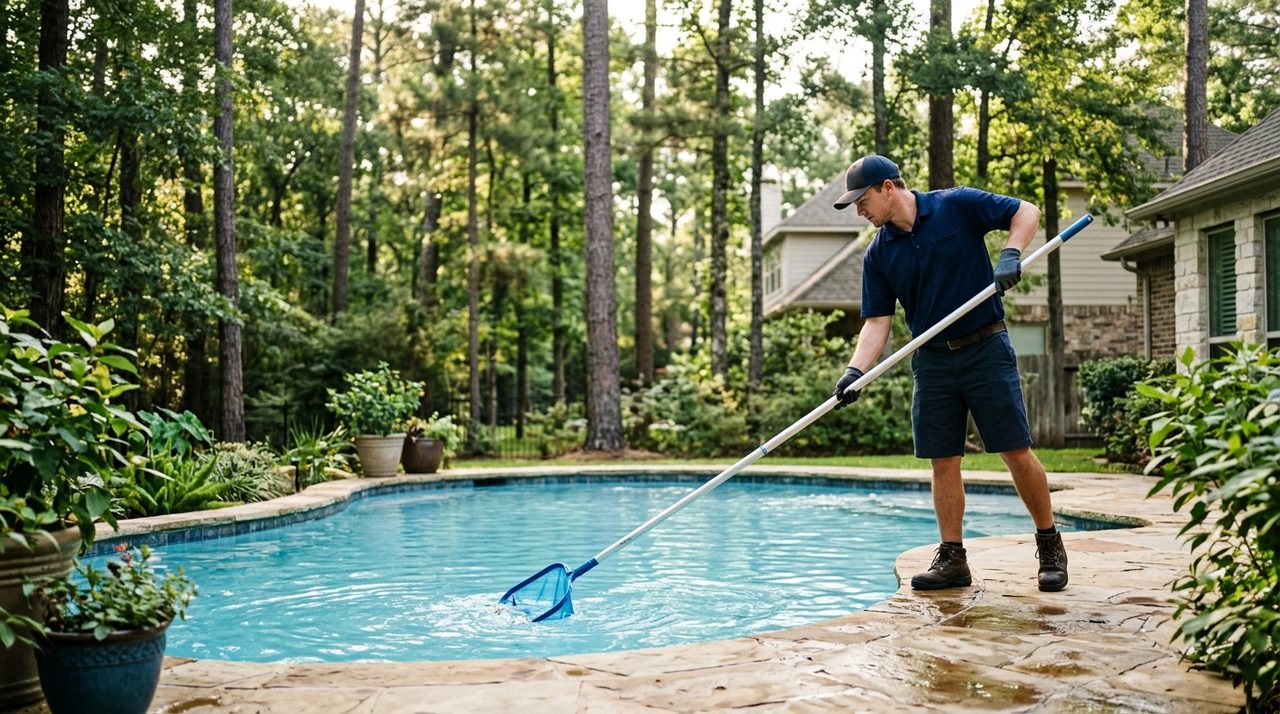
- Median home built
- 1997
- Median home value
- $282,517
- FEMA flood zone
- X (low)
- Typical monthly service cost (est.)
- $150–$250
- Most common local issue
- Phosphate-driven algae blooms from heavy tree canopy debris
Ranked by verified Google rating × review volume × verification tier. How we rank →
Min rating:
10 results Closed
796M Russell Palmer Rd, Kingwood, TX 77339
4303 Kingwood Dr, Humble, TX 77339
5400 Atascocita Road, Atascocita, TX 77346
Closed
8414 Cross Country Dr, Humble, TX 77346
Closed
2855 W Lake Houston Pkwy #110, Kingwood, TX 77339
Closed
19121 W Lake Houston Pkwy, Humble, TX 77346
Closed
18910 Vantage View Ln, Atascocita, TX 77346
Closed
2714 W Lake Houston Pkwy Ste 210, Humble, TX 77339
Closed
19211 W Lake Houston Pkwy Ste 220, Humble, TX 77346
Pool Cleaning in Kingwood: What You Should Know
Heavy Tree Canopy Keeps Phosphate Levels Dangerously High Year-Round
Why it matters to you
Kingwood was deliberately forested as part of its master-plan identity, and that canopy is a direct liability for pool owners. Falling pine needles, oak leaves, sweet gum balls, and spring pollen from the community's mature stands break down rapidly in pool water and spike phosphate levels — the primary algae food source — far faster than in treeless new-construction suburbs like Cinco Ranch or Pearland. Because water temperatures in the Houston area stay above 70°F for eight to nine months, algae have a near-permanent window to exploit that phosphate load.
What a good pro does
A qualified pool-cleaning technician servicing a Kingwood pool should test phosphate levels at every visit — not just chlorine and pH — and apply a phosphate remover before levels exceed 100 ppb, which is the threshold where algae blooms become difficult to prevent with chlorine alone. Weekly skimming and vacuuming of leaf debris before it decomposes is non-negotiable, and pools with heavy overhang may need twice-weekly surface clearing during oak leaf and sweet gum seasons (October–December and March–April). No permit or license is required from the Houston Permitting Center for routine chemical maintenance, though pool contractors performing equipment repairs must pull City of Houston permits for regulated trades.
Sources: City of Houston Permitting Center, Texas Commission on Environmental Quality
HOA Deed Restrictions Create Real Compliance Stakes for Pool Clarity
Why it matters to you
Kingwood is not an optional-HOA neighborhood — the Lake Houston Community Association structure is mandatory, and many of Kingwood's individual village HOAs layer additional deed restrictions on top of the master association's rules. Those restrictions commonly require that pool water remain clear enough to see the main drain, and some village-level HOAs have architectural review authority that extends to equipment screening, fence specifications around pool areas, and deck materials. A pool that turns green — even briefly after a storm or owner absence — can generate a deed-restriction violation notice, not just an aesthetic problem.
What a good pro does
A pool-cleaning professional familiar with Kingwood's HOA structure should be able to provide service documentation (dated visit logs with water chemistry readings) that homeowners can produce if a violation notice is challenged. When selecting a service provider, ask whether they carry records in a format compatible with HOA compliance requests. For any physical upgrades to equipment enclosures, deck surfaces, or fencing around the pool, homeowners must submit to the relevant village HOA's architectural review process before work begins — the Houston Permitting Center handles trade permits for electrical or plumbing work, but HOA approval is a separate and parallel requirement.
Sources: Local HOA / deed restrictions (see area profile), City of Houston Permitting Center
Post-Storm Pool Recovery Is a Recurring Necessity, Not a Rare Event
Why it matters to you
Although most of Kingwood maps to FEMA Zone X, the community's documented experience with Hurricane Harvey (2017) and Hurricane Beryl (July 2024) illustrates that storm debris, wind-stripped leaves, and in some blocks near the San Jacinto River, actual floodwater can overwhelm pool systems quickly. After Beryl, widespread power outages lasting days meant circulation pumps sat idle, accelerating bacterial and algae growth in warm summer water. The older pool equipment in Kingwood's 1970s–1980s villages — Greentree, Woodland Hills — is less likely to have automated safety shutoffs or battery-backed controls that could mitigate this.
What a good pro does
After any named storm or major derecho, a professional should perform a full recovery service: testing and correcting pH and alkalinity first (metals and debris throw both out of range), executing a heavy chlorine shock treatment, running multiple filter backwashes, and applying a clarifier before the pool is considered swimmable. Estimated cost for a full green-pool remediation runs $250–$600 depending on pool size and chemical load. Homeowners in older Kingwood villages should also ask their service provider to inspect pump housing and PVC plumbing for storm-related stress cracks during every post-storm visit, since aging equipment is more vulnerable.
Sources: FEMA National Flood Hazard Layer (NFHL), Harris County Flood Control District
Winter Storm Uri Left a Freeze-Damage Legacy That Hasn't Fully Cleared
Why it matters to you
Winter Storm Uri (February 2021) hit Kingwood's pools hard precisely because most equipment — pump housings, PVC return and suction lines, salt chlorinator cells, and heaters — is installed exposed and uninsulated, an industry norm in a climate that historically sees only a handful of below-freezing nights per year. Kingwood's older villages built in the 1970s and 1980s had the highest concentration of pools without automated freeze guards, meaning pumps were not running when temperatures plunged and standing water in lines cracked plumbing throughout. Some of that damage was repaired quickly; some pools in older sections still have compromised plumbing or equipment that functions marginally but will fail under the next hard freeze.
What a good pro does
A thorough pool-cleaning technician should note and flag any signs of prior freeze damage — hairline cracks in pump housings, evidence of PVC repairs (mismatched pipe sections, visible coupling joints added post-2021), or a salt cell that consistently underproduces — during routine visits. Pump motor replacement runs an estimated $300–$600 installed; salt cell replacement averages $250–$500 installed; full freeze-event pipe and pump repairs can reach $400–$1,500 or more. Equipment replacements involving electrical connections require a City of Houston permit pulled through the Houston Permitting Center — there is no separate Kingwood permit office — and any contractor performing this work should hold appropriate TDLR credentials for pool and spa construction or repair.
Sources: Texas Department of Licensing & Regulation, City of Houston Permitting Center
Pool Cleaning in Kingwood: What You Should Know
Hiring pool cleaning in Kingwood? Kingwood is a large master-planned community in northeast Houston with a mandatory community association structure and deed restrictions governing exterior modifications. The neighborhood encompasses multiple villages with varying build periods, meaning housing stock age and systems vary significantly by subdivision. Homeowners should verify both community-wide and village-level deed restrictions before undertaking exterior or structural work.
- Housing era
- Mixed — development spans from the 1970s through the 2010s across various villages
- Foundation
- Not confirmed — slab-on-grade is typical for Houston-area suburban construction of this era, but…
- Flood zone
- FEMA Zone X (low flood risk) — source
- Permits
- Houston Permitting Center — Kingwood is within City of Houston limits
Housing stock & systems
Building era
Mixed — development spans from the 1970s through the 2010s across various villages. Specific decade varies by subdivision.
Typical style
Not confirmed from available sources — likely a mix of traditional suburban styles typical of Houston master-planned communities across multiple decades.
Foundations
Not confirmed — slab-on-grade is typical for Houston-area suburban construction of this era, but specific confirmation not available for all Kingwood villages.
Common systems
Given the multi-decade build-out, systems range widely: older sections may have original HVAC, galvanized or copper plumbing, and older electrical panels, while newer sections feature modern systems. Homes from the 1970s–1980s may have aging ductwork and R-22 refrigerant HVAC units requiring replacement.
What that means for repairs
Renovation activity likely varies by village age — older Kingwood sections (Greentree, Woodland Hills) may see full HVAC replacements, kitchen/bath remodels, and roof replacements, while newer sections focus on cosmetic updates. All exterior modifications must comply with deed restrictions enforced by the community association.
Permits & restrictions
Permit jurisdiction
Houston Permitting Center — Kingwood is within City of Houston limits. No separate Kingwood municipal permit office exists.
HOA & deed restrictions
Mandatory master association structure — the Lake Houston Community Association manages community-wide facilities and business. Mandatory Kingwood Association fees are approximately $200–$400 annually. Many villages/subdivisions have additional HOAs with fees of $100–$600 annually. Some areas include gated-community surcharges. Deed restrictions are enforced by community associations in lieu of municipal zoning.
Historic districts
No City of Houston historic district designation confirmed.
Contractor note
Contractors must obtain City of Houston permits for regulated work and ensure all exterior modifications comply with both the master community association deed restrictions and any applicable village-level HOA architectural review requirements before beginning work.
Flood & weather
FEMA flood zone
FEMA Zone X (low flood risk) — source: fema_nfhl. Note: Kingwood is situated near the San Jacinto River and Lake Houston; flood risk can vary significantly by specific tract and proximity to waterways. Homeowners in areas closer to the river or drainage channels should verify their individual FIRM panel.
Hurricane Harvey impact
Parts of Kingwood were impacted by Hurricane Harvey in 2017, but specific streets and recurring flood areas could not be confirmed from available sources. Homeowners should check Harris County Flood Control District records and FEMA flood insurance claims data for tract-specific Harvey impact information.
Heat & humidity load
Houston's extreme summer heat and humidity stress HVAC systems heavily across Kingwood's varied housing stock. Older homes may have undersized or aging units struggling to maintain efficiency. High humidity also creates conditions for mold growth in attics and crawl spaces, and heavy summer storms can expose roofing and drainage vulnerabilities.
Working with contractors here
Kingwood's multi-decade build-out means contractors encounter a wide range of systems and conditions depending on the specific village. Older sections built in the 1970s–1980s commonly need HVAC replacements, re-roofing, plumbing upgrades, and electrical panel modernization. Newer sections may focus on cosmetic remodeling and energy efficiency improvements. All exterior work must be pre-approved through the relevant community association or village HOA architectural review process, which can add lead time to project scheduling. Contractors should also be aware that flood remediation and moisture mitigation remain relevant trades in sections closer to waterways, even in areas mapped as Zone X.
Local Tip
Always ask for a written estimate before work begins. Texas contractors are required to provide one on jobs over $1,000.
About Kingwood
Kingwood is a large master-planned community in northeast Houston with a mandatory community association structure and deed restrictions governing exterior modifications. The neighborhood encompasses multiple villages with varying build periods, meaning housing stock age and systems vary significantly by subdivision. Homeowners should verify both community-wide and village-level deed restrictions before undertaking exterior or structural work.
- Median year built
- 1997
- Median home value
- $282,517
- Owner-occupied
- 73.2%
- Population
- 131,451
- Housing units
- 50,892
- Median income
- $101,033
Source: U.S. Census Bureau, ACS 5-Year 2023
Flood & storm risk
FEMA Zone XLow flood riskMost of Kingwood maps to FEMA Zone X (low mapped flood risk), but Houston's flash-flood reality means even low-risk blocks benefit from smart drainage and storm-hardened installs; risk climbs sharply on blocks nearest the San Jacinto River and Lake Houston, where it varies parcel to parcel.
Source: FEMA National Flood Hazard Layer (NFHL). Flood zones vary by parcel — verify your individual FIRM panel.
Frequently Asked Questions
Do I need a City of Houston permit to replace my pool pump or heater in Kingwood?
Because Kingwood sits inside City of Houston limits — there is no separate Kingwood permit office — electrical and mechanical equipment replacements such as pump motors, heaters, and salt chlorinator cells fall under Houston Permitting Center jurisdiction and may require a trade permit depending on the scope of work. Routine chemical cleaning visits do not trigger a permit, but any work touching electrical connections to pool equipment typically requires a licensed electrician to pull a City of Houston electrical permit. Before scheduling equipment replacement, confirm with your pool company whether they will pull the permit or expect you to arrange it; unpermitted electrical work on pool equipment can create issues when you sell the home.
Sources: City of Houston Permitting Center
My Kingwood home is in an older village like Greentree from the early 1980s — are the original pool pipes and fittings still safe after decades in Houston clay soil?
Pools built in Kingwood's earliest villages in the late 1970s and 1980s used PVC plumbing that is now 40-plus years old and has cycled through Houston's expansive clay soil movement, freeze events including Winter Storm Uri in 2021, and multiple major flood events near the San Jacinto River corridor. A pool cleaning technician servicing an older Greentree or Woodland Hills pool should be watching for soft or discolored plaster, visible cracks at return fittings, and slow pressure loss — all signs that clay-driven soil movement has stressed underground plumbing. If your tech flags any of these, a pressure test on the plumbing lines is a reasonable next step before the issues worsen.
My Kingwood pool went green after Hurricane Beryl in July 2024. How long should a full remediation realistically take, and what should it cost?
A typical green-pool remediation in Kingwood after a storm event like Beryl — where debris, floodwater, and sediment crashed sanitizer levels — generally takes three to five days of treatment: an initial superchlorination shock, clarifier application, multiple filter backwashes, and follow-up chemical retesting before water is safe. Cost for this process is typically estimated at $250–$600 for a standard residential pool, varying with how severely chemistry crashed, the size of the pool, and how much chemical load is required. Kingwood's dense canopy makes post-storm recovery slower than in treeless suburbs because leaf tannins and pollen keep phosphate levels elevated even after the visible algae clears, so expect at least one follow-up visit before chemistry is stable.
Does the Lake Houston Community Association actually fine homeowners for a green pool, and what documentation do pool cleaning companies typically provide?
The Lake Houston Community Association enforces deed restrictions requiring pools to maintain water clear enough that the drain is visible, and violations can result in formal notices and fines if not remediated within the stated cure period. Professional pool cleaning companies serving Kingwood will typically provide a dated service log showing each visit, chemical readings, and treatments performed — this paper trail is your evidence of compliance if the HOA flags your property. If you are self-managing chemicals between visits, photograph your test strip results weekly during heavy-canopy months from April through October when phosphate loading peaks.
Sources: Local HOA / deed restrictions (see area profile)
Is there a slow season for pool cleaning service in Kingwood where I could get lower rates or faster scheduling?
Unlike northern markets, Kingwood's subtropical climate means pools rarely go fully dormant — water temperatures stay above 70°F for eight to nine months and algae pressure remains real even in December and January, so most local pool companies carry nearly full service loads year-round. The best window for faster scheduling and occasional off-season pricing is typically January through early February, when demand for new service contracts and equipment repairs dips briefly before spring startup. Scheduling annual acid washes, tile descaling, or equipment inspections in that window — rather than the post-spring-break rush in March and April — can reduce wait times meaningfully.
My Kingwood home is in FEMA Zone X but it's close to Lake Houston. Should my pool cleaning company be doing anything differently given that flood exposure?
Most of Kingwood maps to FEMA Zone X indicating low mapped flood risk, but parcels closest to Lake Houston and the San Jacinto River experience real flash-flood exposure that does not always match the FEMA designation, as Harvey in 2017 and Beryl in 2024 demonstrated. For pools near the water, ask your cleaning company to test for metals — particularly iron and copper — after any flood-adjacent event, because floodwater carrying sediment from the river corridor can introduce metals that stain plaster and disrupt chemistry in ways a standard shock treatment will not resolve. A phosphate test should also be part of every post-flood service visit, since lake-adjacent runoff carries extremely high phosphate loads that feed algae faster than canopy debris alone.