Closed
12844 Market St, Houston, TX 77015
Galena Park's mid-century bungalows and ranch homes — most built between 1940 and 1965 for ship channel workers — present a specific pest-control profile shaped by original cast-iron plumbing, a mix of pier-and-beam and early slab foundations, and proximity to Buffalo Bayou's drainage corridor in a FEMA Zone X500 footprint. The combination of aging substructures, clay-heavy Harris County soil, and recurring heavy-rain events that leave yards saturated for days makes proactive pest management here fundamentally different from newer suburbs. This page is grounded in Galena Park's actual housing stock and drainage conditions, not generic Houston advice.
Ranked by verified Google rating × review volume × verification tier. How we rank →
Some highly-rated pros serve Galena Park from nearby and may not keep a Galena Park street address. Those are listed under "Also serving Galena Park" with their real city and distance, so you always know where each business is based.
12844 Market St, Houston, TX 77015
2819 Berkley St, Houston, TX 77012
Highly-rated pros based nearby who cover Galena Park. Distance shown from the Galena Park area.
Serving Galena Park Based in Pasadena · 3.8 mi away
Serving Galena Park Based in NE Houston · 5.3 mi away
Serving Galena Park Based in Pasadena · 5.6 mi away
Serving Galena Park Based in South Houston · 5.9 mi away
Serving Galena Park Based in Deer Park · 6.3 mi away
Serving Galena Park Based in South Houston · 6.6 mi away
Serving Galena Park Based in NE Houston · 6.7 mi away
Serving Galena Park Based in Deer Park · 6.9 mi away
Why it matters to you
Galena Park's pre-1960s homes — the majority of the city's housing stock, with a Census median year built of 1956 — were plumbed with cast-iron drain lines that corrode, crack, and gap over decades, creating direct sewer-to-slab pathways for American cockroaches (Periplaneta americana). After every heavy-rain event that overloads the flat-grade storm infrastructure near Buffalo Bayou, displaced roaches migrate from flooded sewers up through floor drains, weep holes, and plumbing penetrations into living spaces. Interior spraying alone cannot break this cycle when the entry points are underground.
What a good pro does
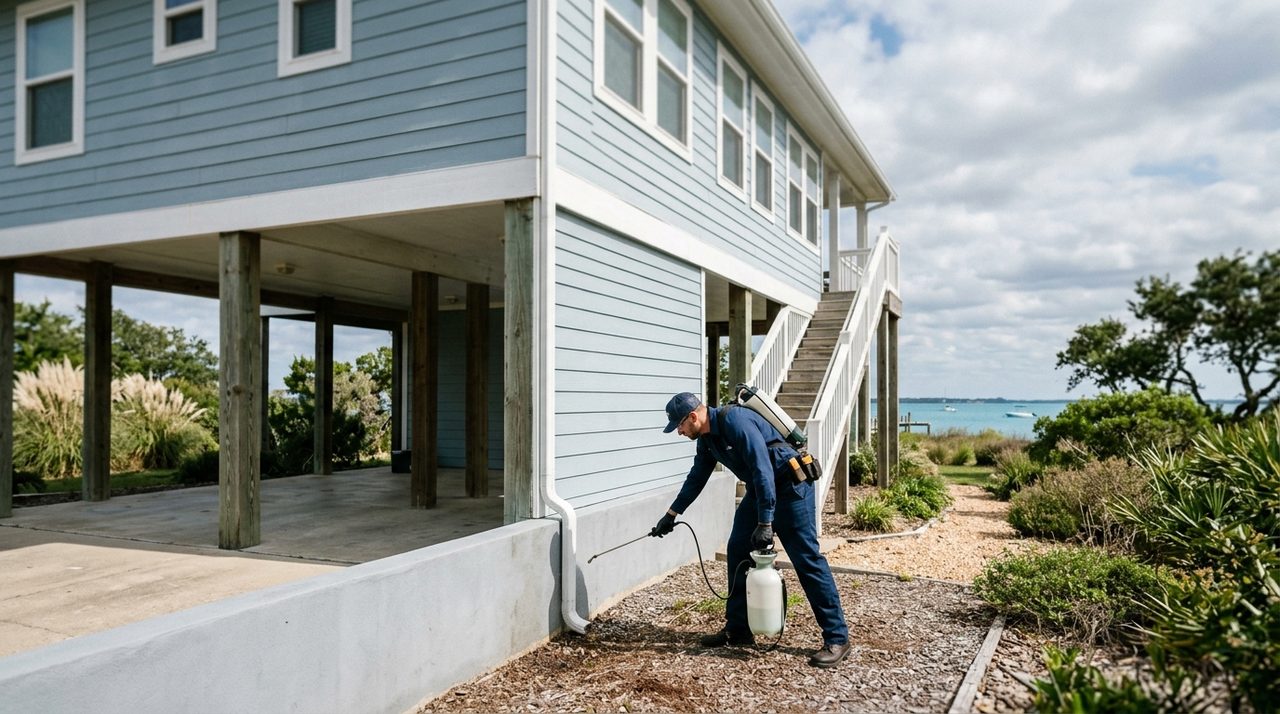
A licensed Texas Structural Pest Control operator (TDLR Structural Pest Control Act) should combine exterior perimeter treatment with targeted drain treatment — gel bait inside floor drains and pyrethroid application at all slab penetrations — and document every crack or gap for the homeowner to hand off to a plumber for re-pipe scoping. If you are already planning the galvanized-to-PEX re-pipe common in Galena Park renovations, schedule the pest inspection first so penetration sealing can be built into the plumbing scope.
Sources: Texas Department of Licensing & Regulation, Harris County Flood Control District
Why it matters to you
A meaningful share of Galena Park's 1940s and early 1950s bungalows sit on pier-and-beam foundations — a construction type that positions untreated floor joists, sill plates, and wood sheathing in close proximity to Houston's notoriously high-pressure Formosan and Reticulitermes termite populations (USDA Zone 5, the highest termite hazard rating in the continental U.S.). Unlike modern slab homes with chemical pre-treatment, these original mid-century crawl spaces were never barrier-treated and often retain wood debris and moisture from decades of drainage issues along the Buffalo Bayou corridor, giving termite colonies prime harborage directly under occupied floors.
What a good pro does
The appropriate treatment for a pier-and-beam home differs from a slab job: a TDLR-licensed Certified Applicator should perform a full crawl-space inspection, treat soil beneath the structure with a liquid termiticide (Termidor-type), and assess whether a bait station perimeter is warranted as a monitoring complement. Expect liquid barrier treatment estimates in the $800–$1,800 range for an average Galena Park lot; bait station programs run $1,200–$2,000 installed plus $300–$500 per year for required monitoring contracts. Permits for pest control treatments are handled through TDLR at the state level — no separate City of Galena Park permit is required for routine termite service.
Sources: Texas Department of Licensing & Regulation, FEMA National Flood Hazard Layer (NFHL)
Why it matters to you
Galena Park falls in FEMA Zone X500 — outside the 100-year floodplain but inside the 500-year — meaning significant rain events routinely leave low-lying yards and the shallow depressions common on modest 1950s-era lots saturated for 72 hours or more on the area's expansive Harris County clay soil. That standing water is prime habitat for Aedes aegypti and Culex quinquefasciatus mosquitoes, which can complete a full breeding cycle in less than a week. Harris County Mosquito Control District (HCAD) aerial spraying addresses public rights-of-way but does not treat private property, leaving residential yards entirely dependent on homeowner-arranged service.
What a good pro does
A qualified pest control operator should perform a source-reduction walk of the property — checking low spots, slab-void pooling, and any clogged or undersized drainage swales common near the Buffalo Bayou drainage network — and apply larvicide (Bti or methoprene) to persistent wet areas before placing a barrier spray program on a monthly schedule through mosquito season. Professional barrier spray programs in the Houston metro run an estimated $75–$150 per application. Operators performing mosquito larviciding on residential property must carry the appropriate TDLR pesticide category endorsement.
Sources: Harris County Flood Control District, FEMA National Flood Hazard Layer (NFHL), Texas Department of Licensing & Regulation
Why it matters to you
Galena Park's clay-heavy soil and modest lot sizes — with irrigated turf running right to foundation edges on most 1950s and 1960s bungalows — create near-ideal conditions for Solenopsis invicta mound establishment. TAMU Extension classifies the entire Houston metro as high-density RIFA territory, and Galena Park's flat drainage patterns mean soil stays moist long after rain events, which encourages mound relocation toward elevated features like foundation slab edges, HVAC disconnect boxes, and irrigation valve covers. For homes adjacent to the light industrial corridor near the ship channel, active construction or ground disturbance nearby regularly displaces colonies into residential yards.
What a good pro does
A pest control operator should apply a two-step program: broadcast bait across the full turf area for colony-level kill, followed by individual mound contact treatment with a fast-acting pyrethroid where mounds are active near the foundation or utility infrastructure. Re-infestation from neighboring lots is near-certain in Galena Park without a perimeter broadcast on a seasonal (at minimum twice-yearly) schedule. No HOA-wide treatment program covers most of Galena Park — the Galena Oaks Property Owners Association serves only that specific subdivision, and the remainder of the city relies on individual service contracts coordinated with city code enforcement for common-area concerns.
Sources: Texas Department of Licensing & Regulation, Local HOA / deed restrictions (see area profile)
Hiring pest control in Galena Park? Galena Park is an incorporated city in Harris County with aging mid-century housing stock built primarily for ship channel workers. Homeowners here contend with older plumbing, mixed foundation types, and proximity to Buffalo Bayou and industrial infrastructure. Permits go through the City of Galena Park rather than Houston, and HOA presence varies by subdivision.
Building era
1940s–1960s, with scattered later infill.
Typical style
Small one-story bungalows, ranch-style homes, and cottages on traditional street grids with modest lot sizes.
Foundations
Mixed — pier-and-beam common in 1940s–1950s builds, slab-on-grade more common from 1960s onward. Precise split not publicly documented; verify on individual parcels.
Common systems
Older galvanized or cast-iron plumbing in pre-1960s homes; window units or aging central HVAC retrofits; original 60–100 amp electrical panels in many older homes, often needing upgrades to modern 200 amp service.
What that means for repairs
Plumbing replacements (galvanized-to-PEX or copper), electrical panel upgrades, and foundation leveling on pier-and-beam homes are the most common renovation drivers. Many homes are candidates for full gut renovations given age and modest original construction quality.
Permit jurisdiction
City of Galena Park permit office (independent incorporated city — not City of Houston Permitting Center). Harris County may have jurisdiction over floodplain and certain regional permits.
HOA & deed restrictions
No single mandatory master HOA covers all of Galena Park. HOA presence is subdivision-by-subdivision. Galena Oaks Property Owners Association serves that specific subdivision; other areas such as the Woodland subdivision have no mandatory HOA. City code enforcement handles property maintenance standards citywide.
Historic districts
No City of Houston historic district designation — Galena Park is a separate incorporated city. No local historic district designation confirmed.
Contractor note
Contractors must permit through the City of Galena Park, not Houston. Familiarity with Galena Park's code of ordinances and inspection processes is essential, as procedures differ from both Houston and unincorporated Harris County.
FEMA flood zone
FEMA Zone X500 (moderate flood risk) — source: fema_nfhl. Galena Park sits north of the Houston Ship Channel along Buffalo Bayou, with low-lying and drainage-adjacent parcels carrying higher localized risk. Property-level flood zone verification is recommended.
Hurricane Harvey impact
Harvey brought extreme rainfall across east Harris County, and low-lying or drainage-adjacent properties in and around Galena Park experienced flooding. However, specific citable evidence of widespread or unique devastation in Galena Park's residential neighborhoods compared to other east-side areas was not located. Scattered flood claims exist near bayou and drainage ditch areas. Individual property flood-loss history should be checked through FEMA and Harris County Flood Control District records.
Heat & humidity load
Older homes with original insulation and aging HVAC systems face extreme cooling loads during Houston summers. Pier-and-beam crawl spaces can trap moisture, promoting mold and pest issues. Galvanized plumbing in pre-1960s homes is vulnerable to corrosion accelerated by heat and humidity.
Working with contractors here
Contractors in Galena Park most commonly handle foundation leveling on pier-and-beam homes, full plumbing re-pipes replacing galvanized lines, and electrical panel upgrades from outdated 60-amp service. The aging 1940s–1960s housing stock means whole-house renovation and weatherization projects are frequent, often including HVAC replacement with modern central systems. Proximity to industrial facilities and Buffalo Bayou means drainage improvements and moisture mitigation are recurring job scopes. Contractors should note that Galena Park is its own incorporated city with a separate permitting process, and job scoping should account for the possibility of encountering original mid-century materials including lead paint and outdated wiring.
Local Tip
Always ask for a written estimate before work begins. Texas contractors are required to provide one on jobs over $1,000.
Galena Park is an incorporated city in Harris County with aging mid-century housing stock built primarily for ship channel workers. Homeowners here contend with older plumbing, mixed foundation types, and proximity to Buffalo Bayou and industrial infrastructure. Permits go through the City of Galena Park rather than Houston, and HOA presence varies by subdivision.
Source: U.S. Census Bureau, ACS 5-Year 2023
Galena Park carries FEMA Zone X500 (moderate flood risk): outside the 100-year floodplain but inside the 500-year, so heavy-rain events still reach homes and flood-aware work pays off.
Source: FEMA National Flood Hazard Layer (NFHL). Flood zones vary by parcel — verify your individual FIRM panel.
Houston-specific estimators to plan your project before you call a pro. All results are planning estimates — a licensed local pro confirms the details on site.
| Pest | Cadence | Active window |
|---|---|---|
Mosquito control A standard 4-week barrier treatment holds a typical suburban lot through Houston's core mosquito season. | Every 28 days | April – October |
Termite (subterranean) A once-a-year spring inspection is the baseline for a drier, sunnier Houston lot — catch mud tubes and swarmer wings before damage compounds. | Annual inspection | Spring |
General pest guard (roaches, ants, spiders) Houston's year-round warmth means general pests never fully die off — a quarterly perimeter treatment is the standard maintenance rhythm. | Quarterly | Mar · Jun · Sep · Dec |
This is a planning estimate only — actual requirements depend on an on-site assessment by a licensed Houston pro. Texas requires an SPCB-licensed applicator for chemical treatment — ask for the technician's license number.
Sources: FEMA National Flood Hazard Layer (NFHL)Harris County Flood Control District
Sources: Texas Department of Licensing & RegulationTexas Windstorm Insurance Association (TWIA)
Sources: Local HOA / deed restrictions (see area profile)