5200 Mitchelldale St Suite E18, Houston, TX 77092
Best Painters in Brookhollow
Brookhollow's 1960s–1980s ranch homes along the US-290 corridor sit on concrete slab-on-grade foundations over Houston's expansive Black clay soil — a combination that produces recurring hairline and step cracks in brick mortar joints and interior drywall that defeat standard paint repairs within a season or two. On top of that, a census median build year of 1975 means a meaningful share of the neighborhood's homes predate the 1978 lead-paint cutoff, adding a federally regulated layer to any repaint project that disturbs existing coatings. Understanding these realities before you hire a painter in Brookhollow is the difference between a finish that lasts and one that's peeling by next summer.
Verified against Google Business data
Updated 2026
See the 10 Painters Serving Brookhollow 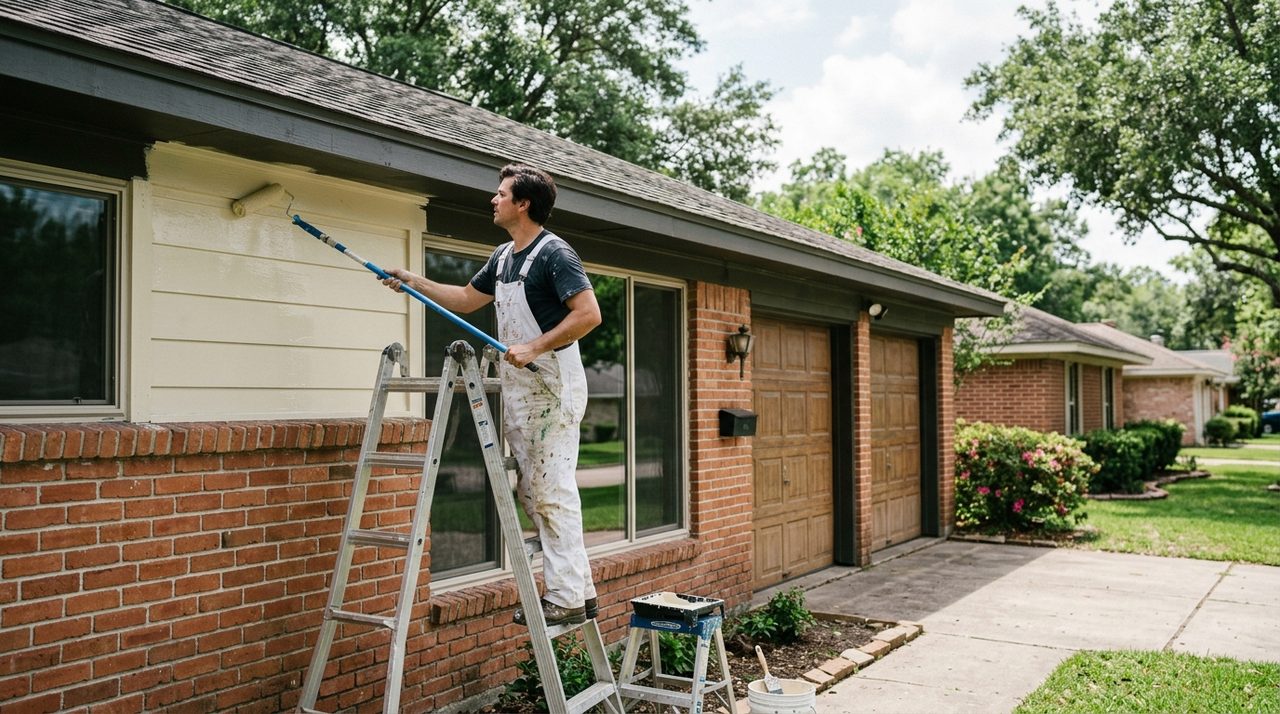
- Median home built
- 1975
- Median home value
- $222,800
- FEMA flood zone
- X (low)
- Typical exterior repaint cost (est.)
- $3,500–$7,500
- Most common local issue
- Clay-soil slab movement cracking brick mortar and drywall paint
Ranked by verified Google rating × review volume × verification tier. How we rank →
Some highly-rated pros serve Brookhollow from nearby and may not keep a Brookhollow street address. Those are listed under "Also serving Brookhollow" with their real city and distance, so you always know where each business is based.
Min rating:
10 resultsBased in Brookhollow
Closed
4000 W 34th St Unit 73, Houston, TX 77092
Closed
6101 Pinemont Dr STE G, Houston, TX 77092
Closed
10200 Hempstead Rd Ste 2J, Houston, TX 77092
Closed
5414 Poinciana Dr, Houston, TX 77092
Also serving Brookhollow
Highly-rated pros based nearby who cover Brookhollow. Distance shown from the Brookhollow area.
Serving Brookhollow Based in Lazybrook / Timbergrove · 0.7 mi away
Closed
Serving Brookhollow Based in Lazybrook / Timbergrove · 1.5 mi away
Closed
Serving Brookhollow Based in Spring Branch · 2.3 mi away
Serving Brookhollow Based in Spring Branch · 2.6 mi away
Closed
Serving Brookhollow Based in Lazybrook / Timbergrove · 2.8 mi away
Painters in Brookhollow: What You Should Know
Cracks Keep Reopening in Brick Mortar Joints and Interior Drywall
Why it matters to you
Brookhollow's slab-on-grade homes rest on Houston's expansive Beaumont/Houston Black clay, which swells and contracts with the region's wet-dry cycles — sometimes shifting the slab by an inch or more seasonally. For ranch homes built in the 1960s–1980s, that continuous movement telegraphs as hairline and step cracks through brick veneer mortar joints and interior drywall, especially along doorframes and at ceiling-wall intersections. Patching and repainting with standard spackling compound or rigid caulk will fail again within one seasonal cycle because the movement never stops.
What a good pro does
A knowledgeable painter working in Brookhollow will use a flexible elastomeric caulk rated for masonry movement on exterior brick joints, and a high-build, crack-bridging primer on interior drywall cracks before finish coats are applied. On the interior, ask your painter whether they are using a latex-based filler that can flex rather than a rigid plaster-style compound. No painting permit is required for this scope of work under City of Houston jurisdiction, but if the crack pattern suggests a deeper foundation issue, that should be evaluated separately before paint work begins.
Sources: City of Houston Permitting Center, International Residential Code (as adopted by City of Houston)
Pre-1978 Construction Triggers Federal Lead-Paint Rules
Why it matters to you
With a census median build year of 1975, a significant portion of Brookhollow homes were constructed before the 1978 federal ban on residential lead-based paint. Any repaint project that involves sanding, scraping, or otherwise disturbing existing painted surfaces — including trim work, window frames, and doors common on 1960s–1970s ranch homes — falls under the EPA Renovation, Repair, and Painting Rule (40 CFR 745). If there are children under six or pregnant occupants in the home, the obligation is especially serious, and improper handling creates both health exposure and legal liability for homeowners who unknowingly hire uncertified crews.
What a good pro does
Confirm that any painting contractor you hire for a pre-1978 Brookhollow home holds EPA Lead-Safe Certification for their firm and that the individual crew supervisor holds an EPA RRP Renovator credential — both are searchable on the EPA's certification database. Certified firms are required to follow specific containment, cleaning, and waste-disposal protocols. Expect this to add real cost, particularly for full exterior repaints where scraping peeling paint is unavoidable; budget toward the higher end of the $3,500–$7,500 exterior repaint estimate range for homes with multiple layers of original coating.
Sources: EPA Lead Renovation, Repair and Painting (RRP) Rule, Texas Department of Licensing & Regulation
Exterior Paint Fades Fast on South- and West-Facing Ranch Elevations
Why it matters to you
Brookhollow's one- and two-story ranch homes typically present long, low horizontal rooflines with broad south- and west-facing wall planes that receive Houston's full solar load — a UV index that regularly hits 10–11 from May through September at roughly 29°N latitude. Deep accent colors and organic pigments on trim, shutters, and front doors are especially vulnerable; homeowners who select these colors based on a paint can's stated fade warranty should know those warranties are calibrated for northern climates and will not reflect Houston's actual UV exposure rate.
What a good pro does
For the exterior of a Brookhollow ranch home, specify a 100-percent acrylic latex paint with a UV-stable inorganic pigment base — products in the Sherwin-Williams Emerald Exterior or Benjamin Moore Aura Exterior lines are designed for high-UV environments and carry more realistic fade resistance. Ask your painter to apply a full two coats (not a thin one-and-a-half coat cut) on south and west elevations, and plan a realistic repaint cycle of 7–10 years rather than the 15 some salespeople quote. No standalone painting permit is required from the City of Houston Permitting Center for a straight residential repaint.
Sources: City of Houston Permitting Center
Humidity-Driven Blistering on Wood Trim and Fascia Is a Recurring Complaint
Why it matters to you
Many of Brookhollow's 1960s–1980s ranch homes retain original wood fascia boards, window trim, and soffit sections that absorb moisture during Houston's high-humidity stretches — the metro's average relative humidity exceeds 75 percent for much of the year. When that moisture vapor pressure builds behind a latex or oil-based film coat and then Houston's afternoon heat drives it outward, paint blisters and peels within months of application, particularly on north-facing elevations where slow drying keeps wood wetter longer and on any trim shaded by the mature tree canopy common in this neighborhood.
What a good pro does
Proper prep on Brookhollow wood trim means allowing surface moisture content to drop below 15 percent before priming — a moisture meter check takes two minutes and separates careful painters from careless ones. A quality oil-based or shellac-based stain-blocking primer bonds more aggressively to weathered wood grain than straight latex primer and significantly reduces blister risk. Painting should be scheduled during Houston's drier winter months (November through February) when ambient humidity is lower and cure conditions are more reliable; summer paint jobs on wood trim in this neighborhood carry meaningfully higher failure risk.
Sources: International Residential Code (as adopted by City of Houston), City of Houston Permitting Center
Painters in Brookhollow: What You Should Know
Hiring painters in Brookhollow? Brookhollow is a northwest Houston neighborhood along the US-290 corridor with housing stock generally dating to the 1960s–1980s. Homeowners here should expect maintenance patterns typical of aging slab-on-grade ranch homes, including HVAC system replacements, cast-iron drain line issues, and periodic foundation monitoring. The neighborhood falls within City of Houston permitting jurisdiction with no historic district restrictions limiting exterior modifications.
- Housing era
- 1960s–1980s (area-wide pattern
- Foundation
- Concrete slab-on-grade (predominant for post-1960 NW Houston subdivisions
- Flood zone
- FEMA Zone X (low flood risk) — source
- Permits
- City of Houston Permitting Center (neighborhood is within Houston city limits)
Housing stock & systems
Building era
1960s–1980s (area-wide pattern; not confirmed for this specific subdivision).
Typical style
One- and two-story ranch, traditional brick, and contemporary traditional homes — based on area-wide NW Houston/US-290 corridor patterns.
Foundations
Concrete slab-on-grade (predominant for post-1960 NW Houston subdivisions; not independently confirmed for this specific neighborhood).
Common systems
Original homes likely have central A/C units nearing or past useful life, galvanized or cast-iron plumbing transitioning to PVC/PEX in renovated units, and older electrical panels (100–150 amp) that may need upgrading for modern loads.
What that means for repairs
Kitchen and bathroom remodels are common in homes of this era, along with re-piping from original galvanized or cast-iron lines, HVAC replacements, and foundation repair due to Houston's expansive clay soils.
Permits & restrictions
Permit jurisdiction
City of Houston Permitting Center (neighborhood is within Houston city limits).
HOA & deed restrictions
Not confirmed — multiple 'Brookhollow' associations exist in Harris County (including Brookhollow Crossing Association, Inc. and Brookhollow Court HOA), but none could be reliably matched to the NW Houston Brookhollow area near US-290. Check Harris County Clerk records for recorded deed restrictions or management certificates tied to specific plat names.
Historic districts
No City of Houston historic district designation confirmed. Brookhollow does not appear on the HAHC list of designated historic districts, and no Certificate of Appropriateness is required for exterior work.
Contractor note
Contractors should verify lot-specific deed restrictions through Harris County Clerk records before planning exterior modifications, as HOA/POA governance for this specific Brookhollow area could not be confirmed. Standard City of Houston building permits apply.
Flood & weather
FEMA flood zone
FEMA Zone X (low flood risk) — source: fema_nfhl. Specific bayou or creek proximity for this neighborhood could not be confirmed from available research; homeowners should verify drainage patterns at the parcel level using Harris County Flood Control District tools.
Hurricane Harvey impact
Harvey impact for the specific Brookhollow neighborhood near US-290 could not be confirmed from available sources. Harvey flood mapping in Harris County is organized by watershed rather than neighborhood name, and no news articles or HCFCD documents explicitly identified Brookhollow (NW Houston) for neighborhood-level Harvey inundation. The FEMA Zone X designation suggests lower overall flood risk, but parcel-level verification is recommended.
Heat & humidity load
Houston's extreme summer heat and humidity place heavy demand on aging HVAC systems common in 1960s–1980s homes. Slab-on-grade foundations in expansive clay soils may experience seasonal movement during drought-to-rain cycles, making foundation monitoring important. Attic insulation upgrades and proper roof ventilation are common service needs to manage cooling costs.
Working with contractors here
Contractors working in Brookhollow most commonly handle HVAC replacements, re-piping from original galvanized or cast-iron drain lines, and foundation repair — all driven by the aging mid-century housing stock typical of the US-290 corridor. Roof replacements on homes 30–50+ years old are frequent, and electrical panel upgrades are common as homeowners add modern loads. Because the HOA landscape is unclear, contractors should verify any exterior modification restrictions with the homeowner and Harris County deed records before scoping jobs. The City of Houston permitting process applies to all structural, electrical, plumbing, and mechanical work requiring permits.
Local Tip
Always ask for a written estimate before work begins. Texas contractors are required to provide one on jobs over $1,000.
About Brookhollow
Brookhollow is a northwest Houston neighborhood along the US-290 corridor with housing stock generally dating to the 1960s–1980s. Homeowners here should expect maintenance patterns typical of aging slab-on-grade ranch homes, including HVAC system replacements, cast-iron drain line issues, and periodic foundation monitoring. The neighborhood falls within City of Houston permitting jurisdiction with no historic district restrictions limiting exterior modifications.
- Median year built
- 1975
- Median home value
- $222,800
- Owner-occupied
- 42%
- Population
- 36,185
- Housing units
- 16,158
- Median income
- $56,741
Source: U.S. Census Bureau, ACS 5-Year 2023
Flood & storm risk
FEMA Zone XLow flood riskMost of Brookhollow maps to FEMA Zone X (low mapped flood risk), but Houston's flash-flood reality means even low-risk blocks benefit from smart drainage and storm-hardened installs.
Source: FEMA National Flood Hazard Layer (NFHL). Flood zones vary by parcel — verify your individual FIRM panel.
Frequently Asked Questions
Do I need a permit from the City of Houston to repaint my Brookhollow ranch home's exterior?
A straightforward exterior repaint — paint only, no structural repairs — does not require a standalone painting permit from the City of Houston Permitting Center. However, if your painter is also replacing rotted fascia boards, patching damaged stucco, or swapping out window trim, those repair scopes can trigger a general building or trade permit through the City of Houston's permitting process. Because Brookhollow sits inside Houston city limits (not a suburban municipality with its own permit office), you only deal with one jurisdiction — the City of Houston Permitting Center — which simplifies things compared to nearby suburbs like Katy or Pearland.
Sources: City of Houston Permitting Center
My Brookhollow home was built in 1969 — does the painter actually have to do anything special, or is the EPA lead rule just a formality?
It is a real federal requirement, not a formality: under the EPA Renovation, Repair, and Painting (RRP) Rule at 40 CFR 745, any firm disturbing painted surfaces in a pre-1978 home must be EPA Lead-Safe Certified and follow specific containment, cleaning, and waste-disposal protocols. This applies to exterior scraping and power-washing as well as interior sanding or patching, so a full ranch-home repaint on a 1969 Brookhollow house almost certainly triggers the rule. Ask any painter you interview to show you their EPA Lead-Safe Certification documentation before signing a contract — firms that skip this step expose you to liability as well as health risk if children or pregnant occupants are present.
Sources: EPA Lead Renovation, Repair and Painting (RRP) Rule
Does Brookhollow have an HOA that has to approve exterior paint colors before I can start?
The HOA situation for the NW Houston Brookhollow area near US-290 could not be reliably confirmed — multiple 'Brookhollow' associations are recorded in Harris County, but none were matched with certainty to this specific neighborhood. Before scheduling an exterior repaint, pull your property's deed restrictions through the Harris County Clerk's records portal to check whether an active HOA or POA governs your specific plat; your title documents from closing are another fast reference. Brookhollow has no City of Houston historic district designation, so no Certificate of Appropriateness is required, but private deed restrictions can still constrain color choices independently of any city rule.
Sources: Local HOA / deed restrictions (see area profile)
What time of year is best to repaint the exterior of a Brookhollow ranch home, given Houston's humidity?
October through early March is generally the most painter-friendly window in the Houston area — relative humidity drops from its summer peak, temperatures are consistently in the 50s–70s°F range, and afternoon dew points rarely threaten fresh latex cure times. Avoid scheduling exterior work during July and August if possible: Houston's average relative humidity exceeds 75% for much of the summer, and afternoon thunderstorms can interrupt surface prep and first-coat dry times on consecutive days. If work must happen in summer, experienced local painters typically start at first light, stop coating by early afternoon before humidity climbs back, and build extra dry time into the schedule.
My Brookhollow home is in FEMA Zone X — do I still need to worry about moisture issues affecting an interior repaint?
FEMA Zone X means low mapped flood risk, so storm-surge flooding is unlikely to be a direct driver, but Zone X does not eliminate Houston's chronic humidity or localized drainage problems from heavy rain events like the May 2024 derecho. Interior moisture problems in Brookhollow's 1960s–1980s slab homes more commonly stem from aging plumbing (original galvanized or cast-iron lines that weep at joints), condensation on poorly insulated exterior walls, and HVAC systems that undersized dehumidification — all of which can cause blistering or peeling paint that looks like a painting failure but is actually a moisture-source problem. A good painter will use a moisture meter on suspect walls before priming; if readings are elevated, the underlying source needs fixing first or the new paint coat will fail just as the old one did.
How long should a full interior repaint of a 1970s Brookhollow ranch home take, and what's a reasonable cost estimate?
For a typical 1,800–2,400 square foot single-story ranch — walls only, two coats, builder-grade paint — expect a crew of two or three to take three to five working days, with an estimated cost of $2,800–$5,500; upgrading to a premium product like Sherwin-Williams Emerald or Benjamin Moore Aura adds an estimated $800–$2,000 more to that range. Homes in this era frequently have textured ceilings, original wood paneling in a den, or multiple small rooms with lots of trim work — all of which slow a crew down and push cost toward the higher end of the range. These are market estimates, not fixed prices, so get at least two written quotes that break out labor, materials, and any prep work (patching, caulking, priming) as separate line items so you can compare apples to apples.