1301 Fannin St #2592, Houston, TX 77002
Best Junk Removal in Midtown
Midtown's dense stack of 1990s–2020s townhomes and 1960s high-rise condos creates junk-removal jobs that look nothing like a suburban house cleanout — there are no wide driveways, no yards to stage debris, and a patchwork of individual HOAs and COAs that each set their own rules about roll-off containers and curbside piles. Whether you're clearing out a 2005 townhome kitchen refresh or hauling off dated appliances from a 1965 mid-rise unit, understanding Midtown's urban logistics and multi-association landscape will save you fines and wasted trips.
Verified against Google Business data
Updated 2026
See the 10 Junk Removal Serving Midtown 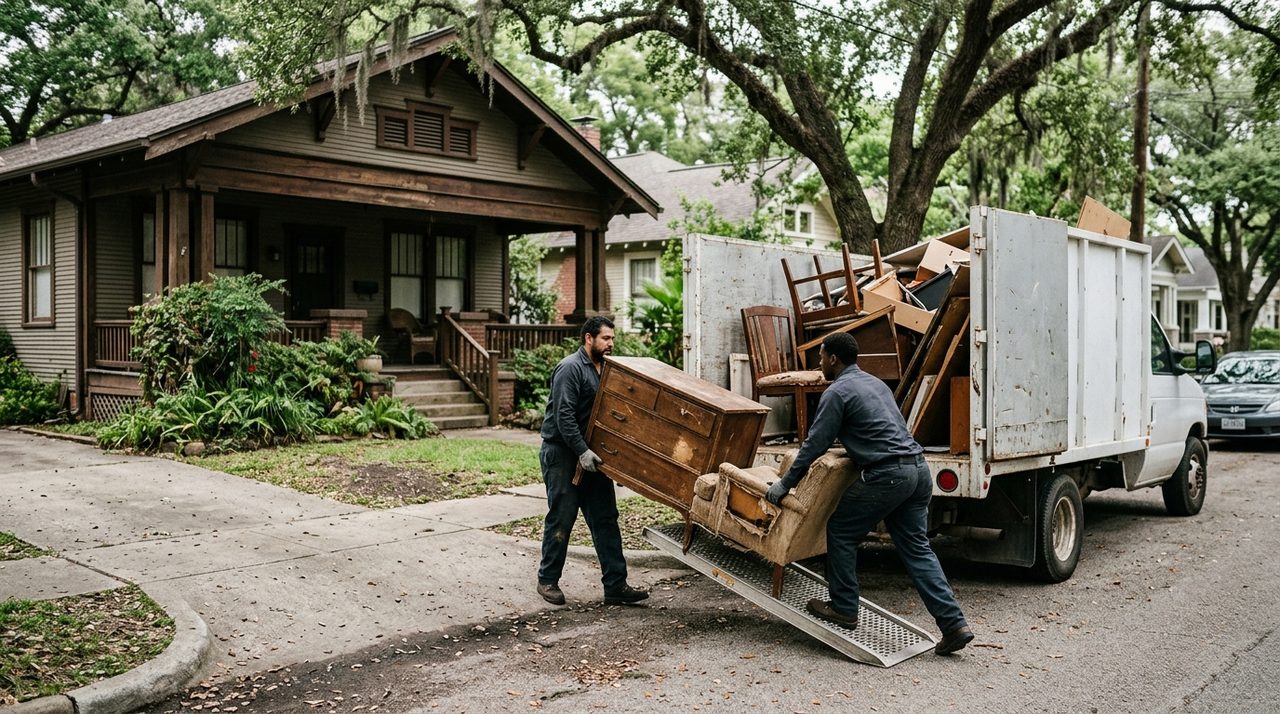
- Median home built
- 1993
- Median home value
- $445,764
- FEMA flood zone
- X (low)
- Typical cost (est.)
- $200–$650
- Most common local issue
- No driveway or staging area — debris must be coordinated with COA/HOA before haulers arrive
Ranked by verified Google rating × review volume × verification tier. How we rank →
Some highly-rated pros serve Midtown from nearby and may not keep a Midtown street address. Those are listed under "Also serving Midtown" with their real city and distance, so you always know where each business is based.
Min rating:
10 resultsBased in Midtown
Open Now
700 Milam St #1300, Houston, TX 77002
Open Now
801 Travis St suite 1785, Houston, TX 77002
Also serving Midtown
Highly-rated pros based nearby who cover Midtown. Distance shown from the Midtown area.
Closed
Serving Midtown Based in Upper Kirby · 2.5 mi away
Closed
Serving Midtown Based in EaDo · 2.9 mi away
Closed
Serving Midtown Based in EaDo · 3 mi away
Open Now
Serving Midtown Based in Galleria · 4.1 mi away
Closed
Serving Midtown Based in EaDo · 4.5 mi away
Serving Midtown Based in Medical Center · 4.7 mi away
Closed
Serving Midtown Based in EaDo · 4.9 mi away
Junk Removal in Midtown: What You Should Know
No Staging Area: Urban Lot Access in Midtown's Townhome Rows
Why it matters to you
The overwhelming majority of Midtown's post-1990 townhomes sit on narrow lots with zero side yard, a shared alley behind, and street parking governed by the city — meaning there is simply nowhere to drop a roll-off container without blocking a lane or violating parking rules. A full townhome cleanout can easily fill 10–12 cubic yards, but the crew has to load directly onto the truck in a single session or stage inside the garage, adding labor time and cost.
What a good pro does
Look for haulers who operate with a same-day load-and-go model on a two-person crew rather than leaving a roll-off overnight. Confirm the hauler is registered as a solid waste transporter with TCEQ and disposes at a permitted facility like the Westpark or McCarty Road transfer stations — illegal curbside abandonment on Midtown's dense streets is a Class B misdemeanor under Texas Health and Safety Code. Expect a partial-truckload job (3–4 cubic yards for a single room clearout) to run roughly $200–$350 as an estimate.
Sources: Texas Commission on Environmental Quality, City of Houston Permitting Center
COA and HOA Approval Before Anything Hits the Curb
Why it matters to you
Midtown has no single neighborhood-wide HOA, but dozens of individual Condominium Owners Associations and HOAs — such as the Midtown Edge Owners Association and Parc at Midtown HOA — each set their own rules about exterior staging, dumpster placement, and how long debris can sit at the building entrance. Violating those deed-restriction rules exposes the homeowner, not the hauler, to fines, and the approval process and architectural standards differ significantly from one complex to the next.
What a good pro does
Before booking any haul-out, pull your specific COA or HOA's rules in writing — most Midtown associations require advance notice of 24–48 hours minimum for any large removal touching common areas or building entries. A thorough junk-removal pro will ask for this documentation upfront, confirm the approved staging window, and schedule the crew to arrive, load, and clear within that window in a single visit.
Sources: Local HOA / deed restrictions (see area profile)
Renovation Debris from 2000s Townhomes Hitting Their First Refresh Cycle
Why it matters to you
Midtown's median year-built is 1993, and thousands of 2000s-era townhomes are now cycling through their first kitchen and bathroom remodels — generating tile, old cabinetry, laminate flooring, and occasionally lead-painted vintage fixtures from units that incorporated salvaged materials. Contractors frequently leave that demo debris for homeowners to handle separately, and mixing construction-and-demolition waste with standard household junk can violate municipal solid waste rules while also triggering per-ton surcharges at disposal facilities.
What a good pro does
Request an itemized quote that separates standard household junk from C&D debris — concrete, tile, and drywall in quantity typically carry a per-ton premium estimated at $60–$120 per ton above base rates. If the remodel involves any pre-1978 painted surfaces or reclaimed materials of unknown age, confirm the hauler follows EPA lead-safe handling protocols, as the City of Houston's permitting process does not separately license junk haulers but disposal must go to a TCEQ-permitted facility.
Sources: Texas Commission on Environmental Quality, EPA Lead Renovation, Repair and Painting (RRP) Rule, City of Houston Permitting Center
Aging Systems in 1960s High-Rise Units: Appliance and HVAC Haul-Away Challenges
Why it matters to you
Midtown's 1960s mid-rise and high-rise buildings often house chilled-water HVAC systems and galvanized plumbing infrastructure that, when replaced, produce bulky equipment — fan coil units, old galvanized pipe sections, cast-iron fixtures — that must travel through shared corridors and elevators before reaching street level. Winter Storm Uri (2021) accelerated appliance and water-heater turnover across Houston, and units in these older buildings saw compressor-style in-unit systems fail at high rates, leaving owners coordinating removal through building management.
What a good pro does
Coordinate with your building's property manager before scheduling the haul-away, since most Midtown high-rises have service elevator hours and loading-dock windows that govern when large items can leave the building. A junk-removal crew experienced with urban multifamily work will bring appropriate hand trucks and protective blankets for corridor floors, confirm elevator reservations in advance, and price the job to reflect the extra labor of multi-floor extraction — budget roughly $150–$350 as an estimate for a single large appliance removal in this context.
Sources: Texas Commission on Environmental Quality, City of Houston Permitting Center
Junk Removal in Midtown: What You Should Know
Hiring junk removal in Midtown? Midtown's housing stock is overwhelmingly post-1990 townhomes and condos interspersed with 1960s-era high-rise multifamily buildings, meaning contractors regularly encounter both modern construction and aging mid-century systems. Multiple individual HOAs and COAs govern exterior modifications, so homeowners must confirm their specific association's approval process before scheduling work. The neighborhood's improved drainage and slightly higher elevation provide relatively lower flood risk compared to much of Houston, though properties near Buffalo Bayou on the northwest edge remain vulnerable.
- Housing era
- Mixed
- Foundation
- Likely predominantly slab-on-grade given the prevalence of post-1990 townhomes and condos
- Flood zone
- FEMA Zone X (low flood risk) — source
- Permits
- City of Houston — Houston Permitting Center
Housing stock & systems
Building era
Mixed: 1960s high-rise multifamily and significant 1990s–2020s infill townhomes and condos.
Typical style
Mid-century high-rise/mid-rise apartments and contemporary/modern 3-story townhomes and low-rise condos.
Foundations
Likely predominantly slab-on-grade given the prevalence of post-1990 townhomes and condos; not explicitly confirmed for all properties.
Common systems
Newer townhomes/condos typically have modern central HVAC, PEX or copper plumbing, and 200-amp electrical panels. 1960s high-rises may have older chilled-water HVAC systems, galvanized or cast-iron plumbing, and dated electrical infrastructure requiring upgrades.
What that means for repairs
Interior condo and townhome remodels are extremely common, particularly kitchen and bathroom updates in 2000s-era units reaching their first refresh cycle. 1960s high-rise units often require full plumbing and electrical overhauls. Exterior modifications in HOA/COA-governed buildings typically need association architectural review.
Permits & restrictions
Permit jurisdiction
City of Houston — Houston Permitting Center.
HOA & deed restrictions
No single neighborhood-wide mandatory HOA. Multiple individual mandatory HOAs and COAs govern specific complexes and subdivisions (e.g., Midtown Edge Owners Association, Inc. [COA]; Parc at Midtown HOA). The Midtown Management District / Midtown Redevelopment Authority is a public quasi-governmental entity, not a homeowner association. Deed restrictions are common at the project/complex level but not uniform across every individually platted lot.
Historic districts
No City of Houston historic district designation confirmed.
Contractor note
Contractors must verify which specific HOA or COA governs a property before beginning exterior or structural work, as approval processes and architectural standards vary significantly between Midtown's many individual associations.
Flood & weather
FEMA flood zone
FEMA Zone X (low flood risk) — source: fema_nfhl. However, flood risk varies by property within Midtown. The northwest end of the neighborhood, closest to Buffalo Bayou, carries the highest flood risk. The neighborhood benefits from an improved drainage system and slightly higher elevation compared to much of Houston.
Hurricane Harvey impact
Midtown is generally characterized as having lower flood risk relative to most of Houston due to improved drainage and elevation. Specific Harvey 2017 damage reports for Midtown were not detailed in available sources, but the northwest portion near Buffalo Bayou was the area most likely to have experienced flooding. Flood insurance is still recommended even outside high-risk zones, as intense storms can cause localized flooding.
Heat & humidity load
Houston's extreme summer heat and humidity stress HVAC systems heavily in Midtown's dense townhome and condo construction. Older 1960s high-rise units with aging HVAC are particularly vulnerable to failures during peak summer. Flat roofs on mid-rise buildings require regular inspection for ponding water and membrane degradation. Interior moisture management is critical in tightly built newer townhomes.
Working with contractors here
Midtown contractors most commonly handle HVAC servicing, interior remodels of townhomes and condos, and plumbing upgrades in 1960s-era high-rise buildings. The dense mix of construction eras means a single block can have vastly different scoping needs — a 2015 townhome needing cosmetic updates versus a 1965 condo requiring full re-piping. Exterior work on townhomes and condos almost always requires HOA or COA architectural approval, and contractors should confirm this before providing bids. Limited parking and tight lot access in Midtown's urban core can affect material staging and crew logistics. Water heater and plumbing repairs in multi-story townhomes frequently require navigating tight utility closets and shared walls.
Local Tip
Always ask for a written estimate before work begins. Texas contractors are required to provide one on jobs over $1,000.
About Midtown
Midtown's housing stock is overwhelmingly post-1990 townhomes and condos interspersed with 1960s-era high-rise multifamily buildings, meaning contractors regularly encounter both modern construction and aging mid-century systems. Multiple individual HOAs and COAs govern exterior modifications, so homeowners must confirm their specific association's approval process before scheduling work. The neighborhood's improved drainage and slightly higher elevation provide relatively lower flood risk compared to much of Houston, though properties near Buffalo Bayou on the northwest edge remain vulnerable.
- Median year built
- 1993
- Median home value
- $445,764
- Owner-occupied
- 31.3%
- Population
- 79,409
- Housing units
- 43,935
- Median income
- $83,570
Source: U.S. Census Bureau, ACS 5-Year 2023
Flood & storm risk
FEMA Zone XLow flood riskMost of Midtown maps to FEMA Zone X (low mapped flood risk), but Houston's flash-flood reality means even low-risk blocks benefit from smart drainage and storm-hardened installs.
Source: FEMA National Flood Hazard Layer (NFHL). Flood zones vary by parcel — verify your individual FIRM panel.
Frequently Asked Questions
Do I need a City of Houston permit to have junk removed from my Midtown condo or townhome?
The City of Houston does not require a separate city-issued permit for junk removal itself, so your hauler can show up and load without filing anything at the Houston Permitting Center. What matters is that your hauler disposes of debris at a TCEQ-permitted solid waste facility — illegal dumping is a Class B misdemeanor under Texas law, so confirm with your hauler where loads actually go. If your removal is tied to a renovation (pulling old tile, cabinetry, or drywall), the remodel work itself may require a permit through the Houston Permitting Center, but the act of hauling the debris away does not.
Sources: Texas Commission on Environmental QualityCity of Houston Permitting Center
My Midtown townhome's 1990s-era kitchen generated a mix of tile, cabinetry, and old appliances — can all of that go in one junk-removal truck?
Haulers can often combine standard household items like appliances and furniture in a single load, but construction and demolition debris — tile, cabinetry, drywall, and flooring — is typically subject to separate pricing and in some cases separate disposal at TCEQ-permitted C&D facilities. Mixing C&D with regular household junk can trigger weight surcharges or add-on tipping fees, so get an itemized quote upfront that separates renovation debris from appliances. For a typical first-refresh Midtown townhome clearout, estimate $350–$650 for a full truckload with C&D included, though final cost depends on weight and debris type.
My Midtown condo is in FEMA Zone X — do I still need to worry about waterlogged debris removal after a heavy storm?
Most of Midtown maps to FEMA Zone X, which carries the lowest mapped flood risk, so widespread gut-out scenarios common along Brays or Buffalo Bayou are far less likely here. That said, Houston's intense rainfall events can overwhelm storm drains even in low-risk zones, and ground-floor condo units or parking garage storage areas in older 1960s high-rises can still take on water during extreme rain. If your unit does experience water intrusion, act within 24–48 hours — waterlogged drywall and flooring should be staged and hauled before mold colonization begins, even if the loss is modest compared to a bayou-adjacent event.
How far in advance should I schedule a junk-removal pickup at a Midtown high-rise or condo building, and are there time-of-day restrictions?
In Midtown's urban core, lead time of 3–7 days is a reasonable estimate for a condo or high-rise job, partly because many buildings have freight elevator reservation systems and loading dock windows that fill up quickly — especially on weekends. Before you book, contact your COA or building management to confirm acceptable haul-out hours (many buildings restrict noisy or heavy-traffic work to weekday business hours) and whether the freight elevator must be reserved in advance. Providing your hauler with the building's loading dock address rather than the main entrance will also prevent delays on the day of pickup.
My 1960s Midtown high-rise unit has old fluorescent light fixtures and a CRT television — can a standard junk hauler take those?
Fluorescent bulbs contain mercury and are classified as hazardous waste, so they cannot legally go into a standard junk load headed to a municipal solid waste facility — a reputable hauler will separate them and direct you to a household hazardous waste drop-off, such as the City of Houston's periodic HHW collection events. CRT televisions are considered e-waste and also require separate handling; many haulers charge an additional $20–$50 per CRT unit (estimate) to cover proper recycling. When booking, specifically disclose these items so the hauler can confirm they have compliant disposal arrangements rather than lumping them into the general load.
What questions should I ask a junk-removal company before booking in Midtown to avoid surprise fees or HOA fines?
Ask specifically whether they have experience with urban townhome and condo jobs where there is no driveway staging — you need a crew that can hand-carry items through a townhome stairwell or down a high-rise corridor without damaging common areas. Confirm they are registered with TCEQ as a solid waste transporter and can name the permitted facility where your load will be disposed. Finally, ask whether their quote covers a potential COA or building loading dock delay if they have to wait for an elevator window, since some companies charge idle-time fees that can add $50–$100 or more to your invoice.