Closed
301 Wells Fargo Dr Suite 3, Houston, TX 77090
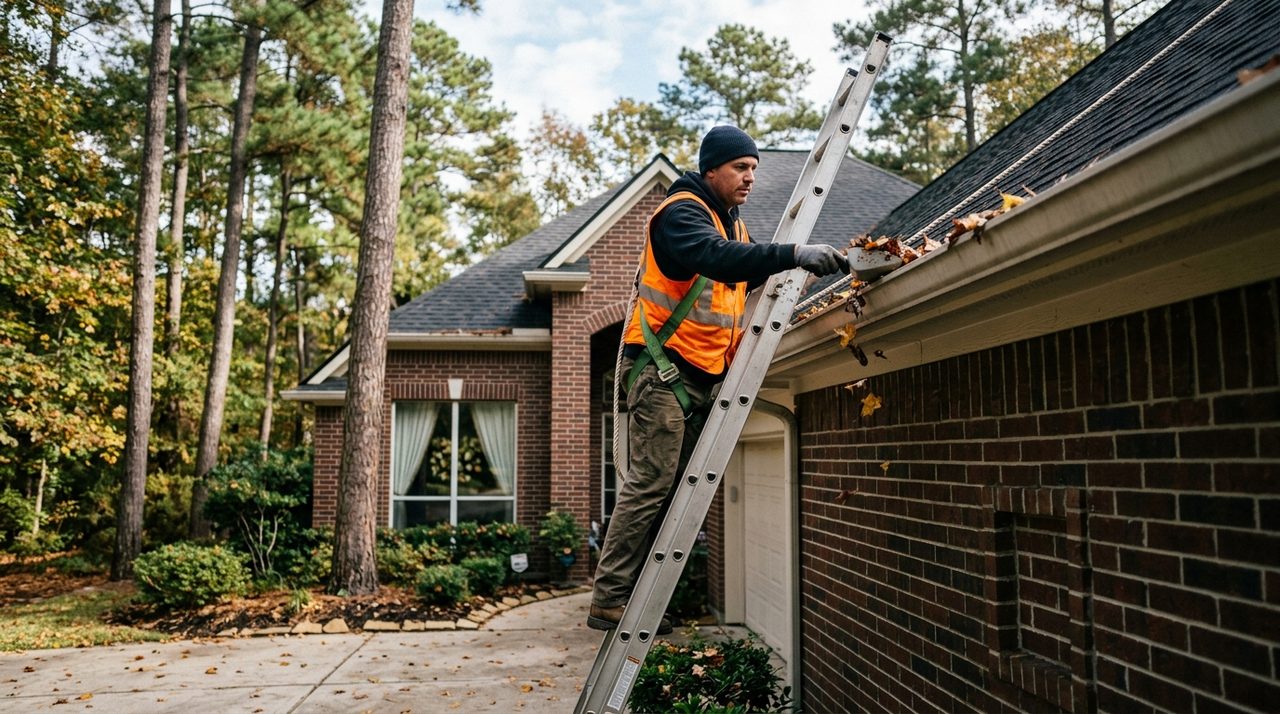
Spring's mostly unincorporated Harris County subdivisions span five decades of construction — from 1970s ranch homes near Spring Creek to 2000s brick two-stories close to SH-99 — and virtually every one sits on expansive Houston Black clay that reacts sharply to moisture swings at the foundation perimeter. Clogged gutters in this area aren't a cosmetic nuisance; they're a direct pathway to differential slab movement on soil that can shift inches between a wet spring and a dry August. This page breaks down the gutter-cleaning challenges that actually apply to Spring's aging housing stock, its dozens of subdivision HOAs, and its position inside Beryl's 2024 damage footprint.
Ranked by verified Google rating × review volume × verification tier. How we rank →
Some highly-rated pros serve Spring from nearby and may not keep a Spring street address. Those are listed under "Also serving Spring" with their real city and distance, so you always know where each business is based.
301 Wells Fargo Dr Suite 3, Houston, TX 77090
24703 Broad Branch Ct, Spring, TX 77373
21522 Falvel Rd, Spring, TX 77388
25825B Aldine Westfield Rd, Spring, TX 77373
26607 Keith St, Spring, TX 77373
726 Sun Lodge Dr, Houston, TX 77073
Highly-rated pros based nearby who cover Spring. Distance shown from the Spring area.
Serving Spring Based in The Woodlands · 1.7 mi away
Serving Spring Based in The Woodlands · 3.3 mi away
Serving Spring Based in The Woodlands · 4.6 mi away
Why it matters to you
A large share of Spring's housing stock was built between 1980 and 2005, putting those 3-tab and dimensional asphalt roofs squarely in the 20-to-40-year window when granule shedding is most aggressive. Harris County has been inside documented hail corridors multiple times in the past decade, accelerating granule loss on already aging shingles. Those granules migrate to downspout top elbows where they compact into near-concrete plugs that a leaf blower pass will not touch, leaving gutters that look clean from the ground but drain nowhere.
What a good pro does
A thorough pro for a Spring home of this era should hand-scoop gutter channels rather than relying solely on blowing, then pressure-flush each downspout individually and confirm discharge at the ground outlet. If granule volumes are heavy, they should flag the roof for a separate inspection — granule loss at this scale often signals that a roof replacement is approaching. No permit is required for gutter cleaning itself under Harris County Engineering Department rules, but a full gutter replacement tied to a roofing contract may require county-level review depending on scope.
Sources: Harris County Flood Control District, City of Houston Permitting Center
Why it matters to you
Spring's slab-on-grade homes sit on Beaumont and Houston Black clay series soils that shrink noticeably during summer drought and re-expand with each rain event. A blocked gutter that spills water against the foundation perimeter repeatedly floods the soil directly adjacent to the slab edge — exactly the differential saturation pattern that foundation repair contractors in this area cite most often as the precursor to pier work. Given Spring's census median build year of 1991 and the prevalence of foundation repair calls already in this market, clogged gutters represent an avoidable risk multiplier.
What a good pro does
Good gutter-cleaning practice for Spring homes specifically includes verifying that downspout extensions discharge at least four feet away from the foundation and that no pooling is occurring at the slab perimeter after a flush test. Pros familiar with the area should also check whether downspout outlets are discharging toward a positive-grade swale or against a flat or inward-sloping grade — a common condition in older Spring subdivisions where grading has settled over decades. No permit is required for cleaning or extending downspouts under Harris County rules.
Sources: Harris County Flood Control District, FEMA National Flood Hazard Layer (NFHL)
Why it matters to you
Spring sits inside the documented damage footprint of both the July 2024 Hurricane Beryl strike and the May 2024 derecho that crossed the northern Harris County corridor. Both events deposited large volumes of bark, small branches, Spanish moss, and wind-stripped shingle fragments into gutters in a matter of hours. Demand for gutter cleaning across the Spring and Humble corridor spiked immediately after each event, with independent operators quoting 2-to-6-week waits. Homeowners who deferred cleaning after either storm may still have partially obstructed gutters heading into the next heavy-rain season.
What a good pro does
After any named storm or severe wind event, Spring homeowners should treat gutter inspection as a 30-day priority rather than a seasonal task. A competent crew should document debris type and volume — especially if shingle granules or fascia fragments are present — since that documentation can support a homeowner's insurance claim for related storm damage. Because Texas has no state license requirement for gutter cleaning as a standalone service, the practical vetting standard is confirmed general liability insurance (at least $1M per occurrence) and workers' compensation coverage for anyone accessing the roof.
Sources: Harris County Flood Control District
Why it matters to you
Spring has no single area-wide HOA; instead, most post-1970 subdivisions carry mandatory property owners' associations with deed-tied rules that must be confirmed through Harris County Clerk records. Many of these POAs — particularly in 1990s and 2000s communities with light-colored brick and white or beige fascia trim — issue written violation notices for visible debris overflow, organic staining on soffit boards, or algae streaking, all of which are direct consequences of deferred gutter cleaning in Spring's year-round humid conditions. Violation notices can escalate to fines or architectural committee hearings in communities with active enforcement.
What a good pro does
Homeowners in Spring should confirm their specific subdivision's POA rules before scheduling — some require that exterior contractors be approved or that work be completed within certain hours, and a gutter crew arriving at 7 a.m. on a Saturday can itself generate a complaint. A pro cleaning gutters on fascia that already shows staining or early rot should photograph the condition and note it in writing to the homeowner, since fascia replacement may require HOA architectural review before work begins even though the cleaning itself requires no Harris County permit.
Sources: Local HOA / deed restrictions (see area profile), City of Houston Permitting Center
Hiring gutter cleaning in Spring? Spring is a large, mostly unincorporated area of Harris County comprising dozens of distinct subdivisions, each with its own HOA rules and deed restrictions. Homeowners here primarily deal with maintaining 1970s–2000s era slab-on-grade suburban homes, with common needs including HVAC replacement, foundation monitoring on expansive clay soils, and roof repairs. Proximity to Spring Creek and Cypress Creek tributaries means flood risk varies dramatically by subdivision, making property-specific flood zone verification essential before any major renovation.
Building era
1970s–2000s, with continued new construction near Grand Parkway (SH-99) in the 2010s–2020s.
Typical style
One- and two-story brick veneer detached single-family homes in traditional, ranch, and contemporary suburban styles with attached two-car garages.
Foundations
Slab-on-grade (dominant); pier-and-beam is rare and limited to occasional older properties.
Common systems
Central HVAC systems (many original units in 1970s–1980s homes are past useful life), copper or CPVC plumbing with some polybutylene in 1980s–early 1990s builds, and 100–200 amp electrical panels typical of era.
What that means for repairs
Kitchen and bathroom remodels are common in 1970s–1990s homes. HVAC system replacements are frequent due to system age. Foundation repair is a recurring need due to expansive clay soils and seasonal moisture fluctuation. Roof replacements are common on 20+ year homes after hail events.
Permit jurisdiction
Harris County Engineering Department for unincorporated areas (most of Spring); some portions within City of Houston ETJ may require Houston Permitting Center coordination.
HOA & deed restrictions
No single area-wide HOA exists. Most post-1970 subdivisions have mandatory property owners' associations (POAs) with deed-tied membership. Some older pockets have voluntary civic clubs or no active HOA. Specific HOA identity must be confirmed via Harris County Clerk deed records or TREC HOA Management Certificate Database.
Historic districts
No City of Houston historic district designation confirmed. Spring is largely unincorporated Harris County with no known HAHC-designated historic districts.
Contractor note
Contractors must verify whether a property falls within an incorporated city or unincorporated Harris County, as permit requirements and inspections differ. HOA architectural review and approval is required in most subdivisions before exterior modifications.
FEMA flood zone
FEMA Zone X (low flood risk) per official NFHL data. However, Spring encompasses areas near Spring Creek and Cypress Creek tributaries where flood risk can vary significantly by subdivision and specific lot. Property-level FIRM verification is strongly recommended.
Hurricane Harvey impact
Hurricane Harvey caused widespread flooding across north Harris County in 2017, with neighborhoods along Spring Creek and Cypress Creek corridors experiencing varying degrees of inundation. A single authoritative list of affected Spring subdivisions is not publicly compiled — property-specific impact should be verified through Harris County Flood Control District mapping tools and seller disclosures.
Heat & humidity load
Sustained 95°F+ temperatures and high humidity stress HVAC systems heavily, especially aging units in 1970s–1980s homes. Expansive clay soils contract during summer drought, increasing foundation movement risk. Attic temperatures can exceed 150°F, accelerating roofing material degradation and making attic insulation upgrades a common summer-driven project.
Working with contractors here
Contractors in Spring most commonly handle HVAC replacements, foundation repair, roof replacements, and kitchen/bath remodels driven by the aging 1970s–2000s housing stock. Foundation work is particularly prevalent due to the area's expansive clay soils and seasonal moisture cycles. Job scoping must account for subdivision-specific HOA architectural guidelines, which frequently regulate exterior colors, materials, fencing, and even contractor work hours. Because Spring is largely unincorporated Harris County, permits are handled through county engineering rather than the City of Houston, and contractors should verify jurisdiction boundaries on a per-property basis. Properties near creek corridors may require additional floodplain development permits even if the lot itself is mapped Zone X.
Local Tip
Always ask for a written estimate before work begins. Texas contractors are required to provide one on jobs over $1,000.
Spring is a large, mostly unincorporated area of Harris County comprising dozens of distinct subdivisions, each with its own HOA rules and deed restrictions. Homeowners here primarily deal with maintaining 1970s–2000s era slab-on-grade suburban homes, with common needs including HVAC replacement, foundation monitoring on expansive clay soils, and roof repairs. Proximity to Spring Creek and Cypress Creek tributaries means flood risk varies dramatically by subdivision, making property-specific flood zone verification essential before any major renovation.
Source: U.S. Census Bureau, ACS 5-Year 2023
Most of Spring maps to FEMA Zone X (low mapped flood risk), but Houston's flash-flood reality means even low-risk blocks benefit from smart drainage and storm-hardened installs.
Source: FEMA National Flood Hazard Layer (NFHL). Flood zones vary by parcel — verify your individual FIRM panel.
Even in Spring, TX where mapped flood risk is lower, Harvey 2017 proved that clogged gutters during multi-day tropical rainfall contribute to soffit rot and fascia damage that compounds repair costs. Clear gutters and secure all gutter hangers before hurricane season so the system stays attached under the high-wind loading that accompanies Gulf storms. As a Harris County community, Spring may follow county rather than City of Houston storm rebuild rules.
The May 2024 derecho demonstrated that Spring, TX isn't immune to structural gutter damage even without flooding; wind-lifted sections land on HVAC equipment, cars, and windows. Replacing standard gutter spikes with hex screws and adding hangers every 18 inches is the most cost-effective pre-storm hardening a gutter cleaning professional can perform. Confirm the current FEMA panel for your Spring parcel — the area maps to Zone X, but adjacent lots can differ.
In Spring, TX, hard freezes are infrequent but severe when they arrive — Uri 2021 left gutters across the metro cracked at end caps and separated at seams because standing debris water froze and expanded. A pre-freeze cleaning in November removes that moisture reservoir and keeps the system intact through thaw and the spring severe-storm season that follows. As a Harris County community, Spring may follow county rather than City of Houston storm rebuild rules.
Sources: FEMA National Flood Hazard Layer (NFHL), Ready.gov -- Hurricanes, CenterPoint Energy -- Storm Center, City of Houston -- Emergency Preparedness, Ready.gov -- Winter Weather, Harris County Flood Control District
Houston-specific estimators to plan your project before you call a pro. All results are planning estimates — a licensed local pro confirms the details on site.
Disconnect & drain every outdoor hose bib
Remove hoses, drain the spigots, and cover each with an insulated faucet sock. Un-drained hose bibs are the #1 burst point in a Houston freeze.
Insulate exposed pipes in the attic & garage
Wrap any pipe in an unconditioned space (attic runs, garage walls) with foam sleeves. Houston homes rarely insulate these because they only matter a few nights a year — which is exactly why they burst.
Open cabinet doors & keep a pencil-width drip
On hard-freeze nights, open kitchen/bath cabinets so warm air reaches the pipes and let faucets on exterior walls drip to relieve pressure.
Protect the attic/garage water heater & its lines
An attic or garage tank sits in unconditioned space. Insulate the cold-inlet and hot-outlet lines and confirm the emergency drain pan is clear so a leak doesn't reach the ceiling.
This is a planning estimate only — actual requirements depend on an on-site assessment by a licensed Houston pro. If a pipe has already burst, shut off your main water supply and call a licensed Houston plumber immediately — freeze bursts flood fast.
Sources: City of Houston Permitting Center
Sources: Local HOA / deed restrictions (see area profile)
Sources: FEMA National Flood Hazard Layer (NFHL)Harris County Flood Control District
Sources: Harris County Flood Control District