Open Now
301 Bennington St, Houston, TX 77022
Independence Heights's century-spanning housing stock — from 1910s Craftsman bungalows and 1950s ranch homes to 2020s infill townhomes — means gutters come in every age, width, and condition imaginable, and the City of Houston's expansive Beaumont clay beneath every slab and pier-and-beam footing turns a clogged downspout into a foundation problem. FEMA Zone X500 status (moderate flood risk, outside the 100-year floodplain but inside the 500-year) means heavy Gulf rain events still test drainage at this neighborhood's grade, making clean gutters one of the lowest-cost ways to keep water away from both aging pier footings and newer slab perimeters. This page covers what actually matters for gutter cleaning on Houston's oldest Black-platted neighborhood's wildly mixed housing stock.
Ranked by verified Google rating × review volume × verification tier. How we rank →
Some highly-rated pros serve Independence Heights from nearby and may not keep a Independence Heights street address. Those are listed under "Also serving Independence Heights" with their real city and distance, so you always know where each business is based.
301 Bennington St, Houston, TX 77022
4005 Kinkaid St, Houston, TX 77093
Highly-rated pros based nearby who cover Independence Heights. Distance shown from the Independence Heights area.
Serving Independence Heights Based in Lazybrook / Timbergrove · 1.6 mi away
Serving Independence Heights Based in Lazybrook / Timbergrove · 2.5 mi away
Serving Independence Heights Based in Acres Homes · 3.5 mi away
Serving Independence Heights Based in Lazybrook / Timbergrove · 3.7 mi away
Serving Independence Heights Based in Acres Homes · 3.7 mi away
Serving Independence Heights Based in EaDo · 3.7 mi away
Serving Independence Heights Based in Lazybrook / Timbergrove · 3.8 mi away
Serving Independence Heights Based in Brookhollow · 4.1 mi away
Why it matters to you
Independence Heights's 1910s–1950s Craftsman bungalows and ranch homes predominantly sit on pier-and-beam foundations, and Houston's Beaumont/Houston Black clay beneath them expands and contracts dramatically with moisture swings. When gutters overflow along the drip line of these older homes, repeated soil saturation immediately adjacent to the piers accelerates differential settlement and wood-beam rot in the crawl space — damage that routinely runs thousands of dollars to correct. Because the neighborhood's census median year built is 1966 and a large share of its legacy homes predate that, the pier-and-beam exposure here is higher than in most Inner Loop areas.
What a good pro does
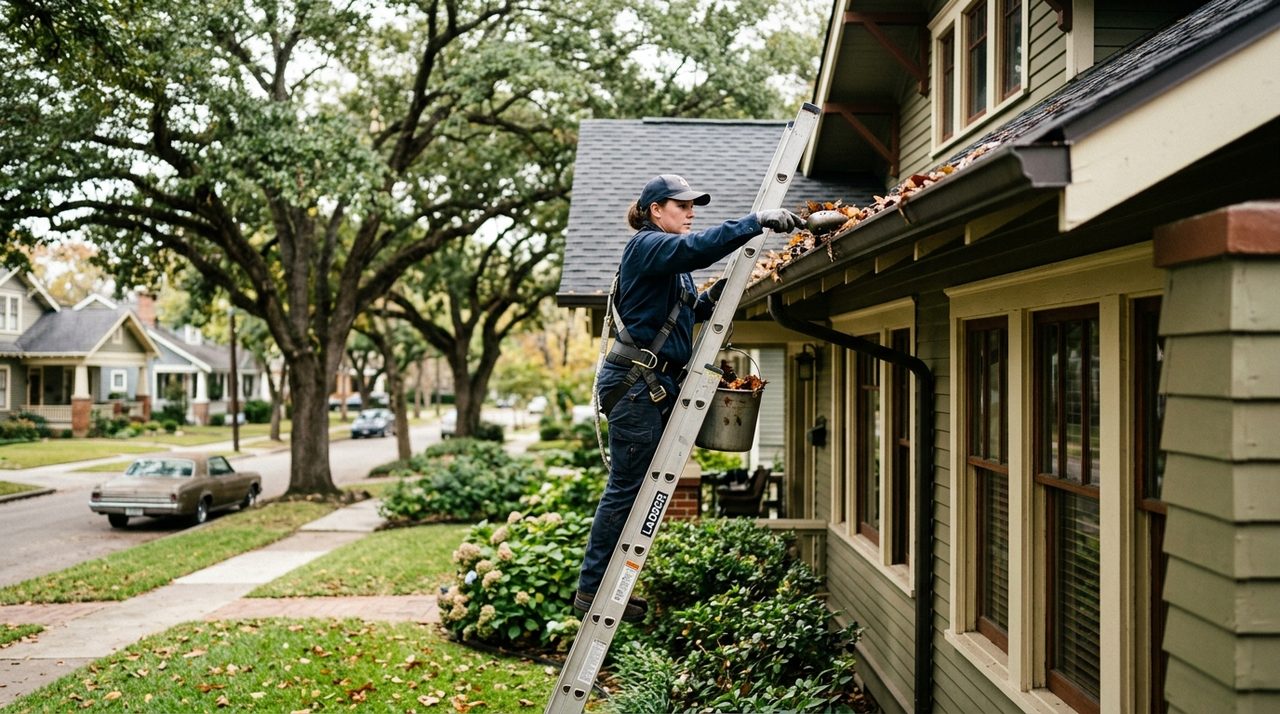
A thorough pro should hand-clear the gutters, flush every downspout to confirm it discharges well away from the pier grid, and visually inspect downspout extensions and splash blocks for proper grading away from the foundation perimeter. No permit is required through the Houston Permitting Center for routine cleaning or minor gutter repairs on these homes, so there is no paperwork barrier — just ask for proof of general liability insurance before anyone climbs onto an older roofline.
Sources: City of Houston Permitting Center, Harris County Flood Control District
Why it matters to you
Independence Heights's mid-century one-story ranch homes — the bulk of the 1950s–1960s build-out that anchors the neighborhood's median year built of 1966 — are squarely in the 15-to-30-year shingle replacement window where granule shedding is heaviest. Granules wash into gutter channels and settle at seams and downspout top elbows, compacting into near-concrete plugs that leaf blowing cannot clear. Harris County hail events accelerate granule loss further, meaning a single storm can advance a mild clog into a full blockage overnight.
What a good pro does
A competent gutter cleaner on these homes should probe each downspout elbow by hand or with a plumber's snake, not just run a blower across the roof edge. Flushing with a garden hose from the closed end toward the downspout confirms full flow and reveals any seam separations that have opened under granule weight. Gutter cleaning is not a permitted trade activity under the Houston Permitting Center, so the only credential check needed is general liability insurance and, for roof-access work, confirmation of workers' compensation coverage.
Sources: City of Houston Permitting Center, International Residential Code (as adopted by City of Houston)
Why it matters to you
The 2000s–2020s infill townhomes now occupying former single-family lots in Independence Heights sit on narrow footprints with gutters that often dump at grade level directly against the adjacent property. When debris dams hold even a few inches of standing water, Harris County Mosquito Control District identifies residential gutters as a primary Aedes aegypti breeding site — and Houston's year-round warmth means a brood can develop in as few as seven days. Townhome clusters with mandatory HOAs (such as the Independence Heights Homes Community Association, Inc.) may also issue exterior-maintenance notices if overflowing gutters stain light-colored fascia boards visible from the street.
What a good pro does
Twice-yearly cleanings — ideally in early May before peak mosquito season and again in late October after fall leaf drop — are the baseline for these townhome gutters. A good pro will flush downspouts at each visit and confirm all outlet extensions direct water away from the shared property line, which matters especially where lots were subdivided to accommodate two- or three-story units side by side. For any HOA-governed cluster, ask the operator to document the work with a dated service report you can file against a potential violation notice.
Sources: Harris County Flood Control District, Local HOA / deed restrictions (see area profile)
Why it matters to you
Independence Heights sits in Harris County, directly inside the documented damage footprint of both Harvey (2017) and Beryl (July 2024), and the neighborhood's wide variation in roofline age means storm aftermath looks different lot by lot: aged asphalt shingles on the 1950s ranch next door may shed a season's worth of granules in a single event, while Spanish moss and small branches from mature canopy trees blow into the gutters of the century-old cottages a few doors down. FEMA Zone X500 means the neighborhood is not in the highest-priority flood tier, but 500-year flood events do occur — Harris County Flood Control District data show recurring overland flooding during major Gulf events — and clogged gutters add unnecessary load to already-stressed drainage.
What a good pro does
After any named storm or severe derecho affecting Houston, plan to schedule gutter cleaning within one to two weeks rather than waiting for the typical seasonal window; contractor backlogs across the metro commonly stretch to four to six weeks post-storm, so early booking matters. Insist the crew inspect downspout straps and hanger screws for any storm-loosened brackets — a common finding on both the older spike-and-ferrule aluminum gutters of the mid-century homes and the K-style gutters on newer infill — since a misaligned gutter pitch traps water regardless of how clean the channel is.
Sources: Harris County Flood Control District, FEMA National Flood Hazard Layer (NFHL), City of Houston Permitting Center
Hiring gutter cleaning in Independence Heights? Independence Heights spans over a century of construction, from 1910s bungalows and 1950s ranch homes to 2020s contemporary townhomes. Homeowners here face a wide range of service needs driven by aging pier-and-beam foundations, outdated plumbing and electrical in mid-century homes, and newer infill properties with their own HOA requirements. The neighborhood's moderate flood risk and mixed housing stock make contractor experience with both historic rehabilitation and modern code compliance essential.
Building era
1910s–1920s (original platted lots), 1950s–1960s (major mid-century build-out, median year built 1958), 2000s–2020s (infill townhomes and new single-family).
Typical style
Craftsman bungalows and vernacular cottages (1910s–1920s), one-story ranch and minimal-traditional (1950s–1960s), contemporary two- and three-story townhomes and modern single-family (2000s–2020s).
Foundations
Mixed — pier-and-beam dominates pre-1960s housing; slab-on-grade common in newer infill construction.
Common systems
Older homes often have galvanized or cast-iron plumbing, outdated 60–100 amp electrical panels, and window-unit or older central HVAC. Mid-century homes typically have early central HVAC with ductwork in unconditioned spaces. Newer infill features modern PEX or CPVC plumbing, 200-amp panels, and high-efficiency HVAC systems.
What that means for repairs
Significant renovation activity driven by new infill development replacing or updating older lots. Historic bungalows and mid-century ranch homes are frequently gut-renovated with foundation repair, full re-plumbing, electrical panel upgrades, and HVAC modernization. Townhome clusters are also emerging on previously single-family lots.
Permit jurisdiction
Houston Permitting Center (City of Houston jurisdiction — neighborhood annexed in 1929).
HOA & deed restrictions
No single mandatory HOA for all of Independence Heights. The area operates under the City of Houston Super Neighborhood 13 council (voluntary civic/advocacy structure). Pocket developments and newer townhome clusters have their own mandatory HOAs, such as Independence Heights Homes Community Association, Inc. (registered POA in Harris County, ZIP 77018). Many legacy lots have no HOA.
Historic districts
No City of Houston historic district designation confirmed, despite the neighborhood's significant cultural history as an early 20th-century planned Black community (incorporated 1915, annexed by Houston 1929).
Contractor note
Contractors must navigate varying deed restrictions that are lot- and subdivision-specific rather than uniform across the neighborhood. New infill projects in HOA-governed clusters may have additional architectural review requirements beyond standard city permitting.
FEMA flood zone
FEMA Zone X500 (moderate flood risk) — source: fema_nfhl. The neighborhood sits just north of Loop 610 and west of I-45 in a lower-elevation area of Houston's near northside. No specific bayou or creek adjacency was confirmed in research, but the I-45 corridor location places it in a drainage-sensitive area.
Hurricane Harvey impact
Specific street-by-street Harvey flood data was not confirmed in available research. The neighborhood's near-northside, lower-elevation location along the I-45 corridor suggests it was likely affected by significant street and structural flooding during Harvey, consistent with broader news coverage of nearby areas. Homeowners should verify parcel-level flood history through Harris County Flood Control District records and FEMA repetitive loss databases.
Heat & humidity load
Older pier-and-beam homes with minimal insulation and aging HVAC systems face extreme summer stress, leading to high energy bills and frequent HVAC service calls. Pier-and-beam crawlspaces are vulnerable to moisture buildup and pest intrusion in Houston's humid summers. Newer infill townhomes with modern insulation and sealed envelopes perform better but may experience condensation issues at transitions between conditioned and unconditioned spaces.
Working with contractors here
Foundation repair is one of the most common service needs, particularly for pier-and-beam homes built in the 1910s–1960s that have experienced decades of Houston's expansive clay soil movement. Re-plumbing is frequently required in mid-century homes still running galvanized or cast-iron drain lines. Electrical panel upgrades from 60-amp to 200-amp service are common as homeowners modernize older homes or add square footage. The active infill market means general contractors regularly handle teardown-and-rebuild projects, often requiring lot-specific deed restriction review. Contractors should be prepared for wide variation in job scope — from historic cottage restoration on one lot to modern townhome punch-list work on the next.
Local Tip
Always ask for a written estimate before work begins. Texas contractors are required to provide one on jobs over $1,000.
Independence Heights spans over a century of construction, from 1910s bungalows and 1950s ranch homes to 2020s contemporary townhomes. Homeowners here face a wide range of service needs driven by aging pier-and-beam foundations, outdated plumbing and electrical in mid-century homes, and newer infill properties with their own HOA requirements. The neighborhood's moderate flood risk and mixed housing stock make contractor experience with both historic rehabilitation and modern code compliance essential.
Source: U.S. Census Bureau, ACS 5-Year 2023
Independence Heights carries FEMA Zone X500 (moderate flood risk): outside the 100-year floodplain but inside the 500-year, so heavy-rain events still reach homes and flood-aware work pays off.
Source: FEMA National Flood Hazard Layer (NFHL). Flood zones vary by parcel — verify your individual FIRM panel.
In Independence Heights, FEMA Zone X500 in the 500-year floodplain can still send significant volumes of water toward your home even if you sit outside the mapped 100-year boundary. Having downspout diverters or underground drain pipes inspected and cleared annually ensures hurricane rainfall routes to the yard rather than pooling at sill level. Much of the housing stock predates modern wind codes (median build year 1966), so retrofits matter more here. In-city Independence Heights work falls under City of Houston floodplain and permitting rules.
In Independence Heights, heavy-cell thunderstorms typical of Houston's severe season can dump two inches in under 30 minutes — have gutters cleared at least twice a year, ideally in March and again in October, so you enter peak storm periods with full drainage capacity. A quick hose-flush by a qualified technician will also reveal any hidden downspout blockage before it causes overflow at the foundation. Confirm the current FEMA panel for your Independence Heights parcel — the area maps to Zone X500, but adjacent lots can differ.
Winter Storm Uri 2021 showed that even Houston neighborhoods outside the 100-year floodplain can see significant meltwater runoff when three days of ice release simultaneously — clear gutters in late fall so the full trough capacity handles that surge without overflowing at the fascia. In Independence Heights, a quick November cleaning and downspout flush is the most efficient single step to protect the structure through both the freeze and the thaw. With a median build year of 1966, the older building stock here is more exposed to hard-freeze damage than newer construction. In-city Independence Heights work falls under City of Houston floodplain and permitting rules.
Sources: FEMA National Flood Hazard Layer (NFHL), Ready.gov -- Hurricanes, CenterPoint Energy -- Storm Center, City of Houston -- Emergency Preparedness, Ready.gov -- Winter Weather, Harris County Flood Control District
Houston-specific estimators to plan your project before you call a pro. All results are planning estimates — a licensed local pro confirms the details on site.
Disconnect & drain every outdoor hose bib
Remove hoses, drain the spigots, and cover each with an insulated faucet sock. Un-drained hose bibs are the #1 burst point in a Houston freeze.
Insulate exposed pipes in the attic & garage
Wrap any pipe in an unconditioned space (attic runs, garage walls) with foam sleeves. Houston homes rarely insulate these because they only matter a few nights a year — which is exactly why they burst.
Open cabinet doors & keep a pencil-width drip
On hard-freeze nights, open kitchen/bath cabinets so warm air reaches the pipes and let faucets on exterior walls drip to relieve pressure.
Protect the attic/garage water heater & its lines
An attic or garage tank sits in unconditioned space. Insulate the cold-inlet and hot-outlet lines and confirm the emergency drain pan is clear so a leak doesn't reach the ceiling.
This is a planning estimate only — actual requirements depend on an on-site assessment by a licensed Houston pro. If a pipe has already burst, shut off your main water supply and call a licensed Houston plumber immediately — freeze bursts flood fast.
Sources: City of Houston Permitting Center
Sources: FEMA National Flood Hazard Layer (NFHL)Harris County Flood Control District
Sources: Local HOA / deed restrictions (see area profile)