25261 Kelly Rd, Porter, TX 77365
Best Garage Door Repair in Porter, TX
Porter's dozens of subdivisions—ranging from 1970s acreage tracts to brand-new Valley Ranch production homes—mean garage door needs vary as much as the housing stock itself: older slab-on-grade homes on Montgomery County's expansive clay soil develop racking frames and binding tracks, while newer HOA communities add an architectural review layer before any replacement can begin. All permitting runs through Montgomery County Engineering rather than any city office, a distinction that trips up homeowners and contractors alike. Whether you're dealing with a 1990s builder-grade door that predates modern insulation standards or a fresh install in a Valley Ranch community with strict style rules, this guide gives you the Porter-specific information you need.
Verified against Google Business data
Updated 2026
See the 8 Garage Door Repair Serving Porter 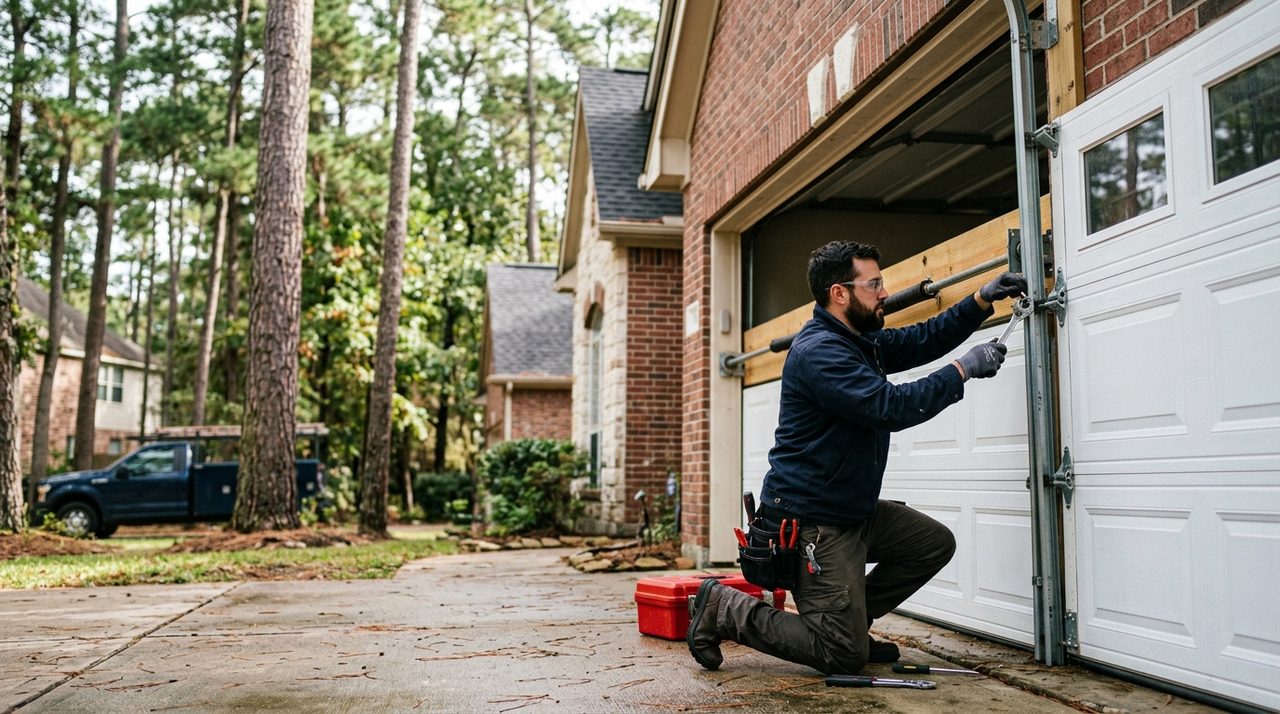
- Median home built
- 2001
- Median home value
- $226,053
- FEMA flood zone
- X (low)
- Typical cost (est.)
- $900–$2,400 installed
- Most common local issue
- Clay-soil frame racking on 1980s–2000s slab homes
Ranked by verified Google rating × review volume × verification tier. How we rank →
Some highly-rated pros serve Porter from nearby and may not keep a Porter street address. Those are listed under "Also serving Porter" with their real city and distance, so you always know where each business is based.
Min rating:
8 resultsBased in Porter
Closed
22415 Toronado Ridge Ln, Porter, TX 77365
Open Now
24420 FM1314, Porter, TX 77365
Open Now
23575 US-59, Porter, TX 77365
Also serving Porter
Highly-rated pros based nearby who cover Porter. Distance shown from the Porter area.
Open Now
Serving Porter Based in Kingwood · 3.2 mi away
Open Now
Serving Porter Based in Kingwood · 3.6 mi away
Open Now
Serving Porter Based in Kingwood · 3.8 mi away
Open Now
Serving Porter Based in Humble · 6.7 mi away
Garage Door Repair in Porter: What You Should Know
Clay Soil Movement Warping Garage Frames on Porter's Older Slabs
Why it matters to you
A large share of Porter's housing stock was built between the 1980s and early 2000s on concrete slab-on-grade foundations sitting atop Montgomery County's moisture-reactive clay soils—the same Beaumont and Houston Black series that plagues the broader Houston region. Seasonal wet-dry cycles cause the slab to heave and settle differentially, gradually distorting the rough opening around the garage door. Homeowners notice the door binding in one corner, rollers skipping out of the track, or a persistent gap at the bottom seal that no amount of adjustment seems to fix permanently.
What a good pro does
A qualified pro should assess the rough opening with a level before quoting any repair; if the frame is out of plumb by more than half an inch, adjusting spring tension alone is a temporary fix. The correct approach includes shimming or reframing the header and jambs to re-square the opening, then recalibrating the track and replacing worn rollers with nylon-coated versions that tolerate minor misalignment better than standard steel. Because this work touches the structural opening, a full door replacement in Porter requires a permit through Montgomery County Engineering rather than any city permit office—confirm this with your contractor before work begins.
Sources: International Residential Code (as adopted by City of Houston), Municipal permit office (see area profile)
Gulf Humidity Accelerating Spring and Hardware Corrosion Across All Porter Subdivisions
Why it matters to you
Porter sits roughly 30 miles north of Houston's urban core but still experiences the Gulf Coast's year-round humidity, which averages 65–70% and regularly spikes above 90% during summer months. For garage doors—especially in the many Porter homes where the garage is uninsulated and unventilated—torsion springs, bottom brackets, cables, and hinges are exposed to near-constant moisture. Oil-tempered springs that might deliver 10,000 cycles in a drier Texas city can fail in five to seven years here, often snapping without warning and leaving the door inoperable.
What a good pro does
When replacing springs on a Porter home, ask specifically for galvanized or corrosion-resistant coated torsion springs rather than bare oil-tempered steel; the modest upcharge pays back in extended service life given local humidity. A twice-yearly lubrication schedule using a silicone- or lithium-based spray (not WD-40) on springs, hinges, and rollers meaningfully slows corrosion. Torsion spring replacement for a two-spring system runs an estimated $200–$350 in the Houston metro; budget at the higher end if the hardware has visible rust, because corroded cables and bottom brackets typically need replacement at the same visit.
Sources: ENERGY STAR / U.S. Dept. of Energy
HOA Architectural Review in Valley Ranch and Other Governed Subdivisions
Why it matters to you
Porter has no citywide zoning and many of its rural tracts carry no deed restrictions at all—but that is not the full picture. Master-planned communities including Valley Ranch and North Country have mandatory HOAs whose architectural control committees (ACCs) specify permitted panel styles, colors, and sometimes materials for garage doors. A homeowner who buys a steel door in the wrong color or panel pattern—even one that looks similar to the original—can face fines and a mandatory reinstallation at their own cost. Because these rules sit in private deed covenants rather than county code, Montgomery County's permit office will not flag a violation.
What a good pro does
Before finalizing any door selection, pull your subdivision's deed restrictions through TREC's HOA management-certificate database or request the ACC guidelines directly from your HOA management company. Submit a written ACC application with the manufacturer's spec sheet, color swatch, and a photo of the installed look; get written approval before ordering, because lead times on specific door models can run two to four weeks and a denial after delivery leaves you holding a non-returnable product. Your contractor should be familiar with this dual-track process—Montgomery County permit plus HOA approval—and should not schedule installation until both are in hand.
Sources: Local HOA / deed restrictions (see area profile), Municipal permit office (see area profile)
Uninsulated Doors Driving Cooling Costs in Porter's Sun-Exposed Production Homes
Why it matters to you
The bulk of Porter's housing built from the 1990s through the 2010s features attached two-car garages with original single-layer or minimally insulated steel doors, many of which face west or south in the grid-planned subdivisions along FM 1314 and the Grand Parkway corridor. Houston logs more than 150 hours above 95°F each year, and an uninsulated door (R-0) turns the garage into a radiant heat box that raises temperatures in adjacent living spaces and forces HVAC systems—already working hard in Montgomery County's summer climate—to run longer cycles. Older homes with 100–150-amp panels and aging R-22 equipment feel this load the most.
What a good pro does
Upgrading to an insulated steel door rated R-13 to R-18 is one of the highest-return envelope improvements available in Porter's sun-exposed suburban layout. A double-car insulated replacement door runs an estimated $1,200–$2,400 installed in the Houston metro; the energy savings on cooling-dominated bills can offset a meaningful portion of that cost over five to seven years, and the improvement in garage comfort is immediate. Look for ENERGY STAR-certified door units and verify the R-value is measured as a whole-assembly rating rather than just the foam core, since edge and frame conduction matters in extreme heat.
Sources: ENERGY STAR / U.S. Dept. of Energy, International Residential Code (as adopted by City of Houston)
Garage Door Repair in Porter: What You Should Know
Hiring garage door repair in Porter? Porter is a sprawling, unincorporated Montgomery County area composed of dozens of individual subdivisions—some master-planned with mandatory HOAs, others completely unrestricted rural tracts. Housing ranges from 1970s-era homes on acreage to brand-new production builds in communities like Valley Ranch. Homeowners must navigate county-level permitting and widely varying deed restrictions, making it essential to verify rules at the subdivision level before any project.
- Housing era
- 1970s–2020s, with significant growth from the 1990s through 2010s and ongoing new construction
- Foundation
- Predominantly concrete slab-on-grade for post-1960 construction
- Flood zone
- FEMA Zone X (low flood risk) per official NFHL data
- Permits
- Montgomery County Engineering and applicable special utility districts (MUDs)
Housing stock & systems
Building era
1970s–2020s, with significant growth from the 1990s through 2010s and ongoing new construction.
Typical style
Mix of traditional single-family brick and frame homes in older plats, and newer production-style traditional homes in master-planned communities.
Foundations
Predominantly concrete slab-on-grade for post-1960 construction; some pier-and-beam in older or custom rural builds — specific subdivision data not confirmed.
Common systems
Newer homes typically feature central HVAC with high-SEER units, PEX or copper plumbing, and 200-amp electrical panels; older 1970s–1990s homes may have original R-22 HVAC systems, galvanized or CPVC plumbing, and 100–150-amp panels.
What that means for repairs
Older subdivisions see HVAC replacements, re-plumbing from galvanized to PEX, and kitchen/bath remodels. Unrestricted acreage tracts attract new construction, additions, and outbuilding projects. Master-planned communities focus on cosmetic updates and energy efficiency upgrades.
Permits & restrictions
Permit jurisdiction
Montgomery County Engineering and applicable special utility districts (MUDs). Not within City of Houston or any incorporated city permit jurisdiction.
HOA & deed restrictions
Varies widely by subdivision. Valley Ranch HOA is mandatory for all property owners. North Country Homeowners Association, Inc. operates as a subdivision HOA. The Highlands is governed by a mandatory HOA. Many properties in broader Porter have no HOA at all. Confirm for any specific property via deed records or TREC HOA management-certificate database.
Historic districts
No historic district designation confirmed. Porter is in unincorporated Montgomery County with no City of Houston HAHC jurisdiction.
Contractor note
Contractors must obtain permits through Montgomery County rather than a city permit office. Additionally, many subdivisions require separate HOA architectural review committee (ACC) approval before exterior work begins, so contractors should verify both county and private-covenant requirements for each job.
Flood & weather
FEMA flood zone
FEMA Zone X (low flood risk) per official NFHL data. However, properties near the East Fork of the San Jacinto River and its tributaries may carry higher risk; confirm flood zone at the parcel level as conditions vary across this large unincorporated area.
Hurricane Harvey impact
Parts of Montgomery County, including areas along the San Jacinto River and its tributaries, experienced flooding during Hurricane Harvey. Subdivision-specific or street-level Harvey impact data for the broader Porter area was not confirmed in available sources. Property-specific flood history should be verified through FEMA NFIP records and the Montgomery County floodplain administrator.
Heat & humidity load
Extreme summer heat and humidity drive heavy HVAC demand; older 1970s–1990s systems may struggle with efficiency. Slab foundations on expansive clay soils can shift during prolonged dry spells, and homes on rural lots with septic systems face additional stress during saturated-soil conditions in late summer storms.
Working with contractors here
Porter's wide range of housing ages means contractors encounter everything from 1970s-era galvanized re-pipes and aging R-22 HVAC changeouts to warranty work in brand-new master-planned communities. Unrestricted acreage properties frequently generate new-build, barndominium, and accessory-structure projects that require Montgomery County permitting and septic coordination. In HOA-governed subdivisions like Valley Ranch and North Country, exterior projects require ACC approval in addition to county permits, and contractors should budget time for that review process. The area's rapid growth means utility infrastructure varies—some neighborhoods are served by MUDs with specific tap and connection standards that affect plumbing and site work. Job scoping should always include verifying the specific subdivision's HOA status, applicable deed restrictions, and whether the property is on municipal water/sewer or septic.
Local Tip
Always ask for a written estimate before work begins. Texas contractors are required to provide one on jobs over $1,000.
About Porter
Porter is a sprawling, unincorporated Montgomery County area composed of dozens of individual subdivisions—some master-planned with mandatory HOAs, others completely unrestricted rural tracts. Housing ranges from 1970s-era homes on acreage to brand-new production builds in communities like Valley Ranch. Homeowners must navigate county-level permitting and widely varying deed restrictions, making it essential to verify rules at the subdivision level before any project.
- Median year built
- 2001
- Median home value
- $226,053
- Owner-occupied
- 79.5%
- Population
- 109,578
- Housing units
- 38,772
- Median income
- $83,660
Source: U.S. Census Bureau, ACS 5-Year 2023
Flood & storm risk
FEMA Zone XLow flood riskMost of Porter maps to FEMA Zone X (low mapped flood risk), but Houston's flash-flood reality means even low-risk blocks benefit from smart drainage and storm-hardened installs.
Source: FEMA National Flood Hazard Layer (NFHL). Flood zones vary by parcel — verify your individual FIRM panel.
Houston Storm Readiness in Porter
Hurricane & flooding
Wind-load rating is the top hurricane priority for garage doors in Porter, TX — a TDLR-licensed technician can verify whether your door carries the required wind-resistance label and install a vertical and horizontal bracing kit if it does not. A battery-backup opener is equally critical, since CenterPoint outages during Gulf landfalls routinely cut power for 72-plus hours even in lower-flood-risk neighborhoods. As a Montgomery County community, Porter may follow county rather than City of Houston storm rebuild rules.
Severe storms & hail
Hail impacts accumulate across Houston's storm seasons and gradually compromise the integrity of garage-door panels in Porter, TX, often without obvious visual cues from the ground. After any storm that the National Weather Service reports as producing hail above three-quarters of an inch in your area, a professional inspection of panel surfaces, hinges, and weatherstripping is the proactive step that keeps the door's wind rating intact. Confirm the current FEMA panel for your Porter parcel — the area maps to Zone X, but adjacent lots can differ.
Ice storms & freezes
Garage doors in Porter, TX are among the most vulnerable entry points to freezing temperatures during events like Uri 2021, when sustained sub-20°F air turned standard bottom seals brittle and cracked weatherstripping that had never experienced such cold. Replacing foam-based seals with cold-temperature-rated vinyl or rubber seals before winter, and adding an insulated door panel if the current door is uninsulated, keeps the garage from becoming a heat sink. As a Montgomery County community, Porter may follow county rather than City of Houston storm rebuild rules.
Sources: FEMA National Flood Hazard Layer (NFHL), Ready.gov -- Hurricanes, CenterPoint Energy -- Storm Center, City of Houston -- Emergency Preparedness, Ready.gov -- Winter Weather, Harris County Flood Control District
Free Porter Tools & Calculators
Houston-specific estimators to plan your project before you call a pro. All results are planning estimates — a licensed local pro confirms the details on site.
Houston Freeze Prep & Pipe Insulation Checklist
Open full tool & FAQ →Your freeze checklist — 4 tasks
- 1
Disconnect & drain every outdoor hose bib
Remove hoses, drain the spigots, and cover each with an insulated faucet sock. Un-drained hose bibs are the #1 burst point in a Houston freeze.
- 2
Insulate exposed pipes in the attic & garage
Wrap any pipe in an unconditioned space (attic runs, garage walls) with foam sleeves. Houston homes rarely insulate these because they only matter a few nights a year — which is exactly why they burst.
- 3
Open cabinet doors & keep a pencil-width drip
On hard-freeze nights, open kitchen/bath cabinets so warm air reaches the pipes and let faucets on exterior walls drip to relieve pressure.
- 4
Protect the attic/garage water heater & its lines
An attic or garage tank sits in unconditioned space. Insulate the cold-inlet and hot-outlet lines and confirm the emergency drain pan is clear so a leak doesn't reach the ceiling.
This is a planning estimate only — actual requirements depend on an on-site assessment by a licensed Houston pro. If a pipe has already burst, shut off your main water supply and call a licensed Houston plumber immediately — freeze bursts flood fast.
Frequently Asked Questions
Do I need a permit from Montgomery County to replace my garage door in Porter?
If you are replacing a garage door within the same structural opening — meaning no framing changes — Montgomery County Engineering generally does not require a building permit for a like-for-like door swap; purely mechanical work like spring or opener replacement does not require a permit either. However, if you are widening or altering the rough opening, you will need to pull a permit through Montgomery County Engineering, not a city office, since Porter is unincorporated and has no municipal permit department. Always call Montgomery County Engineering directly to confirm, because code interpretation can shift and the rules differ from what Houston-based contractors may be used to.
Sources: Municipal permit office (see area profile)
My Porter home was built in the early 1990s — is my garage door too old to meet current wind-load requirements?
Doors installed before the 2003 IRC wind-load amendments were adopted widely likely do not meet current minimum wind-resistance standards, which require garage doors to withstand design pressures specific to the local wind zone. Porter is in Montgomery County, outside the TWIA Tier 1 and Tier 2 coastal zones, so a WPI-8 windstorm certificate is not required and TWIA insurance does not apply here — standard homeowner's wind coverage governs instead. That said, the May 2024 derecho that cut across the north Houston metro demonstrated that inland locations like Porter are not immune to damaging straight-line winds, so upgrading a 30-year-old door to a wind-rated model is a reasonable precaution even without a TWIA mandate.
Sources: International Residential Code (as adopted by City of Houston)Texas Windstorm Insurance Association (TWIA)
I'm in Valley Ranch — do I need HOA approval before scheduling a garage door replacement, or can I just order the door and get it installed?
Valley Ranch has a mandatory HOA with an Architectural Control Committee (ACC), and exterior replacements including garage doors typically require ACC approval before work begins, not after. Submitting your door style, color, and material specs to the ACC first is the right order of operations; approval timelines commonly run two to four weeks depending on how frequently the committee meets. Skipping this step and installing a non-conforming door can result in a fine and a forced replacement, so confirm the ACC submittal requirements directly with Valley Ranch HOA management before you sign any contractor agreement.
Sources: Local HOA / deed restrictions (see area profile)
Porter maps mostly to FEMA Zone X, so should I worry about flood damage to my garage door hardware?
Zone X designation means Porter carries a low mapped flood risk, and most of the area does not face the repetitive street-flooding that hammers Meyerland or Greenspoint; however, Montgomery County's heavy clay soils shed water poorly during intense rain events, and localized ponding around garage slabs does occur after severe storms. The practical concern is not catastrophic inundation but repeated moisture exposure at the door's bottom seal, track anchor points, and floor-level hardware — all of which corrode faster when water sits even briefly. Choosing a galvanized or coated bottom bracket, a quality rubber bottom seal, and scheduling an annual hardware lubrication are low-cost measures worth taking regardless of flood zone.
What's a realistic cost estimate and timeline for a full garage door replacement in Porter, and when is the worst time of year to schedule it?
For a standard 16×7-foot insulated steel door with opener replacement in Porter, budget an estimated $1,500–$2,400 installed; if your home is in an HOA subdivision and ACC approval is required, add two to four weeks to the timeline before installation can even be scheduled. The tightest window for getting a crew is typically late spring through early fall, when the combination of post-storm repair demand and new-construction punch-list work in fast-growing communities like Valley Ranch keeps installers heavily booked. If your project is not urgent, scheduling in late fall or winter often gets you faster availability and occasionally better pricing.
After Winter Storm Uri, my opener circuit board died from condensation. What should I ask a garage door company in Porter to prevent that from happening again?
Ask specifically whether the replacement opener uses a conformal-coated circuit board or is rated for operation in high-humidity and wide temperature-swing environments; many residential-grade openers sold in Houston-spec markets are not hardened for the sub-20°F conditions Uri produced. Also ask the technician to show you how to use the manual emergency release and confirm the release cord is accessible and functional — during Uri, many Porter homeowners could not exit their garages for days because they had never practiced this. A battery backup unit, which most modern belt-drive openers now support as an add-on, is a worthwhile investment in an area that still experiences multi-day outages after major storms.