4010 Hopper Rd, Houston, TX 77093
Best Garage Door Repair in Independence Heights
Independence Heights is one of Houston's most architecturally layered neighborhoods — century-old Craftsman bungalows, 1950s ranch homes on pier-and-beam foundations, and 2020s infill townhomes sometimes share the same block — and that diversity creates a wide range of garage door challenges that a cookie-cutter service company may not anticipate. Because the neighborhood falls entirely within City of Houston permit jurisdiction (annexed 1929), any structural garage door replacement triggers a Houston Permitting Center building permit, and the lot-specific deed restrictions in newer HOA-governed townhome clusters add a separate approval layer most homeowners don't know about until after ordering a door.
Verified against Google Business data
Updated 2026
See the 10 Garage Door Repair Serving Independence Heights 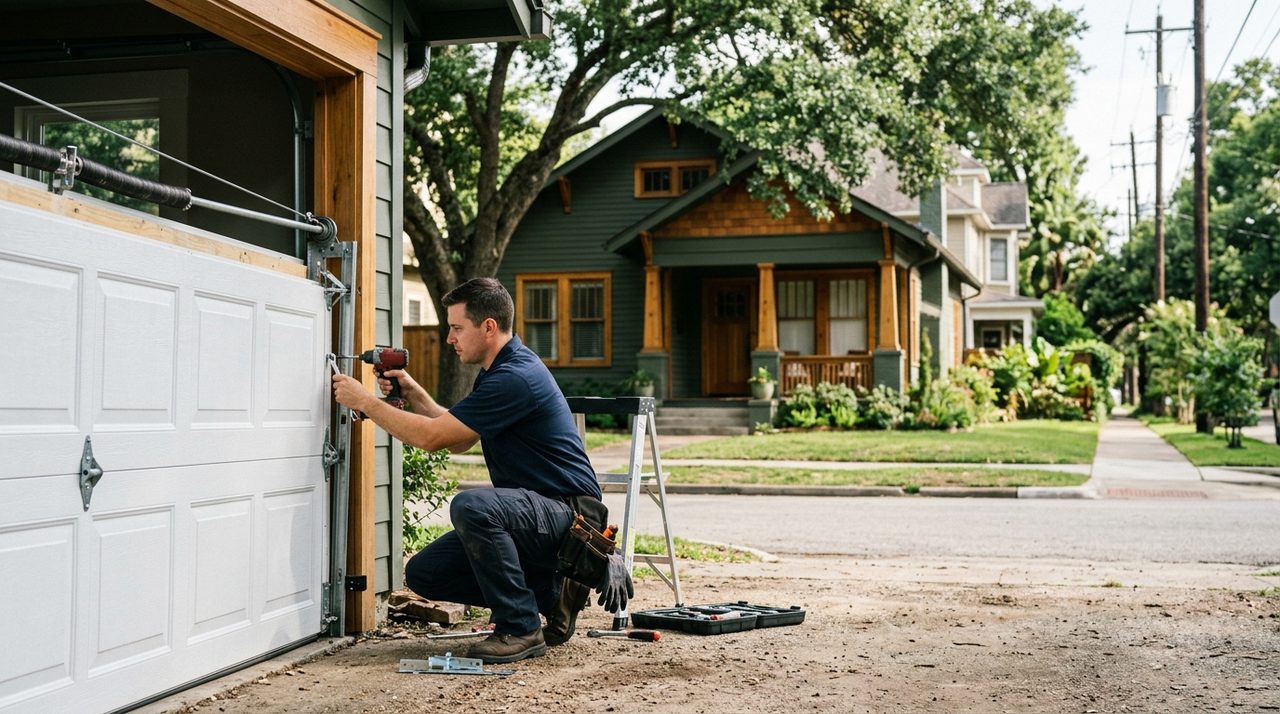
- Median home built
- 1966
- Median home value
- $153,975
- FEMA flood zone
- X500 (moderate)
- Typical replacement cost (est.)
- $900–$2,400 installed
- Most common local issue
- Frame racking on mid-century pier-and-beam garages from decades of clay-soil movement
Ranked by verified Google rating × review volume × verification tier. How we rank →
Some highly-rated pros serve Independence Heights from nearby and may not keep a Independence Heights street address. Those are listed under "Also serving Independence Heights" with their real city and distance, so you always know where each business is based.
Min rating:
10 resultsBased in Independence Heights
Also serving Independence Heights
Highly-rated pros based nearby who cover Independence Heights. Distance shown from the Independence Heights area.
Closed
Serving Independence Heights Based in Lazybrook / Timbergrove · 0.3 mi away
Open Now
Serving Independence Heights Based in The Heights · 1 mi away
Closed
Serving Independence Heights Based in Lazybrook / Timbergrove · 1.4 mi away
Open Now
Serving Independence Heights Based in The Heights · 1.4 mi away
Serving Independence Heights Based in Lazybrook / Timbergrove · 1.5 mi away
Closed
Serving Independence Heights Based in Lazybrook / Timbergrove · 3 mi away
Closed
Serving Independence Heights Based in Lazybrook / Timbergrove · 3.1 mi away
Open Now
Serving Independence Heights Based in Lazybrook / Timbergrove · 3.5 mi away
Serving Independence Heights Based in Lazybrook / Timbergrove · 3.5 mi away
Garage Door Repair in Independence Heights: What You Should Know
Pier-and-Beam Garages That Shift Every Wet Season
Why it matters to you
The majority of Independence Heights homes built between the 1910s and 1960s sit on pier-and-beam foundations, and the detached or integrated garages from that era follow the same structural logic. Houston's expansive Beaumont clay soil swells with winter rains and shrinks in summer drought, causing individual piers to move at different rates over decades. By the time a mid-century ranch home here has accumulated 50-plus years of seasonal movement, the rough opening framing around the garage door is often visibly out of square — rollers bind, one side of the bottom seal gaps by an inch or more, and no amount of track adjustment holds for more than a season.
What a good pro does
A competent garage door pro serving Independence Heights will measure the rough opening diagonally (both corners) before quoting any replacement, and will note pier-and-beam deflection rather than treating it as a simple frame-swap. If the opening has racked more than 3/4 inch out of square, a structural carpenter should sister or jack the header before the new door is hung — otherwise the warranty on the new door is irrelevant. Because this work alters the structural opening, the Houston Permitting Center requires a building permit for the replacement; confirm your contractor pulls it.
Sources: City of Houston Permitting Center, International Residential Code (as adopted by City of Houston)
Gulf Humidity Accelerating Spring and Hardware Failure in Unventilated Detached Garages
Why it matters to you
Independence Heights's older bungalows and ranch homes typically have detached, minimally ventilated garages — converted carports, timber-framed outbuildings, or concrete-block structures with no insulation and no climate control. Houston averages 65–70% relative humidity year-round, spiking above 90% through summer. Inside one of these unventilated structures, torsion springs, cables, and bottom brackets corrode at roughly double the rate they would in a conditioned garage, and oil-tempered springs that might last a decade elsewhere can fail in five to seven years here without regular lubrication and corrosion-resistant coatings.
What a good pro does
Ask specifically for galvanized or powder-coated torsion springs rated for high-humidity environments, and request stainless or galvanized bottom brackets rather than bare steel. A torsion spring replacement on a single-car door runs an estimated $200–$350 installed and does not require a City of Houston permit — but that affordability makes it tempting to skip quality upgrades. An annual lubrication service with a lithium-based or silicone spray (not WD-40, which strips grease) noticeably extends hardware life in Independence Heights's climate.
Sources: ENERGY STAR / U.S. Dept. of Energy
Uninsulated Original Doors Driving Cooling Costs in Attached or Adjacent Living Spaces
Why it matters to you
The infill townhomes and gut-renovated bungalows that have proliferated across Independence Heights since the 2000s frequently share a wall between the garage and conditioned living space, or have a bedroom directly above a converted garage. Older original doors on mid-century homes are almost universally single-layer, uninsulated steel or aluminum — effectively R-0. With Houston logging more than 150 hours above 95°F annually, a south- or west-facing uninsulated door acts as a radiant heat panel, pushing BTUs into adjacent rooms and forcing the HVAC systems that Independence Heights homeowners have typically just upgraded to work harder.
What a good pro does
Upgrading to an insulated door rated R-13 to R-18 is one of the highest-return envelope improvements for an attached or townhome garage in this neighborhood. A double-car insulated steel door installed runs an estimated $1,200–$2,400 depending on panel style and insulation grade. When selecting a replacement, check the door's ENERGY STAR certification for the South-Central climate zone — verified products carry independently tested R-values rather than manufacturer estimates.
Sources: ENERGY STAR / U.S. Dept. of Energy, City of Houston Permitting Center
HOA Style Rules in Townhome Clusters — and How to Avoid a Costly Re-Do
Why it matters to you
Legacy lots in Independence Heights carry no HOA and no uniform deed restrictions, so most longtime residents assume the whole neighborhood is unrestricted. That assumption breaks down on blocks where a developer platted a townhome cluster in the 2010s or 2020s — entities like the Independence Heights Homes Community Association, Inc. (a registered POA in Harris County, ZIP 77018) govern those specific properties and typically specify permitted door panel styles, colors, and sometimes materials. Ordering a carriage-house-style door in the wrong color because you assumed no HOA rules apply can trigger fines and a mandatory replacement at full cost.
What a good pro does
Before selecting any replacement door, pull your deed and check Harris County Appraisal District records and the Texas Secretary of State's HOA search to confirm whether your specific lot is governed by a POA. If it is, request the community's architectural guidelines in writing from the POA before placing a door order — not after. City of Houston permit requirements apply to all structural replacements in the neighborhood regardless of HOA status, so coordinate both approvals together to avoid separate trips to the Houston Permitting Center.
Sources: Local HOA / deed restrictions (see area profile), City of Houston Permitting Center
Garage Door Repair in Independence Heights: What You Should Know
Hiring garage door repair in Independence Heights? Independence Heights spans over a century of construction, from 1910s bungalows and 1950s ranch homes to 2020s contemporary townhomes. Homeowners here face a wide range of service needs driven by aging pier-and-beam foundations, outdated plumbing and electrical in mid-century homes, and newer infill properties with their own HOA requirements. The neighborhood's moderate flood risk and mixed housing stock make contractor experience with both historic rehabilitation and modern code compliance essential.
- Housing era
- 1910s–1920s (original platted lots), 1950s–1960s (major mid-century build-out, median year built 1958), 2000s–2020s (infill…
- Foundation
- Mixed — pier-and-beam dominates pre-1960s housing
- Flood zone
- FEMA Zone X500 (moderate flood risk) — source
- Permits
- Houston Permitting Center (City of Houston jurisdiction — neighborhood annexed in 1929)
Housing stock & systems
Building era
1910s–1920s (original platted lots), 1950s–1960s (major mid-century build-out, median year built 1958), 2000s–2020s (infill townhomes and new single-family).
Typical style
Craftsman bungalows and vernacular cottages (1910s–1920s), one-story ranch and minimal-traditional (1950s–1960s), contemporary two- and three-story townhomes and modern single-family (2000s–2020s).
Foundations
Mixed — pier-and-beam dominates pre-1960s housing; slab-on-grade common in newer infill construction.
Common systems
Older homes often have galvanized or cast-iron plumbing, outdated 60–100 amp electrical panels, and window-unit or older central HVAC. Mid-century homes typically have early central HVAC with ductwork in unconditioned spaces. Newer infill features modern PEX or CPVC plumbing, 200-amp panels, and high-efficiency HVAC systems.
What that means for repairs
Significant renovation activity driven by new infill development replacing or updating older lots. Historic bungalows and mid-century ranch homes are frequently gut-renovated with foundation repair, full re-plumbing, electrical panel upgrades, and HVAC modernization. Townhome clusters are also emerging on previously single-family lots.
Permits & restrictions
Permit jurisdiction
Houston Permitting Center (City of Houston jurisdiction — neighborhood annexed in 1929).
HOA & deed restrictions
No single mandatory HOA for all of Independence Heights. The area operates under the City of Houston Super Neighborhood 13 council (voluntary civic/advocacy structure). Pocket developments and newer townhome clusters have their own mandatory HOAs, such as Independence Heights Homes Community Association, Inc. (registered POA in Harris County, ZIP 77018). Many legacy lots have no HOA.
Historic districts
No City of Houston historic district designation confirmed, despite the neighborhood's significant cultural history as an early 20th-century planned Black community (incorporated 1915, annexed by Houston 1929).
Contractor note
Contractors must navigate varying deed restrictions that are lot- and subdivision-specific rather than uniform across the neighborhood. New infill projects in HOA-governed clusters may have additional architectural review requirements beyond standard city permitting.
Flood & weather
FEMA flood zone
FEMA Zone X500 (moderate flood risk) — source: fema_nfhl. The neighborhood sits just north of Loop 610 and west of I-45 in a lower-elevation area of Houston's near northside. No specific bayou or creek adjacency was confirmed in research, but the I-45 corridor location places it in a drainage-sensitive area.
Hurricane Harvey impact
Specific street-by-street Harvey flood data was not confirmed in available research. The neighborhood's near-northside, lower-elevation location along the I-45 corridor suggests it was likely affected by significant street and structural flooding during Harvey, consistent with broader news coverage of nearby areas. Homeowners should verify parcel-level flood history through Harris County Flood Control District records and FEMA repetitive loss databases.
Heat & humidity load
Older pier-and-beam homes with minimal insulation and aging HVAC systems face extreme summer stress, leading to high energy bills and frequent HVAC service calls. Pier-and-beam crawlspaces are vulnerable to moisture buildup and pest intrusion in Houston's humid summers. Newer infill townhomes with modern insulation and sealed envelopes perform better but may experience condensation issues at transitions between conditioned and unconditioned spaces.
Working with contractors here
Foundation repair is one of the most common service needs, particularly for pier-and-beam homes built in the 1910s–1960s that have experienced decades of Houston's expansive clay soil movement. Re-plumbing is frequently required in mid-century homes still running galvanized or cast-iron drain lines. Electrical panel upgrades from 60-amp to 200-amp service are common as homeowners modernize older homes or add square footage. The active infill market means general contractors regularly handle teardown-and-rebuild projects, often requiring lot-specific deed restriction review. Contractors should be prepared for wide variation in job scope — from historic cottage restoration on one lot to modern townhome punch-list work on the next.
Local Tip
Always ask for a written estimate before work begins. Texas contractors are required to provide one on jobs over $1,000.
About Independence Heights
Independence Heights spans over a century of construction, from 1910s bungalows and 1950s ranch homes to 2020s contemporary townhomes. Homeowners here face a wide range of service needs driven by aging pier-and-beam foundations, outdated plumbing and electrical in mid-century homes, and newer infill properties with their own HOA requirements. The neighborhood's moderate flood risk and mixed housing stock make contractor experience with both historic rehabilitation and modern code compliance essential.
- Median year built
- 1966
- Median home value
- $153,975
- Owner-occupied
- 53.2%
- Population
- 72,226
- Housing units
- 25,388
- Median income
- $44,671
Source: U.S. Census Bureau, ACS 5-Year 2023
Flood & storm risk
FEMA Zone X500Moderate flood riskIndependence Heights carries FEMA Zone X500 (moderate flood risk): outside the 100-year floodplain but inside the 500-year, so heavy-rain events still reach homes and flood-aware work pays off.
Source: FEMA National Flood Hazard Layer (NFHL). Flood zones vary by parcel — verify your individual FIRM panel.
Houston Storm Readiness in Independence Heights
Hurricane & flooding
Confirm your garage door opener has a battery-backup module before hurricane season, since CenterPoint outages in Independence Heights during past Gulf storms have stranded homeowners without grid power for days. While flooding is a secondary concern in this zone, a door with full horizontal wind-bracing bars prevents the panel failure that can cascade into structural roof damage when sustained tropical winds arrive. Much of the housing stock predates modern wind codes (median build year 1966), so retrofits matter more here. In-city Independence Heights work falls under City of Houston floodplain and permitting rules.
Severe storms & hail
For homeowners in Independence Heights: straight-line winds from the May 2024 derecho routinely exceeded 80 mph across Houston's moderate-flood suburbs, enough to bow untested garage-door panels inward and bend tracks permanently — confirm your door carries a current wind-load label and add horizontal bracing if it does not. A battery-backup opener also keeps you from being locked out when severe thunderstorms knock out CenterPoint power mid-afternoon. Confirm the current FEMA panel for your Independence Heights parcel — the area maps to Zone X500, but adjacent lots can differ.
Ice storms & freezes
After a hard freeze in Independence Heights, check whether ice has re-frozen the door in the closed position before running the opener, since forcing a bonded door can strip the drive gear or snap a cable; use warm water poured carefully along the threshold to break the seal first. Winter Storm Uri 2021 generated a wave of broken torsion springs across Houston because many homeowners ran openers against frozen doors repeatedly before the spring snapped. With a median build year of 1966, the older building stock here is more exposed to hard-freeze damage than newer construction. In-city Independence Heights work falls under City of Houston floodplain and permitting rules.
Sources: FEMA National Flood Hazard Layer (NFHL), Ready.gov -- Hurricanes, CenterPoint Energy -- Storm Center, City of Houston -- Emergency Preparedness, Ready.gov -- Winter Weather, Harris County Flood Control District
Free Independence Heights Tools & Calculators
Houston-specific estimators to plan your project before you call a pro. All results are planning estimates — a licensed local pro confirms the details on site.
Houston Freeze Prep & Pipe Insulation Checklist
Open full tool & FAQ →Your freeze checklist — 4 tasks
- 1
Disconnect & drain every outdoor hose bib
Remove hoses, drain the spigots, and cover each with an insulated faucet sock. Un-drained hose bibs are the #1 burst point in a Houston freeze.
- 2
Insulate exposed pipes in the attic & garage
Wrap any pipe in an unconditioned space (attic runs, garage walls) with foam sleeves. Houston homes rarely insulate these because they only matter a few nights a year — which is exactly why they burst.
- 3
Open cabinet doors & keep a pencil-width drip
On hard-freeze nights, open kitchen/bath cabinets so warm air reaches the pipes and let faucets on exterior walls drip to relieve pressure.
- 4
Protect the attic/garage water heater & its lines
An attic or garage tank sits in unconditioned space. Insulate the cold-inlet and hot-outlet lines and confirm the emergency drain pan is clear so a leak doesn't reach the ceiling.
This is a planning estimate only — actual requirements depend on an on-site assessment by a licensed Houston pro. If a pipe has already burst, shut off your main water supply and call a licensed Houston plumber immediately — freeze bursts flood fast.
Frequently Asked Questions
Do I need a permit from the City of Houston to replace a garage door on my 1950s ranch home in Independence Heights?
Yes — because Independence Heights sits entirely within City of Houston jurisdiction (annexed in 1929), any full garage door replacement that alters or affects the structural rough opening requires a building permit from the Houston Permitting Center. Purely mechanical work like swapping springs, cables, or an opener does not trigger a permit. Pull the permit before installation starts; an inspector will want to confirm the new door and its framing meet current code, which matters especially on mid-century homes where the original rough opening framing may be undersized or deteriorated.
Sources: City of Houston Permitting Center
My 1920s bungalow in Independence Heights has a detached garage with a wooden swing-out door — can a garage door company convert it to a roll-up sectional on a pier-and-beam structure?
Conversion is doable but requires a company experienced with pier-and-beam framing, which is not the same as the slab-on-grade work most modern installers default to. The header opening in a 1910s–1920s wood-frame structure often needs reinforcing before standard sectional tracks can be mounted, and the sill plate at floor level may be rotted or settled unevenly after more than a century of Houston clay-soil movement. Ask any bidder specifically whether they have converted swing-out or barn-style doors on pier-and-beam garages — not just slab-on-grade — before you book the job.
Independence Heights is in FEMA Zone X500 — does that moderate flood risk affect what kind of garage door bottom seal or threshold I should specify?
Zone X500 means your property sits outside the 100-year floodplain but inside the 500-year boundary, so heavy-rain events from storms like Harvey (2017) or Beryl (2024) can still push water into detached garages, especially on lots with shallow slope-to-street. Specify a reinforced rubber bulb bottom seal rather than a standard vinyl T-seal, and ask about a raised aluminum threshold bar that adds an extra 1–2 inches of resistance to sheet-flow entry. These upgrades run roughly $80–$150 in added materials (estimate) but dramatically reduce the bottom-track corrosion and seal replacement cycle that Independence Heights detached garages see after each major rain event.
How long does a full garage door replacement typically take from permit filing to finished installation for an Independence Heights address?
At the Houston Permitting Center, an online residential building permit for a straightforward door replacement currently processes in roughly 3–10 business days under the standard review queue, though that window can stretch if the application is flagged for additional structural review on older framing. Material lead times for in-stock steel insulated doors are usually 1–5 business days from a local distributor; custom sizes or carriage-house panel styles for townhome HOA compliance can add 2–4 weeks. Budget 3–6 weeks total from signed contract to completed installation if your project involves permitting and a non-stock door style — these are estimates and timelines vary by contractor and permit backlog.
Sources: City of Houston Permitting Center
The townhome cluster I live in on the north side of Independence Heights has an HOA — do they control what replacement door I can install, or does the City of Houston override them?
Both apply independently and neither overrides the other. The City of Houston Permitting Center sets the structural and code requirements (IRC wind-load minimums, header sizing, opener circuit wiring), while your HOA — if registered, like Independence Heights Homes Community Association, Inc. in ZIP 77018 — governs aesthetic choices such as panel style, color, window pattern, and material. You must satisfy the HOA's architectural review before ordering the door and still pull the city permit before installation; a door that passes city inspection can still trigger HOA fines if you skipped their approval step, which means a potential mandatory re-installation at your expense.
Sources: Local HOA / deed restrictions (see area profile)City of Houston Permitting Center
Is winter the right time to get torsion springs replaced on a mid-century Independence Heights home, or does Houston's climate make any season equally risky for spring failure?
Houston's humidity-driven corrosion means springs degrade year-round, but the two peak failure windows are mid-summer — when daily temperature swings between a 75°F air-conditioned garage interior and 105°F exterior metal stress the spring coil — and during rare freeze events like Winter Storm Uri (February 2021), when lubricants congealed and cold-brittled springs snapped across the metro. For mid-century homes in Independence Heights whose springs have never been replaced, any season carries meaningful risk; schedule proactive replacement in spring or fall when crews are less backlogged from storm or freeze emergency calls, and ask the technician to apply a corrosion-inhibiting lubricant rated for high-humidity environments rather than a standard petroleum spray.