Open Now
15115 Monrad Dr, Houston, TX 77053
Westbury's roughly 5,000 one-story brick-veneer ranch homes were built in the 1950s and 1960s directly on concrete slabs over Houston's expansive Beaumont clay — a combination that has been working against foundations for six decades. Those same slabs now sit above cast-iron drain lines that were already stressed by Winter Storm Uri in 2021, meaning a crack in your door frame may trace back to a slow plumbing leak as much as to soil movement. All underpinning or structural repair work in Westbury falls under City of Houston permit requirements, and any exterior trenching or perimeter work must also clear the Westbury Civic Club's Architectural Review Committee before a shovel hits the ground.
Ranked by verified Google rating × review volume × verification tier. How we rank →
Some highly-rated pros serve Westbury from nearby and may not keep a Westbury street address. Those are listed under "Also serving Westbury" with their real city and distance, so you always know where each business is based.
15115 Monrad Dr, Houston, TX 77053
13016 Player St, Houston, TX 77045
6703 Dickson Way, Houston, TX 77085
13920 Regg Dr, Houston, TX 77045
13311 Dunlap St suite f, Houston, TX 77085
5326 Trafalgar Dr, Houston, TX 77045
14329 Cheryl, Houston, TX 77085
Highly-rated pros based nearby who cover Westbury. Distance shown from the Westbury area.
Serving Westbury Based in Meyerland · 0.4 mi away
Serving Westbury Based in Meyerland · 1.1 mi away
Serving Westbury Based in Braeswood · 1.6 mi away
Why it matters to you
Every Westbury ranch home built between 1950 and 1965 has a slab that has gone through roughly 60 wet-dry cycles on Houston Black clay — soil that can swell and shrink several inches seasonally. The wide, flat lots typical of this neighborhood leave foundation perimeters directly exposed to the sun during the 2022–2023 La Niña drought, baking the clay away from the slab edge and opening voids that allow subsequent rain to rush underneath rather than soak in gradually. Homeowners in this housing era often first notice sticking doors, diagonal cracks running from window corners, or brick veneer separation — all signs of differential movement that has been accumulating for decades.
What a good pro does
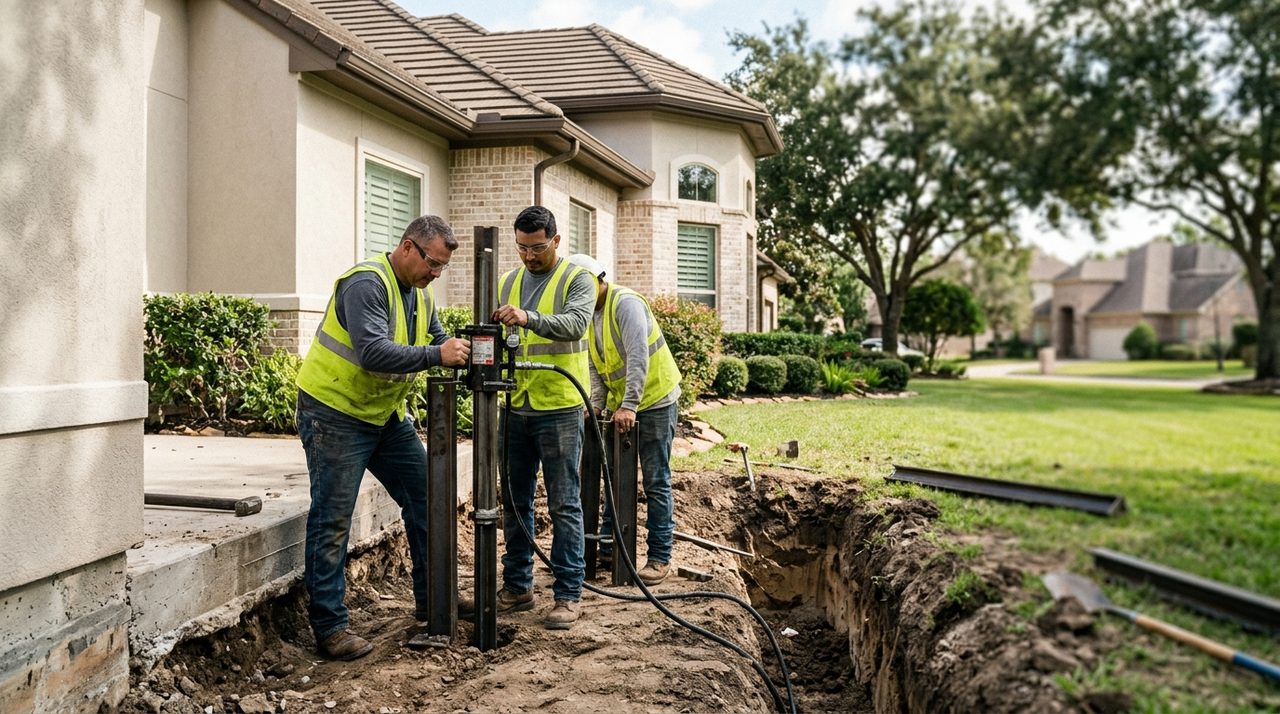
A qualified contractor should probe the perimeter for void gaps before recommending any underpinning method. For a typical 1,800–2,200 sq ft Westbury ranch, pressed concrete piling repair (the legacy Houston method) is estimated at $3,500–$9,000, while steel push pier underpinning runs roughly $1,200–$1,800 per pier for 8–16 piers — get at least three written proposals specifying pier count and depth. All underpinning work on a City of Houston property requires a permit through the COH Development Services Department; do not sign a contract with a contractor who proposes to skip the permit step.
Sources: City of Houston Permitting Center, Municipal permit office (see area profile)
Why it matters to you
Original Westbury homes from the 1950s–1960s were plumbed with cast-iron under-slab drain lines that were already nearing the end of their service life when Winter Storm Uri hit in February 2021. Many homeowners patched visible interior damage — drywall, flooring — without verifying whether the under-slab lines were also cracked. A slow, ongoing drain leak saturates the clay directly beneath the slab, first causing localized heave as moisture is absorbed, then settlement as the soil structure breaks down. The pattern mimics pure soil movement and is routinely misdiagnosed if a plumbing evaluation is skipped.
What a good pro does
Before signing any foundation repair contract, commission a hydrostatic plumbing test — a licensed plumber caps the drain system and pressurizes it to detect leaks — which runs an estimated $250–$400. Under Texas law, any scope involving under-slab drain line repair or rerouting must be performed or overseen by a plumber licensed by the Texas State Board of Plumbing Examiners. Fixing the plumbing leak first is essential; underpinning over an active leak is a repair that will need to be redone.
Sources: Texas State Board of Plumbing Examiners, City of Houston Permitting Center
Why it matters to you
Westbury's mid-century streetscapes include established live oaks and water oaks whose root systems can extend 40–60 feet from the trunk — well past the foundation edge of most one-story ranch homes on these lots. During dry summers, those roots aggressively extract soil moisture on the tree side of the slab, causing localized clay shrinkage and a measurable drop on that corner while the opposite perimeter stays comparatively stable. This asymmetric movement is what produces the characteristic diagonal cracking pattern in brick veneer and interior drywall that Westbury homeowners frequently report.
What a good pro does
A foundation contractor evaluating a Westbury home with a large oak within 20 feet of the structure should document differential elevation readings at multiple perimeter points — not just quote pier count from a visual walk. A consistent soaker-hose irrigation program along the dry side of the foundation (running 30–60 minutes every 3–4 days during drought) is the most cost-effective prevention. If underpinning is warranted, helical piers (estimated $1,500–$2,200 each) may be appropriate where steel push piers cannot reach competent load-bearing soil due to root interference; your contractor should specify the method in writing.
Sources: International Residential Code (as adopted by City of Houston)
Why it matters to you
Westbury homeowners face a two-step compliance requirement that catches many off guard: the City of Houston requires a foundation repair permit for underpinning and structural work through its Development Services Department, AND the Westbury Civic Club's Architectural Review Committee enforces deed restrictions that apply to exterior modifications — including perimeter trenching, concrete work visible from the street, and any changes to the facade that expose the foundation. Skipping either step creates liability: unpermitted structural work can surface on a title search at resale, and deed restriction violations in Westbury have historically been enforced through civil action.
What a good pro does
Before any contractor breaks ground, confirm that a City of Houston permit has been applied for and that the Westbury Civic Club ARC has been notified of the exterior scope — check the specific deed restrictions recorded with Harris County Clerk for your lot, since restriction language varies by section within the neighborhood. Texas requires sellers to disclose known foundation movement and all prior repairs on the TREC seller's disclosure form, so fully documented, permitted work protects your resale position. Keep the COH permit, inspection records, and any contractor warranty in your home file permanently.
Sources: City of Houston Permitting Center, Municipal permit office (see area profile), Local HOA / deed restrictions (see area profile)
Hiring foundation repair in Westbury? Westbury is a large 1950s-era subdivision of roughly 5,000 single-family homes plus thousands of multifamily units in southwest Houston. Homeowners here contend with aging slab foundations, original-era plumbing and electrical systems, and flood risk in sections near Willow Waterhole and Brays Bayou. Deed restrictions enforced by the Westbury Civic Club/HOA require architectural review for exterior modifications, making pre-project compliance checks essential.
Building era
1950s–1960s (original subdivision), with later multifamily and infill development.
Typical style
One-story mid-century ranch homes with brick veneer, low-sloped or hipped roofs, attached garages or carports, and wide lots.
Foundations
Predominantly concrete slab-on-grade; some pier-and-beam may exist in earliest sections but slab is clearly prevalent in listings.
Common systems
Original homes likely have galvanized steel or early copper supply lines, cast iron drain lines, 100-amp electrical panels, and older forced-air HVAC systems or window units later converted to central air. Many systems are 50–70 years old and approaching or past end of life.
What that means for repairs
Kitchen and bathroom remodels are common as owners update mid-century layouts. Whole-house replumbing (replacing galvanized and cast iron), electrical panel upgrades to 200-amp service, and HVAC replacements are frequent due to system age. Some lots see teardown-rebuild activity as land values support new construction.
Permit jurisdiction
City of Houston Permitting Center (Westbury is within Houston city limits).
HOA & deed restrictions
Westbury Civic Club, Inc. operates as the primary neighborhood association (Super Neighborhood 37). Deed restrictions with an Architectural Review/Control Committee are described as mandatory for compliance. The exact legal status of dues (mandatory vs. voluntary for each section) is not fully verifiable from public sources alone — check Harris County Clerk deed restriction records for your specific lot.
Historic districts
No City of Houston historic district designation confirmed.
Contractor note
Contractors must obtain City of Houston permits for structural, mechanical, electrical, and plumbing work, and should verify Westbury's deed restriction and ARC/ACC requirements before beginning any exterior modifications including fencing, roofing material changes, or additions.
FEMA flood zone
FEMA Zone X (low flood risk) per official NFHL data. However, Westbury is adjacent to Brays Bayou and Willow Waterhole, and portions of the neighborhood — especially lower-lying southern and eastern sections near these drainage features — have documented histories of flooding. Parcel-level flood risk can vary significantly; an elevation certificate and HCFCD inundation maps should be consulted for individual addresses.
Hurricane Harvey impact
Significant flooding occurred in portions of Westbury during Hurricane Harvey (2017), particularly in lower-lying sections closest to Willow Waterhole, Brays Bayou, and drainage corridors near US 90A and South Post Oak. Post-Harvey flood mitigation projects were implemented around Willow Waterhole. Block-by-block impact data is not available in text sources; homeowners should request seller's disclosure, prior flood claim history, and Harris County Flood Control District high-water-mark data for specific addresses.
Heat & humidity load
1950s slab homes with original insulation and single-pane windows put heavy loads on HVAC systems during Houston summers. Aging ductwork in unconditioned attics degrades efficiency. Foundation movement on expansive clay soils accelerates during summer drought cycles, making seasonal watering programs and foundation monitoring important for these older slabs.
Working with contractors here
The dominant work in Westbury involves updating 1950s–1960s building systems: whole-house replumbing from galvanized and cast iron to PEX/PVC, electrical panel upgrades from 100-amp to 200-amp service, and HVAC replacement with modern high-efficiency equipment. Slab foundation repair is common due to the age of the homes and Houston's expansive clay soils. Contractors should be aware that the Westbury Architectural Review Committee requires compliance with deed restrictions for exterior work, so scope proposals for roofing, siding, fencing, or additions should account for review and approval timelines. Flood-damaged properties near Willow Waterhole and Brays Bayou may require remediation work including mold abatement, drywall replacement, and elevated mechanical equipment installation.
Local Tip
Always ask for a written estimate before work begins. Texas contractors are required to provide one on jobs over $1,000.
Westbury is a large 1950s-era subdivision of roughly 5,000 single-family homes plus thousands of multifamily units in southwest Houston. Homeowners here contend with aging slab foundations, original-era plumbing and electrical systems, and flood risk in sections near Willow Waterhole and Brays Bayou. Deed restrictions enforced by the Westbury Civic Club/HOA require architectural review for exterior modifications, making pre-project compliance checks essential.
Source: U.S. Census Bureau, ACS 5-Year 2023
Most of Westbury maps to FEMA Zone X (low mapped flood risk), but Houston's flash-flood reality means even low-risk blocks benefit from smart drainage and storm-hardened installs; risk climbs sharply on blocks nearest Brays Bayou, where it varies parcel to parcel.
Source: FEMA National Flood Hazard Layer (NFHL). Flood zones vary by parcel — verify your individual FIRM panel.
Houston's flash-flood reality means even low-mapped-risk areas like Westbury can see sheet flow accumulate against a foundation during a slow-moving Gulf system, so verify that your perimeter drainage is clear and properly sloped before hurricane season opens. A TDLR-licensed foundation contractor can add or reposition surface drains to intercept runoff before it softens the clay bearing layer beneath your slab. Because Westbury drains toward Brays Bayou, block-level runoff can differ sharply from the mapped zone.
Even with low mapped flood risk, Westbury is not immune to the localized sheet flow that accompanies a Houston severe thunderstorm, and repeated minor inundation at the foundation perimeter sustains the clay moisture that drives slow heave cycles. A pre-storm season inspection confirming that soil grade, splash blocks, and downspout extensions all direct water away from the slab is the most cost-effective foundation repair step you can take. In-city Westbury work falls under City of Houston floodplain and permitting rules.
Winter Storm Uri's multi-day freeze caused Houston clay soils to go through freeze-thaw cycling not common in the region, and even low-flood-risk neighborhoods in Westbury saw new door-sticking and brick-step cracking appear in the spring following the storm. A post-winter Zip-Level survey establishes whether that movement is seasonal and self-correcting or progressive and in need of pier work before summer drying amplifies the differential. With a median build year of 1977, the older building stock here is more exposed to hard-freeze damage than newer construction. Confirm the current FEMA panel for your Westbury parcel — the area maps to Zone X, but adjacent lots can differ.
Sources: FEMA National Flood Hazard Layer (NFHL), Ready.gov -- Hurricanes, CenterPoint Energy -- Storm Center, City of Houston -- Emergency Preparedness, Ready.gov -- Winter Weather, Harris County Flood Control District
Houston-specific estimators to plan your project before you call a pro. All results are planning estimates — a licensed local pro confirms the details on site.
Grouped by mature root aggression & water demand.
Trunk center to the nearest exterior wall.
The root zone likely reaches your foundation's soil during Houston's dry summers, when clay shrinks most. Watch for sticking doors and diagonal cracks, keep soil moisture even with a soaker hose during drought, and have a foundation pro evaluate if you see any movement.
Find a Houston foundation pro →This is a planning estimate only — actual requirements depend on an on-site assessment by a licensed Houston pro. Guidance is based on general species root behavior in expansive clay, not a soil test.
Disconnect & drain every outdoor hose bib
Remove hoses, drain the spigots, and cover each with an insulated faucet sock. Un-drained hose bibs are the #1 burst point in a Houston freeze.
Insulate exposed pipes in the attic & garage
Wrap any pipe in an unconditioned space (attic runs, garage walls) with foam sleeves. Houston homes rarely insulate these because they only matter a few nights a year — which is exactly why they burst.
Open cabinet doors & keep a pencil-width drip
On hard-freeze nights, open kitchen/bath cabinets so warm air reaches the pipes and let faucets on exterior walls drip to relieve pressure.
Protect the attic/garage water heater & its lines
An attic or garage tank sits in unconditioned space. Insulate the cold-inlet and hot-outlet lines and confirm the emergency drain pan is clear so a leak doesn't reach the ceiling.
This is a planning estimate only — actual requirements depend on an on-site assessment by a licensed Houston pro. If a pipe has already burst, shut off your main water supply and call a licensed Houston plumber immediately — freeze bursts flood fast.
Sources: City of Houston Permitting Center
Sources: FEMA National Flood Hazard Layer (NFHL)Harris County Flood Control DistrictTexas State Board of Plumbing Examiners
Sources: Local HOA / deed restrictions (see area profile)
Sources: City of Houston Permitting CenterLocal HOA / deed restrictions (see area profile)