Closed
510 E Whitney St, Houston, TX 77022
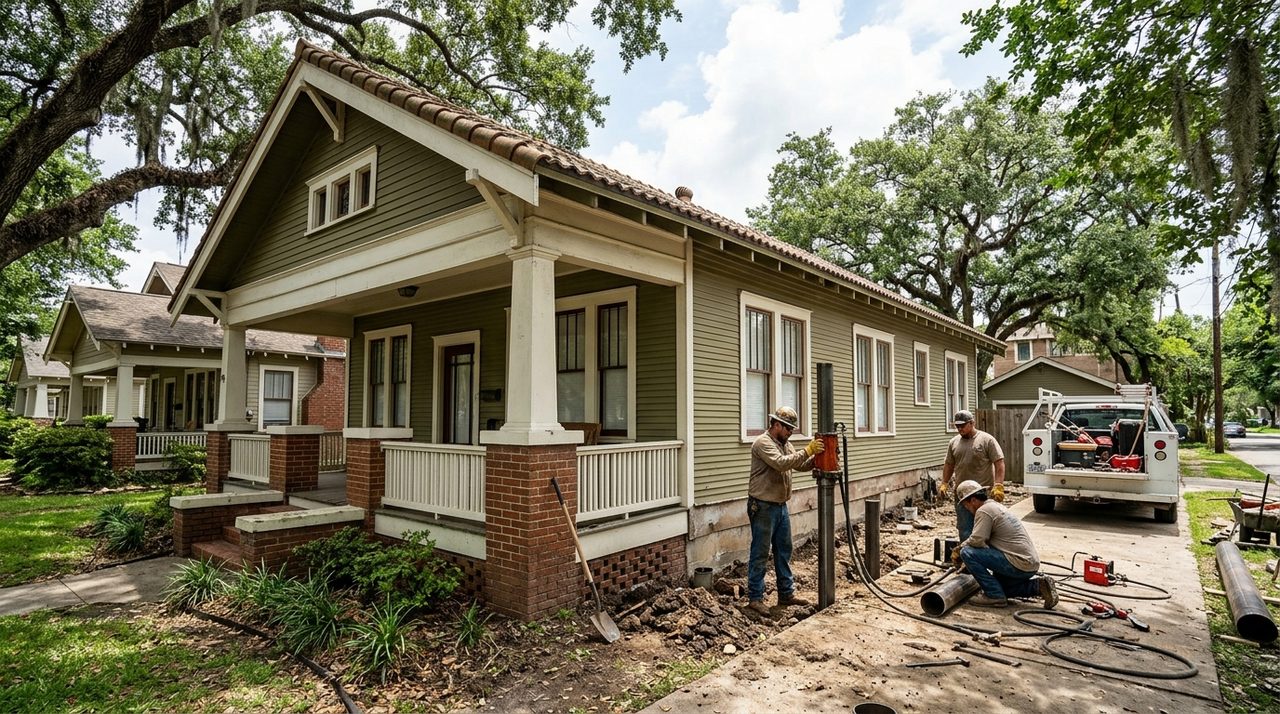
Independence Heights sits on Houston's expansive Beaumont clay, but what sets it apart from most Inner Loop neighborhoods is its split foundation identity: 1910s–1960s pier-and-beam bungalows and ranch homes on one block, slab-on-grade infill townhomes on the next. That century-plus span of construction means foundation repair here is rarely a single-method job — contractors fluent only in slab underpinning won't help the owner of a 1952 ranch cottage, and someone who knows only pier-and-beam shimming won't diagnose the perimeter void forming under a 2018 townhome slab. All work in this neighborhood falls under City of Houston jurisdiction (Houston Permitting Center), annexed since 1929, with permits required for underpinning and structural repair.
Ranked by verified Google rating × review volume × verification tier. How we rank →
Some highly-rated pros serve Independence Heights from nearby and may not keep a Independence Heights street address. Those are listed under "Also serving Independence Heights" with their real city and distance, so you always know where each business is based.
510 E Whitney St, Houston, TX 77022
1614 Parker Rd, Houston, TX 77093
2514 Vaughn St, Houston, TX 77093
415 E Crosstimbers St, Houston, TX 77022
Highly-rated pros based nearby who cover Independence Heights. Distance shown from the Independence Heights area.
Serving Independence Heights Based in Lazybrook / Timbergrove · 0.6 mi away
Serving Independence Heights Based in Lazybrook / Timbergrove · 1.5 mi away
Serving Independence Heights Based in Garden Oaks · 2.1 mi away
Serving Independence Heights Based in Lazybrook / Timbergrove · 2.3 mi away
Serving Independence Heights Based in Lazybrook / Timbergrove · 3.3 mi away
Serving Independence Heights Based in The Heights · 3.4 mi away
Why it matters to you
The majority of Independence Heights homes built between the 1910s and 1960s sit on pier-and-beam foundations — wood posts, sill beams, and floor joists suspended above grade. Decades of Houston humidity, termite pressure, and the neighborhood's clay soil movement have left many of these systems with rotted sill plates, settled concrete block piers, or badly shimmed posts that shift seasonally. The ACS 5-Year 2023 data puts the neighborhood's median year built at 1966, masking a large inventory of homes well older than that. When floors bounce, doors stick only in summer, or there's a noticeable slope toward the back of the house, the pier-and-beam substructure is usually the first place to investigate.
What a good pro does
A qualified contractor should perform a crawl-space inspection — not just a walk-around — to photograph every pier, sill beam, and girder for rot, settlement, and unlevel conditions. Repair may mean replacing individual wood posts with concrete piers or adjustable steel columns, sistering damaged beams, or re-leveling the grid across the full perimeter. Because this is structural repair affecting the building envelope, a City of Houston foundation repair permit is required through the Houston Permitting Center before work begins; the inspector will verify pier placement and beam bearing before sign-off.
Sources: City of Houston Permitting Center, International Residential Code (as adopted by City of Houston)
Why it matters to you
Independence Heights's mid-century ranch homes — built predominantly in the 1950s–1960s — commonly retain original cast-iron under-slab or under-floor drain lines. Winter Storm Uri (February 2021) froze and fractured thousands of these lines across Houston's Inner Loop. In pier-and-beam homes, a slow drain leak wets the soil beneath the subfloor, accelerating wood rot and softening the clay bearing surface under the piers. In the neighborhood's newer slab homes, the same ongoing leak saturates clay directly under the concrete, producing localized heave followed by settlement as soil structure breaks down. Many homeowners had walls patched in 2021 but never tested whether the underground lines were intact.
What a good pro does
Before signing any foundation repair contract on a home that experienced Uri damage or that still has cast-iron drain lines, insist on a hydrostatic plumbing test — estimated $250–$400 — to confirm the under-slab or under-floor lines are watertight. If leaks are confirmed, a plumber licensed by the Texas State Board of Plumbing Examiners (TSBPE) must perform the drain repair or re-route scope; a foundation contractor cannot legally do that work themselves. Addressing active leaks first prevents re-settlement of any piering or shimming work done beforehand.
Sources: Texas State Board of Plumbing Examiners, City of Houston Permitting Center
Why it matters to you
The 2000s–2020s infill townhomes and modern single-family homes scattered across Independence Heights were built slab-on-grade on Houston Black clay, many on previously vacant or scraped lots with minimal established shade canopy. The 2022–2023 La Niña drought cycle baked these lots hard, pulling clay away from slab perimeters and creating voids that leave beam edges unsupported. When seasonal rains returned, water funneled into those gaps instead of soaking in slowly, eroding the bearing soil beneath the perimeter beam. The neighborhood's FEMA Zone X500 classification means these homes aren't in the 100-year floodplain, but heavy rain events — including the May 2024 derecho and Hurricane Beryl (2024) — still push significant runoff across lots with poor grading.
What a good pro does
A thorough inspection of a post-2000 slab home here should include probing the perimeter for voids and evaluating site drainage and gutter discharge points — downspouts terminating against the foundation perimeter are a recurring culprit. Void fill via polyurethane foam injection (estimated $2,000–$5,000 for a moderate job) re-supports the beam edge without the disruption of full pier underpinning, provided active settlement has stopped. If underpinning with steel push piers is warranted (estimated $1,200–$1,800 per pier), a City of Houston permit is required; the contractor must pull it through the Houston Permitting Center, not self-certify completion.
Sources: City of Houston Permitting Center, FEMA National Flood Hazard Layer (NFHL), Harris County Flood Control District
Why it matters to you
Independence Heights has no single neighborhood-wide HOA, but the infill townhome clusters that have emerged since the 2000s — including developments governed by the Independence Heights Homes Community Association, Inc. (a registered POA in Harris County, ZIP 77018) — carry their own mandatory architectural review requirements for exterior work. Trenching around a foundation perimeter, relocating downspouts, or installing visible steel pier brackets can all trigger HOA review before a contractor is allowed on site. Meanwhile, legacy bungalow lots operate under lot-specific deed restrictions that vary block by block — a complication that surprises both homeowners and contractors new to this part of the Inner Loop.
What a good pro does
Before scheduling foundation work on any Independence Heights property, confirm whether the lot sits inside an HOA-governed cluster by searching the Harris County Appraisal District property record and the Texas Secretary of State's HOA registration list. If an HOA applies, obtain written architectural approval before signing a contractor agreement — some POAs require 10–30 days for review. For all properties, the City of Houston permit is still required independently of any HOA approval; the Houston Permitting Center does not accept HOA sign-off as a substitute for a city-issued permit.
Sources: Local HOA / deed restrictions (see area profile), City of Houston Permitting Center, Municipal permit office (see area profile)
Hiring foundation repair in Independence Heights? Independence Heights spans over a century of construction, from 1910s bungalows and 1950s ranch homes to 2020s contemporary townhomes. Homeowners here face a wide range of service needs driven by aging pier-and-beam foundations, outdated plumbing and electrical in mid-century homes, and newer infill properties with their own HOA requirements. The neighborhood's moderate flood risk and mixed housing stock make contractor experience with both historic rehabilitation and modern code compliance essential.
Building era
1910s–1920s (original platted lots), 1950s–1960s (major mid-century build-out, median year built 1958), 2000s–2020s (infill townhomes and new single-family).
Typical style
Craftsman bungalows and vernacular cottages (1910s–1920s), one-story ranch and minimal-traditional (1950s–1960s), contemporary two- and three-story townhomes and modern single-family (2000s–2020s).
Foundations
Mixed — pier-and-beam dominates pre-1960s housing; slab-on-grade common in newer infill construction.
Common systems
Older homes often have galvanized or cast-iron plumbing, outdated 60–100 amp electrical panels, and window-unit or older central HVAC. Mid-century homes typically have early central HVAC with ductwork in unconditioned spaces. Newer infill features modern PEX or CPVC plumbing, 200-amp panels, and high-efficiency HVAC systems.
What that means for repairs
Significant renovation activity driven by new infill development replacing or updating older lots. Historic bungalows and mid-century ranch homes are frequently gut-renovated with foundation repair, full re-plumbing, electrical panel upgrades, and HVAC modernization. Townhome clusters are also emerging on previously single-family lots.
Permit jurisdiction
Houston Permitting Center (City of Houston jurisdiction — neighborhood annexed in 1929).
HOA & deed restrictions
No single mandatory HOA for all of Independence Heights. The area operates under the City of Houston Super Neighborhood 13 council (voluntary civic/advocacy structure). Pocket developments and newer townhome clusters have their own mandatory HOAs, such as Independence Heights Homes Community Association, Inc. (registered POA in Harris County, ZIP 77018). Many legacy lots have no HOA.
Historic districts
No City of Houston historic district designation confirmed, despite the neighborhood's significant cultural history as an early 20th-century planned Black community (incorporated 1915, annexed by Houston 1929).
Contractor note
Contractors must navigate varying deed restrictions that are lot- and subdivision-specific rather than uniform across the neighborhood. New infill projects in HOA-governed clusters may have additional architectural review requirements beyond standard city permitting.
FEMA flood zone
FEMA Zone X500 (moderate flood risk) — source: fema_nfhl. The neighborhood sits just north of Loop 610 and west of I-45 in a lower-elevation area of Houston's near northside. No specific bayou or creek adjacency was confirmed in research, but the I-45 corridor location places it in a drainage-sensitive area.
Hurricane Harvey impact
Specific street-by-street Harvey flood data was not confirmed in available research. The neighborhood's near-northside, lower-elevation location along the I-45 corridor suggests it was likely affected by significant street and structural flooding during Harvey, consistent with broader news coverage of nearby areas. Homeowners should verify parcel-level flood history through Harris County Flood Control District records and FEMA repetitive loss databases.
Heat & humidity load
Older pier-and-beam homes with minimal insulation and aging HVAC systems face extreme summer stress, leading to high energy bills and frequent HVAC service calls. Pier-and-beam crawlspaces are vulnerable to moisture buildup and pest intrusion in Houston's humid summers. Newer infill townhomes with modern insulation and sealed envelopes perform better but may experience condensation issues at transitions between conditioned and unconditioned spaces.
Working with contractors here
Foundation repair is one of the most common service needs, particularly for pier-and-beam homes built in the 1910s–1960s that have experienced decades of Houston's expansive clay soil movement. Re-plumbing is frequently required in mid-century homes still running galvanized or cast-iron drain lines. Electrical panel upgrades from 60-amp to 200-amp service are common as homeowners modernize older homes or add square footage. The active infill market means general contractors regularly handle teardown-and-rebuild projects, often requiring lot-specific deed restriction review. Contractors should be prepared for wide variation in job scope — from historic cottage restoration on one lot to modern townhome punch-list work on the next.
Local Tip
Always ask for a written estimate before work begins. Texas contractors are required to provide one on jobs over $1,000.
Independence Heights spans over a century of construction, from 1910s bungalows and 1950s ranch homes to 2020s contemporary townhomes. Homeowners here face a wide range of service needs driven by aging pier-and-beam foundations, outdated plumbing and electrical in mid-century homes, and newer infill properties with their own HOA requirements. The neighborhood's moderate flood risk and mixed housing stock make contractor experience with both historic rehabilitation and modern code compliance essential.
Source: U.S. Census Bureau, ACS 5-Year 2023
Independence Heights carries FEMA Zone X500 (moderate flood risk): outside the 100-year floodplain but inside the 500-year, so heavy-rain events still reach homes and flood-aware work pays off.
Source: FEMA National Flood Hazard Layer (NFHL). Flood zones vary by parcel — verify your individual FIRM panel.
Confirm that your foundation's exterior grade has not eroded over the past year, because even moderate inundation in Independence Heights accelerates clay shrink-swell cycles that loosen interior piers from their bell-bottom footings. A licensed foundation repair specialist can re-grout or re-drive piers that have lost contact with stable soil before a tropical system turns residual soft spots into visible floor slopes. Much of the housing stock predates modern wind codes (median build year 1966), so retrofits matter more here. In-city Independence Heights work falls under City of Houston floodplain and permitting rules.
The May 2024 derecho generated pressure differentials across Houston structures that cracked brick veneer at foundation-to-wall transitions in neighborhoods far outside the 100-year floodplain. If you see new step cracks in your brick or fresh separation at the base of your exterior wall in Independence Heights, have a TDLR-licensed foundation repair professional evaluate whether the crack originated in the wall or in foundation movement before waterproofing or tuckpointing the brick. Confirm the current FEMA panel for your Independence Heights parcel — the area maps to Zone X500, but adjacent lots can differ.
Foundation contractors in Independence Heights saw a wave of post-Uri inspection calls because frozen and burst pipes beneath slabs created plume-shaped soil saturation zones that caused dramatic localized heave in otherwise stable clay subgrades. If your home had any pipe damage during a hard freeze, a Zip-Level survey 45 to 90 days after the event will catch soil-moisture-driven foundation movement before it becomes visible as floor slope or jammed doors. With a median build year of 1966, the older building stock here is more exposed to hard-freeze damage than newer construction. In-city Independence Heights work falls under City of Houston floodplain and permitting rules.
Sources: FEMA National Flood Hazard Layer (NFHL), Ready.gov -- Hurricanes, CenterPoint Energy -- Storm Center, City of Houston -- Emergency Preparedness, Ready.gov -- Winter Weather, Harris County Flood Control District
Houston-specific estimators to plan your project before you call a pro. All results are planning estimates — a licensed local pro confirms the details on site.
Grouped by mature root aggression & water demand.
Trunk center to the nearest exterior wall.
The root zone likely reaches your foundation's soil during Houston's dry summers, when clay shrinks most. Watch for sticking doors and diagonal cracks, keep soil moisture even with a soaker hose during drought, and have a foundation pro evaluate if you see any movement.
Find a Houston foundation pro →This is a planning estimate only — actual requirements depend on an on-site assessment by a licensed Houston pro. Guidance is based on general species root behavior in expansive clay, not a soil test.
Disconnect & drain every outdoor hose bib
Remove hoses, drain the spigots, and cover each with an insulated faucet sock. Un-drained hose bibs are the #1 burst point in a Houston freeze.
Insulate exposed pipes in the attic & garage
Wrap any pipe in an unconditioned space (attic runs, garage walls) with foam sleeves. Houston homes rarely insulate these because they only matter a few nights a year — which is exactly why they burst.
Open cabinet doors & keep a pencil-width drip
On hard-freeze nights, open kitchen/bath cabinets so warm air reaches the pipes and let faucets on exterior walls drip to relieve pressure.
Protect the attic/garage water heater & its lines
An attic or garage tank sits in unconditioned space. Insulate the cold-inlet and hot-outlet lines and confirm the emergency drain pan is clear so a leak doesn't reach the ceiling.
This is a planning estimate only — actual requirements depend on an on-site assessment by a licensed Houston pro. If a pipe has already burst, shut off your main water supply and call a licensed Houston plumber immediately — freeze bursts flood fast.
Sources: City of Houston Permitting CenterMunicipal permit office (see area profile)
Sources: FEMA National Flood Hazard Layer (NFHL)Harris County Flood Control District
Sources: Local HOA / deed restrictions (see area profile)City of Houston Permitting Center