Open Now
2323 S Voss Rd Ste 510-18, Houston, TX 77057
Tanglewood's blend of surviving 1950s–1960s ranch homes and the luxury teardown-and-rebuild wave that has reshaped it since the 1990s means fence contractors here face a dual reality: mature lots with decades of buried utility modifications layered beneath them, and the Tanglewood Homes Association's legally binding architectural controls that govern every board, post, and gate choice before a shovel breaks ground. Getting the HOA approval sequence right matters as much as the installation itself — THA has enforced deed-restriction violations with mandatory removal orders on finished work.
Ranked by verified Google rating × review volume × verification tier. How we rank →
Some highly-rated pros serve Tanglewood from nearby and may not keep a Tanglewood street address. Those are listed under "Also serving Tanglewood" with their real city and distance, so you always know where each business is based.
2323 S Voss Rd Ste 510-18, Houston, TX 77057
2410 Fountain View Dr ste 312, Houston, TX 77057
2401 Fountain View Dr # 315, Houston, TX 77057
Highly-rated pros based nearby who cover Tanglewood. Distance shown from the Tanglewood area.
Serving Tanglewood Based in Sharpstown · 3 mi away
Serving Tanglewood Based in Bellaire · 3.2 mi away
Serving Tanglewood Based in Westchase · 3.3 mi away
Serving Tanglewood Based in Bellaire · 3.3 mi away
Serving Tanglewood Based in Bellaire · 3.4 mi away
Serving Tanglewood Based in Spring Branch · 3.5 mi away
Serving Tanglewood Based in Bellaire · 3.6 mi away
Why it matters to you
The Tanglewood Homes Association, founded in 1948 and governing all 23 sections of roughly 1,220 lots, enforces strict architectural deed restrictions that specify allowable fence materials, heights, and orientations — and those rules frequently go beyond what the City of Houston's permitting code requires. On teardown-and-rebuild lots, where a new custom home may share a fence line with a 1960s original ranch neighbor, THA's Architectural Review Committee must approve exterior changes before work begins, not after. A fence installed without THA sign-off — even one that passes City inspection — can face a mandatory removal order.
What a good pro does
A knowledgeable fence contractor working in Tanglewood will submit detailed material samples, post orientation details, and height drawings to THA for written architectural approval before scheduling City of Houston permit applications. Build two to four weeks of THA review time into the project timeline. Confirm that the approved design matches exactly what is permitted and installed, since THA inspects completed work against its own approval, not just the City's.
Sources: Local HOA / deed restrictions (see area profile), City of Houston Permitting Center
Why it matters to you
Tanglewood lots have been modified repeatedly — original 1950s utilities, mid-century additions, and new-construction rebuilds layered over multiple decades mean buried electrical conduit, irrigation lines, and drainage modifications rarely appear where older plat drawings suggest they should be. On lots that have gone through full teardown-and-rebuild, new utility service entries, gas lines, and foundation drainage systems may not be reflected in any recorded easement document a homeowner can easily access. Hitting a buried line during post augering is a real risk on properties modified across multiple construction eras.
What a good pro does
A professional fence installer in Tanglewood should call 811 (Texas One Call) before any digging — this is legally required statewide, not optional. Because 811 marks only active public utility lines and will not flag private irrigation or undocumented drainage additions from prior renovations, a good contractor will also walk the property with the homeowner to identify any privately installed systems, probe test locations manually, and adjust post spacing if needed to avoid conflict zones. On lots with known extensive modification history, a private utility locate service adds meaningful protection.
Sources: City of Houston Permitting Center, International Residential Code (as adopted by City of Houston)
Why it matters to you
Despite Tanglewood's prestigious address, the neighborhood sits on the same Beaumont and Houston Black expansive clay soils that affect the broader inner-loop West Houston area. These clay soils shrink during dry summers — which in Houston can be prolonged and intense — and swell significantly when heavy rains follow, exerting lateral and vertical pressure on concrete-encased fence posts. On lots with extensive landscaping and mature trees, root systems and irrigation cycles create localized moisture variation that accelerates post lean and heave, sometimes unevenly along a single fence run. This process is not unique to lower-priced neighborhoods; it affects new high-end cedar and ornamental iron installations equally.
What a good pro does
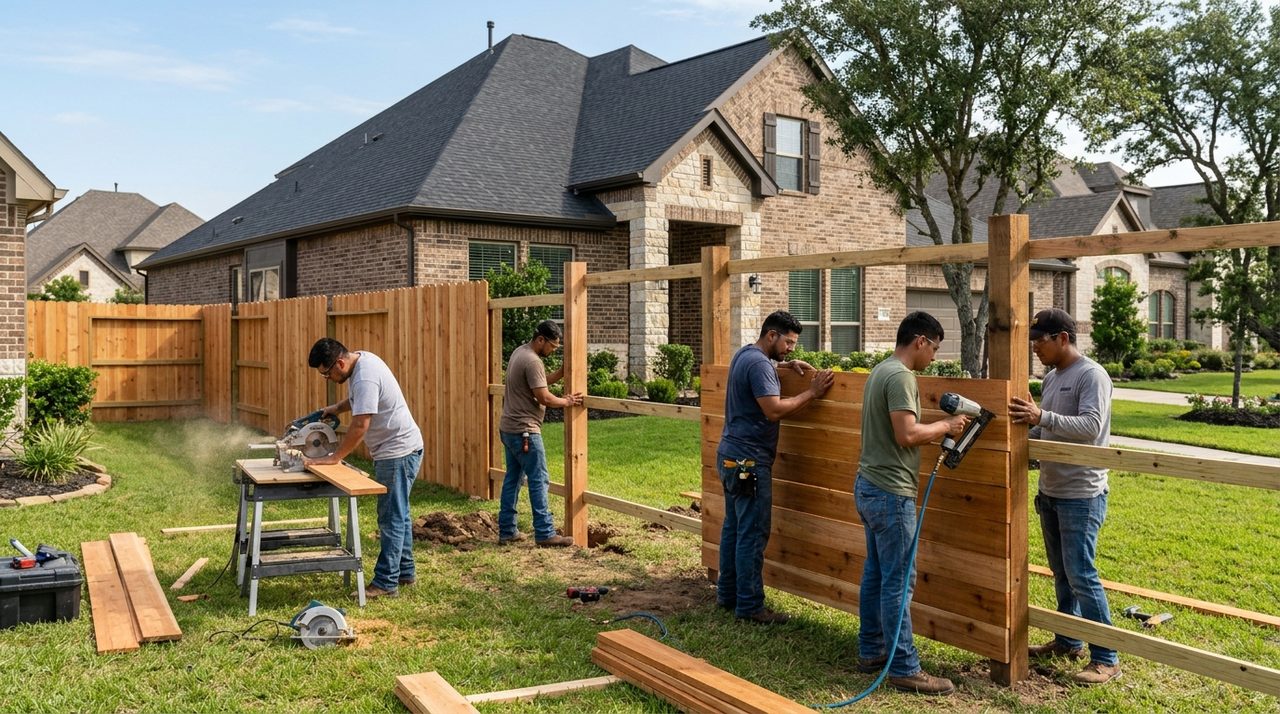
A fence contractor who understands Houston clay should set posts in tapered or belled concrete footings extending at least 36 inches deep, which distributes the load across a greater soil mass and resists heave better than straight-sided footings. For the cedar board-on-board privacy fences common in Tanglewood rear yards — typically running $18–$30 per linear foot installed, estimated — posts should be spaced no more than 8 feet on center to reduce wind-load torque that compounds clay-movement lean over time. After installation, avoiding irrigation directly at post bases slows moisture cycling in the immediate soil column.
Sources: International Residential Code (as adopted by City of Houston), Local HOA / deed restrictions (see area profile)
Why it matters to you
Tanglewood sits within Houston city limits in Harris County, so the City of Houston Permitting Center — not a suburban municipal office — is the permit authority here. A City permit is required for any fence exceeding 6 feet in height, and many of the privacy fences installed on Tanglewood's larger lots meet or exceed that threshold. The critical homeowner mistake is treating THA architectural approval and City permitting as interchangeable: they are parallel obligations. THA approval does not substitute for a City permit, and a City permit does not immunize a fence from THA enforcement if the design was not reviewed by the Architectural Review Committee first.
What a good pro does
The correct sequence is to obtain THA architectural approval in writing first, then apply to the City of Houston Permitting Center for the fence permit using the THA-approved design specifications. Texas has no state license requirement specific to fence contractors — no TDLR registration exists for this trade — so the burden of confirming permitting compliance falls on the homeowner and contractor together. Ask any fence contractor bidding Tanglewood work to confirm in the contract who is responsible for pulling the City permit, and retain both the THA approval letter and the City permit card before installation begins.
Sources: City of Houston Permitting Center, Local HOA / deed restrictions (see area profile), Municipal permit office (see area profile)
Hiring fence builders in Tanglewood? Tanglewood is one of Houston's most prestigious single-family neighborhoods, with roughly 1,220 lots governed by the mandatory Tanglewood Homes Association and strict deed restrictions. The housing stock spans original 1950s–1960s ranch homes and extensive new-construction luxury builds, creating a wide range of home service needs from aging-system upgrades to high-end custom installations. Contractors working here must navigate HOA architectural controls in addition to City of Houston permitting requirements.
Building era
1950s–1960s original construction with significant teardown and new-construction activity from the 1990s to present.
Typical style
Mix of original mid-century ranch-style homes and newer traditional and contemporary luxury builds.
Foundations
Likely predominantly slab-on-grade, especially on newer and replacement homes — not explicitly confirmed in sources; verify on a property-by-property basis.
Common systems
Original homes may retain older copper or galvanized plumbing, older electrical panels, and aging central HVAC systems. Newer builds typically feature modern high-efficiency HVAC, PEX or copper plumbing, and 200-amp electrical service. The wide era range means system conditions vary dramatically from lot to lot.
What that means for repairs
Teardown-and-rebuild is extremely common, replacing original 1950s–1960s homes with large custom residences. Whole-home renovations and major additions on surviving original structures are also frequent, often requiring full mechanical system upgrades to meet modern codes and homeowner expectations.
Permit jurisdiction
City of Houston — Houston Permitting Center. Tanglewood is within Houston city limits in Harris County.
HOA & deed restrictions
Mandatory HOA — Tanglewood Homes Association (THA), founded 1948, governing approximately 1,220 residential lots across 23 sections. THA actively enforces strict deed restrictions covering design, construction, and property use. Note: nearby communities such as Tanglewood Park and Tanglewood West have separate HOAs.
Historic districts
No City of Houston historic district designation confirmed. Tanglewood is not listed among HAHC-designated historic districts; no Certificate of Appropriateness is required for exterior work solely due to location in Tanglewood.
Contractor note
Contractors must obtain City of Houston permits for all applicable work and should confirm all exterior modifications and new construction plans with the Tanglewood Homes Association before beginning work, as THA enforces strict architectural and design deed restrictions that may exceed or differ from municipal code requirements.
FEMA flood zone
FEMA Zone X (low flood risk) per official NFHL data. Tanglewood is not immediately adjacent to a major bayou, though its general West Houston location places it in the broader Buffalo Bayou watershed.
Hurricane Harvey impact
No authoritative source documents significant neighborhood-wide structure flooding in Tanglewood during Hurricane Harvey. Available real estate and community descriptions do not flag flood-prone status as a major concern, suggesting Tanglewood did not experience the widespread damage seen in bayou-adjacent neighborhoods. However, this is inference rather than documented fact — flood risk should be evaluated on an address-specific basis using Harris County Flood Control District tools and seller disclosures.
Heat & humidity load
Houston's extreme summer heat and humidity place heavy demand on HVAC systems across all eras of Tanglewood housing stock. Original 1950s–1960s homes may have undersized ductwork and aging insulation, leading to higher cooling costs and more frequent HVAC service calls. Newer luxury builds with large square footage require properly sized multi-zone systems. Prolonged heat also accelerates weathering of exterior materials and drives demand for irrigation system maintenance on Tanglewood's characteristically large, wooded lots.
Working with contractors here
Contractors in Tanglewood most commonly handle full teardown-and-rebuild projects, converting mid-century ranch homes into large custom residences, as well as major whole-home renovations on surviving original structures. Plumbing and electrical upgrades are frequent on pre-1970s homes that still have original galvanized or cast-iron drain lines and older panels. The mandatory Tanglewood Homes Association requires architectural review and approval for exterior work, so contractors should build THA coordination into project timelines. High-end finish expectations are the norm — clients in this neighborhood typically expect premium materials, meticulous workmanship, and detailed project management. Job scoping should account for large lot sizes, mature tree protection, and potential underground utility complications on properties that have been modified over multiple decades.
Local Tip
Always ask for a written estimate before work begins. Texas contractors are required to provide one on jobs over $1,000.
Tanglewood is one of Houston's most prestigious single-family neighborhoods, with roughly 1,220 lots governed by the mandatory Tanglewood Homes Association and strict deed restrictions. The housing stock spans original 1950s–1960s ranch homes and extensive new-construction luxury builds, creating a wide range of home service needs from aging-system upgrades to high-end custom installations. Contractors working here must navigate HOA architectural controls in addition to City of Houston permitting requirements.
Source: U.S. Census Bureau, ACS 5-Year 2023
Most of Tanglewood maps to FEMA Zone X (low mapped flood risk), but Houston's flash-flood reality means even low-risk blocks benefit from smart drainage and storm-hardened installs.
Source: FEMA National Flood Hazard Layer (NFHL). Flood zones vary by parcel — verify your individual FIRM panel.
Sources: Local HOA / deed restrictions (see area profile)
Sources: City of Houston Permitting CenterLocal HOA / deed restrictions (see area profile)
Sources: FEMA National Flood Hazard Layer (NFHL)Harris County Flood Control District
Sources: Local HOA / deed restrictions (see area profile)
Sources: International Residential Code (as adopted by City of Houston)