119 Midway St, Spring, TX 77373
Best Fence Builders in Spring, TX
Spring's sprawling patchwork of 1970s–2000s subdivisions across unincorporated Harris County means fence projects here involve three overlapping complications that rarely all appear together: highly expansive Houston Black clay soil that heaves and tilts posts within a few seasons, subdivision-specific HOA deed restrictions that vary street by street with no single authority overseeing the whole area, and a permit process routed through the Harris County Engineering Department rather than any city building department. Getting a fence quote without resolving all three first is how Spring homeowners end up with a leaning fence, an HOA violation notice, and a county stop-work order at the same time.
Verified against Google Business data
Updated 2026
See the 10 Fence Builders Serving Spring 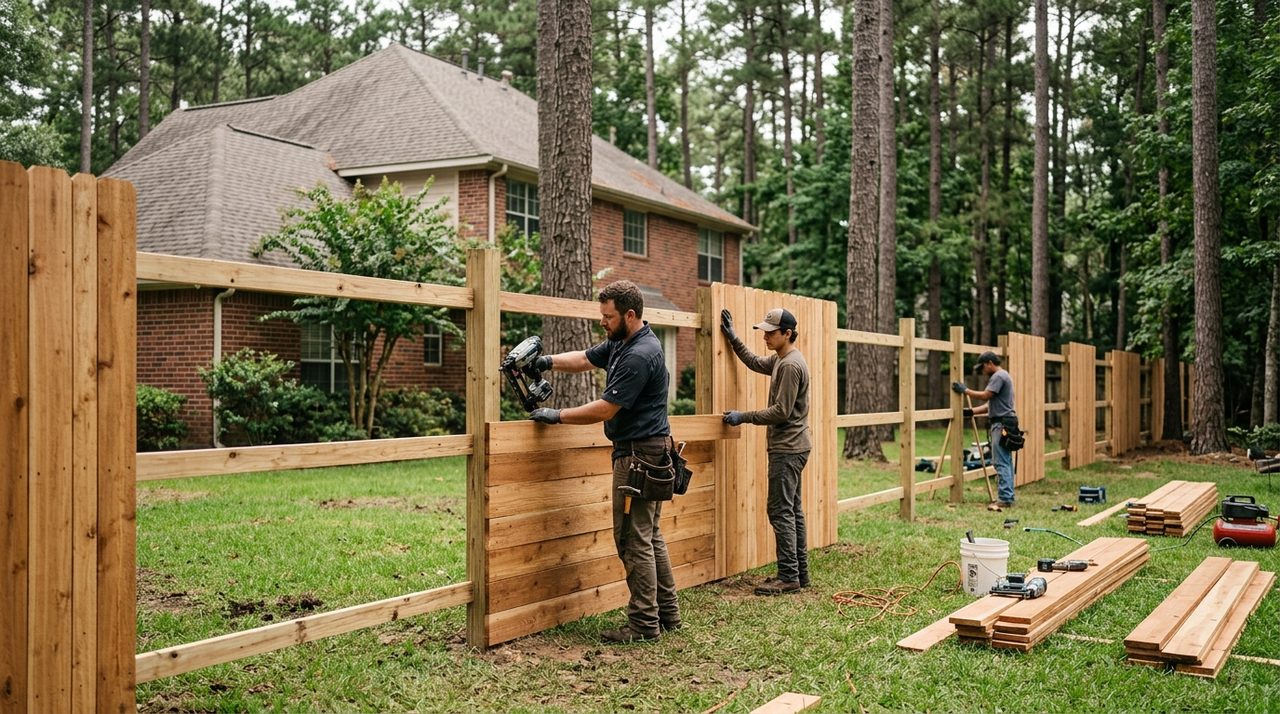
- Median home built
- 1991
- Median home value
- $221,300
- FEMA flood zone
- X (low)
- Typical installed cost (est.)
- $18–$30/linear ft (cedar), $30–$55/linear ft (ornamental iron)
- Most common local issue
- Clay-soil post heave in 1980s–1990s subdivisions on native Harris County clay
Ranked by verified Google rating × review volume × verification tier. How we rank →
Some highly-rated pros serve Spring from nearby and may not keep a Spring street address. Those are listed under "Also serving Spring" with their real city and distance, so you always know where each business is based.
Min rating:
10 resultsBased in Spring
Open Now
17226 Bamwood Rd, Houston, TX 77090
Closed
301 Wells Fargo Dr Suite 3, Houston, TX 77090
Closed
21520 I-45, Spring, TX 77373
Closed
17906 Bamwood Rd, Houston, TX 77090
Closed
25528 Aldine Westfield Rd #142, Spring, TX 77373
Open Now
22820 North Fwy Unit 3p, Spring, TX 77373
Closed
1004 Spring Cypress Rd, Spring, TX 77373
Also serving Spring
Highly-rated pros based nearby who cover Spring. Distance shown from the Spring area.
Open Now
Serving Spring Based in The Woodlands · 3.1 mi away
Open Now
Serving Spring Based in The Woodlands · 3.9 mi away
Fence Builders in Spring: What You Should Know
Houston Black Clay Heaves Posts in Spring's Older Subdivisions
Why it matters to you
Most of Spring sits on native Beaumont and Houston Black clay — the same expansive soil responsible for the widespread foundation movement in the area's 1970s–1990s slab-on-grade homes. Seasonal dry summers followed by heavy Gulf rainfall cause the clay to shrink and swell dramatically, and shallow concrete footings poured at standard Houston depths (18–24 inches) will heave, tilt, or crack posts within a few years, especially on corner and gate posts under constant tension. Homeowners in subdivisions like Cypresswood and Spring Shadows frequently report entire fence lines shifting several inches within a single weather cycle.
What a good pro does
A qualified installer in Spring should set posts a minimum of 36 inches deep — deeper than typical Houston practice — and consider a dry-pack concrete fill method that allows limited post movement rather than a rigid monolithic footing that amplifies heave forces. Posts should be pressure-treated to at minimum UC4B retention levels, and gate posts in particular benefit from oversized diameter (4x6 or larger) to resist torque from clay movement. Ask any bidder specifically how they handle clay-soil footing depth in unincorporated Harris County.
Sources: International Residential Code (as adopted by City of Houston), Harris County Flood Control District
Subdivision HOA Rules in Spring Are Not Uniform — Verify Before You Buy Materials
Why it matters to you
Spring has no single area-wide HOA. Most subdivisions platted after 1970 have their own mandatory property owners' associations with deed-tied architectural rules, but the specific requirements — cedar only vs. wrought iron, board-on-board orientation, maximum height, whether chain-link is prohibited on street-facing sides — differ from one subdivision to the next and sometimes between phases of the same subdivision. An older pocket near FM 2920 may have only a voluntary civic club, while a late-1990s Springwoods Village-area community might require full architectural review committee (ARC) approval before a single post is set. Ordering materials before confirming your subdivision's specific deed restrictions risks a forced-removal demand at your expense.
What a good pro does
Before signing any fence contract, pull your deed restrictions from the Harris County Clerk's records or the TREC HOA Management Certificate Database to identify your exact POA and its current architectural guidelines. Submit a written ARC application with a site plan, material specification, and color sample — most Spring POAs require this before any exterior modification. A fence contractor experienced in Spring should be willing to pause the project pending ARC approval rather than proceeding on a verbal OK from a neighbor.
Sources: Local HOA / deed restrictions (see area profile), Municipal permit office (see area profile)
Hurricane and Derecho Wind Damage to Board-on-Board Privacy Fences
Why it matters to you
Spring sits well within the corridor that absorbed the May 2024 derecho, which generated wind gusts exceeding 80–100 mph across northern Harris County and destroyed privacy fences throughout the area. The standard 6-foot cedar board-on-board privacy fence — the dominant style in Spring's 1980s–2000s subdivisions — acts as a solid sail with no wind-relief gaps, and when posts are already compromised by clay-soil heave, a single major wind event takes down entire fence lines. Full storm-replacement jobs for an average Spring suburban lot typically range $3,000–$8,000 as an estimate, and demand spikes immediately after events mean the worst-prepared homeowners wait the longest.
What a good pro does
Specify posts set at a minimum 1/3 of total post length below grade (not just 24 inches) and use 4x4 or 4x6 posts on no more than 8-foot spacing, tightened to 6-foot spacing on exposed rear fence lines facing open spaces or drainage corridors. Some Spring homeowners opt for spaced-picket designs or ornamental aluminum on wind-exposed sides — both reduce sail effect and qualify for potential TWIA wind coverage consideration in applicable policies. Confirm that your installer pulls a Harris County permit so footing depth is inspected rather than assumed.
Sources: Texas Windstorm Insurance Association (TWIA), International Residential Code (as adopted by City of Houston), Municipal permit office (see area profile)
Fence Builders in Spring: What You Should Know
Hiring fence builders in Spring? Spring is a large, mostly unincorporated area of Harris County comprising dozens of distinct subdivisions, each with its own HOA rules and deed restrictions. Homeowners here primarily deal with maintaining 1970s–2000s era slab-on-grade suburban homes, with common needs including HVAC replacement, foundation monitoring on expansive clay soils, and roof repairs. Proximity to Spring Creek and Cypress Creek tributaries means flood risk varies dramatically by subdivision, making property-specific flood zone verification essential before any major renovation.
- Housing era
- 1970s–2000s, with continued new construction near Grand Parkway (SH-99) in the 2010s–2020s
- Foundation
- Slab-on-grade (dominant)
- Flood zone
- FEMA Zone X (low flood risk) per official NFHL data
- Permits
- Harris County Engineering Department for unincorporated areas (most of Spring)
Housing stock & systems
Building era
1970s–2000s, with continued new construction near Grand Parkway (SH-99) in the 2010s–2020s.
Typical style
One- and two-story brick veneer detached single-family homes in traditional, ranch, and contemporary suburban styles with attached two-car garages.
Foundations
Slab-on-grade (dominant); pier-and-beam is rare and limited to occasional older properties.
Common systems
Central HVAC systems (many original units in 1970s–1980s homes are past useful life), copper or CPVC plumbing with some polybutylene in 1980s–early 1990s builds, and 100–200 amp electrical panels typical of era.
What that means for repairs
Kitchen and bathroom remodels are common in 1970s–1990s homes. HVAC system replacements are frequent due to system age. Foundation repair is a recurring need due to expansive clay soils and seasonal moisture fluctuation. Roof replacements are common on 20+ year homes after hail events.
Permits & restrictions
Permit jurisdiction
Harris County Engineering Department for unincorporated areas (most of Spring); some portions within City of Houston ETJ may require Houston Permitting Center coordination.
HOA & deed restrictions
No single area-wide HOA exists. Most post-1970 subdivisions have mandatory property owners' associations (POAs) with deed-tied membership. Some older pockets have voluntary civic clubs or no active HOA. Specific HOA identity must be confirmed via Harris County Clerk deed records or TREC HOA Management Certificate Database.
Historic districts
No City of Houston historic district designation confirmed. Spring is largely unincorporated Harris County with no known HAHC-designated historic districts.
Contractor note
Contractors must verify whether a property falls within an incorporated city or unincorporated Harris County, as permit requirements and inspections differ. HOA architectural review and approval is required in most subdivisions before exterior modifications.
Flood & weather
FEMA flood zone
FEMA Zone X (low flood risk) per official NFHL data. However, Spring encompasses areas near Spring Creek and Cypress Creek tributaries where flood risk can vary significantly by subdivision and specific lot. Property-level FIRM verification is strongly recommended.
Hurricane Harvey impact
Hurricane Harvey caused widespread flooding across north Harris County in 2017, with neighborhoods along Spring Creek and Cypress Creek corridors experiencing varying degrees of inundation. A single authoritative list of affected Spring subdivisions is not publicly compiled — property-specific impact should be verified through Harris County Flood Control District mapping tools and seller disclosures.
Heat & humidity load
Sustained 95°F+ temperatures and high humidity stress HVAC systems heavily, especially aging units in 1970s–1980s homes. Expansive clay soils contract during summer drought, increasing foundation movement risk. Attic temperatures can exceed 150°F, accelerating roofing material degradation and making attic insulation upgrades a common summer-driven project.
Working with contractors here
Contractors in Spring most commonly handle HVAC replacements, foundation repair, roof replacements, and kitchen/bath remodels driven by the aging 1970s–2000s housing stock. Foundation work is particularly prevalent due to the area's expansive clay soils and seasonal moisture cycles. Job scoping must account for subdivision-specific HOA architectural guidelines, which frequently regulate exterior colors, materials, fencing, and even contractor work hours. Because Spring is largely unincorporated Harris County, permits are handled through county engineering rather than the City of Houston, and contractors should verify jurisdiction boundaries on a per-property basis. Properties near creek corridors may require additional floodplain development permits even if the lot itself is mapped Zone X.
Local Tip
Always ask for a written estimate before work begins. Texas contractors are required to provide one on jobs over $1,000.
About Spring
Spring is a large, mostly unincorporated area of Harris County comprising dozens of distinct subdivisions, each with its own HOA rules and deed restrictions. Homeowners here primarily deal with maintaining 1970s–2000s era slab-on-grade suburban homes, with common needs including HVAC replacement, foundation monitoring on expansive clay soils, and roof repairs. Proximity to Spring Creek and Cypress Creek tributaries means flood risk varies dramatically by subdivision, making property-specific flood zone verification essential before any major renovation.
- Median year built
- 1991
- Median home value
- $221,300
- Owner-occupied
- 74.8%
- Population
- 67,103
- Housing units
- 22,974
- Median income
- $86,888
Source: U.S. Census Bureau, ACS 5-Year 2023
Flood & storm risk
FEMA Zone XLow flood riskMost of Spring maps to FEMA Zone X (low mapped flood risk), but Houston's flash-flood reality means even low-risk blocks benefit from smart drainage and storm-hardened installs.
Source: FEMA National Flood Hazard Layer (NFHL). Flood zones vary by parcel — verify your individual FIRM panel.
Frequently Asked Questions
Do I need a permit from Harris County to replace or build a new fence in Spring, TX?
Most of Spring is unincorporated Harris County, so permit requirements run through the Harris County Engineering Department rather than any city building department. Harris County does not require a permit for standard residential privacy fences under 6 feet, but if your fence sits within a recorded drainage or utility easement — common on Spring-area plats near creek corridors — you may need a floodplain development permit or easement encroachment approval before breaking ground. Always pull your property's recorded plat from the Harris County Clerk's office to confirm easement locations before your contractor sets a single post.
Sources: Municipal permit office (see area profile)
My Spring subdivision was built in the 1980s. How do I find out what my HOA actually allows for fencing materials and height?
Spring has no single area-wide HOA — each post-1970 subdivision has its own deed restrictions recorded independently with the Harris County Clerk, and some blocks have voluntary civic clubs with no real enforcement while adjacent streets have active architectural review committees. The most reliable starting point is to pull your subdivision's deed restrictions directly from the Harris County Clerk's deed records portal, then cross-reference with the TREC HOA Management Certificate Database to find the current management contact. Buying cedar boards before getting written architectural approval is a common and expensive mistake in Spring's patchwork of associations.
Sources: Local HOA / deed restrictions (see area profile)
My lot backs up to a drainage ditch near a Cypress Creek tributary. Are there fence restrictions I should know about in Spring?
Even though most of Spring maps to FEMA Zone X, lots adjacent to drainage ditches often carry HCFCD-regulated drainage easements on their recorded plats, and solid privacy fences within those easements can be prohibited or require county floodplain administrator approval because solid panels trap debris and impede flow. Before installing anything within 10–15 feet of a rear drainage ditch, request a floodplain determination letter from Harris County Flood Control and verify the easement boundary on your survey — this step has caught Spring homeowners off guard after Harvey-era enforcement tightened across Harris County.
Sources: Harris County Flood Control DistrictFEMA National Flood Hazard Layer (NFHL)
Wood fence posts in my 1990s Spring neighborhood keep rotting at the ground line after just a few years. What's actually causing this and what should I ask contractors about?
Spring's native Houston Black clay holds moisture at the soil surface far longer than sandy soils, and the combination of that persistent ground-contact moisture with Houston's year-round high humidity creates fungal conditions that destroy even pressure-treated pine posts prematurely — often in under five years in low-lying sections of Spring subdivisions built on undisturbed clay. Ask contractors specifically whether they use #2 or better pressure-treated lumber rated for ground contact (UC4B minimum per building standards), whether they slope the top of the concrete collar away from the post to shed water, and whether they leave the bottom 6 inches of the footing unencased to allow drainage — these details separate installers who understand Houston conditions from those importing dryer-climate habits.
Sources: International Residential Code (as adopted by City of Houston)
What's a realistic timeline and budget estimate for replacing a full backyard fence on a typical Spring, TX lot after derecho or storm damage?
On a standard Spring subdivision lot with roughly 150 linear feet of backyard perimeter, budget estimates for 6-foot cedar board-on-board replacement run approximately $2,700–$4,500 installed, with storm-season demand — particularly after a major derecho or hurricane — pushing crews into 4–8 week backlogs and sometimes nudging per-foot pricing toward the higher end of that range. If multiple posts were sheared at the footing by wind load, add an estimated $150–$300 per post for full footing replacement, which is the correct repair when clay-saturated concrete was fractured rather than just the board panels. Filing a homeowners insurance claim for wind damage before signing a contractor contract is worth doing first, as documented wind events like the May 2024 derecho have supported successful fence claims across north Harris County.
Is there a best time of year to schedule a fence install in Spring, TX, and are there any Spring-specific timing traps to avoid?
Late October through February is generally the lowest-demand window for fence crews in the Spring area and offers more flexible scheduling, though a hard freeze event — like Winter Storm Uri in February 2021 — can disrupt concrete curing and cause freshly poured footings to crack if saturated clay freezes before the concrete sets. Summer installs are doable but peak storm season runs June through October, and back-to-back hurricane or derecho damage in 2024 created months-long crew shortages across north Harris County. One Spring-specific trap: scheduling an install in late spring without first getting HOA architectural approval in writing, since some Spring POAs run committees that only meet quarterly and can delay approval by 60–90 days regardless of when you're ready to start.