Closed
1802 Preston Ave, Pasadena, TX 77503
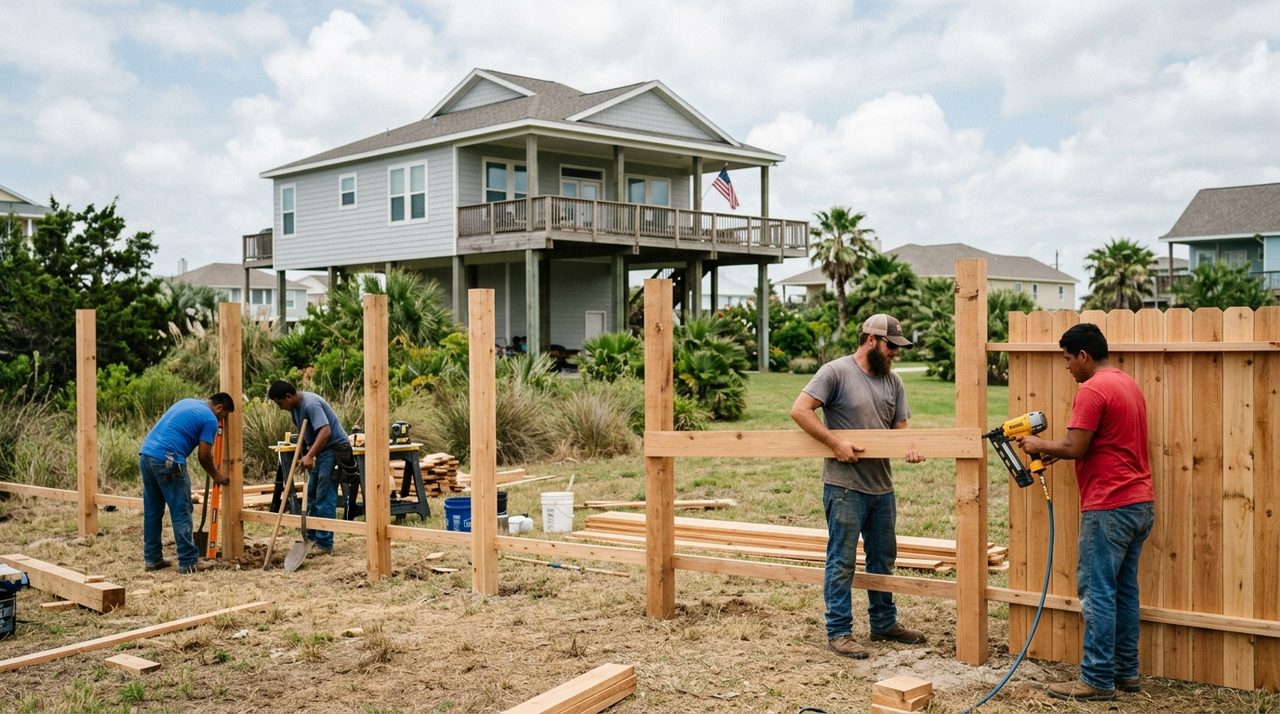
Deer Park's mid-century brick ranch homes — most built between the 1950s and 1980s on Harris County's native Beaumont clay — sit on soil that quietly pushes, tilts, and loosens fence posts year after year, and the SE Houston location puts every wood privacy fence in the crosshairs of Gulf-driven wind events like Beryl in 2024. Whether your block falls inside a Villages of Deer Park HOA or a completely unrestricted older plat, knowing the City of Deer Park's own permitting rules — not Houston's, not Harris County's — before breaking ground can save you a forced removal and a full re-dig.
Ranked by verified Google rating × review volume × verification tier. How we rank →
Some highly-rated pros serve Deer Park from nearby and may not keep a Deer Park street address. Those are listed under "Also serving Deer Park" with their real city and distance, so you always know where each business is based.
1802 Preston Ave, Pasadena, TX 77503
Highly-rated pros based nearby who cover Deer Park. Distance shown from the Deer Park area.
Serving Deer Park Based in Pasadena · 4.9 mi away
Serving Deer Park Based in Highlands · 5 mi away
Serving Deer Park Based in Galena Park · 6.5 mi away
Serving Deer Park Based in Galena Park · 6.6 mi away
Serving Deer Park Based in Galena Park · 6.7 mi away
Serving Deer Park Based in La Porte · 6.7 mi away
Why it matters to you
The Houston-Beaumont Black clay underlying most Deer Park lots swells when the bayou-adjacent SE Houston rains soak in and then shrinks hard during the long, dry summers the area regularly sees — a cycle that works concrete post footings like a slow piston. On properties built in the 1950s through 1970s, original fence posts were often set only 18–24 inches deep in standard concrete collars that simply cannot resist the lateral pressure of this repeated soil movement, producing the leaning and cracked-footing fences common throughout older Deer Park blocks.
What a good pro does
A knowledgeable contractor will set posts to at least 30 inches depth in Deer Park's clay-heavy soil, use a tube-form footing that keeps concrete from bonding directly to the moving clay, and allow proper drainage at the base so water does not pool and accelerate heave. Ask your bidder specifically how they handle clay-expansion pressure on post footings — it is the single biggest driver of premature fence failure on mid-century Deer Park lots.
Sources: International Residential Code (as adopted by City of Houston), Municipal permit office (see area profile)
Why it matters to you
Deer Park's position in SE Harris County — east of Hobby and fully exposed to Gulf storm tracks — meant Hurricane Beryl in July 2024 delivered sustained winds and gusts that dropped board-on-board privacy fences across entire streets. Standard 6-foot panels with solid infill and undersized 4×4 posts act like sails in those conditions; TWIA-territory insurers in Harris County routinely see total fence losses after each named storm, and the cost of full replacement on an average Deer Park backyard runs roughly $3,000–$8,000 depending on linear footage and material.
What a good pro does
Fence builders working in Deer Park's storm corridor should set 4×6 or larger treated posts at 6-foot intervals maximum, embed them at least one-third of the total post length into the ground with compacted backfill, and consider shadowbox or spaced-picket designs that allow wind relief rather than solid-panel construction that catches full load. Confirm that your contractor is familiar with TWIA coverage documentation requirements if you plan to file a wind-damage claim after future events.
Sources: Texas Windstorm Insurance Association (TWIA), International Residential Code (as adopted by City of Houston), Municipal permit office (see area profile)
Why it matters to you
Deer Park is an independent incorporated city with its own Building Inspections Department, which means City of Houston permit rules, Harris County rules, and any rules you may have read about unincorporated areas do not apply here. Fences in Deer Park that exceed the city's adopted height limits require a permit through Deer Park's own office, and contractors who skip this step leave homeowners exposed to stop-work orders or forced removal at their own expense — a real risk given active code enforcement in Harris County's incorporated cities.
What a good pro does
Before any post is set, verify the current height limit and setback requirements directly with the City of Deer Park Building Inspections Department, because municipal codes are updated independently of neighboring cities. Your contractor should be willing to pull the permit themselves and schedule the required inspection; if a bidder suggests skipping permits on a fence that meets the threshold, that is a red flag specific to Deer Park's regulatory environment.
Sources: Municipal permit office (see area profile)
Why it matters to you
Deer Park's housing stock is a genuine mix: some blocks in Villages of Deer Park and Deer Park Estates fall under active homeowners associations with architectural review requirements covering fence material, height, and even which side of the board faces outward, while many older 1950s–1960s plats nearby have no HOA at all and no appearance restrictions on fencing. Homeowners who assume their street is unrestricted — or vice versa — and install a chain-link or non-cedar fence without HOA pre-approval can face fines and a mandatory removal order that voids the entire installation cost.
What a good pro does
Pull your property's deed and plat records from Harris County Appraisal District or a title search before contracting any fence work, and confirm directly with Villages of Deer Park HOA or Deer Park Estates HOA if your address falls within those boundaries. A reputable fence contractor working in Deer Park will ask for this documentation upfront rather than leave you to discover the restriction after the concrete sets.
Sources: Local HOA / deed restrictions (see area profile), Municipal permit office (see area profile)
Hiring fence builders in Deer Park? Deer Park is an incorporated city east of Houston with a housing stock built primarily from the 1950s through the 1980s. Homeowners here contend with aging HVAC systems, original plumbing in older homes, and foundation maintenance on slab-on-grade construction typical of coastal plain development. The mix of HOA-governed subdivisions and unrestricted older neighborhoods means contractor requirements vary block by block.
Building era
1950s–1980s, with some later infill development through the 1990s and 2000s.
Typical style
One- and two-story brick veneer ranch and traditional suburban tract homes.
Foundations
Slab-on-grade (inferred from era and region; not formally documented in public records).
Common systems
Older homes likely have original galvanized or copper plumbing, R-22 refrigerant HVAC systems nearing or past end of life, and fuse or early breaker-panel electrical in pre-1970s builds. Homes from the 1980s onward more commonly have copper supply lines and 200-amp panels.
What that means for repairs
Kitchen and bath remodels, HVAC system replacements (R-22 to R-410A conversions), and re-piping of galvanized lines are common in the older mid-century housing stock. Some homeowners undertake foundation leveling due to expansive clay soils.
Permit jurisdiction
City of Deer Park Building Inspections Department (independent incorporated city with its own permitting office).
HOA & deed restrictions
HOA status is subdivision-specific. Confirmed mandatory HOAs include Villages of Deer Park Homeowner Association, Inc. and Deer Park Estates Homeowners Association. Many older platted areas have no organized HOA and market homes with no HOA fees. Deed restrictions likely exist in platted subdivisions but no city-wide compilation is publicly available.
Historic districts
No City of Houston or local historic district designation confirmed. Deer Park is an independent incorporated city and does not fall under HAHC jurisdiction.
Contractor note
Contractors must pull permits through the City of Deer Park, not Houston or Harris County. HOA-governed subdivisions such as Villages of Deer Park and Deer Park Estates may require architectural review or pre-approval for exterior modifications.
FEMA flood zone
FEMA Zone X (low flood risk) per official NFHL data. Deer Park sits on relatively flat terrain in southeast Harris County near the San Jacinto River basin and Buffalo Bayou watershed; localized drainage issues may still occur despite the Zone X designation.
Hurricane Harvey impact
Research indicates Deer Park experienced some flooding during Hurricane Harvey but was not among the most catastrophically impacted areas in Harris County. No verifiable official source naming specific repeatedly flooded streets within Deer Park was identified. Homeowners should consult Harris County Flood Control District repetitive-loss maps and FEMA records for parcel-level flood history.
Heat & humidity load
Prolonged summer heat and humidity stress aging HVAC systems common in 1950s–1980s homes. Condensation and moisture intrusion can cause attic mold and soffit deterioration in brick veneer construction. Slab-on-grade foundations on expansive clay soils are susceptible to seasonal movement during summer drought cycles.
Working with contractors here
The most common contractor work in Deer Park involves HVAC replacement on mid-century and 1980s-era systems, whole-house re-piping of galvanized supply lines, and slab foundation repair driven by clay soil movement. Roof replacements are frequent given the age of the housing stock and Gulf Coast storm exposure. Contractors should confirm whether a property falls within an HOA-governed subdivision, as Villages of Deer Park and Deer Park Estates enforce appearance standards. All permits must be pulled through the City of Deer Park's own building department, which maintains separate inspection schedules and code interpretations from Houston or Harris County.
Local Tip
Always ask for a written estimate before work begins. Texas contractors are required to provide one on jobs over $1,000.
Deer Park is an incorporated city east of Houston with a housing stock built primarily from the 1950s through the 1980s. Homeowners here contend with aging HVAC systems, original plumbing in older homes, and foundation maintenance on slab-on-grade construction typical of coastal plain development. The mix of HOA-governed subdivisions and unrestricted older neighborhoods means contractor requirements vary block by block.
Source: U.S. Census Bureau, ACS 5-Year 2023
Most of Deer Park maps to FEMA Zone X (low mapped flood risk), but Houston's flash-flood reality means even low-risk blocks benefit from smart drainage and storm-hardened installs.
Source: FEMA National Flood Hazard Layer (NFHL). Flood zones vary by parcel — verify your individual FIRM panel.
Sources: Municipal permit office (see area profile)
Sources: FEMA National Flood Hazard Layer (NFHL)Harris County Flood Control District
Sources: Local HOA / deed restrictions (see area profile)
Sources: Municipal permit office (see area profile)