Closed
15015 Westheimer Pkwy Suite D3-1010, Houston, TX 77082
Alief's patchwork of 1970s–1990s subdivisions on Houston Black clay soil means fence posts face relentless seasonal heave, and the subdivision-by-subdivision HOA landscape — some blocks have mandatory architectural review, others have none — makes pre-job homework as important as the installation itself. Add the City of Houston permitting jurisdiction that governs most Alief addresses and the area's FEMA Zone X500 moderate flood exposure, and a straightforward backyard fence project has more moving parts here than in a newer, more uniform suburb.
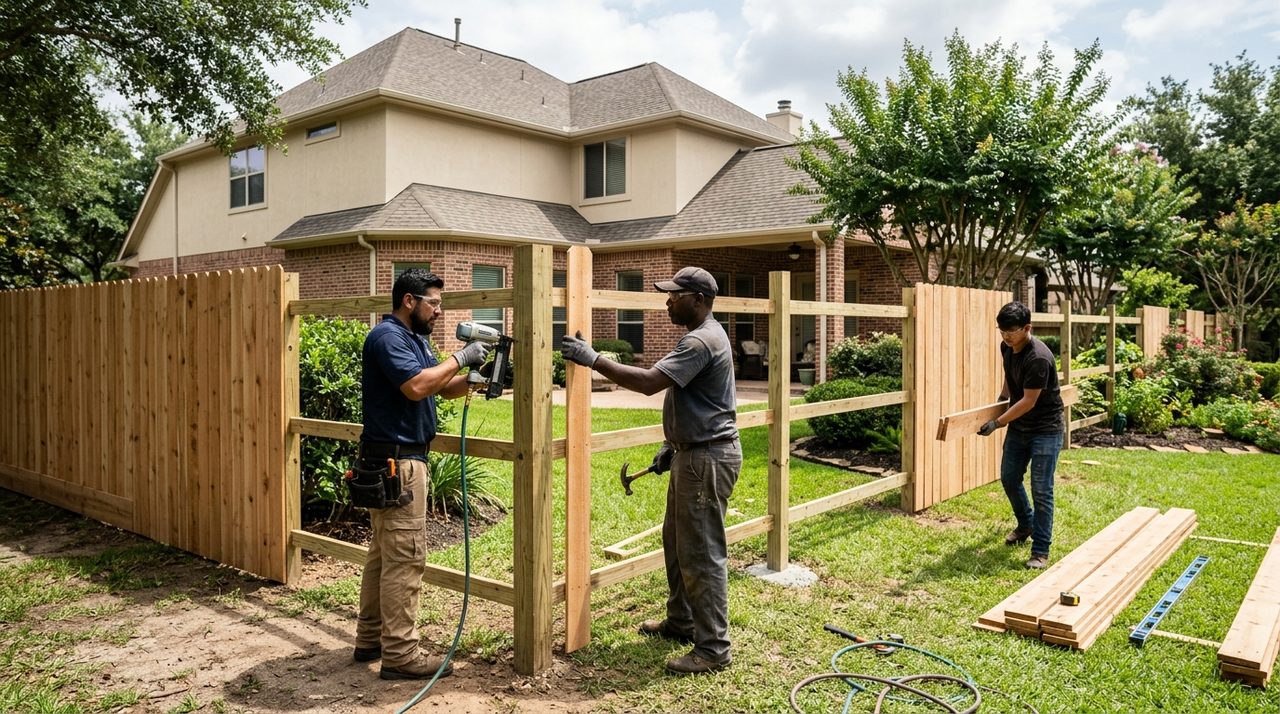
Ranked by verified Google rating × review volume × verification tier. How we rank →
Some highly-rated pros serve Alief from nearby and may not keep a Alief street address. Those are listed under "Also serving Alief" with their real city and distance, so you always know where each business is based.
15015 Westheimer Pkwy Suite D3-1010, Houston, TX 77082
10706 Cobleskill Ln, Houston, TX 77099
N107B, 11331 Richmond Ave, Houston, TX 77082
15702 Barbarossa Dr, Houston, TX 77083
10303 Covey Ct, Houston, TX 77099
6801 Baneway Dr suite, Houston, TX 77072
4419 Continental Dr Suite 2, Houston, TX 77072
Highly-rated pros based nearby who cover Alief. Distance shown from the Alief area.
Serving Alief Based in Westchase · 1.9 mi away
Serving Alief Based in Westchase · 2.3 mi away
Serving Alief Based in Sharpstown · 2.7 mi away
Why it matters to you
Most Alief homes were built between the 1970s and 1990s on Harris County's expansive Beaumont/Houston Black clay, and original fence posts installed decades ago were typically set in shallow concrete footings of 18–24 inches — adequate for the day but vulnerable to the violent shrink-swell cycles that follow a dry Houston summer and then heavy Gulf rainfall. Homeowners in Alief's ranch-style subdivisions frequently see entire fence runs leaning or cracking within a few seasons, especially where yard drainage is slow and clay retains moisture unevenly.
What a good pro does
A knowledgeable contractor will set new 4x4 or 6x6 posts in footings drilled to at least 36 inches and sized at a minimum 10-inch diameter, and some experienced installers in the area skip the concrete collar entirely on fence-line posts — backfilling with compacted gravel instead — to allow moisture to migrate past the post base rather than pooling and freezing against concrete. Post replacement alone runs an estimated $150–$300 per post including concrete as a budgeting reference point.
Sources: International Residential Code (as adopted by City of Houston), Harris County Flood Control District
Why it matters to you
Unlike a uniform master-planned community, Alief has no single governing HOA: some subdivisions such as Park West have mandatory architectural review committees that specify cedar-only materials, maximum heights, and even which face of the fence must face outward, while neighboring tracts operate only through civic clubs with no enforceable deed restrictions at all. Ordering 200 linear feet of board-on-board cedar without first pulling the specific subdivision's deed restrictions from Harris County records is how Alief homeowners end up with a fence they must remove at their own cost.
What a good pro does
Before signing a contract, search the Harris County Clerk's deed records for your specific subdivision plat and any recorded restrictions — this is free online at the HCAD and Harris County Clerk portals. If an HOA exists, submit the fence design to the architectural review committee and get written approval before any post is set; verbal OK from a neighbor is not binding. A contractor familiar with Alief should include this verification step in their pre-construction checklist as a standard practice.
Sources: Local HOA / deed restrictions (see area profile), City of Houston Permitting Center
Why it matters to you
Alief sits largely within Houston city limits, meaning the City of Houston Permitting Center — not a suburban municipal office — is the correct permit jurisdiction for most addresses here. The City of Houston requires a permit for fences exceeding 6 feet in height, and work done without the required permit can result in a stop-work order or forced removal; Texas has no state-issued fence contractor license, so any operator can legally perform the work, but that does not exempt the project from local permit requirements.
What a good pro does
Confirm your specific Alief address falls within Houston city limits rather than an unincorporated pocket — the city's online GIS portal can verify this in minutes. For any fence over 6 feet, the homeowner or contractor must pull a permit through the City of Houston Permitting Center before breaking ground. A reputable fence installer working in Alief will include permit cost and coordination in their bid rather than asking the homeowner to handle it separately.
Sources: City of Houston Permitting Center, Municipal permit office (see area profile)
Why it matters to you
Alief carries a FEMA Zone X500 designation — outside the 100-year floodplain but inside the 500-year boundary — which means many lots experience standing water after significant Gulf rain events even without formal flooding. For a neighborhood whose median home was built in 1986, many existing wood fences were installed with standard pine or minimally treated lumber; Harris County's persistent humidity above 70% year-round combined with clay-induced slow drainage creates fungal conditions that can rot ground-contact wood fence posts in as few as 3–5 years, regardless of how well the post footing was set.
What a good pro does
Specify ground-contact rated lumber (minimum UC4B pressure treatment per IRC standards) for all posts and bottom rails, and consider a concrete or gravel base collar that keeps the wood post face from sitting in standing water. On lots with visibly slow yard drainage, a contractor should note those drainage patterns in the project scope and may recommend setting posts on concrete piers that bring the wood above grade rather than embedding it directly in clay. Composite or aluminum fence components eliminate the rot risk entirely and are worth pricing for comparison.
Sources: FEMA National Flood Hazard Layer (NFHL), International Residential Code (as adopted by City of Houston), Harris County Flood Control District
Hiring fence builders in Alief? Alief is a large, diverse area in southwest Houston encompassing dozens of individual subdivisions, each with its own governance structure, housing stock, and deed restrictions. Homeowners should verify their specific subdivision's HOA status, deed restrictions, and flood history at the parcel level rather than relying on area-wide generalizations. The moderate flood risk zone and aging housing stock across many tracts drive significant demand for plumbing, foundation, and weatherproofing services.
Building era
Not confirmed at the neighborhood-wide level — varies by subdivision. Many tracts developed from the 1970s through 1990s, but this should be verified tract-by-tract.
Typical style
Not confirmed — Alief includes a mix of single-family ranch-style homes, townhomes, and multi-family units depending on the subdivision.
Foundations
Primarily slab-on-grade, consistent with Houston-area construction norms, but not universally confirmed across all Alief subdivisions.
Common systems
Homes from the 1970s–1990s era typically feature central HVAC systems that may need replacement, copper or galvanized plumbing (older tracts), and electrical panels that may require upgrading to modern standards.
What that means for repairs
Not confirmed at the area-wide level. Given the likely age range of housing stock, common renovation activity likely includes HVAC replacement, re-piping from galvanized to PEX or copper, roof replacement, and kitchen/bath modernization.
Permit jurisdiction
City of Houston Permitting Center (Alief is generally within Houston city limits, though boundary verification is recommended for any specific address).
HOA & deed restrictions
No single area-wide HOA governs Alief. Some subdivisions have mandatory HOAs (e.g., Park West Community Association, Inc.). Others are organized only through civic clubs or the Alief Super Neighborhood Council, which is a community forum, not an HOA. Check Harris County deed records for the specific subdivision.
Historic districts
No City of Houston historic district designation confirmed. No evidence found that any part of Alief requires HAHC Certificates of Appropriateness.
Contractor note
Contractors must verify the specific subdivision's HOA requirements before beginning exterior work, as rules vary dramatically across Alief. Confirm the property is within Houston city limits for correct permitting jurisdiction.
FEMA flood zone
FEMA Zone X500 (moderate flood risk) — source: fema_nfhl. Alief is situated in southwest Houston; proximity to specific bayous or drainage channels should be verified at the parcel level.
Hurricane Harvey impact
Specific Harvey 2017 impact data for Alief was not confirmed through available research. Flood impact varied by subdivision and street; homeowners and contractors should check parcel-level flood history using Harris County Flood Control District tools and FEMA flood claim records rather than relying on area-wide assumptions.
Heat & humidity load
Houston's extreme summer heat and humidity place heavy demand on HVAC systems, particularly in older homes with less efficient equipment. Slab foundations in clay soils are susceptible to movement during prolonged dry spells, and moisture intrusion risks increase during summer storm events.
Working with contractors here
Alief's large geographic footprint and subdivision-by-subdivision variability mean contractors must scope each job individually rather than assuming uniform conditions. Older homes from the 1970s–1980s commonly need re-piping, electrical panel upgrades, and HVAC replacement. Foundation repair is a recurring need given Houston's expansive clay soils and the moderate flood risk designation. Exterior work such as siding, roofing, and fencing may be subject to HOA architectural review in some subdivisions but not others, so pre-job verification is essential. Language diversity in the area may also be a practical consideration for customer-facing contractors.
Local Tip
Always ask for a written estimate before work begins. Texas contractors are required to provide one on jobs over $1,000.
Alief is a large, diverse area in southwest Houston encompassing dozens of individual subdivisions, each with its own governance structure, housing stock, and deed restrictions. Homeowners should verify their specific subdivision's HOA status, deed restrictions, and flood history at the parcel level rather than relying on area-wide generalizations. The moderate flood risk zone and aging housing stock across many tracts drive significant demand for plumbing, foundation, and weatherproofing services.
Source: U.S. Census Bureau, ACS 5-Year 2023
Alief carries FEMA Zone X500 (moderate flood risk): outside the 100-year floodplain but inside the 500-year, so heavy-rain events still reach homes and flood-aware work pays off.
Source: FEMA National Flood Hazard Layer (NFHL). Flood zones vary by parcel — verify your individual FIRM panel.
Sources: City of Houston Permitting CenterMunicipal permit office (see area profile)
Sources: Local HOA / deed restrictions (see area profile)
Sources: FEMA National Flood Hazard Layer (NFHL)Harris County Flood Control District