14635 S Main St, Houston, TX 77085
Best Carpet Cleaning in Westbury
Westbury's roughly 5,000 mid-century ranch homes — most built on concrete slab-on-grade in the 1950s and 1960s — sit on Houston's expansive Beaumont clay and carry aging pad and carpet that absorbs moisture from both the slab below and the Gulf Coast air above. With about half of Westbury's households renting and the Westbury Civic Club enforcing active deed restrictions, carpet cleaning here is as much about protecting aging flooring systems as it is about move-out documentation. This page explains the specific challenges that make a generic cleaning package fall short on these streets.
Verified against Google Business data
Updated 2026
See the 10 Carpet Cleaning Serving Westbury 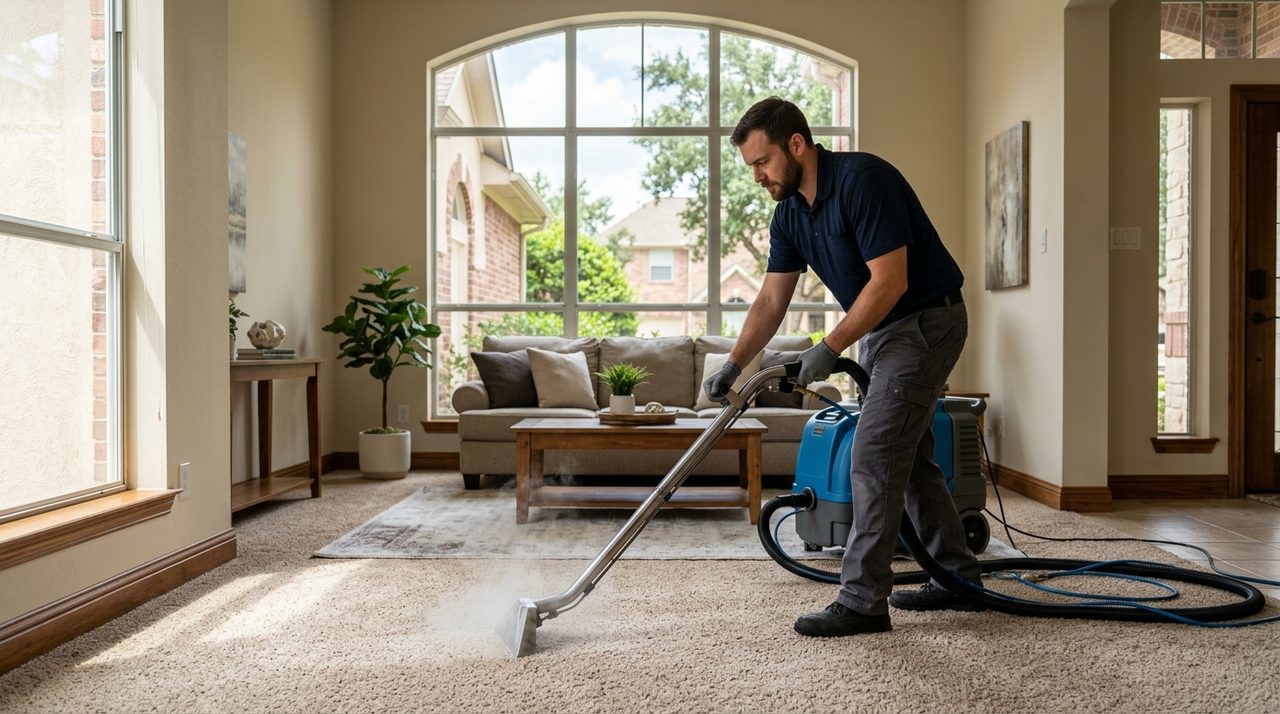
- Median home built
- 1977
- Median home value
- $257,773
- FEMA flood zone
- X (low)
- Typical cost (est.)
- $140–$420
- Most common local issue
- Slab moisture wicking through 50–70-year-old pad on Beaumont clay
Ranked by verified Google rating × review volume × verification tier. How we rank →
Some highly-rated pros serve Westbury from nearby and may not keep a Westbury street address. Those are listed under "Also serving Westbury" with their real city and distance, so you always know where each business is based.
Min rating:
10 resultsBased in Westbury
Also serving Westbury
Highly-rated pros based nearby who cover Westbury. Distance shown from the Westbury area.
Serving Westbury Based in Meyerland · 1.6 mi away
Open Now
Serving Westbury Based in Meyerland · 1.8 mi away
Closed
Serving Westbury Based in Meyerland · 1.8 mi away
Serving Westbury Based in Meyerland · 1.9 mi away
Serving Westbury Based in Sharpstown · 2.5 mi away
Closed
Serving Westbury Based in Medical Center · 2.6 mi away
Serving Westbury Based in Sharpstown · 2.7 mi away
Closed
Serving Westbury Based in Sharpstown · 3.2 mi away
Closed
Serving Westbury Based in Bellaire · 3.2 mi away
Carpet Cleaning in Westbury: What You Should Know
Old Slabs on Beaumont Clay Keep Pad Wet From Below — Not Just From the Machine
Why it matters to you
Westbury's slab-on-grade homes from the 1950s and 1960s were built with thinner vapor barriers than current standards require, and the Beaumont clay series underneath them transmits moisture vapor through the concrete year-round. When a technician runs hot-water extraction without first checking pad moisture with a probe meter, the carpet may appear dry to the touch within hours but remain saturated at the backing — wicking soil back to fiber tips and creating musty odors within 24–48 hours, particularly during Houston's summer months when outdoor relative humidity averages 75–90 percent.
What a good pro does
A thorough technician will probe the pad at several points before and after cleaning, and will run commercial air movers for at least four hours in a closed, air-conditioned room to drive down the dew point inside the home. If probe readings show vapor transmission above roughly 3 lbs per 1,000 sq ft per 24 hours, the honest recommendation is pad replacement rather than repeated cleaning — an assessment that costs nothing extra to request upfront. Texas does not license carpet cleaners through TDLR, so ask for IICRC Carpet Cleaning Technician (CCT) certification as your benchmark for this kind of diagnostic work.
Sources: IICRC (water/mold restoration standards), Texas Commission on Environmental Quality
Uri Pipe Bursts Left Contamination in Carpets That Were Never Properly Remediated
Why it matters to you
Winter Storm Uri in February 2021 ruptured water lines across southwest Houston, and Westbury's galvanized steel and early copper supply lines — many original to the 1950s build — were among the most vulnerable in the metro. An estimated 1.4 million Texas homes experienced burst pipes during Uri, and many Westbury homeowners had emergency water extracted but skipped full pad replacement due to the contractor backlogs that followed. That original pad now re-releases calcium scale, drywall dust, and microbial byproducts during Houston's humid summers, showing up as recurring musty odors and allergy-triggering particulates even in carpets that look visually clean.
What a good pro does
If your Westbury home still has its pre-2021 pad and you recall any Uri water intrusion — even a slow leak — request a pad moisture probe and UV light inspection before agreeing to a surface-only cleaning. IICRC S500 protocols distinguish between clean-water (Category 1) losses that can be dried in place and gray- or black-water events where pad must be removed; a certified Water Damage Restoration Technician (WRT) can document which category applied to your loss. Mold remediation work beyond cleaning — such as encapsulation or antimicrobial treatment of the subfloor — may trigger TDLR Mold Remediation licensing requirements under Texas Occupations Code Chapter 1958, so verify credentials before that scope begins.
Sources: IICRC (water/mold restoration standards), Texas Commission on Environmental Quality
Brays Bayou Proximity Means Some Blocks Face Real Post-Flood Carpet Decisions, Not Just a Cleaning
Why it matters to you
Most of Westbury maps to FEMA Zone X, indicating low mapped flood risk, but flood risk climbs sharply parcel by parcel on blocks nearest Brays Bayou and Willow Waterhole. Homes on those streets experienced Category 2 or Category 3 water intrusion during Harris County flood events, and IICRC S500 protocols are unambiguous: carpet and pad wetted by gray water or black water should be removed, not cleaned. Requesting a cleaning instead of replacement on a flood-affected Westbury home may reduce a short-term invoice but leaves bacterial and mold contamination embedded in the pad and potentially on the slab surface.
What a good pro does
Before scheduling any post-flood cleaning on a street near Brays Bayou or Willow Waterhole, pull your parcel's flood history from Harris County Flood Control District records and confirm the water source. If inundation involved bayou overflow or backed-up sewage — both Category 2 or 3 events — an IICRC-certified Applied Microbial Remediation Technician (AMRT) should assess, and the scope will likely include pad removal, subfloor treatment, and written documentation for your insurance carrier rather than extraction alone. Post-flood assessment and antimicrobial treatment add an estimated $75–$200 to a base cleaning quote.
Sources: IICRC (water/mold restoration standards), FEMA National Flood Hazard Layer (NFHL), Harris County Flood Control District
Nearly Half of Westbury Rents, and Lease Turnover Creates Tight Certification Deadlines
Why it matters to you
With roughly 47 percent of Westbury households renting according to the ACS 2023 five-year estimates, the neighborhood sees constant lease-end turnover across its single-family rentals and multifamily units. Many lease agreements and property managers in this corner of southwest Houston require a written receipt or certificate of professional cleaning within 24–72 hours of move-out, and disputes over what qualifies as 'professional' — especially for pet-odor treatments — are common when low-cost operators skip enzyme pretreatment steps. Houston's moderately hard municipal water (averaging 130–180 mg/L as CaCO₃) leaves alkaline residue in extraction machines that reactivates pet urine salt crystals, intensifying odor after a basic clean rather than eliminating it.
What a good pro does
Renters and landlords alike should request an itemized quote that explicitly lists enzyme pretreatment, an acidic rinse step, and a written invoice on company letterhead showing the technician's IICRC certification number — documentation that holds up in security-deposit disputes. Texas imposes no state licensing on carpet cleaners through TDLR, so the IICRC Carpet Cleaning Technician credential and a legible certificate are your best verification tools. For pet-urine sub-surface pad flushing, budget an additional $50–$120 per room above the base extraction rate when negotiating scope before the technician arrives.
Sources: IICRC (water/mold restoration standards), Local HOA / deed restrictions (see area profile)
Carpet Cleaning in Westbury: What You Should Know
Hiring carpet cleaning in Westbury? Westbury is a large 1950s-era subdivision of roughly 5,000 single-family homes plus thousands of multifamily units in southwest Houston. Homeowners here contend with aging slab foundations, original-era plumbing and electrical systems, and flood risk in sections near Willow Waterhole and Brays Bayou. Deed restrictions enforced by the Westbury Civic Club/HOA require architectural review for exterior modifications, making pre-project compliance checks essential.
- Housing era
- 1950s–1960s (original subdivision), with later multifamily and infill development
- Foundation
- Predominantly concrete slab-on-grade
- Flood zone
- FEMA Zone X (low flood risk) per official NFHL data
- Permits
- City of Houston Permitting Center (Westbury is within Houston city limits)
Housing stock & systems
Building era
1950s–1960s (original subdivision), with later multifamily and infill development.
Typical style
One-story mid-century ranch homes with brick veneer, low-sloped or hipped roofs, attached garages or carports, and wide lots.
Foundations
Predominantly concrete slab-on-grade; some pier-and-beam may exist in earliest sections but slab is clearly prevalent in listings.
Common systems
Original homes likely have galvanized steel or early copper supply lines, cast iron drain lines, 100-amp electrical panels, and older forced-air HVAC systems or window units later converted to central air. Many systems are 50–70 years old and approaching or past end of life.
What that means for repairs
Kitchen and bathroom remodels are common as owners update mid-century layouts. Whole-house replumbing (replacing galvanized and cast iron), electrical panel upgrades to 200-amp service, and HVAC replacements are frequent due to system age. Some lots see teardown-rebuild activity as land values support new construction.
Permits & restrictions
Permit jurisdiction
City of Houston Permitting Center (Westbury is within Houston city limits).
HOA & deed restrictions
Westbury Civic Club, Inc. operates as the primary neighborhood association (Super Neighborhood 37). Deed restrictions with an Architectural Review/Control Committee are described as mandatory for compliance. The exact legal status of dues (mandatory vs. voluntary for each section) is not fully verifiable from public sources alone — check Harris County Clerk deed restriction records for your specific lot.
Historic districts
No City of Houston historic district designation confirmed.
Contractor note
Contractors must obtain City of Houston permits for structural, mechanical, electrical, and plumbing work, and should verify Westbury's deed restriction and ARC/ACC requirements before beginning any exterior modifications including fencing, roofing material changes, or additions.
Flood & weather
FEMA flood zone
FEMA Zone X (low flood risk) per official NFHL data. However, Westbury is adjacent to Brays Bayou and Willow Waterhole, and portions of the neighborhood — especially lower-lying southern and eastern sections near these drainage features — have documented histories of flooding. Parcel-level flood risk can vary significantly; an elevation certificate and HCFCD inundation maps should be consulted for individual addresses.
Hurricane Harvey impact
Significant flooding occurred in portions of Westbury during Hurricane Harvey (2017), particularly in lower-lying sections closest to Willow Waterhole, Brays Bayou, and drainage corridors near US 90A and South Post Oak. Post-Harvey flood mitigation projects were implemented around Willow Waterhole. Block-by-block impact data is not available in text sources; homeowners should request seller's disclosure, prior flood claim history, and Harris County Flood Control District high-water-mark data for specific addresses.
Heat & humidity load
1950s slab homes with original insulation and single-pane windows put heavy loads on HVAC systems during Houston summers. Aging ductwork in unconditioned attics degrades efficiency. Foundation movement on expansive clay soils accelerates during summer drought cycles, making seasonal watering programs and foundation monitoring important for these older slabs.
Working with contractors here
The dominant work in Westbury involves updating 1950s–1960s building systems: whole-house replumbing from galvanized and cast iron to PEX/PVC, electrical panel upgrades from 100-amp to 200-amp service, and HVAC replacement with modern high-efficiency equipment. Slab foundation repair is common due to the age of the homes and Houston's expansive clay soils. Contractors should be aware that the Westbury Architectural Review Committee requires compliance with deed restrictions for exterior work, so scope proposals for roofing, siding, fencing, or additions should account for review and approval timelines. Flood-damaged properties near Willow Waterhole and Brays Bayou may require remediation work including mold abatement, drywall replacement, and elevated mechanical equipment installation.
Local Tip
Always ask for a written estimate before work begins. Texas contractors are required to provide one on jobs over $1,000.
About Westbury
Westbury is a large 1950s-era subdivision of roughly 5,000 single-family homes plus thousands of multifamily units in southwest Houston. Homeowners here contend with aging slab foundations, original-era plumbing and electrical systems, and flood risk in sections near Willow Waterhole and Brays Bayou. Deed restrictions enforced by the Westbury Civic Club/HOA require architectural review for exterior modifications, making pre-project compliance checks essential.
- Median year built
- 1977
- Median home value
- $257,773
- Owner-occupied
- 52.8%
- Population
- 148,525
- Housing units
- 57,470
- Median income
- $67,468
Source: U.S. Census Bureau, ACS 5-Year 2023
Flood & storm risk
FEMA Zone XLow flood riskMost of Westbury maps to FEMA Zone X (low mapped flood risk), but Houston's flash-flood reality means even low-risk blocks benefit from smart drainage and storm-hardened installs; risk climbs sharply on blocks nearest Brays Bayou, where it varies parcel to parcel.
Source: FEMA National Flood Hazard Layer (NFHL). Flood zones vary by parcel — verify your individual FIRM panel.
Frequently Asked Questions
Do I need a City of Houston permit to have my carpet professionally cleaned in Westbury?
No City of Houston permit is required for carpet cleaning alone, and the City of Houston Permitting Center does not classify routine hot-water extraction or upholstery cleaning as a permitted trade activity. The only scenario where licensing comes into play is if the technician pivots into mold remediation work, which triggers TDLR requirements under Texas Occupations Code Chapter 1958 — a realistic concern in Westbury homes where post-flood or Uri-related mold is discovered mid-job. For a standard cleaning appointment, no permit or city notification is needed.
Our 1950s Westbury ranch home still has the original carpet pad — can it just be cleaned, or does the age of the pad matter?
Pad age matters significantly on a mid-century Westbury slab because pad installed 30 or more years ago has typically lost its density, traps soil and moisture at a higher rate, and often sits directly on concrete with a deteriorated or absent vapor barrier underneath. Houston's Beaumont clay soil causes seasonal slab movement that can crack or compress old pad unevenly, making hot-water extraction less effective and drying times longer. A good technician will probe the pad with a moisture meter before quoting — if the pad is saturated from below or visibly crumbling, replacement rather than cleaning is the honest call.
A few of my neighbors near Willow Waterhole had water intrusion during a heavy rain last year. Is my Westbury home in a flood zone, and does that affect what a carpet cleaner should do?
Most of Westbury maps to FEMA Zone X, which carries low mapped flood risk, but blocks closest to Brays Bayou and Willow Waterhole can face parcel-by-parcel variation where risk rises considerably. If your home sustained even minor rainwater intrusion, an IICRC-trained technician should classify the water source before cleaning: intrusion carrying bayou backflow or standing exterior water can reach Category 2 or 3 contamination levels, under which IICRC S500 protocols recommend pad removal rather than cleaning. Requesting a written water-category assessment protects you if an insurer later questions why contaminated carpet was cleaned rather than replaced.
Sources: FEMA National Flood Hazard Layer (NFHL)IICRC (water/mold restoration standards)Harris County Flood Control District
My Westbury tenant just gave notice and the lease requires a professional cleaning receipt within 48 hours of move-out. What should I ask the cleaning company to provide so it actually holds up?
Ask specifically for an invoice that lists the technician's IICRC certification number, the method used (hot-water extraction is the industry standard for documentation purposes), the square footage cleaned by room, and a dated certificate of completion — not just a receipt. A generic invoice from an uncertified cleaner is routinely rejected in Houston-area lease disputes and small claims proceedings. Given that nearly half of Westbury households are renters per ACS 2023 data, local companies familiar with the neighborhood understand this documentation pressure and should provide it without an upcharge.
Is there a worst time of year to schedule a carpet cleaning in Westbury, and how long should I expect the carpet to take to dry?
Houston's June through September stretch — when relative humidity routinely runs 80–90 percent — is genuinely the hardest time to get carpet fully dry after hot-water extraction, and in a Westbury ranch home with older HVAC and low ceilings that limit airflow, drying times can stretch from the typical four to six hours to twelve or more if the technician doesn't deploy fans or air movers. Scheduling in the cooler months of November through February gives you lower ambient humidity and faster drying, reducing the risk of the slab-to-pad moisture cycle restarting before the carpet cures. If you must clean in summer, confirm the company will leave air-moving equipment running rather than packing out immediately after extraction.
Houston water is pretty hard — will the minerals in the water the cleaning company uses make my Westbury carpet stiff or smell worse after cleaning?
Houston municipal supply delivered in southwest Houston blends surface and groundwater that typically measures 130–180 mg/L hardness as calcium carbonate, and when hot-water extraction equipment uses this untreated supply the residual mineral content can leave an alkaline film on fibers that attracts soil quickly and can reactivate pet urine salts already crystallized in the backing. A professional technician should finish with an acidic fiber rinse step, which neutralizes the alkaline residue and helps carpet stay cleaner longer — this step is not always included in entry-level package quotes, so ask before booking whether a pH-balancing rinse is part of the service or an add-on.