Open Now
8950 Westpark Dr, Houston, TX 77063
Briargrove's 1950s homes — many of which carry original or partially renovated interiors under active HOA oversight in west Houston — present carpet-cleaning challenges that go beyond a standard hot-water extraction run. Renovation dust from the neighborhood's frequent whole-home remodels, Houston's Beaumont clay soil tracked across thresholds, and aging slab or pier-and-beam subfloors that hold residual moisture all conspire to re-dirty carpet quickly after cleaning. Understanding these dynamics means getting a cleaning that actually lasts, not one that looks dull again within a week.
Ranked by verified Google rating × review volume × verification tier. How we rank →
Some highly-rated pros serve Briargrove from nearby and may not keep a Briargrove street address. Those are listed under "Also serving Briargrove" with their real city and distance, so you always know where each business is based.
8950 Westpark Dr, Houston, TX 77063
8950 Westpark Dr Suite 202, Houston, TX 77063
Highly-rated pros based nearby who cover Briargrove. Distance shown from the Briargrove area.
Serving Briargrove Based in Tanglewood · 0.6 mi away
Serving Briargrove Based in Tanglewood · 0.8 mi away
Serving Briargrove Based in Tanglewood · 0.8 mi away
Serving Briargrove Based in Tanglewood · 0.9 mi away
Serving Briargrove Based in Tanglewood · 0.9 mi away
Serving Briargrove Based in Tanglewood · 0.9 mi away
Serving Briargrove Based in Tanglewood · 1.9 mi away
Serving Briargrove Based in Tanglewood · 2 mi away
Why it matters to you
Briargrove is one of west Houston's most active teardown-and-rebuild corridors, with whole-home remodels routinely modernizing kitchens, baths, and mechanical systems in 1950s shells. Even with plastic sheeting, fine drywall calcium and silica particles migrate into adjacent carpeted rooms and act as abrasives at the fiber base — a problem that accelerates wear on carpet that may already be ten or more years old in un-renovated sections of these homes.
What a good pro does
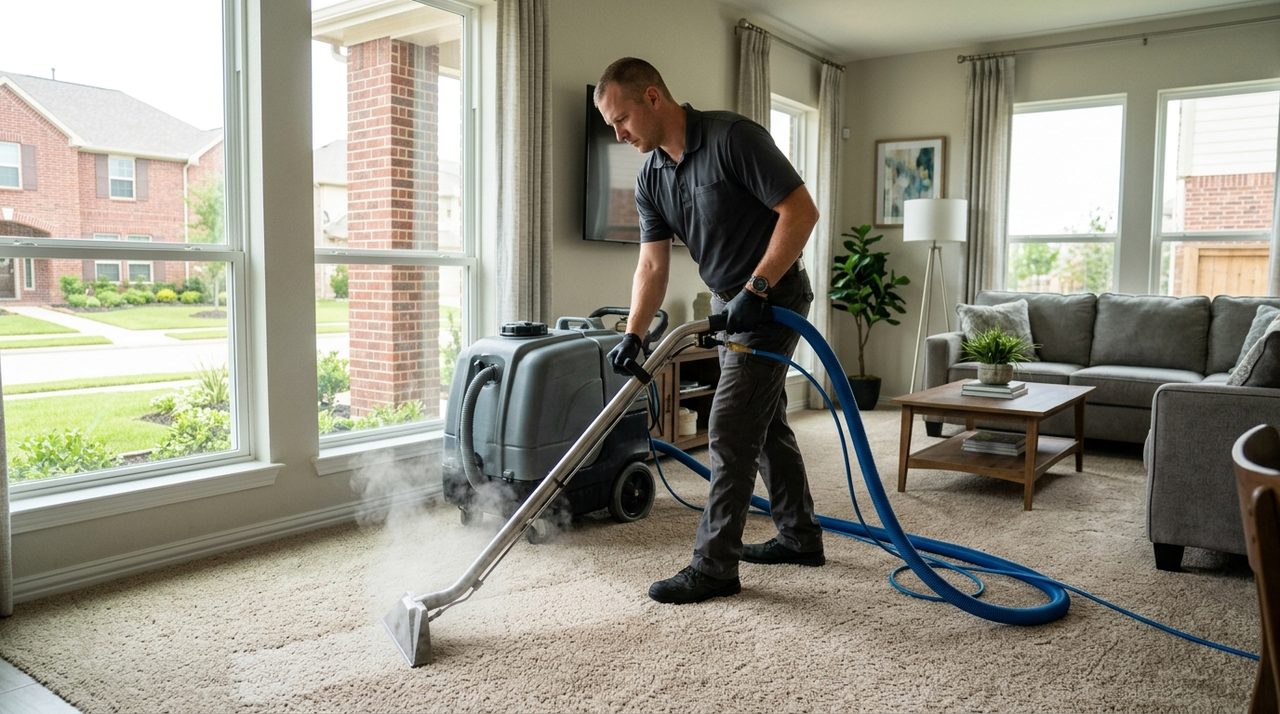
A qualified technician should perform a thorough dry-vacuum pass with a high-filtration commercial machine before any hot-water extraction, removing grit that would otherwise be driven deeper by water pressure. On Briargrove jobs following a remodel, ask the company to inspect fiber tips for abrasion scoring and note whether a pre-spray agitation step is included — it should be. No City of Houston trade permit is required for the cleaning itself, but renovation contractors pulling permits through the Houston Permitting Center are responsible for jobsite dust containment that protects your carpet in the first place.
Why it matters to you
The iron-rich Houston series clay underlying Briargrove (Munsell 5YR–10YR, reddish-brown to dark gray) is a constant presence on entryway and hallway carpet, particularly during and after Houston's storm-heavy wet seasons. Repeated wet-dry cycles from the Gulf Coast's weather pattern grind clay particles below the fiber tips into the backing, making a single standard extraction pass insufficient to restore appearance in high-traffic zones of these older homes.
What a good pro does
Effective treatment requires a high-alkalinity pre-spray left to dwell for five to ten minutes, followed by mechanical agitation with a counter-rotating brush before extraction — not just a wand pass over the surface. For homes with original 1950s-era carpet or carpet installed before a recent remodel, the technician should probe pad moisture with a meter before starting, since clay-heavy subgrade around older Briargrove slabs can introduce vapor-side wetting that makes cleaning results short-lived without addressing the underlying moisture first.
Sources: IICRC (water/mold restoration standards), Texas Commission on Environmental Quality
Why it matters to you
Unlike newer suburbs built entirely on uniform modern slabs, Briargrove's 1950s construction includes homes on both slab-on-grade and pier-and-beam foundations — and the foundation type is not always obvious without inspection. On slab homes, Beaumont clay's seasonal heave and the thinner vapor barriers common in pre-1990 construction allow concrete moisture vapor transmission to saturate carpet pad from beneath, a condition invisible on the surface until cleaning causes fresh wicking of embedded soil back to fiber tips within days.
What a good pro does
Before quoting a flat rate, a thorough technician should probe the pad with a calibrated moisture meter in at least three locations — especially near exterior walls and under furniture that has been in place for years. If pad moisture exceeds safe thresholds, encapsulation cleaning or low-moisture methods may outperform hot-water extraction for Briargrove slabs with active vapor drive. Texas does not license carpet cleaners at the state level, but technicians holding IICRC Water Damage Restoration Technician (WRT) credentials are trained to interpret pad-moisture readings correctly.
Sources: IICRC (water/mold restoration standards), EPA Lead Renovation, Repair and Painting (RRP) Rule
Why it matters to you
Houston municipal water runs 130–180 mg/L hardness depending on blending ratios at the point of delivery, and Briargrove's owner-occupancy rate of roughly 27.5 percent means a significant share of homes are long-term rentals where carpet — particularly in un-renovated 1950s-era rooms — may be ten or more years old with accumulated pet-urine salt crystals. High-mineral hot water used in standard extraction leaves an alkaline residue that reactivates those crystals, and many low-price quote packages do not include the enzyme pretreatment and acidic rinse step needed to neutralize them.
What a good pro does
For any Briargrove home with pets and carpet older than five years, insist on a written quote that itemizes enzyme injection and sub-surface pad flushing separately — budget roughly $50–$120 per affected room above the base cleaning rate (estimate). The technician should apply a topical enzyme pre-spray, allow a minimum 10-minute dwell time, then follow with a pH-neutral or mildly acidic rinse solution in the extraction tank to counteract Houston's hard-water alkalinity. If the pad has reached a point of full urine saturation, IICRC S100 protocols indicate replacement is the only reliable path to odor elimination.
Sources: IICRC (water/mold restoration standards), Local HOA / deed restrictions (see area profile)
Hiring carpet cleaning in Briargrove? Briargrove is a well-established 1950s subdivision in west Houston with tree-lined streets, an active mandatory HOA, and a housing stock that increasingly blends original mid-century construction with significant modern updates. Homeowners here frequently navigate renovation projects that must satisfy both City of Houston permitting requirements and Briargrove HOA deed restrictions. The aging infrastructure—plumbing, electrical, and HVAC—drives steady demand for upgrades and whole-home remodels.
Building era
1950s, with ongoing renovations and some teardown-rebuilds in subsequent decades.
Typical style
Older homes with modern updates; specific architectural style breakdown (ranch, traditional, mid-century modern) not confirmed in available research.
Foundations
Not confirmed - check with local inspectors; both slab-on-grade and pier-and-beam are common in 1950s-era Houston subdivisions.
Common systems
Homes of this era typically feature galvanized or cast-iron drain lines, copper supply piping, older electrical panels (potentially 100-amp or fuse boxes in un-renovated homes), and central HVAC systems that may have been retrofitted or replaced multiple times.
What that means for repairs
Significant teardown and rebuild activity is common in established west Houston neighborhoods like Briargrove, alongside whole-home remodels that modernize kitchens, bathrooms, and mechanical systems while preserving lot footprints under HOA guidelines.
Permit jurisdiction
City of Houston Permitting Center (Briargrove is within Houston city limits).
HOA & deed restrictions
Mandatory HOA: Briargrove Homeowners Association, Inc. (also referenced as Briargrove Property Owners Association). The association actively enforces deed restrictions and community rules. Specific recorded deed restriction details not confirmed - check Harris County Clerk records.
Historic districts
No City of Houston historic district designation confirmed.
Contractor note
Contractors must obtain City of Houston permits for structural, electrical, plumbing, and mechanical work, and should verify project plans comply with Briargrove HOA deed restrictions before beginning exterior modifications or new construction.
FEMA flood zone
FEMA Zone X (low flood risk) - source: fema_nfhl. Briargrove is located in west Houston; specific bayou or creek proximity details were not confirmed in available research.
Hurricane Harvey impact
Specific Hurricane Harvey (2017) flooding data for Briargrove was not confirmed in available research. Recurring flood-prone streets or blocks could not be identified from provided sources. Homeowners should check Harris County Flood Control District records and individual property flood history for site-specific risk.
Heat & humidity load
Houston's extreme summer heat and humidity place heavy demands on HVAC systems in 1950s-era homes, which may have inadequate insulation, single-pane windows, or undersized ductwork. Contractors should expect high seasonal demand for AC repairs, attic insulation upgrades, and weatherization work. Foundation movement from clay soil expansion and contraction during summer drought cycles is also a recurring concern.
Working with contractors here
Briargrove's 1950s housing stock generates consistent demand for plumbing re-pipes (replacing galvanized and cast-iron lines), electrical panel upgrades, and HVAC system replacements. Whole-home remodels and teardown-rebuilds are common as homeowners invest in modernizing aging properties on desirable lots. Contractors should be prepared to coordinate with the Briargrove HOA on exterior work, including fencing, roofing materials, and driveway modifications. Foundation repair is a frequent need given the age of homes and Houston's expansive clay soils. Job scoping should account for potential asbestos or lead paint in original construction materials, requiring proper testing and abatement procedures.
Local Tip
Always ask for a written estimate before work begins. Texas contractors are required to provide one on jobs over $1,000.
Briargrove is a well-established 1950s subdivision in west Houston with tree-lined streets, an active mandatory HOA, and a housing stock that increasingly blends original mid-century construction with significant modern updates. Homeowners here frequently navigate renovation projects that must satisfy both City of Houston permitting requirements and Briargrove HOA deed restrictions. The aging infrastructure—plumbing, electrical, and HVAC—drives steady demand for upgrades and whole-home remodels.
Source: U.S. Census Bureau, ACS 5-Year 2023
Most of Briargrove maps to FEMA Zone X (low mapped flood risk), but Houston's flash-flood reality means even low-risk blocks benefit from smart drainage and storm-hardened installs.
Source: FEMA National Flood Hazard Layer (NFHL). Flood zones vary by parcel — verify your individual FIRM panel.
Sources: Local HOA / deed restrictions (see area profile)IICRC (water/mold restoration standards)
Sources: Texas Commission on Environmental QualityIICRC (water/mold restoration standards)
Sources: FEMA National Flood Hazard Layer (NFHL)IICRC (water/mold restoration standards)