914 Main St Suite#110, Houston, TX 77002
Best Appliance Repair in Midtown
Midtown's mix of 1990s–2020s townhomes and 1960s high-rise condos creates two entirely different appliance-repair realities on the same block: modern inverter-drive washers in slab-on-grade townhomes stressed by Beryl's 2024 power surges, and aging mid-century laundry and kitchen setups in high-rise units that predate modern control-board electronics. Because the neighborhood sits in FEMA Zone X with relatively low flood exposure but dense urban construction with shared walls and tight utility closets, the real friction here is storm-driven electronics damage and hard-water scaling — not flood corrosion. Understanding which of Midtown's many individual HOAs or COAs governs your unit before scheduling any gas-line reconnection or dryer-vent modification will save you the cost of a second trip.
Verified against Google Business data
Updated 2026
See the 10 Appliance Repair Serving Midtown 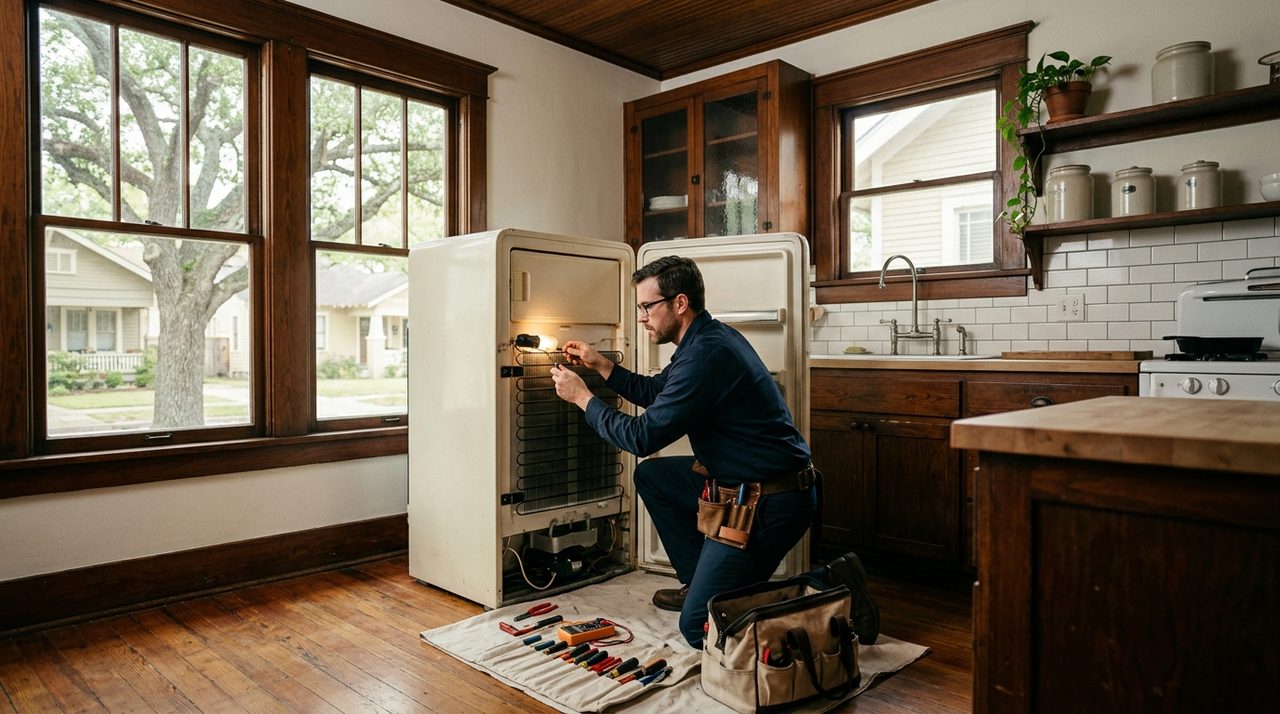
- Median home built
- 1993
- Median home value
- $445,764
- FEMA flood zone
- X (low)
- Typical repair cost (est.)
- $150–$650
- Most common local issue
- Storm surge-fried control boards in post-2015 smart appliances
Ranked by verified Google rating × review volume × verification tier. How we rank →
Some highly-rated pros serve Midtown from nearby and may not keep a Midtown street address. Those are listed under "Also serving Midtown" with their real city and distance, so you always know where each business is based.
Min rating:
10 resultsBased in Midtown
Open Now
4201 Main St, Houston, TX 77002
Also serving Midtown
Highly-rated pros based nearby who cover Midtown. Distance shown from the Midtown area.
Open Now
Serving Midtown Based in Lazybrook / Timbergrove · 1.9 mi away
Open Now
Serving Midtown Based in River Oaks · 2.2 mi away
Closed
Serving Midtown Based in Upper Kirby · 2.6 mi away
Serving Midtown Based in Upper Kirby · 2.8 mi away
Closed
Serving Midtown Based in The Heights · 3.3 mi away
Closed
Serving Midtown Based in EaDo · 4.9 mi away
Closed
Serving Midtown Based in South Houston · 5.1 mi away
Closed
Serving Midtown Based in Bellaire · 5.5 mi away
Appliance Repair in Midtown: What You Should Know
Beryl and the May 2024 Derecho Fried Smart Appliances in Midtown's Newer Townhomes
Why it matters to you
The overwhelming majority of Midtown's townhomes were built between 1995 and 2020, which means they are disproportionately stocked with the inverter-drive washers, Wi-Fi-enabled dishwashers, and variable-speed refrigerators that are most vulnerable to voltage spikes during CenterPoint grid restoration. After Beryl's 2024 outages and the May 2024 derecho, homeowners in 2010s-era townhomes along Bagby, Gray, and McGowen corridors reported control board and Wi-Fi module failures that appeared days after power returned — a known dirty-power restoration pattern. Without whole-home surge protection, a single restoration event can cost $300–$650 in control board parts and labor alone, estimated.
What a good pro does
A qualified repair technician should perform a full diagnostics scan on all electronics-dependent appliances after any extended Midtown outage, not just the unit that stopped working. Control board replacement requires brand-specific parts and, on units under warranty, documentation that the damage was surge-related; technicians should provide a written assessment for insurance or warranty claims. Ask whether the technician recommends a whole-home surge protector installation — a separate electrician scope — before the next storm season.
Sources: City of Houston Permitting Center, Texas Department of Licensing & Regulation
Houston's Hard Water Scales Out Dishwashers and Ice Makers Faster in Dense Midtown Kitchens
Why it matters to you
Midtown draws from City of Houston municipal supply, which the City of Houston Water Quality Report documents at 17–20 grains per gallon hardness — enough to build visible lime scale in dishwasher spray arms and refrigerator ice-maker orifices within 18–24 months on units without softened water. In Midtown's compact 3-story townhomes, kitchens are often stacked over garages or utility areas without room for a full-size water softener, so scaling issues frequently go unaddressed until a spray arm clogs or an ice-maker inlet valve seizes. This is accelerated wear relative to national appliance-life benchmarks.
What a good pro does
A repair technician working on a scaling-related failure in a Midtown kitchen should descale spray arms and flush inlet valve screens as part of the repair, not just swap the failed component — otherwise the new part will fail on the same timeline. For townhome owners, ask your technician about inline scale-reduction filters sized for under-counter installation as a cost-effective alternative to a full softener. Estimate $150–$350 for a dishwasher pump motor or inlet valve repair after diagnosis.
Sources: ENERGY STAR / U.S. Dept. of Energy
1960s High-Rise Units Face Aging Infrastructure That Complicates Simple Appliance Swaps
Why it matters to you
Midtown's mid-century high-rises — several along Main Street and the south side of the neighborhood — contain condo units where the electrical panels, plumbing stub-outs, and even appliance alcoves were designed for 1960s-era appliance dimensions and amperage draws. A like-for-like dishwasher or range replacement in one of these units can uncover undersized wiring, galvanized supply lines with reduced flow, or non-standard cabinet openings that stall the swap and escalate costs. These buildings also typically have COA (condo owners association) architectural review requirements that can affect whether a vent modification or new appliance circuit is permissible without board approval.
What a good pro does
Before ordering a replacement appliance for a 1960s-era Midtown high-rise unit, have the technician verify circuit amperage and water supply line condition during the diagnostic visit — discovering a 15-amp circuit behind a new 20-amp-draw dishwasher after delivery wastes a service call. Any new 240V circuit or gas line modification requires a City of Houston permit through the Houston Permitting Center; confirm with your specific COA whether their architectural review process runs concurrently or must precede permit application.
Sources: City of Houston Permitting Center, Local HOA / deed restrictions (see area profile), Texas State Board of Plumbing Examiners
Tight Utility Closets and Shared Walls in Midtown Townhomes Complicate Dryer Venting and Washer Leveling
Why it matters to you
Post-1990 Midtown townhomes typically stack laundry on a second or third floor in a closet-sized alcove flanked by shared demising walls — a layout that makes dryer vent runs longer, more tortuous, and harder to inspect than a ground-floor setup. During Houston's 100-plus heat-index days from June through September, a kinked or partially blocked vent in an interior second-floor closet raises the dryer's ambient operating temperature significantly, accelerating heating element failures and extending dry times noticeably. The slab-on-grade foundations common to these townhomes can experience minor seasonal movement on Houston's expansive clay soils, which over time can shift a stacked laundry unit just enough out of level to cause front-load washer bearing wear.
What a good pro does
A thorough appliance technician servicing a townhome washer or dryer in Midtown should check vent run length, kink points, and exhaust flow as part of the call — not just the appliance itself — because a clean vent can resolve repeated heating element failures without further parts cost. Leveling should be confirmed with a bubble level at the time of any washer bearing or drum-seal repair; bearing jobs on front-loaders run $250–$500 estimated, and if the unit is over eight years old with hard-water wear history, a replacement discussion is warranted. No City of Houston permit is required for a like-for-like appliance swap, but dryer vent modifications that penetrate an exterior wall in a COA-governed building typically require association approval.
Sources: City of Houston Permitting Center, Local HOA / deed restrictions (see area profile), ENERGY STAR / U.S. Dept. of Energy
Appliance Repair in Midtown: What You Should Know
Hiring appliance repair in Midtown? Midtown's housing stock is overwhelmingly post-1990 townhomes and condos interspersed with 1960s-era high-rise multifamily buildings, meaning contractors regularly encounter both modern construction and aging mid-century systems. Multiple individual HOAs and COAs govern exterior modifications, so homeowners must confirm their specific association's approval process before scheduling work. The neighborhood's improved drainage and slightly higher elevation provide relatively lower flood risk compared to much of Houston, though properties near Buffalo Bayou on the northwest edge remain vulnerable.
- Housing era
- Mixed
- Foundation
- Likely predominantly slab-on-grade given the prevalence of post-1990 townhomes and condos
- Flood zone
- FEMA Zone X (low flood risk) — source
- Permits
- City of Houston — Houston Permitting Center
Housing stock & systems
Building era
Mixed: 1960s high-rise multifamily and significant 1990s–2020s infill townhomes and condos.
Typical style
Mid-century high-rise/mid-rise apartments and contemporary/modern 3-story townhomes and low-rise condos.
Foundations
Likely predominantly slab-on-grade given the prevalence of post-1990 townhomes and condos; not explicitly confirmed for all properties.
Common systems
Newer townhomes/condos typically have modern central HVAC, PEX or copper plumbing, and 200-amp electrical panels. 1960s high-rises may have older chilled-water HVAC systems, galvanized or cast-iron plumbing, and dated electrical infrastructure requiring upgrades.
What that means for repairs
Interior condo and townhome remodels are extremely common, particularly kitchen and bathroom updates in 2000s-era units reaching their first refresh cycle. 1960s high-rise units often require full plumbing and electrical overhauls. Exterior modifications in HOA/COA-governed buildings typically need association architectural review.
Permits & restrictions
Permit jurisdiction
City of Houston — Houston Permitting Center.
HOA & deed restrictions
No single neighborhood-wide mandatory HOA. Multiple individual mandatory HOAs and COAs govern specific complexes and subdivisions (e.g., Midtown Edge Owners Association, Inc. [COA]; Parc at Midtown HOA). The Midtown Management District / Midtown Redevelopment Authority is a public quasi-governmental entity, not a homeowner association. Deed restrictions are common at the project/complex level but not uniform across every individually platted lot.
Historic districts
No City of Houston historic district designation confirmed.
Contractor note
Contractors must verify which specific HOA or COA governs a property before beginning exterior or structural work, as approval processes and architectural standards vary significantly between Midtown's many individual associations.
Flood & weather
FEMA flood zone
FEMA Zone X (low flood risk) — source: fema_nfhl. However, flood risk varies by property within Midtown. The northwest end of the neighborhood, closest to Buffalo Bayou, carries the highest flood risk. The neighborhood benefits from an improved drainage system and slightly higher elevation compared to much of Houston.
Hurricane Harvey impact
Midtown is generally characterized as having lower flood risk relative to most of Houston due to improved drainage and elevation. Specific Harvey 2017 damage reports for Midtown were not detailed in available sources, but the northwest portion near Buffalo Bayou was the area most likely to have experienced flooding. Flood insurance is still recommended even outside high-risk zones, as intense storms can cause localized flooding.
Heat & humidity load
Houston's extreme summer heat and humidity stress HVAC systems heavily in Midtown's dense townhome and condo construction. Older 1960s high-rise units with aging HVAC are particularly vulnerable to failures during peak summer. Flat roofs on mid-rise buildings require regular inspection for ponding water and membrane degradation. Interior moisture management is critical in tightly built newer townhomes.
Working with contractors here
Midtown contractors most commonly handle HVAC servicing, interior remodels of townhomes and condos, and plumbing upgrades in 1960s-era high-rise buildings. The dense mix of construction eras means a single block can have vastly different scoping needs — a 2015 townhome needing cosmetic updates versus a 1965 condo requiring full re-piping. Exterior work on townhomes and condos almost always requires HOA or COA architectural approval, and contractors should confirm this before providing bids. Limited parking and tight lot access in Midtown's urban core can affect material staging and crew logistics. Water heater and plumbing repairs in multi-story townhomes frequently require navigating tight utility closets and shared walls.
Local Tip
Always ask for a written estimate before work begins. Texas contractors are required to provide one on jobs over $1,000.
About Midtown
Midtown's housing stock is overwhelmingly post-1990 townhomes and condos interspersed with 1960s-era high-rise multifamily buildings, meaning contractors regularly encounter both modern construction and aging mid-century systems. Multiple individual HOAs and COAs govern exterior modifications, so homeowners must confirm their specific association's approval process before scheduling work. The neighborhood's improved drainage and slightly higher elevation provide relatively lower flood risk compared to much of Houston, though properties near Buffalo Bayou on the northwest edge remain vulnerable.
- Median year built
- 1993
- Median home value
- $445,764
- Owner-occupied
- 31.3%
- Population
- 79,409
- Housing units
- 43,935
- Median income
- $83,570
Source: U.S. Census Bureau, ACS 5-Year 2023
Flood & storm risk
FEMA Zone XLow flood riskMost of Midtown maps to FEMA Zone X (low mapped flood risk), but Houston's flash-flood reality means even low-risk blocks benefit from smart drainage and storm-hardened installs.
Source: FEMA National Flood Hazard Layer (NFHL). Flood zones vary by parcel — verify your individual FIRM panel.
Frequently Asked Questions
Do I need a City of Houston permit to replace my gas range in a Midtown condo or townhome?
The City of Houston Permitting Center does not require a permit for a simple like-for-like appliance swap, but any modification to the gas line itself — even re-routing a flexible connector — requires a licensed master plumber or licensed gas fitter to perform the work and pull the appropriate gas permit through the Houston Permitting Center. In Midtown's denser townhome buildings with shared walls, the permitting office may also want documentation that the installation meets clearance requirements, so confirm with your specific building's COA or HOA before scheduling the swap.
Sources: City of Houston Permitting CenterTexas State Board of Plumbing Examiners
My Midtown COA or HOA says I need approval before a tech works on anything — does that apply to appliance repair inside my unit?
For purely interior appliance repairs with no exterior penetrations — fixing a dishwasher pump or replacing a refrigerator start relay — your individual Midtown COA or HOA typically does not require architectural review, since no common-area or exterior elements are touched. However, dryer vent modifications that terminate on an exterior wall or shared building facade almost always trigger your specific association's approval process, so check with your COA or HOA before scheduling any vent-related work or dryer-vent rerouting in your building.
Sources: Local HOA / deed restrictions (see area profile)
How long will a repair take after I call, and is summer or post-storm timing going to slow things down in Midtown?
For standard repairs in a single-family townhome, most Midtown appliance techs can schedule a diagnostic within two to five business days under normal conditions, though post-storm windows — especially following a CenterPoint outage like Beryl 2024 — can stretch that to one to two weeks as control-board replacement demand spikes across the metro. Parts availability for higher-end or European brands sometimes common in Midtown's 2010s-era townhomes can add another three to seven days if a board needs to be ordered; ask the technician to confirm parts stock before you commit to a repair slot.
The technician mentioned EPA Section 608 certification for my refrigerator repair — what does that mean for a Midtown homeowner?
Any technician who needs to handle, recover, or recharge refrigerant in your refrigerator or any refrigerant-circuit appliance is federally required to hold an EPA Section 608 certification — this is a federal requirement enforced by the EPA, not a Texas state license. You can and should ask any Midtown appliance tech to show their Section 608 card before they open a refrigerant circuit; an uncertified tech handling refrigerants is violating federal law and could void your appliance warranty.
I live in a 1960s high-rise condo in Midtown — should I repair or replace an old washer that shook loose after years of use?
In Midtown's 1960s-era high-rise units, washer replacement often makes more financial sense than repair once a front-loader is over eight years old and showing bearing or drum-seal failure, since repair estimates for those jobs typically run $250–$500 (Houston-market estimate) — and older machines in buildings with aging plumbing connections are prone to follow-on failures. Before replacing, confirm with your building's COA whether the laundry hookup location is in a shared utility space with building-managed plumbing, because COA rules in some Midtown high-rises restrict which connections can be modified and by whom.
Sources: Local HOA / deed restrictions (see area profile)
What should I ask a Midtown appliance repair tech about diagnosing a dishwasher that's been running poorly since the 2024 storms?
Ask the technician specifically whether they will test the control board for storm-related voltage damage and check the water inlet valve and spray arm orifices for hard-water scaling, since both failure modes are common in Midtown after Beryl 2024's dirty-power restoration events and Houston's 17–20 grains-per-gallon municipal water hardness. Also ask whether your townhome or condo has whole-home surge protection — if not, even a perfectly repaired control board is vulnerable to the next CenterPoint grid restoration event, and the tech should be able to advise on point-of-use surge protectors rated for the appliance.
Sources: City of Houston Permitting Center