Closed
1210 Genova St, Houston, TX 77009
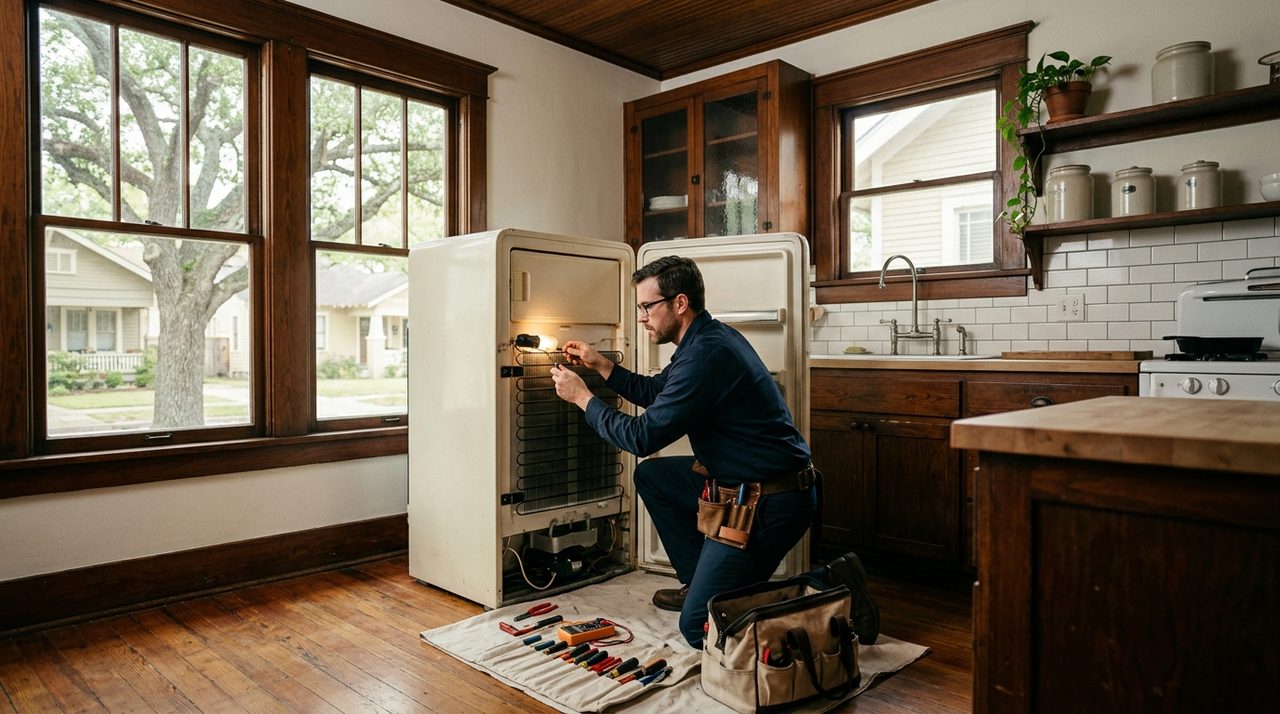
The Heights throws appliance technicians a curveball that almost no other Inner Loop neighborhood can match: a single block may hold a 1910 pier-and-beam Craftsman bungalow with cloth-wrapped wiring and galvanized supply lines sitting next to a 2008 slab-on-grade townhome packed with inverter-drive washers and Wi-Fi-enabled refrigerators. That hardware diversity — combined with Houston's punishing humidity and the voltage chaos that Beryl (2024) and the May 2024 derecho inflicted on CenterPoint's grid — means repairs in The Heights routinely surface layered problems that a standard diagnostic checklist will miss. Understanding which era your home belongs to, and what that means for your appliances, is the real starting point for any repair call here.
Ranked by verified Google rating × review volume × verification tier. How we rank →
Some highly-rated pros serve The Heights from nearby and may not keep a The Heights street address. Those are listed under "Also serving The Heights" with their real city and distance, so you always know where each business is based.
1210 Genova St, Houston, TX 77009
Highly-rated pros based nearby who cover The Heights. Distance shown from the The Heights area.
Serving The Heights Based in Lazybrook / Timbergrove · 1.8 mi away
Serving The Heights Based in Lazybrook / Timbergrove · 2.2 mi away
Serving The Heights Based in Lazybrook / Timbergrove · 2.3 mi away
Serving The Heights Based in River Oaks · 2.8 mi away
Serving The Heights Based in Independence Heights · 3 mi away
Serving The Heights Based in Midtown · 3.2 mi away
Serving The Heights Based in Independence Heights · 3.3 mi away
Serving The Heights Based in Spring Branch · 3.6 mi away
Serving The Heights Based in Lazybrook / Timbergrove · 3.8 mi away
Why it matters to you
The wave of 2-to-4-story townhomes built in The Heights from the late 1990s through the 2010s tends to be packed with high-efficiency, inverter-drive appliances — front-load washers, smart dishwashers, French-door refrigerators — all of which rely on sensitive electronic control boards. When Beryl (July 2024) and the May 2024 derecho knocked out CenterPoint power for extended periods and delivered dirty-power restoration events, those boards absorbed voltage spikes that standard circuit breakers do not stop. Because most of these townhomes lack whole-home surge protection, the damage was widespread and in some cases showed up weeks later as intermittent error codes rather than immediate failure.
What a good pro does
A thorough technician will test input voltage at the appliance's dedicated circuit before touching the appliance itself — a quick step that reveals whether the circuit, not just the machine, is the problem. Control board replacement on mid-tier brands runs an estimated $300–$650 parts and labor in the Houston market; on an 8-to-10-year-old inverter washer, a good tech will walk you through the repair-versus-replace math honestly. After repairs, ask about installing a dedicated appliance-level surge protector or discuss a whole-home unit with a licensed electrician.
Sources: City of Houston Permitting Center, ENERGY STAR / U.S. Dept. of Energy
Why it matters to you
Pre-1950s pier-and-beam bungalows that have not undergone full gut renovations often carry partially updated electrical systems — a 200-amp panel feeding circuits that still terminate in knob-and-tube or cloth-wrapped branch wiring inside walls. When a homeowner installs a modern high-draw appliance (a large-capacity washer, a convection range) on one of these partially upgraded circuits, the appliance's control board can be starved of clean voltage or exposed to voltage fluctuations — symptoms that mimic component failure but originate in the home's wiring. The Heights' renovated-but-not-fully-rewired bungalows are a particularly common setting for this pattern.
What a good pro does
A knowledgeable appliance tech will check outlet voltage and ground integrity before diagnosing the machine — and will tell you plainly if the outlet, not the appliance, is the problem. If the wiring is the culprit, the next call is to a licensed electrician for a circuit evaluation; the City of Houston Permitting Center requires permits for new or upgraded 240V appliance circuits, so confirm your electrician pulls the appropriate permit before work begins.
Sources: City of Houston Permitting Center, Municipal permit office (see area profile)
Why it matters to you
City of Houston municipal water — which supplies virtually all of The Heights — averages 17–20 grains per gallon hardness according to the City of Houston Water Quality Report, and many renovated bungalows and older townhomes here were never fitted with a water softener during remodels that focused on aesthetics over systems. Lime scale builds rapidly inside dishwasher spray-arm orifices, washing machine inlet valve screens, and refrigerator ice-maker fill tubes, cutting water flow and forcing motors to overwork. In kitchens with older galvanized supply stubs that were not fully replaced during renovation — a common half-measure in The Heights — mineral buildup accelerates further because galvanized pipe deposits mix with incoming hard water.
What a good pro does
A good tech will pull and inspect spray arms, inlet valve screens, and ice-maker fill orifices as part of any dishwasher or refrigerator service call in this neighborhood, not just the reported failed component. Descaling a spray arm or clearing an ice-maker line is a straightforward repair in the $150–$350 range (estimated, Houston market); skipping it means the same call recurs in 12–18 months. If galvanized stubs are found behind appliances, flag that finding for a licensed plumber — the City of Houston Permitting Center handles plumbing permits for those supply-line replacements.
Sources: City of Houston Permitting Center, Texas State Board of Plumbing Examiners
Why it matters to you
The large inventory of post-1990s slab-on-grade townhomes in The Heights sits on the same expansive Beaumont/Houston Black clay that moves seasonally under the entire Inner Loop. Even modest slab movement — common enough that foundation leveling is one of the most frequent contractor jobs in the neighborhood — can put a front-load washer measurably out of level, causing violent drum vibration that accelerates bearing wear and tears door gaskets. Stacked washer-dryer units in townhome utility closets are especially vulnerable because a few millimeters of tilt at the base is amplified at the top of the stack, and the exhaust run in many townhomes is long enough to kink if a dryer shifts.
What a good pro does
Any washer repair call in a Heights townhome should include a level check and leg adjustment before reassembly — a five-minute step that is often skipped and is the single most effective thing a tech can do to extend bearing life. If re-leveling reveals the slab itself has moved significantly, note the observation for a foundation specialist; the appliance repair is a short-term fix if the floor keeps moving. Drum bearing and seal jobs on front-loaders run an estimated $250–$500 in Houston — at the upper end on a machine over eight years old, replacement often pencils out better given ongoing hard-water and vibration wear.
Sources: ENERGY STAR / U.S. Dept. of Energy, City of Houston Permitting Center
Hiring appliance repair in The Heights? The Heights spans housing from the 1890s through brand-new construction, meaning contractors encounter pier-and-beam Craftsman cottages and modern slab-on-grade townhomes on the same block. Deed restrictions are common across most plats, and dozens of small mandatory HOAs govern newer townhome enclaves, so exterior work often requires checking recorded covenants at the Harris County Clerk's office. The mix of century-old galvanized plumbing and modern PEX systems makes thorough pre-job inspections essential.
Building era
Mixed: original 1890s–1930s bungalows, scattered mid-century infill (1940s–1960s), and a dominant wave of townhome and new single-family construction from the late 1990s through the 2010s.
Typical style
Historic Craftsman bungalows, Victorian/Queen Anne–inspired homes, contemporary 2-to-4-story townhomes with rooftop decks, and transitional new-build single-family homes with traditional exteriors and modern interiors.
Foundations
Mixed — older homes (pre-1950s) are predominantly pier-and-beam; newer townhomes and post-1990s construction are typically slab-on-grade.
Common systems
Older homes: original or retrofitted central HVAC, galvanized or cast-iron drain lines, knob-and-tube or cloth-wrapped wiring that may have been partially updated. Newer construction: modern central HVAC with high-efficiency units, PEX or copper plumbing, 200-amp electrical panels. Many renovated older homes have hybrid systems mixing old and new.
What that means for repairs
Tear-down-and-rebuild of older cottages for new single-family or townhome construction is extremely common. Remaining historic homes frequently undergo full gut renovations including foundation leveling, complete re-plumbing from galvanized to PEX, electrical panel upgrades, and HVAC modernization while preserving Craftsman exterior character.
Permit jurisdiction
Houston Permitting Center (City of Houston).
HOA & deed restrictions
No single neighborhood-wide mandatory HOA. The Houston Heights Association (HHA) is a voluntary civic organization focused on deed restriction enforcement and community events. Numerous small mandatory HOAs/POAs exist for specific townhome and gated developments (e.g., Heights Abbey HOA, Studemont Heights POA). Deed restrictions are common across most original Heights plats and recorded with the Harris County Clerk.
Historic districts
Portions of the Heights fall within City of Houston Historic Districts (Heights East, Heights West, Heights South) subject to Houston Archaeological & Historical Commission (HAHC) review for exterior modifications and demolition. Exact boundaries should be confirmed with the HAHC before any exterior work.
Contractor note
Properties in HAHC-designated historic districts require a Certificate of Appropriateness for exterior changes, including roofing material, siding, windows, and fencing. Contractors should verify historic district status before quoting exterior work, as non-compliant modifications can result in stop-work orders and forced remediation.
FEMA flood zone
FEMA Zone X (low flood risk) per the official NFHL API. However, proximity to White Oak Bayou along the southern and eastern edges of the Heights means localized street flooding and bayou overflow can affect properties near the waterway, particularly south of 11th Street.
Hurricane Harvey impact
Not confirmed with specific damage statistics from research. The Heights generally fared better than many Houston neighborhoods during Hurricane Harvey (2017) due to its slightly elevated terrain — the neighborhood was historically marketed as being higher than downtown Houston. However, areas near White Oak Bayou experienced flooding, and some low-lying streets saw significant water intrusion. Specific property impact should be verified through Harris County Flood Control District records.
Heat & humidity load
Pier-and-beam homes with older insulation and single-pane windows place extreme demands on HVAC systems during Houston summers. Crawl space moisture under pier-and-beam foundations promotes mold, wood rot, and pest issues. Newer townhomes with flat or low-slope roofs and rooftop decks require diligent roof drainage maintenance to prevent ponding and leaks during summer storms.
Working with contractors here
The Heights is one of Houston's most active markets for both renovation and new construction. Contractors most commonly handle foundation leveling and repair on pier-and-beam homes, whole-house re-plumbing to replace aging galvanized lines, and electrical upgrades from outdated panels and wiring to modern 200-amp service. Exterior work on historic district properties requires HAHC approval, adding lead time and material specification constraints that must be factored into bids. Townhome work frequently involves rooftop deck waterproofing, stucco repair, and shared-wall considerations that require coordination with adjacent owners or HOA boards. Given the extreme variation in housing age on a single block, contractors should never assume systems or foundation types based on neighboring properties — each home demands its own inspection.
Local Tip
Always ask for a written estimate before work begins. Texas contractors are required to provide one on jobs over $1,000.
The Heights spans housing from the 1890s through brand-new construction, meaning contractors encounter pier-and-beam Craftsman cottages and modern slab-on-grade townhomes on the same block. Deed restrictions are common across most plats, and dozens of small mandatory HOAs govern newer townhome enclaves, so exterior work often requires checking recorded covenants at the Harris County Clerk's office. The mix of century-old galvanized plumbing and modern PEX systems makes thorough pre-job inspections essential.
Source: U.S. Census Bureau, ACS 5-Year 2023
Most of The Heights maps to FEMA Zone X (low mapped flood risk), but Houston's flash-flood reality means even low-risk blocks benefit from smart drainage and storm-hardened installs; risk climbs sharply on blocks nearest White Oak Bayou, where it varies parcel to parcel.
Source: FEMA National Flood Hazard Layer (NFHL). Flood zones vary by parcel — verify your individual FIRM panel.
Sources: City of Houston Permitting CenterTexas State Board of Plumbing Examiners
Sources: City of Houston Permitting Center
Sources: Texas State Board of Plumbing ExaminersTexas Department of Licensing & Regulation