15115 Lindstrom Rd, Crosby, TX 77532
Best AC Repair in Crosby, TX
Crosby's housing stock spans from 1970s Lake Houston subdivisions still running aging R-22 systems to post-2010 Cedar Pointe builds with modern equipment—and nearly every home sits on Harris County's high-plasticity clay, which shifts with every wet-dry cycle and stresses refrigerant line sets year after year. Because Crosby is unincorporated, mechanical permits are pulled through the Harris County Engineering Department rather than the City of Houston, a distinction that trips up many contractors and delays summer repairs. If your system failed after a heavy-rain event near the San Jacinto River corridor or simply gave out on a 98°F July afternoon, this page explains what's actually going on beneath the slab.
Verified against Google Business data
Updated 2026
See the 4 AC Repair Serving Crosby 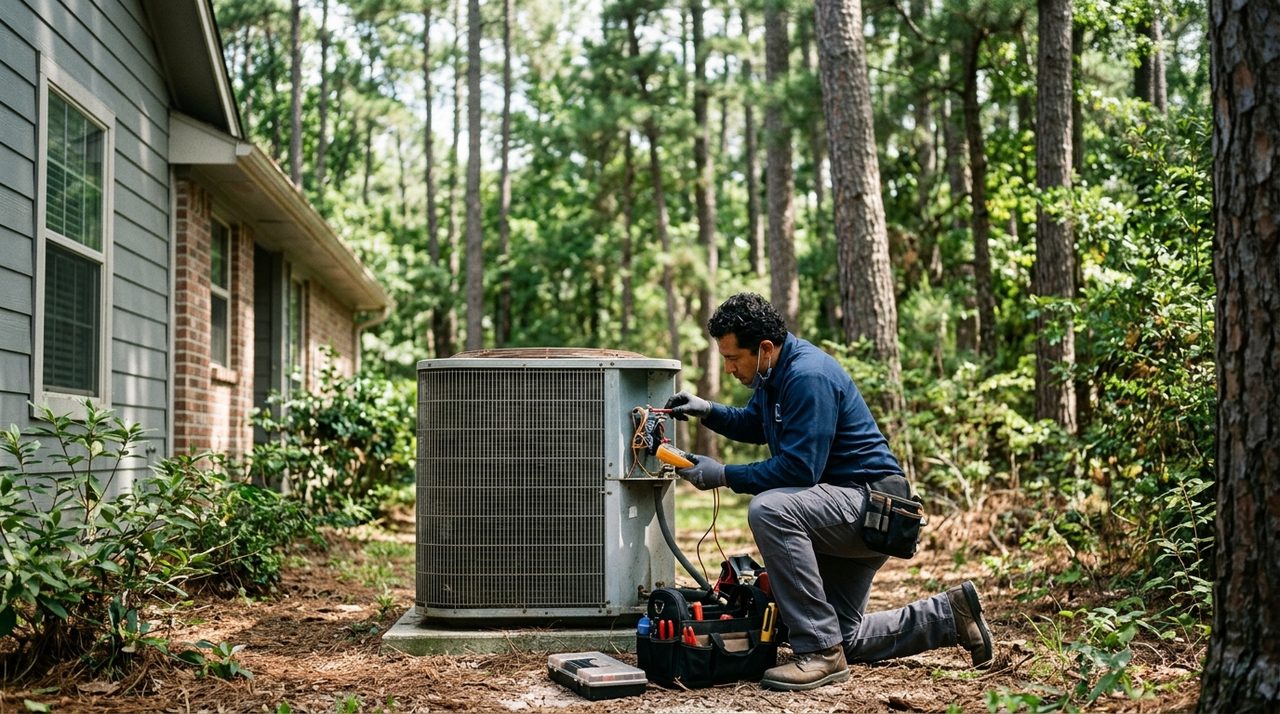
- Median home built
- 1985
- Median home value
- $202,700
- FEMA flood zone
- X500 (moderate)
- Typical AC repair or replacement cost (est.)
- $350–$9,500 depending on scope
- Most common local issue
- End-of-life R-22 systems in 1970s–1990s Lake Houston subdivisions
Ranked by verified Google rating × review volume × verification tier. How we rank →
Some highly-rated pros serve Crosby from nearby and may not keep a Crosby street address. Those are listed under "Also serving Crosby" with their real city and distance, so you always know where each business is based.
Min rating:
4 resultsBased in Crosby
Open Now
14450 FM 2100 Suite 352A, Crosby, TX 77532
Closed
4914 Hereford Dr, Crosby, TX 77532
Also serving Crosby
Highly-rated pros based nearby who cover Crosby. Distance shown from the Crosby area.
Serving Crosby Based in Highlands · 8.9 mi away
AC Repair in Crosby: What You Should Know
R-22 Systems in Older Lake Houston Subdivisions Are Hitting a Hard Dead End
Why it matters to you
The Census-reported median build year for Crosby is 1985, which means a large share of homes in neighborhoods like Indian Shores and older lakefront communities are still running R-22 (Freon) equipment that is now 30-plus years old. Since January 2020, the EPA has banned new R-22 production, and reclaimed refrigerant in the Houston market routinely costs $80–$150 per pound—so a modest refrigerant leak that would cost $350–$650 to fix on a modern R-410A system can balloon to $600–$1,500 or more on an R-22 unit, often making repair economically irrational. Many Crosby homeowners are unaware that so-called 'drop-in' retrofit refrigerants like R-407C require a compressor compatibility check before use.
What a good pro does
A qualified technician should pressure-test the system before adding any refrigerant, document the leak location, and walk you through a side-by-side repair-versus-replace cost comparison using current reclaimed R-22 pricing. If replacement makes more sense—and it often does at this equipment age—the contractor must pull a mechanical permit through the Harris County Engineering Department and the new system must meet current TDLR licensing requirements; homeowners cannot self-pull HVAC mechanical permits in Harris County. A 3-ton 16 SEER2 split-system replacement typically runs $5,500–$9,500 installed, permit fees included.
Sources: Texas Department of Licensing & Regulation, Municipal permit office (see area profile), ENERGY STAR / U.S. Dept. of Energy
Clay Soil Movement Under Slabs Is Kinking Line Sets and Tilting Condenser Pads
Why it matters to you
Virtually all post-1960 Crosby subdivisions are slab-on-grade construction sitting atop the same Houston Black clay that plagues the rest of Harris County. The wet season following a Lake Houston-area rain event can raise soil moisture enough to lift slab sections by a half inch or more, then the summer dry spell drops them back—a cycle that slowly kinks original 1980s copper line sets running under or through slabs, cracks condensate drain connections, and tilts outdoor condenser pads to angles that pool refrigerant oil and wear compressor bearings prematurely. Homes in Crosby that have also had documented foundation repairs are at elevated risk because re-leveling a slab shifts line-set routing unexpectedly.
What a good pro does
A thorough site visit should include checking the condenser pad for level (manufacturers specify no more than 2–3 degrees of tilt), inspecting the refrigerant line set for kinks or oil staining at fittings, and pressure-testing the low side for micro-leaks introduced by movement. Re-routing a compromised line set requires a Harris County mechanical permit even if the equipment itself is not being replaced; a TDLR-licensed contractor must pull it. Estimated cost for line-set repair or partial re-routing ranges from roughly $400–$1,200 depending on access.
Sources: Texas Department of Licensing & Regulation, Municipal permit office (see area profile), FEMA National Flood Hazard Layer (NFHL)
Clogged Condensate Drains and Pan Overflow on Slab Homes Near Bayous
Why it matters to you
Crosby sits adjacent to the San Jacinto River and Lake Houston, creating a persistently humid microclimate where evaporator coil surfaces stay wet for months at a stretch—Houston averages 90 percent or higher relative humidity through much of the summer. On slab-on-grade homes, which make up the vast majority of Crosby's post-1960 housing stock, a clogged condensate drain line has nowhere to drain harmlessly; overflow from the secondary pan intrudes directly onto the slab and wicks into drywall or under flooring, especially in the tight interior closets common to 1980s-era home designs. Condensate drain clogs are the single most frequent AC service call in the Houston market, and Crosby's bayou-adjacent humidity accelerates algae growth in drain lines faster than in drier inland communities.
What a good pro does
A proper service visit includes flushing the primary drain with a wet-vac, treating the pan with an algaecide tablet rated for HVAC use, and confirming the secondary drain terminates visibly outside so you can spot a future clog before it overflows. Air handler closets in older Crosby homes often lack floor drains, so ask your technician to install a float-switch shutoff on the secondary pan—it cuts system power before overflow occurs and costs roughly $75–$150 added to any service call. Condensate drain clearing alone typically runs $95–$225 in the Houston market.
Sources: Texas Department of Licensing & Regulation, FEMA National Flood Hazard Layer (NFHL)
HOA Condenser Screening and Harris County Permits: Two Separate Approval Tracks
Why it matters to you
Crosby has no single area-wide HOA, but individual subdivisions—Indian Shores Property Owners Association, Crosby Farms Homeowners Association, Sundance Cove Homeowners Association, and others—each carry their own deed restrictions that may require condenser units to be screened from street view, specify approved fence or lattice materials, or mandate an architectural-committee sign-off before installation. A homeowner in Sundance Cove replacing a storm-damaged unit faces two parallel processes: a Harris County Engineering Department mechanical permit (not a City of Houston permit) and a separate HOA architectural review, and the timelines rarely align. Rural tracts and older un-platted lots in Crosby have neither constraint, but contractors sometimes assume HOA rules don't exist and install condensers in positions that trigger deed-restriction enforcement letters weeks later.
What a good pro does
Before scoping a replacement, ask your contractor to confirm the property's subdivision status and pull the relevant deed restrictions—many Harris County subdivision restrictions are recorded with the County Clerk and searchable online. HOA approval should be initiated the same day the mechanical permit application is submitted to Harris County Engineering, since HOA review can take two to four weeks in some Crosby communities. A TDLR-licensed contractor handles the county permit; HOA paperwork is the homeowner's responsibility but a good contractor will flag the requirement rather than let you discover it after installation.
Sources: Local HOA / deed restrictions (see area profile), Municipal permit office (see area profile), Texas Department of Licensing & Regulation
AC Repair in Crosby: What You Should Know
Hiring ac repair in Crosby? Crosby is a sprawling unincorporated community spanning decades of housing stock—from older town-core homes and 1970s–1990s Lake Houston subdivisions to 2010s–2020s new-build communities. Homeowners here face a patchwork of HOA requirements, deed restrictions, and flood risk that varies dramatically from lot to lot. Contractors should verify whether a property is in a deed-restricted subdivision, an unrestricted rural tract, or a lakefront community before scoping any project.
- Housing era
- Mixed
- Foundation
- Predominantly slab-on-grade for post-1960 subdivisions
- Flood zone
- FEMA Zone X500 (moderate flood risk) - source
- Permits
- Harris County Engineering Department (unincorporated Harris County)
Housing stock & systems
Building era
Mixed: mid-20th-century town core, 1970s–1990s lake-oriented subdivisions, and 2000s–2020s new construction.
Typical style
Production one- and two-story brick or brick-and-siding traditional suburban homes; ranch-style and lake-house variants near Lake Houston.
Foundations
Predominantly slab-on-grade for post-1960 subdivisions; some pier-and-beam in older pre-1960 town-core and rural structures.
Common systems
Older subdivisions (1970s–1990s) commonly have original copper or galvanized plumbing, R-22 HVAC systems nearing or past end-of-life, and 100–150 amp electrical panels. Newer communities like Cedar Pointe feature modern R-410A systems and 200-amp service.
What that means for repairs
Older Lake Houston subdivisions see frequent storm-damage repair, HVAC replacement, and plumbing repiping. Newer subdivisions typically require only cosmetic updates. Flood-damaged properties in low-lying areas may need extensive drywall, insulation, and flooring restoration.
Permits & restrictions
Permit jurisdiction
Harris County Engineering Department (unincorporated Harris County). Projects do not go through City of Houston permitting.
HOA & deed restrictions
No single area-wide HOA. Individual subdivisions have mandatory HOAs including Indian Shores Property Owners Association, Crosby Farms Homeowners Association, and Sundance Cove Homeowners Association. Many rural tracts and older lots have no HOA at all.
Historic districts
No City of Houston historic district designation confirmed. Crosby is unincorporated and not subject to HAHC oversight.
Contractor note
Crosby is unincorporated Harris County, so permits are pulled through county engineering rather than the City of Houston. Contractors must verify subdivision-specific deed restrictions and HOA architectural review requirements, which vary widely from one community to the next.
Flood & weather
FEMA flood zone
FEMA Zone X500 (moderate flood risk) - source: fema_nfhl. Proximity to the San Jacinto River, its tributaries, and Lake Houston creates localized high-risk flood exposure, particularly for lakefront subdivisions like Indian Shores.
Hurricane Harvey impact
Crosby was within the broader San Jacinto River and Lake Houston flood impact area during Hurricane Harvey (2017). Lake-adjacent and low-lying neighborhoods experienced flooding, though specific street-by-street damage data for Crosby subdivisions is not confirmed in available records. Recurring flood risk exists along river and bayou corridors throughout the community.
Heat & humidity load
Houston's extreme summer heat and humidity stress aging HVAC systems in 1970s–1990s homes, driving high demand for AC repair and replacement. High humidity also accelerates mold growth in flood-prone or poorly ventilated structures, and slab-on-grade foundations in clay soils are susceptible to seasonal expansion and contraction cracking.
Working with contractors here
Crosby's diverse housing stock creates a wide range of contractor needs. In older 1970s–1990s Lake Houston subdivisions, plumbing repiping (replacing galvanized lines), HVAC system upgrades from R-22 to modern refrigerants, and electrical panel upgrades are the most common jobs. Flood mitigation and storm-damage restoration are recurring needs given the area's proximity to the San Jacinto River and Lake Houston. New-construction communities like Cedar Pointe generate warranty-period work and landscaping/hardscaping projects. Contractors should always confirm whether a property is in an HOA-governed subdivision with architectural review requirements or on an unrestricted rural tract, as this significantly affects permitting and project scope.
Local Tip
Always ask for a written estimate before work begins. Texas contractors are required to provide one on jobs over $1,000.
About Crosby
Crosby is a sprawling unincorporated community spanning decades of housing stock—from older town-core homes and 1970s–1990s Lake Houston subdivisions to 2010s–2020s new-build communities. Homeowners here face a patchwork of HOA requirements, deed restrictions, and flood risk that varies dramatically from lot to lot. Contractors should verify whether a property is in a deed-restricted subdivision, an unrestricted rural tract, or a lakefront community before scoping any project.
- Median year built
- 1985
- Median home value
- $202,700
- Owner-occupied
- 66.9%
- Population
- 3,038
- Housing units
- 1,216
- Median income
- $43,795
Source: U.S. Census Bureau, ACS 5-Year 2023
Flood & storm risk
FEMA Zone X500Moderate flood riskCrosby carries FEMA Zone X500 (moderate flood risk): outside the 100-year floodplain but inside the 500-year, so heavy-rain events still reach homes and flood-aware work pays off; risk climbs sharply on blocks nearest the San Jacinto River, where it varies parcel to parcel.
Source: FEMA National Flood Hazard Layer (NFHL). Flood zones vary by parcel — verify your individual FIRM panel.
Houston Storm Readiness in Crosby
Hurricane & flooding
Even in Crosby, TX, where FEMA Zone X500 in the 500-year floodplain and proximity to the San Jacinto River is less frequent than in mapped AE zones, heavy tropical rainfall can back-flood condenser pad areas, so confirm your unit sits at least 12 inches above finished grade and the surrounding pad drains away from the equipment. A pre-season refrigerant pressure check and tight electrical cover gaskets keep moisture out of the control board during extended rain events. Because Crosby drains toward the San Jacinto River, block-level runoff can differ sharply from the mapped zone.
Severe storms & hail
Straight-line winds during severe thunderstorms routinely lift or twist condenser line-set covers off exterior walls in Crosby, TX, leaving refrigerant tubing exposed to UV and mechanical damage — re-secure or replace covers after every major storm as a quick preventive step. If the line set itself shows kinking or oily residue at a fitting, schedule a pressure test before running the system. Confirm the current FEMA panel for your Crosby parcel — the area maps to Zone X500, but adjacent lots can differ.
Ice storms & freezes
Ice loading on refrigerant line sets and duct boots in unconditioned attics caused subtle refrigerant leaks in numerous Crosby, TX homes after Uri 2021 — schedule a post-freeze refrigerant pressure test and attic duct inspection each winter to catch slow leaks before the summer cooling season. Catching a quarter-pound refrigerant loss costs far less than the compressor damage that follows two months of running low on charge. With a median build year of 1985, the older building stock here is more exposed to hard-freeze damage than newer construction. As a Harris County community, Crosby may follow county rather than City of Houston storm rebuild rules.
Sources: FEMA National Flood Hazard Layer (NFHL), Ready.gov -- Hurricanes, CenterPoint Energy -- Storm Center, City of Houston -- Emergency Preparedness, Ready.gov -- Winter Weather, Harris County Flood Control District
Free Crosby Tools & Calculators
Houston-specific estimators to plan your project before you call a pro. All results are planning estimates — a licensed local pro confirms the details on site.
Houston AC Tonnage & Sizing Estimator
Open full tool & FAQ →Living space you want cooled (400–10,000 sq ft).
5.0tons
Recommended nominal size
60,000 BTU/hr
Estimated cooling load
This is a planning estimate only — actual requirements depend on an on-site assessment by a licensed Houston pro. Houston's humidity and long cooling season make an oversized unit a common, costly mistake — it short-cycles and never dehumidifies. A licensed contractor confirms sizing with a full Manual J calculation.
Houston Freeze Prep & Pipe Insulation Checklist
Open full tool & FAQ →Your freeze checklist — 4 tasks
- 1
Disconnect & drain every outdoor hose bib
Remove hoses, drain the spigots, and cover each with an insulated faucet sock. Un-drained hose bibs are the #1 burst point in a Houston freeze.
- 2
Insulate exposed pipes in the attic & garage
Wrap any pipe in an unconditioned space (attic runs, garage walls) with foam sleeves. Houston homes rarely insulate these because they only matter a few nights a year — which is exactly why they burst.
- 3
Open cabinet doors & keep a pencil-width drip
On hard-freeze nights, open kitchen/bath cabinets so warm air reaches the pipes and let faucets on exterior walls drip to relieve pressure.
- 4
Protect the attic/garage water heater & its lines
An attic or garage tank sits in unconditioned space. Insulate the cold-inlet and hot-outlet lines and confirm the emergency drain pan is clear so a leak doesn't reach the ceiling.
This is a planning estimate only — actual requirements depend on an on-site assessment by a licensed Houston pro. If a pipe has already burst, shut off your main water supply and call a licensed Houston plumber immediately — freeze bursts flood fast.
Frequently Asked Questions
Who issues the mechanical permit for an AC replacement in Crosby, TX, and how long does approval take?
Because Crosby is unincorporated, your contractor must pull a mechanical permit through the Harris County Engineering Department—not the City of Houston Permitting Center, which covers incorporated Houston addresses only. Approval timelines at the county level typically run 3–7 business days for a standard residential replacement, though summer demand spikes can stretch that; plan ahead if your system fails in June or July. Your contractor is legally required to be TDLR-licensed to pull this permit—homeowners cannot self-pull HVAC mechanical work in Harris County.
Sources: Texas Department of Licensing & RegulationMunicipal permit office (see area profile)
My Crosby home is in Indian Shores subdivision—does my HOA have to approve my new condenser unit before Harris County will issue a permit?
Yes, and these are two completely independent tracks: Harris County issues the mechanical permit based on equipment specs and code compliance, while the Indian Shores Property Owners Association enforces its own deed restrictions on condenser placement and screening—neither approval satisfies the other. You should submit your HOA architectural review request at the same time your contractor applies for the county permit so the approvals arrive in parallel rather than in sequence. Check your specific CC&Rs, because screening requirements and setback distances vary between Indian Shores, Crosby Farms, and Sundance Cove.
Sources: Local HOA / deed restrictions (see area profile)
My 1980s Lake Houston subdivision home flooded during a heavy rain event near the San Jacinto River—is my storm-damaged condenser unit covered by homeowners insurance or do I need TWIA?
Crosby sits in FEMA Zone X500, meaning most properties fall outside the standard 100-year floodplain, so typical homeowners policies—not TWIA—are usually the first call for wind and rain damage to your condenser unit; TWIA primarily applies to properties in designated coastal counties like Galveston. That said, if flood water actually inundated the unit, a standard HO policy's flood exclusion may kick in, and you'd need a separate NFIP or private flood policy to cover it. Document the damage with photos and get a written contractor assessment before filing so the adjuster can distinguish wind/debris impact from submersion damage.
Sources: Texas Windstorm Insurance Association (TWIA)FEMA National Flood Hazard Layer (NFHL)
How much should I budget to replace a failed 1990s R-22 system in a Crosby ranch-style home, and is there an affordable repair option first?
A full split-system replacement (3-ton, 16 SEER2, labor and refrigerant included) in the Crosby area is estimated at roughly $5,500–$9,500 depending on brand tier and access complexity—add $75–$250 for the Harris County mechanical permit fee. Topping off an R-22 system is rarely a sound investment: reclaimed R-22 is estimated at $80–$150 per pound in the Houston market, making even a small recharge cost $600–$1,500+, and the federal production ban means supply will only tighten. If a leak test confirms a manageable leak and the compressor is otherwise healthy, a retrofit refrigerant evaluation (R-407C compatibility check) is worth one conversation, but most 1990s-vintage Lake Houston subdivision systems are past economic repair.
My Crosby home was built in 2015 in Cedar Pointe—do newer R-410A systems in this area have any specific maintenance issues I should watch for?
Post-2010 Cedar Pointe homes use R-410A equipment, so the R-22 dead-end issue doesn't apply, but Crosby's high-plasticity Harris County clay still expands and contracts seasonally and can settle concrete condenser pads and stress line sets over time—even in a 10-year-old home. Condensate drain clogging is also a top service call in this humidity corridor year-round, and a slab-on-grade home without a floor drain near the air handler can turn a clogged drain into a flooring repair. Annual tune-ups before Memorial Day (rather than waiting for a June failure) are the most effective way to catch pad settling, refrigerant pressure drift, and drain blockage before peak cooling season.
What should I specifically ask an HVAC contractor before hiring them to do a system replacement in Crosby?
Ask for their TDLR license number upfront and confirm they are familiar with pulling permits through Harris County Engineering—not the City of Houston—since contractors unfamiliar with Crosby's unincorporated status sometimes attempt to file under the wrong jurisdiction, causing delays. Also ask whether they will handle HOA architectural review documentation if your subdivision requires condenser screening approval, since many contractors skip this step and leave you out of compliance. Finally, request a written proposal that separately itemizes equipment cost, labor, permit fee, and any line-set inspection or pad-releveling work, so you can compare bids accurately.
Sources: Texas Department of Licensing & RegulationLocal HOA / deed restrictions (see area profile)